Friday, March 25, 2022

The Ranch: March 2022 Walkabout

 Spring has truly sprung at the Ranch:

Locals looking back:

The bees are back!  They will be here for about a month or so before moving on to different climes.


Looking up into the back of the Upper Meadow:

Looking back on the Upper Meadow:


The Winterfall from the snow in January is still with us:


The Middle Meadow:

The Middle Meadow Sump:

Complete with Tourist!

There is still die off from the harsh drought.  Those brown trees will have to come down.

The Lower Meadow:

Another oak that gave way:

That brown is glass embedded into the trunk of tree, far below what would have been accessible.  How did it get there?  How long was it there?  We will never know.


The vernal creek that runs through all the Meadows.  The fact it is this low already is not a good sign; we should still be into the rainy season.

The Lower Meadow pond is full:


And the eternal cycle of Polliwogs has commenced.


Looking back from the Lower Meadow to the Middle Meadow:


How or why the sky is this blue in Spring, I will never know.  It seems more blue than anywhere else on earth.


Thursday, March 24, 2022

Jonquils


The Jonquils of Spring
blossom as they ever have,
in spite of The World.

Wednesday, March 23, 2022

On A Dream And Praying

 Yesterday morning I awoke with the fierce need to pray.

I had come out of a dream that (like most of my dreams) I can make little sense of.  In this case I had returned to university (more or less at my current age) and was apparently wandering around a dorm for some reason (I have not seen the inside of a college dorm since the early '90's).  The mix of students there all seemed to be "college" aged (e.g. I stuck out like a sore thumb) but my presence there did not seem particularly unusual.  

At some point a young woman came through wondering where X was. I had no idea of course, and off she went.  What I realized as I continued to wander through the halls to the outdoors was that a number of people were suddenly looking for other people that had seemingly disappeared.

The Rapture, I thought.  The Rapture has come and I missed it.

And then I woke up.

We can have - at another date perhaps - a discussion about the Book of Revelations and whether one is a pre/post/a millennialist and lose ourselves in a debate on the end times.  What struck me in this instance was, waking up, I felt the need to pray.  And I am not someone that believes myself to have any manner of prophetic dreams, nor do I particularly read anything into this one.  But it has been a great while since I awoke with the need to feel that I should do something - right then.

There was no great sense of what I needed to pray for, so I went through my usual round of prayer petitions (as I have said before, you are all on the list as well).  That did not lessen up the need to pray though, and it is even still with me as I write this, and so I shall bear in mind praying throughout the day (which, I might add, I am generally pretty bad at).

I will say that it has been a long time that God has put such a thing on my heart, for what it is worth.

The other thing - and I will just put this out here because, having the thought present, there is undoubtedly someone that needs to hear this - is that you are loved. Loved by God of course; loved (much more brokenly) by me.  I am not sure why this matters in the post, other than Uisdean Ruadh's recent trials have minded me that given the modern world, we may hear those words often, but not  in a form or way that it is actually meant.

Praying for all of you,

Your Obedient Servant, Toirdhealbheach Beucail

Tuesday, March 22, 2022

On Downsizing And The Removal Of Things

 In having my weekly chat with Uisdean Ruadh last night, I asked him how the pre-move was going.  Hard, he replied.

Perhaps coming as no surprise, he is downsizing his life in preparation for what (likely) will be a smaller living space and shared with his mother.  He has a storage locker but of course that is not enough for the accoutrements of over 50 years of living and at least 30 of living on his own.  And so he is processing his items now.

He has made trips to the Goodwill bringing books he realizes he will no longer read and things he will no longer use.  He will have to the same thing again, of course, when he moves his mother, but has already begun to assess what he is bringing from her apartment and what needs to go.

His pain is real.  He has spent the last 15 years building up a life and a place that reflected him and comforted him and in some ways protected him from a world that has not always done him right, and now he is having to rip it apart on a timeclock.

I sympathized and told him so - after all, here we are over a year after my parents left their home and yet I am still slowly getting around to removing things, my issue being much the same as his - that these have sentimental value beyond their simple existence; they are things that reflect not just themselves but my parents that bought them.

Although, I pointed out to him, in reality it is just a forerunner of the way life works.

My parents, in their current living situation, have precisely nothing that they owned except their wedding rings.  They are always nicely dressed when we see them, but the clothes are never ones that we recognize or originally sent them with.  The material possessions of 60 years of married life, of working and saving and searching things out and preserving, are all now longer in their lives.  To be honest, I suspect they do not remember the great majority of them ever existed.

Why, then, do I cling so fiercely to my own things?

I am no different than Uisdean Ruadh or, I suspect, the majority of people.  Not only have I spent a live collecting things that in many cases serve no purpose other than as a happy memory or to remind me of something, I continue to pursue some level of things (to a lesser extent than I used to, but still).  Were our positions reversed, I would be going through the exact same anguish that he is.  I can somehow pretend, in the absence of having to make a decision, that I could do it - but who am I kidding?  Myself, mostly.

So why am I not preparing myself for this now?

There are two tracks, of course. The first is simply to acquire less.  The question I am asking more and more is "Do I really, really need this"?  Some things, like shoes, I do.  Some things, like books, I do not not (although in an interesting twist, I am now reclaiming Nighean Dhonn's books as she is done with them).  My list of books has grown much shorter and is much more around the specific things that I want to study.

The other track is "get rid of it".  This is harder, oddly enough.  I am one of those people that infuses inanimate objects with emotion and feeling.  Which makes them harder to get rid of. However, as I have continued to come to my parents, I may have found the key to that as well:  simply put them out of sight.  When you come across something you have not seen in months (or even years), ask "Do I really still need this"?  If I have not used it or thought of it in months, likely not.

The reality - for all of us - is that at some point there will be a time where we can take none of it with us, be it through having to move to a place where we cannot have it or by dying, where we can never take it.  Best, at least for me, to work harder on this process now.

Monday, March 21, 2022

Consider, Choose, And Commit

"In every situation, consider what precedes it and what may follow - then act.  If you act rashly, without regard to consequences, you may defeat your purposes.

Say your goal is to win a wrestling match at the Olympic Games.  Consider what comes before, during, and after the event.  Before, you must train rigorously, eat a strict diet, abstain from alcohol, obey your coach, and follow the rules of the competition.  During the match, you may be thrown down, dislocate your arm, sprain your ankle, eat dust, and be beaten.

If you have considered all this, and you still want to wrestle - by all means, begin training.  Otherwise, you are like a child who daydreams about being a great wrestler and acts out shows with his friends.

Some hear a lecture from a wise philosopher, and are inspired to become philosophers.  Lacking study and practice, they are mere imitators.

You may fancy yourself a wrestler, then a gladiator, then an orator, then a philosopher - but never begin training in earnest.  If so, you are a dabbler who samples many fields, but when the time comes to commit to one, you move on to the next.

To find your vocation, first consider your talents and inclinations.  Do you have the back, shoulders, and thighs of a wrestler?  Or the potential and determination to gain them through exercise?

Do you live in a way befitting a philosopher?  Or are you restless, quick to anger, and a glutton for food and wine?  If you truly wise to become a philosopher, you must gain self-control, give up friends who are bad influences, be prepared to face ridicule and scorn, and be willing to give up honors, offices, riches, and fame.

If you have fully considered the consequences, and you still wish to make these sacrifices for peace, freedom, and inner harmony - by all means, begin your philosophical training.

Whatever your vocation, pursue it wholeheartedly.  Consider, choose, and commit."

- Epictetus, The Enchiridion (Version by Sam Torode)

Sunday, March 20, 2022

A Loss And Leaving Last Impressions

 My ordinary daily routine involves me checking my Book Of Face account once every day or once every two days - on the whole, I tend to flitter by what people post and most of what they do post is mostly either humor or personal stories about them and their families, something that can be reviewed whenever and has a minimal impact on my life.  

In the case of last Friday, I was flitting through waiting for an event to start when I saw a picture of friend on another's friend's feed with a comment along the lines of "Gone, but not forgotten".  This puzzled my brain and I went and looked more directly on his page.

Yes, it was true.  He had died the day before.

I had met G at a Highland Games event 6 or 7 years ago.  We are grouped together by age and sex and so, over time, you come to see the same people throwing in your neck of the woods.  The whole thing becomes something of a slow rolling family reunion as you see people the same people multiple times in the same year.  Some are just people you see and throw with, but others you strike a chord with and become a bit more than just "throwing buddies".  

Such were G and myself.  We were both at the lower end of the performance scale, but over the years we both got better and encouraged each other.  It came to be where he was one of the people I looked forward to seeing every game he was at, as we would constantly encourage each other in our battle for last place.  In the off season, I would more likely follow his posts than he mine, as his were sometimes vociferous - but I found out that we shared an interest in old Post Apocalyptic Role Playing games and Science Fiction Games, for example. 

I had not seen him since the Autumn of 2019, pre-Plague.  I was looking forward to seeing him in only a few weeks.  

Now, that will never happen.

The cause of death was listed as "unexpected", which usually means a host of things, none of them good.  To satisfy my curiosity, I went to his page - he had posted something the morning of this death and judging from what he posted, he did not expect it to be his last post.  He was two years younger than I am, which of course got my attention.

And which, of course, ran me down a whole different course of thought.

I had already considered the fact of living each day as if it is one's last.  What I had not considered - and what I should have considered as well - is what one leaves behind every day, including the last day.

We - or more likely I - too often think that we will have some level of consciousness about our own demise, that we will see it coming and thus control our messaging on the way out.  In point of fact this is not so: every public appearance could be our last, every post could be our last, every "cutting remark" and "funny at the time" picture could exist as the last public memory of us out there.  

What kind of memory - in that sense - do I want to leave?

It has made me even more conscious - not that I was not already, I suppose - of what I am displaying and putting out as me, both here and in my real life in general.  What I should like to ensure is that even if the end comes "unexpectedly", the last thing that will be out there is not something that I should have or could have undone, if I had been given more time. 

It also makes me reconsider exactly what I am doing with my time and what I am messaging.  Is this the sort of thing that - were it my last post - I would want to leave?  Are the words I speak with anyone the last words I want them to remember of me?  Am I conscious that eternity looms around us not as some far off event but as a faint but ever present reality?

C.S. Lewis in his essay "The World's Last Night"  wrote the following:

"We can, perhaps, train ourselves to ask more and more often how the thing we are doing or saying (or failing to do) at each moment will look when the irresistible light streams in upon it; that light which is so different than the light of this world - and yet, even now, we know just enough to take it into account."

How often I do not consider my almost unconscious actions in the light of eternity.


Saturday, March 19, 2022

Preserving Lemons

 About two weeks ago Nighean Bhan came home with a container of Meyer Lemons from the store - "because they were on sale".  She needed a few to make lemon juice but had a number leftover.  Was there anything I wanted to do them?

If only I had a book...


The recipe that leapt out at me was Moroccan  Preserved Lemons.  They are a staple of Moroccan cooking and I had actually found some last year a a specialty store.  Preserving citrus (beyond drying them) is always of interest to me, so why not?

Step One: Quarter the lemons.


Step Two:  Prepare a container of kosher salt and thoroughly cover lemons with salt.


(Instruction 2.5:  Be aware the combination of lemon juice and salt on small cuts caused by cutting said lemons may induce "sensation"...)


Step Three:  Allow the lemons to sit for 24 hours to soften.  After 24 hours, dry them off (note:  I had no drying to do).


Step Four:  The next day, prepare your other ingredients:  cinnamon sticks (one per jar), garlic cloves (one per jar), black pepper, bay leaves (one per jar), paprika (although not specified, please, please use Hungarian Paprika.  There is no other.), olive oil (the recipe called for a 1:1 ratio of olive oil to vegetable oil, but I am not a fan of vegetable oil), and a sealable jar to put it all in.


Step Five: Create a layer of lemons, then pepper and paprika them.


Step Six:  Cover the layer with olive oil. Rinse and repeat.  At some point drop in one or more peeled and slightly macerated garlic cloves.


Step Seven:  When near the top, cover with olive oil.  Insert a cinnamon stick down the center and add a bay leaf.


Step Eight:  Seal Jars.  Allow to refrigerate for 3 weeks.  Lemons may be used for 6 weeks after that.


I have to confess I am pretty excited about this, not only because it is a new thing (and hopefully a new way to preserve lemons) but the fact that (as The Shield Maiden pointed out) that I will likely end up with a great deal of spicy lemon olive oil, which I am pretty sure will go well with homemade bread.  

Friday, March 18, 2022

0345

 I woke up at 0345 the night before last.  This has been a trend lately for a couple of reasons.  

The first - the reasonable one - is the fact that Daylight Savings Time has cursed me once again with its gift of disrupted schedule.  Every year we do this, it is a little harder to adjust.  The discussions that I remember my elders having about all the issues of aging springs again to my mind.

The second - the one that is something I have noticed as a trend - is that I had alcohol with dinner.  I simply do not sleep well anymore and always wake up early after having alcohol - again, something that seems to become more prevalent as the years go by.  I have been phasing alcohol out anyway, but this is just moving that process all the quicker.

I can lay in bed, or I can get up.  As The Ravishing Mrs. TB still seems to be asleep, I roll out of bed, grab my glasses, and head for the door.  Poppy The Brave, who often now goes to bed with us and sleeps in the chair in our room (as opposed to the chair in living room which is theoretically for anyone but really seems to be hers) gets up to go out with me.

As we come out, A the Cat greets us - as usual, I have to shoo him away from the door lest he scoot in and hop up on the bed.  Instead, I coax him along as I shut the door.  Poppy heads off to her chair; A and I get ready for our early morning routine.

I will lay on the couch, at which point A will hop up and walk over to my chest, where he will promptly head butt me while purring, then settle himself on top of me.  Sometimes - like this morning - he then proceeds to give himself a vigorous cleaning as if somehow having a human platform makes cleaning a more pleasurable act.  Finally he settles into ball, purring away until it stops and he goes to sleep.

I do not tell A this of course, but I find these times some of the most enjoyable.  For me, there is some visceral about having a happy cat sleeping on you that makes all right with the world.

Laying as I am, on the couch and below the level of the family room window, I cannot really see out.  The light from our neighbor's backyard hanging lights floods in as it does every night since they moved in.  I cannot remember precisely when this started, only that it started.  Beyond just the annoyance of having light throughout the night, I have no idea why anyone would do this - beyond just seemingly being rude, who wants to pay for that electricity?

Whether because of the lights or just because, a bird is singing away in the dark.  I am reminded later by The Ravishing Mrs. TB  that this happens every year about this time.  I again have no idea why a bird would sing away in the dark, as if trying to call forth the attention of the owls I know frequent the neighborhood.

Off in the distance, I hear a train horn for the local switching yard about four miles away.  It strikes me that I almost never hear it in the during the day; is it just the ambient noise of the day, the fact they do not sound, or the fact that I simply do not pay attention?  It reminds me of growing up when, due to the train tracks being less than a mile away, I would also hear them in the dark.

Closer, I hear a truck driving through our neighborhood.  Usually if I am laying a bit in bed (or on the couch), this is how I judge the time:  by how many cars and trucks I hear leaving for work.  In this case it is only one; it is likely still earlier than my normal rising time.

I do not really "sleep" as I lie there, although I think that in some cases I might have done so. I feel A dreaming on my chest, his paws racing after something.  He starts to slide a bit and resettles, giving a head butt or two to make sure I am still there.  The bird continues to sing, the light continues to pour in over the couch edge.  I have flashes of dreams that seem like hallucinations, yet at no time do I feel that I have slipped over the edge into sleep.

Finally at some point, A starts to wake up.  It is not necessarily a clock, but it is his clock.  I check the time - 0615, a little later than I like to get up but more or less on target.  I creak off the couch and pass through the kitchen, clicking on the coffee pot as I prepare for my morning routine.

I know in the back of my mind that I will be exhausted today, and that the likelihood that I will nod off in a meeting I am not leading is real (especially with the reality of working from home and being in meetings on mute, it has almost happened more than once).  Yet I cannot find it my heart to be particularly grumpy about it.

Those moments in time - stretched out with a rumbling cat on my chest, listening to the night noises - have a certain peace about them that I cannot replicate.  There is something about being on the couch with the edges above one that create a barrier in my mind to the larger world around me.  For a time, I can simply push everything away and be in the moment.

Outside the cars start the sounds of their daily parade.  The world is starting.

Wednesday, March 16, 2022

A Backyard Slab And A Question

 So I am need of wisdom from the group mind.

One of the projects I am considering this year is to use a space in my backyard - specifically a slab in my backyard (pictured below with local supervisor Poppy the Brave).


From what I can guess (there is a concrete riser to the left of the  picture), whoever installed this intended to do something else with it at some point, be it a workshop or a hot tub.  It consists of three sections, each slab 39" by 50", or 120" by 100" total.


Being located where it is at the corner of the yard and largely shade free, it tends to get a great deal of sun, more than my current garden does.


I am wondering if I can put more garden there -  it would have to be raised beds, as the slabs themselves are 3" deep (pictures below).  There is no way I am breaking those up and hauling them away.


The thought would be to use something like retaining wall paving stones laid over weed cloth both for cost and for the fact that if and when we do sell, I can essentially sell it "with a pad" and new owner can decide if they want to keep the beds or build something else.

What would I use for the garden?  I have a good three years of wood pellets which have been used as rabbit bedding, broken down and combined with old hay and rabbit droppings.


Does this sound like any kind of plan at all?  Should I consider something else?

Tuesday, March 15, 2022

Memento Mori

In his book It Is A Good Day To Die, Herman J. Viola and Jan Shelton Danis record the biographical remembrances of the Sioux that faced the Seventh Cavalry at the Little Big Horn.  A phrase - attributed to Crazy Horse but apparently originally recorded from the Sioux Low Dog - is the phrase "Today is a good day to die."

In the case given, it was (I think) intended to both inspire courage and remind the warriors that this was exactly what they were called to do.  But as I pondered it more - in the context of the Birthday of TB The Elder - I had (at least for myself) some additional enlightenment.

In Western Civilization of course, we know this train of thought:  during the Roman triumphs someone walked beside the victorious general, speaking the words "Memento mori" - or so at least the stories go - to remind the general that he, too, was mortal.  Marcus Aurelius - that last of the "Five Good Emperors" - dwelt on this a fair amount in his Meditations as well:  "Death smiles at us; all a man can do is smile back" and "It is not death that man should fear, but he should fear never beginning to live."  And yet we have lost the immediacy and reality of death - that we could die at any time.  

Even Christianity, which should constantly be a reminder (to us Christians, anyway) that we are literally one heartbeat away from death has largely become a "long term activity" that we engage in.   "For what is your life?  It is even a vapor that appears for a little while and vanishes away" says James 3:14(b); we have gone from "remember that you are dust" to "we really do not talk about death here" in one to two generations lulled by increasing life spans that keep push out the age that death is somehow "too young".  The martyrs looking down on us must shake their heads in disbelief.

What does it mean, for those of us not faced with the immediacy of armed conflict, - or perhaps any armed conflict at all - that today is a good day to die?  As I pondered it, I realized that today should be a good day to die because I have made it so.  

I have made things right where I could.  I have put things in order where I needed to.  I have said the things that needed to be said.  I have confessed the sins I needed to confess.  Where I was needed - truly needed, not just where society or my peer group or even my "feelings" said I was needed -  there I was.

Today should be a good day to die - if it comes to that - because I have lived fully and to the best of my ability have not left what was critical undone.  I have tried, to the best of my ability, to do the work I was given to do.  

If I am so fortunate as to live to tomorrow as well - then, tomorrow should be just as good a day to die. The same governing thoughts should apply.  

Some will speak about "your best life now".  I wonder if, instead, we should discuss "your best day - now".  And the next.  And the next.

At some point, of course, it will be the day to die.  Let us so live and conduct ourselves that, when it comes, we can say "Today, too, is a good day to die".

Monday, March 14, 2022

The Birthday Of TB The Elder

 This weekend was TB The Elder's 83rd birthday.

The home where he is staying sent my sister a picture of him celebrating, with a hat and cake with candles in front of him.  He looks happy and, knowing him,  I am sure was very happy about the cake.  Even now, from what they tell us, he is still very happy about food. 

My father and I had a rough relationship for most of my growing up years - not so much from any behavioral issues as the fact that we were very different people. He was blue collar worker that worked with this hands, working his way up in a utility company from ditch digger to foreman; I was the proverbial nerd who read all the time and whose head was lost in the clouds of fantasy and imagination.  We had few touchpoints:  animals were one, cars were another.  It was only far later that we were able to find more.

I feared my father, not from any sort of physical violence - that was never, ever a thing - as much from the fact that he had a temper and would react (and feel sorry afterwards).  I learned to either say nothing at all or to try and hide my mistakes or disobedience, which taught me the sorts of habits that in some ways I am still working on to this day (the fact that I continue to work on them remains completely my own issue, not his:  I recognized it, but am still working to confront it). The fact that I still abhor confrontation to this day is something I continue to deal with; I will walk out of a room rather than hear two people argue, even people I do not know.

Probably like most sons with their fathers, I only learned later - mostly from my mother but partially from my father - some of the issues that made him who he was:  a relatively poor childhood (his parents migrated as part of the Great Depression), a brother that was killed by a drunk driver when he was 6 or 7 and how the family essentially went into survival mode (my grandfather took care of my granny, his older brother took care of his younger sister, and my father was largely left on his own), and a series of moves from the time they arrived in their new home (my Old Home) as they moved from place to place following the agriculture work (one of the last things we did before everything went downhill was drive from place to place as he would point out where they had lived; most of the locations are gone now except in his mind).

He became angry when I ran the car out of gas more than once or had a small fender bender; it was only years later that my mother told me about how he had totaled his older brother's car when he had taken it without permission.  

But even with all of this, his positive qualities outshone anything that I might have perceived about him.

He was a loyal spouse and good father in that we never went hungry, did not have clothes, or did not have a roof over our head - things that I suspect he had experienced at some point.  He came to literally every event my sister and I did in grammar school or high school.  He never went to college, but he made sure we did.  

He claimed that he never really "knew anything", but somehow he knew a lot about a lot:  he re-roofed our house, fixed our cars, built a chicken pen, cleared The Ranch of scrub brush, and a thousand other things that I had no idea he could do.  He thought that he could pretty much give anything a try at least, something that I have inherited.

He was a natural raconteur and loved to talk with people, sometimes spending hours visiting.  He and mother traveled through the US in a trailer and motorhome over the years. Over time, he even picked up reading.  For years they square danced until most of their friends who were older were not longer able to our died and the group simply faded away.

But in his greatest, most selfless act, he became the caretaker of my mother when she was diagnosed with Alzheimer's and for the last six years, learned to do everything that she had done:  cook, clean, laundry.  He negotiated doctor's appointments.  He made sure the cars ran and the house was warm.  He did it all until - literally - his body gave out on him and betrayed his mind.

I will go to see him this coming weekend, and hopefully he will have had a good night's sleep and we can visit. As is the case, if we do I will likely have no idea what he is trying communicate; I will nod and try to answer the question I think he asking and hopefully, both he and I will be satisfied with the answer.

I can speak to my father still, but it is as if a dark glass lies between the two of us and even though he is still there, the things that made him my father are now locked away in a place I can no longer access them.  I can only pick through the memories of a life and the gleanings of their home, 62 years of married life.  

Happy Birthday, Dad.


Saturday, March 12, 2022

A Prayer For Uisdean Ruadh And A Reality Check

Readers of this blog will undoubtedly recall the name Uisdean Ruadh, my long time (35+ year) friend from high school.  He has remained - along with The Actor - one of the two people with whom I regularly keep in contact with from high school.  We have our traditions now - every time I am back in Old Home we have dinner, a walk, and frozen yogurt.  He also remains really the only person I regularly have phone conversations with on my "smart" phone.

Checking in with him last night, he relayed to me two unfortunate pieces of news.  The first was that he had received an eviction notice from his landlord - apparently given the current market, the landlord has decided to upgrade the apartment and sell.  The second was that his mother had also received an eviction notice for the same reason.  They both have 90 days.

A Mhathair na hUisdean Ruadh's (his mother) is in her 90's at this point, born even before the Great Depression (and may likely outlive us all at this point).  This is the place she has lived for almost 45 years.  Uisdean Ruadh has lived in his apartment for the last 15 years.  In both cases, it is very much like they are leaving a family home.

As you can imagine of course, he is freaking out more than a little bit.

His solution at this point, given the situation, is to find an apartment for both himself and his mother.  His mother's property manager, a long time acquaintance, feels that she can find something for them that will fit the bill.   He has started the process of securing a storage locker and packing up his things, after which he will begin the same process at his mother's house.  Fortunately he is well plugged into his church (he is a Catholic, as you may recall) and has many offers of assistance for when the day comes.  His life, of course, has essentially been put on hold and his future has compressed to three months consisting of three things:  1)  Find an apartment.  2)  Move.  3) Move Mhathair na hUisdean Ruadh.

One of the shocks he related was the fact that looking at rent amounts in Old Home.   In his case (and mine, it is my hometown) is that it has become "a desirable place to live" and thus home prices and rents have gone through the roof - he will likely pay there what is close to our mortgage here.  And of course since they have been renting for many years their rents were relatively below market price so the increase is a second shock - fortunately he is able to work from home, or else this would be a far different situation (especially now, given the current fuel situation).

It is easy enough to say, I suppose, that if he had differing living arrangements this would be a different story.  That is possibly true, but in point of fact most people are effectively "renting" their living space - for most it is from the bank rather than a third party landlord, but the results are effectively the same.  Things happen.  And having been through a job loss once, I can assure you a bank has even less pity than a landlord might.  It will take longer perhaps, but the end result will be the same.

It was a harsh reality check for him. It is a harsh reality check for me as well.

In point of fact, most of us - many of us? - are really only one bad event away from having this sort of life-changing event occur.  In our case, we are doing very well now and have savings - but a significant job loss or other catastrophic event (a health crisis, for example) would put us in exactly the same sort of situation - we might have a little more time to get there than fixed 90 days, but we would get there.  And in the process of getting there, we would suddenly have a houseful of things that we would need to decide what to do with:  Store them?  Sell them?  If downsizing, what stays and what goes?

It has certainly given me a lot to think about.

If you could keep him and his mother in your prayers, I am sure they would very much appreciate it - specifically that they are able to find a place within their budget and they are able to move out within the 90 day period.  And especially for him as well:  I am sure that moving back in with one's parents after 40+ years of not living together will be a huge adjustment.

Before we left the call last night, he said "I really think that God has decided that my focus needs to be on caring for my mother at this point.  He has just made the decision easier."  Would that we all had that kind of faith and clarity.

Friday, March 11, 2022

Efforts, Professional And Personal

One of the things that perhaps comes to mind in any industry is the extent to which one really cannot influence the ultimate outcome.

My particular industry is biopharmaceutical/medical devices  and my roles in it over the years have been in manufacturing and quality and project management, but I suspect that my tale would be familiar to anyone in any other industry:  we only have the ability to do the work that is in front of us, without necessarily knowing how the larger game is playing out or if our work will ever be successful.  We strive and do:  we make product, we test product, we ship product, we manage the inevitable 1001 details that are a part of getting anything accomplished in the commercial world.  

And yet, there is absolutely no guarantee that one's efforts go anywhere.

The assumption, of course, is always success:  do the work, get the grade, just like things worked in school.  However as anyone that has worked for any time in an industry can tell you, great products and great ideas have no more likelihood of success than their mediocre brethren.  The best execution can be halted by a simple failures, the best product can fail because it is not available.  And yet for myself - and for many - we pour our days and weeks and hours into the parts that we think we can influence, never truly knowing if our efforts will bear fruit or they will become yet another in a long line "it almost worked" business studies.

I contrast this with the impact that one can have on one's own life.

The outcome is never 100% in our control of course:  random things like illness or financial setback or just plain bad luck can occur.  And yet our effort and our results are almost 100% within our control.  For many of the projects or goals that we have, the road to success is both much clearer and well documented:  almost every success book will in some form or fashion tell you that the road to success in almost anything is already out there and available, one simply has to pay their dues and do the work.  But in these sorts of things, effort almost always translates into visible progress rather than a sort of ethereal "we are going to make it".

So, I ask myself, why do I find it so easy to spend hours and effort on the things of industry and cannot muster the same will to follow the things of my life?

Is it as simple as sloth?  Perhaps, although I would argue that without enough recharge time from work related efforts, sloth can also simply be a form of mental recharge.  Is it lack of will?  Perhaps, but it is not that I have greater will do complete my day job, only consequences.  

Perhaps that is it, a lack of consequences.  Fail at my job and the results will be immediate; fail at my personal aspirations and the impact is not nearly so immediate, but far more insidious.

Or, I wonder - perhaps is it that I do not believe that I can truly succeed at something, that my efforts will likely yield the same sort of out of control results that I have experienced in my work and so I fail to commit?  That I simply lack the confidence that the trail of success will work for me as it has for others.

"Success" is a loaded term of course, and means different things to different people. Success in business is pretty well defined; success in a personal life or endeavor is as widely varied from an achievement to a better relationship.  And so it can become a moving scale which we cannot fully assess - except that we know when we have hit the mark.

All of which leaves me with a simple question:  If the path to hitting the mark in anything is known (Things under my control/work + effort), why will I not do for myself what I will do for a business?  Or perhaps phrased another way, why do I value the impersonal of a corporation above the personal of myself?

Thursday, March 10, 2022

Waiting For Godot, Tax Refund Edition

In a somewhat ominous turn of events, our tax refund has still not appeared.

I am one of those people that tends to overpay my taxes - mostly because of the fact that I sincerely loathe having to write a check at the end of the year to the government.  I understand in theory the concept that I am "losing" the value of money with it sitting in the government's coffers instead of my own.  At the same time, the absolute feeling of anger and depression when I have to do so is enough to convince me it is a convenience to do so, for my own mental health if for now other reason.

So, at the end of last month - having secured all of our tax documentation - I filed our taxes and patiently waited for the tax return to appear in the bank account.  That was two weeks ago.

As it turns out, the IRS does have a site where you can check on the status of your tax return (https://www.irs.gov/refunds).  Although I have never had cause to use it, I went ahead and filled out the form (Social Security Number, filing status, precise refund amount), and waited.

Congratulations, the website returned.  Your refund has been approved and you can expect your money to hit the bank in the not too distant future.

Now, I try to measure my words here and in my personal life about the government - after all, it really just serves no useful purpose and in many cases the "government" is just a lot of people going about their lives like the rest of us.  But I find it not a little irritating that for the years I have "owed" money, the money comes out almost immediately - and as some may know, if you miscalculate it more by $1,000 two years running, you will be charged a fee for not withholding enough and it will be strongly "suggested" that you move to quarterly payments.

I am sure, of course, that it is just a technical spread issue - they are earning some level of interest on my money while it sits for the additional days until it magically appears in my bank account.  And to be doubly fair, the amount sitting there really is my own issue due to previous years of not doing as good  a job as I could have with estimating and having the shock at the end of the process.  

Still - and as a public service message - I might humbly suggest to those in power that one way to not irritate the people to pay your salaries through their taxes is to ensure receiving their refund is as simple and easy as getting a refund at a store.  The private sector has the technology and I suggest it would go a small way towards reducing irritation on the whole issue of taxes.

Wednesday, March 09, 2022

Of Stoicism, Research, and Books

 One of the first things I will do when picking up any sort of interest - Stoicism in this case, but others as well - is to look for a book (well, really books) on the subject.  This reflects a lifelong practice and first reaction of "Need to know something or do something?  Get a book".

Over the years, the way I have gone about doing this sort of research has changed.  Originally, I would go to the library to borrow books.  This worked quite well when I was younger through high school and college (Pre-InterWeb of course) and even to some extent for my graduate degree.  Where it fell down was as I continued to push into more esoteric areas:  simply put, the libraries no longer had the knowledge that I needed.  And so - even more than before - I began to buy books.

The books I buy and have bought have changed over the years as well for these sorts of exercises.  Originally I purchased what I would call "narratives" or surveys, books that would take (in this case) a piece of history and give an overview of it.  Over time, this books became less of use for two reasons:  the first was that as one continues to press into a subject, one finds that people are generally writing the same thing in just a slightly different way (and sometimes quoting each other); the other is that writers are no different than any of the rest of us and tend to put their own interpretations into history instead of letting history speak for itself.  And so more and more, I have begun purchasing the original source material whenever I can.

The books are less common and thus - as less common - tend to be more expensive; for example, the current books I tend to purchase for any Classical studies will be the dual language editions of Loeb Classical Library (Green for Greek, Red for Latin - I have written about some purchase of Isocrates and the reading of Columella). They have the original words of the authors and the words alone with occasional footnotes.  Instead of reading about what the authors of the past have written, I can read their words directly.  To be fair, there are other versions of the same: I like the dual language versions for the potential practice it can give me (I have a little Latin and even less Greek, but it good to have something to train on).

Of the existing writings we have of the Stoics, they are only of the later period:  Seneca, Epictetus, Marcus Aurelius.  Seneca I have at least one work of and Aurelius I own Meditations - some day it will make sense to pick up more of both but for now, I am fine.  This leaves Epictetus, which Loeb conveniently has in two volumes, the (apparently) coveted 1925 translation.  One problem:  the second book on The Borg is around $25, which is in line with the cost of the book these days.  The first book clocks in at $67.00.

I love books. But that is a bit steep.

So I wandered over to Alibris.  The price was better there - still a bit high at $33 - but they had both books and they both had dust covers (yes, I am that person:  I prefer my hardbacks with dust covers. Unripped if possible).  Still, I dithered and dithered - with shipping that was going to be a chunk of money.

And then, of course, fuel went up over the weekend.  That settled it:  I ordered both.

One could make the argument - a pretty strong one - that this knowledge can be acquired other ways.  And it can.  But for something like this, I really need to understand what the originators of the philosophy believed and wrote on, not what other people think that they wrote.  And for me, at least, such things are investments in knowledge: unlike an article or post, they will always be there when I need them for the refresher or the research. 

And, they simply make me happy.

"When I have a little money, I buy books.; and if I have any left, I buy food and clothes." - Desiderius Erasmus

Tuesday, March 08, 2022

Stoicism And Stockdale And A Research Project

 Every now and again one finds a post, which leads to a link, which leads to something so stunning in terms of content that one realizes that one needs to write something about it.  And of course, one finds out that it is an entirely new area of study that one has to engage in to be able to speak about it intelligently.

The "thing" is a speech by Vice Admiral James Stockdale entitled "Stockdale of Stoicism I:  The Stoic Warrior's Triad".  It is about a 20 page read and is a speech given by the Vice Admiral in 1995.  In a short summary, it is a brief introduction to Stoicism and its practical application.

I have fuzzy memories of Stockdale. I only really "know" him from his Vice-Presidential candidacy with Ross Perot (and as it turns out, he died from Alzheimer's, so that is a small link that we share).   But that was it:  a blip in my political awareness, and then I carried on with my life. As it turns out, I missed a very great deal, which apparently I now need to rectify, both for the man and the philosophy.

Stoicism, most people know, was originally found by Zeno of Citium sometime around 300 B.C.  Less people maybe know that it was names after the Stoa, or columns, of the market place (Agora) where Zeno lectured in Athens.  A great many people know of its most currently famous practitioner, the Roman Emperor Marcus Aurelius, whose book Meditations has waxed and waned in popularity (I believe now it is more on the "waxing" side).  Perhaps less people know other practitioners of whose works we have extant:  Lucius Annaeus Seneca the Younger or Epictetus (both whose quotes have graced these pages in recent years).  And many of course will know of Marcus Porcius Cato the Younger (Uticensis), the Roman Senator upright in practice and avowed enemy of Julius Caesar in his quest for power who ultimately committed suicide at Utica. 

Our modern perception of Stoicism, were one to gather opinions, would be (I suspect) a version of the Vulcan Mr. Spock from Star Trek:  Emotionless, passionless, logical.  Some readers of Aurelius' Meditations might throw in a regular consideration of our life in the face of death, but that would likely be it.


Like most modern interpretations and trends, this is at best about 10% and at worst, none at all.  Even I, in my little world, know it is much more than that.

As it turns out, Stoicism (up to the 3rd Century A.D.) was something of a thing up with early Christians (not the religious aspects of it of course - because there were religious aspects - as much as the other parts of the philosophy) as well as through the Middle Ages to a lesser extent.  So even Christianity found aspects that were compatible with it.


 So rather than write a half-baked article on Stoicism, it appears that I have a new research project (well, really two with Admiral Stockdale).  Which is not really what I intended to end up with, but the subject matter almost begs that I do - because reading people's interpretation of it, it seems (not surprisingly) that as with many other things Ancient, modern society can barely focus its attention long enough to even know such a thing existed once upon a time. 


All we in the modern world can seem to manage is that the sayings make nice inspirational posters.


Monday, March 07, 2022

Fuel Price Jump

 As I was filling up my car this weekend, I realized that the price was different - about 22 cents different - from the price I had paid the week before, and that the price of that fuel was about 20 cents or more expensive than the week before.  

I wish I had the receipt for the fuel purchase for both weeks - I do not really print them out anymore - but I can pretty conclusively remember that the price has gone up about 16% in the course of two weeks, which officially made it over 2 X the cost of gas during the low point of The Plague.

I shudder as I filled up the tank, as I am enough of an economically savvy person to realize the implications of this as it works its way through the system.  Because literally everything travels at some point by a fuel powered conveyance, be it big rig or delivery truck or auto drop off.

The change will not show up there at once, of course.  It will trickle in. Prices will start to go up, first on the delivery side and then on the item side.  Delivery charges have already bumped up for the services that I use:  Alibris went from $3.99 to $4.49; overseas shipments have climbed as well.  

Then, of course, the change ripples out.  People begin to have to make choices between fuel and other things.  All of a sudden, the expendable category of expenses become more expendable. Non-essentials become the non-purchased, services become something that is done at home.

It always amuses me - in a dark sort of way - when Our Political And Social Betters react with a sort of lukewarm enthusiasm to this sort of problem.  "It is temporary" we hear, or "we are doing "things" (usually undefined things) to resolve the issue".  In point of fact very little gets done that is of impact; in the past they have simply played for time until the market corrected itself.  That works every time of course, right until the market does not correct itself.

I checked on the price yesterday.  It had gone up another 10 cents in less than 24 hours.  I am now starting to think of ordering items that have delivery charges now, before the delivery charges climb again.

The Great Emergency may not be upon us.  But A Great Emergency may very well be.

Sunday, March 06, 2022

Resisting Pleasures


One of the things as I have continued to move through life that I have discovered is learning give things up.

I cannot confess to you that this came as a conscious decision or an accident.  It just seems to be something that has been happening organically over the last few years.

It happens in many and varied ways:  setting aside alcohol (for the most part), practicing reuse/reuse/recycle/ do without out instead of immediately spending, learning to be more satisfied with the simple than the complicated, learning to make a practice of a life spent doing, not a life spent entertaining myself ,and learning (very slowly) to let go of pride and the need to always be right or even recognized.

I have found it important as it is helping me learn to do an important thing:  learn to say no to myself.

In so many ways, I am my own worst enemy.  I coddle myself,  I make excuses for myself, I do almost everything in my power to please myself.  Every time I learn to say no, I infinitesimally strengthen my self discipline.

It is not that for most of these anything is particularly wrong with these things.  It is that, practiced without control, they make us slaves of them.  Pleasure practiced unstintingly and without the ability to say no always ends with the inability to control one's self.

I am not speaking here precisely of the physical elements that cannot be overcome (although they too can be bad; addiction is an awful thing).  I am speaking of those things which do not become physical or psychological addictions which we still find ourselves unable to refuse.

I suppose this could be considered a form of ascetism, although I am no practicing ascetic - rereading The Sayings Of The Desert Fathers I am about as far away from that rigorous life as could be expected.  But neither is it the complete yielding of the hedonist to everything that could present one with pleasure.

It does give one wonderful benefit, which Epictetus refers to above:  it frees one from the slavery of whatever pleasure is in question.  When I resist a pleasure simply for the sake of doing so - when I refuse to overeat or spend the money or let the incident pass without anger (because pride can be a pleasure like any other), I prove to myself that I can either have the thing or let it go.

Which is how we would define an adult, would we not?  The ability to manage one's life and exercise pleasures at our decision, rather than being in a place where we do whatever we want whenever we want - in other words, we act as children, fulfilling every pleasure thought that comes into our brain.

We do not expect children to act except at children - but we expect adults to act as adults.  Sadly perhaps, Western Civilization has in many ways adopted the actions of children - of fulfilling any pleasure at any time - as the real evidence of freedom.  In point of fact it is quite reversed:  adults control, children cannot.  And the difficulty will become - and may already be - that for many, the shackles have already quietly slipped on their wrists, and they simply do not realize it.

Saturday, March 05, 2022

The Information And Knowledge I Had At The Time

 Ed, The Forty-Five's Resident Optimist, got me thinking.

His response to an earlier post (in part) got me rambling along on my morning walk with Poppy the Brave:

"When I look back at the things that went wrong in my life with the power of 20/20 hindsight vision, if I really get to the very moment that triggered it, I would almost always make the same decision I did back then with the information and knowledge I had at the time.

I guess what I'm saying is that I think it is impossible to look back and think that we could have done any better then or look to the present and think we can avoid making mistakes now."

Ed is always a thoughtful commenter, and as I walked and chewed on his thoughts, the line that kept coming up was "with the information and knowledge I had at the time".

Information, knowledge - data if one wishes to name it as that - matters.

In my own life - the only one I can confidently comment on - I wonder how often I have truly sought out all the information and knowledge to make a truly informed decision.  Which, of course, then brings into question precisely where one is deriving it from.

I have heard the argument from more than one person that college really only teaches two things:  information and the ability to find and research said information in that it can give one a structured process for how one goes about researching a topic and what level of information or data is "enough" to make a conclusion (not to say by any means that this is solely the domain of college; many people learn it through other ways or simply "have the knack").  My rule of thumb that I eventually arrived at in graduate school was when all of my sources either a) essentially said the same thing or b) began quoting each other, I had likely gathered "enough" information to begin forming assessments.

It strikes me that while this is a thing which comes to be valued in college and graduate level thesis and dissertations, it is a strikingly absent practice of philosophy in most daily life.

In reality, information seeking is not something that we as a society seem to value much anymore.  We value "news", which is really nothing more than stories told about (usually) current events.  Our seeking of data and knowledge has been reduced to thirty second to two minute slices of time that usually tell us "what" happened, and maybe "who" was involved, but not much more.

In thinking through this, three elements of information or data gathering came to the fore:

1)  The information -  What information are we gathering?  Where are we gathering it from?  Who are we gathering it from?  How many pieces are we gathering?  A jigsaw puzzle of a 1000 pieces that only had the edge pieces and five pieces in the middle done would not tell anyone much about what it was intended to picture.

2)  Totality of information - Do we have all the information we need to make the decision?  Have we only undertaken gathering information from those sources that most comport with our own internal likings and bents (I am often guilty of this)?

3)  Reliability of information - This is, to my mind, the hardest of all.  We can have great pools of information (in the day, it was represented as individual pieces of data on 3 x 5 note cards), the information can essentially "rhyme" in terms of content, and we can even have gathered it from a variety of sources - but is it reliable?  Is it true?   How do we determine that (that could be an entirely separate post)?

To Ed's point, most of us do the best we can at the time with the inputs that we have.  The question - at least for me - is if I am seeking out the very best information and casting a wide enough net, or if I am simply willing to settle for what agrees with the decision I may have already made.


Thursday, March 03, 2022

Inflection Points

 I have commented more than once how much I enjoy the good folks at Chant de Depart and their writings: Old AFSarge with his (very good) historical fiction, Juvat with his weekly updates of just life/running an cabin rental business/Wine cruises, Tuna with his occasional very thoughtful reflections, and Beans with a cornucopia of random subjects, some surprisingly deep.  I have said it before, but if you do not follow them, you are missing some fine writing.

This week there was a back to back set of postings that had me thinking:  one, a posting by a long-time comment Pawel Kapersky on the view of the current Russian -Ukrainian conflict from Poland, and the other a daily update in the ongoing series Sarge is posting about early World War II, in this case France just before the invasion.

This two contrasting pieces - one current, one about events 80 years ago - got me to thinking about realizations of the world changing, and how seldom it is a process that we seem to realize is occurring until, looking back, we always realize that it had happened.

It is not just confined to the sort of world shaking events the authors above are writing about: it happens in simple things as well.  The relationship that breaks that one realizes had fallen apart years ago yet no-one commented, the business that failed because it failed to take advantage of technological change and thus doomed itself, the religious organization that eventual fell apart because it made a key decision on a principle of faith that eventually dissolved its purpose for being.  The day you realize you will never regularly drop your children off at school again.

Most of the world and indeed, even ourselves, often do not notice that these moments are slipping by.  We realize it after some point of course, when the divorce paperwork is filed or the business goes out of business or the religious organization simply dissolves.  At that moment, we can look back and clearly see that point at which everything turned to a new direction; the old one simply ended.

I think there is value in coming to understand those moments, a value that our world scarcely places on such things - the world, of course, would simply tell us to be in the moment and follow the river wherever it leads, which of course presumes that the river is going somewhere that we want or need to be.  That is a pretty big assumption which can be more impactful in some cases than others:  knowing that Box store is going out of business in the future may be inconvenient if they have our favorite brand of crackers; knowing that the international political system may be reset has a slightly different impact.

The moments are difficult to catch - if we become caught up with and involved in the system to the point that we are always doing, and not observing and pondering.  History is a help here, from the history of states and how they act to the history of individuals in our lives and how frequently they break relationships and which dating relationship they may be on.  The signs are there for those that can see and think on them.

The benefit of realizing such moments is, I think, threefold.  One is simply that forewarned is forearmed, and to the extent we can see these sorts of changes, the better prepared we can be.  The second is that in knowing them, we are much less surprised of the changes in the situation as we always have a constant sense of awareness (zanshin  in Japanese).

The third, though, is the most important though perhaps the least relevant: it allows us to realize those points of changes and denote them in our mind, for the sake of memory or remembrance.  Knowing when something changed, we can look back before and think of those memories and events not colored by the new outcomes (which may have changed how they are viewed) but rather by the events in the fulness of their time and place in history.

A world that too often seems to value exclusively the stream of progress and future, where visual images and current interpretations come to dominate the way the world is viewed will be a world which, in every sense, no longer can understand how it came to where it was or even why it got there.  And to not know how one arrived at a point makes it all the more difficult to either move forward meaningfully or retrace one's steps.

Wednesday, March 02, 2022

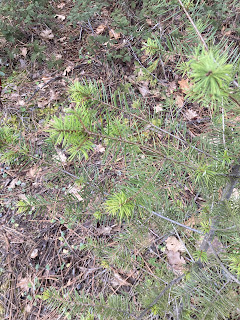
Pine Spring


 Above the dark green,
sprite green needles raise their tips:
Spring follows hard on.

Tuesday, March 01, 2022

Morning Walks With Poppy

One of the morning practices  is that Poppy the Brave and I go for a walk.

The reason for going is probably split about 50/50:  She very much likes and needs her walk in the morning, and I need to put in the miles as well.  So every morning that is not frozen beyond measure (cold puppy paws) or dumping rain (A wet me is an unhappy me), I assemble my walking clothes, strap on my weight vest, pocket a bag for "duty", get the leash, and off we go.

Being in an urban area, the roads to walk are both well marked and limited in their novelty.  I can make one loop which is about 1.25 miles or another loop that is about the same.  I can make a full loop of my old running path for 3 miles.  But these are all roads that I have walked and other than the occasional new landscaping or for sale/for rent signs, there is not a lot of newness to be seen.

I struggle with the best time to walk.  I prefer to walk in the dark (morning or night), both because I simply find it more enjoyable (less people out) and the dark somehow makes it easier to ponder and think.  That said, I struggle with getting my "morning routine" in before I walk, as if I do the sun has inevitably started to come up.  I have not found a suitable compromise between "wanting to complete my routine" and "wanting to get out before the sun rise".  

When I walk, I generally do so without headphones.  I have worn them on occasion but in point of fact I am easily confused by doing two things at the same time; I cannot multi-task.  As a result, I have come to view this time as thinking or meditative time:  I think about things I might post on (this post, for example), argue through trends I see occurring, and generally just give myself 30 minutes to an hour to mull things over.

Poppy of course is wandering back and forth across the path: sniffing here and there, starting to bolt after the rabbit grabbing a last minute snack or a squirrel grabbing an early one, occasionally adding her contribution to those that have been there before, and the now-expected "squat", followed by me grumbling about the fact that I have to stop and pick things up (and then walk the rest of the way with a bag in my hand).  She loves it and generally - after the first rush of being out, is generally a good companion under some level of moderate control.

The remarkable thing to me is how much I miss these walks when I cannot take them.  I have come to value the  ability to organize and manage my thoughts before the world comes crashing in.  Of course, I have to manage such things appropriately:  any urge to "see what the world is up to" has to  be mercilessly put down lest that becomes the point of my morning constitutional.

I wish I could get better at it of course:  I still spend too much time thinking on things that I have no ability to actually influence and can engage myself in rather heated imaginary conversations with myself or others.  Like everything else, I suppose walking with the dog is a practice which it can take a lifetime to achieve balance in.

Poppy, of course, already seems to have achieved balance.  But perhaps that is simply in a dog's nature.