Saturday, February 18, 2023

On Tracking Job Losses

 One of my daily InterWeb stops is Dailyjobcuts.com.  I do not really have a precise idea who runs the site and could not tell you how long I have been stopping by there (it has been some years), but as economic news remains salient to my life, I regularly check in.

From the general format of the site, it is likely that whomever operates the site tends more to the reddish/conservative side.  That is okay, if that is not someone's cup of tea:  the news is confined to the header portion; the actual information I am interested in is below.

There are three columns:  Layoffs, Whose Hiring, and Closing.  For each of these columns, the site is regularly updated directly to the the press releases announcing the news.  

One of the things that the study of history can teach one is to look for trends.  Effects are created by causes, which are themselves then in turn the catalyst for a new cycle of causes.  As one wave crests and retreats, another comes after it.  But it is only looking at things day after day that one can begin to see the patterns beginning to emerge.

I am not an economist and would not begin to suggest that I have any insight into the finer details of economic patterns.  However, it is interesting to watch as some sense of mega-trends occur.

I think most people are familiar now with the layoffs that have occurred in high technology - many that are very big business names, but many also that are smaller (that I would never have heard of prior to this site).  As those have moved on, a logical question is where is the impact to be felt.  It then seems to emerge in the companies that support those sorts of businesses.  Then, as those businesses are affected, the businesses that depend on people being employed and having disposable begin laying off.  Then the companies that supply those business have layoffs.  As they are users of technology (who is not these days) and secondary services (the first two tranches), their decrease in employment then moves back up to the top of the chain.

And so it goes.

Homes are another prime example of this trend.  Mortgage rates are up; banks are beginning to layoff mortgage employees.  With less homes being bought and sold, realtors and builders will be affected.  That will work its way down to title firms and other secondary support firms.  The restaurants they went to, the services they employed, will feel the pinch.

The hiring column also has entries, but they are a fraction of the other two columns, and the numbers that are being hired are in the hundreds, even as potentially thousands are being laid off.

It is fair to say that our economy has always had its share of "creative destruction", and that new things come out of failed enterprises.  At the same time, it has been at least 14 years since we have seen anything like to sort of economic malaise we are currently facing; a whole generation has entered the work force and, like investors or real estate agents in a long running bull market, assume things will only and ever get better and go up.

When cracks appear, they usually start in the places we are not looking.  Look in those places, and perhaps the future, while not being clearly seen, can at least be anticipated.

Friday, February 17, 2023

February Brown And Green

Our weather here in New Home continues to frustrate:  we oscillate between what could effectively be considered as early Summer days and lows at night that remind one that we still remain in the relative depths of Winter.

Our cold fronts, when they come, are not the generally slow moving cold fronts that I remember of my youth, a gradual transition that happens over days.  They are wild sorts of things, violent in their arrival, wrenching the trees from side to side, hurling yellow clouds hither and yon to the detriment of allergy sufferers everywhere.  Even I, who have been largely immune for years to the local versions of pollens, find myself sneezing uncontrollably and reaching for a combination of something to wipe my nose and allergy medication to hopefully let me function without having to close my eyes and restrain sneezes every 10 seconds.

It is undoubtedly frustrating and disorienting to the plant life as well:  our trees, having weathered a freeze that cracked branches and shattered trunks, now find themselves assaulted by the other extreme of heat.  Wind cracks branches already failing but not collapsed and so, a new tunnel of branches along the roads is likely.  This is also our second leaf fall:  beyond the usual sorts of dead leaves that would always fall will be the addition of the shocked leaves that fall and the withered leaves from branches now dead but that no-one noticed until now.  They fall upon the grasses which were sun-scorched and water deprived from the last Summer, leaving everything a dreary, dead brown mess.

Raking - one of my least favorite tasks - yields piles of decayed leaves and dead grass in piles that resemble not the classic red-brown piles of Norman Rockwell but the cinders of burnt out volcanoes, dotting the landscape as if the tectonic plates themselves were creating an island chain in my yard, to be captured into containers before the wind scatters them or simply blows back to cover what appears to be a row of dead lawns down the street, bodies laid in order on the coroner's tables.

There is life still, of course - but it is the life of the native plants that thrive in this environment as they have for thousands of years.  They rise a little every day, green and thriving, almost reaching the point of need to be trimmed, making a mockery of everything that society and social constructs have spent time and money putting in place.  These plants exist not for the benefit and pleasure of the homeowner but for their own purposes, living a life in ordered society of the landscape but at this moment living a life beyond the landscape and its conditions.  The cultivated and cultured struggle and die, while the uncultivated and not cultured seem to thrive in exactly the same conditions.

I watch the the wind swirl the dead leaves and grass even as it riffles the living green into waves that hide and over-run the dead things surrounding it.  Life, as Michael Crichton said, will find a way.  It is those who demand of it to find it in their way and in their confines that are always surprised.

The grasses, of course, always knew that they would grow.

Thursday, February 16, 2023

The Collapse LXXXXI: One Year On

27 April 20XX+1

My Dear Lucilius:

I make note of the fact that, according to my records, it has been a year since I first re-initiated contact with you.

That sounds terribly dry, does it not? It reminds me of the days when we would receive unsolicited mail with “We Have Been Trying To Reach You” scrawled across the front of the envelope as if generated by a real person instead of a printer; the appearance of personalized instead of the actuality of it. One would think that after the year we have had, I could at least approach something more of a colloquial nature.

I laugh silently of course; I do not think that colloquial is in me.

I had not suspected, when I sent that first missive to you, that somehow it would form what has become the effective chronicling of a slow and steady unraveling of everything – perhaps one might argue a sort of foolish luck. It was not quite luck of course, but rather the visit of minor level bureaucrats imploring me to do something I had not considered in some years – actually paying attention to the world around me – that caused me to take various actions including, of course, writing to you.

It does make me ponder the nature of being aware.

The circumstances that we find ourselves in – you with Our Friend and your new love where we grew up, I here far away, both of us in the compost heap of what was a civilization – certainly did not just occur in the course of three months over the Summer last year. The decay had been present for many years prior to that, a rot and decay slowly spreading throughout not just one institution that supported civilization, but all of them.

One can argue that this should have been paid attention to more. And possibly it was, on the level that our society had come to pay attention to such things: big, brash, lurid failures and intellectual wars made the headlines and generated reaction and counter-reaction. The smaller things – the thousand things that make up a civilization – did not merit the same amount of attention even though they, in the end, proved to be the more damaging.

Should we have been more aware? Could we have been more aware? Possibly – but at least for myself and from the conversations we had for you as well, we found ourselves at a period and point in our lives that such issues interested us not at all. We were no longer building careers or families or fortunes and had come to desire only quiet and peace. The ascetics sought out isolated places to find such things and perhaps we, in our way, simply did the same – or as much as we could in the modern world.

Spring is more and more on the horizon here as the days continue to lengthen – which is greatly appreciated, given the fact that this is likely the last Spring that we can count on scraps of our former civilization supplying our needs in a meaningful way. There is much to do – and much I should make a habit of documenting in our letters (as if you were getting these at this point): the bees are coming out more in the finer weather, the quail have begun to lay again (with the knowledge I will need them to reproduce this year for sure), the seedlings have all been started in the greenhouse, and the Winter Wheat is remembering that it is time to finish what it had started last Autumn.

Of course, the other items as well: house rabbits to indulge, books to re-read, and a thousand and one small tasks that continually need completing and now – freed in some fashion from even the minimal trappings of society that I formerly lived with – have at least some time to attend to.

And, I am now reliably informed by Pompeia Paulina, tea on Tuesdays. As apparently this is now a thing.

It has been a long year Lucilius, and one full of both tragedy and hardship in ways that could not be imagined when I wrote you. And yet, I find myself in a strange way more hopeful than ever.

Your Obedient Servant, Seneca

Wednesday, February 15, 2023

On Linda's Prayer Request

 [Editor's note: I again apologize in advance for deferring this week's installment of Old English and its history.  As will perhaps become apparent below, circumstances have taken precedence.]

At the tail end of yesterday's blog, I had noted a prayer request from longtime friend of this blog LindaG.  I had referenced the post there yesterday as it was a late notice on my part; I post it here today: 

"I know many of you have seen this on faceless book; but I ask you to pray for my husband.  Ask everyone you can to pray for him.

He is asking me to kill him.  :-(

You all be safe and God bless (insert heart emoji here, something I can never do - Editor) "

This is a shocking thing to read as you are about to close down at 2245 local time - however, something I know a bit about as well as this is the same request my father had made of us near the end.  I will not say the thought stuck with me all night, but it was indeed a restless sleep.

Suicide is not something which I have any idea that "runs" in my family; if there was a member that was anywhere close to it even in a theoretical sense it was me from ages 17 to 19.  In my case it was (likely) less of a serious attempt than a cry for help (which did get answered), although to this day there are likely slight scars underneath years of tanning and melanin to speak of a day where it was a bit more than theoretical.  In my case, some years of counseling as well as learning to find some level of balance in my own life.

My father for many years was never one to discuss his internal workings or fears; the day that he mentioned almost in passing that he had been diagnosed as a manic-depressive in his sixties was one of the most surprising of my life, as well as the fact that he was taking medication for it (likely a serotonin inhibitor).  That was probably the only time that he mentioned it; after that it was just something we both knew but never discussed.

The conversation in question started at some point after July of 2020, when I started going to The Ranch once a month to stay with my parents.  I recall the moment quite clearly:  we were out on the porch, my father was talking about my mother's condition and at some point said "If I get much worse, I want you to shoot me".

These are words I never expected to hear.  Frankly, these are never words that a child should hear from their parent.

I talked it off of course, saying that things were not that bad and we could do something to resolve them.  But that was not the only time the conversation came up, either with myself or my sister.  It was never anything to do with my mother, always with him.  "You can just shoot me" - never "I am going to shoot myself".

We took precautions of course, verifying that any potential items which could be used in that way were locked up and the combination conveniently hidden.  And it certainly was not for every visit, just now and again.

Then, of course, the move happened, and then the stroke right after it.

After my father's initial recovery and in the period of time between that and his second stroke - perhaps 3 weeks - the conversation came up again with my father.  It was my sister this time; at one point she got up, told him she was not discussing that with him, and left.  Then of course the second stroke happened, and most all conversations, whether of that nature or others, halted.

To those that have never dealt with a family member that is inclined - verbally or by action - towards talking about suicide, you cannot imagine the stress of everyday living.  Every call potentially becomes something of a potentially bad event.  And it strikes without warning - my own failing seem to have passed on to at least one child, Nighean Gheal.  What do you say to a seven year old that tells you that she wants to kill herself?

You watch.  You get help as you can.  You try to catch conversations before they spiral out of control. And you worry.  You worry a lot.

So as I write this, I suppose in one way I was "prepared" for the conversation that my father had out of the blue with me, because I had been managing that sort of thing for years before.

Why would my father have wished for this?  I cannot fully say, but I suspect it was a combination of stress from years of being a primary caregiver and the burden of watching the love of your life and companion for 50 plus years slowly fall apart and being unable to do anything to halt it.  It is one thing for tragedy to strike when one is younger, when the wisdom and experience may be lacking but the energy and stamina is there.  It is another thing for it to happen years later when the situation is reversed and the wisdom and experience is present but the energy and stamina is not.  

There is never, I suppose, a good time for tragedy, but the timing does affect how we can and are able to respond to it.

 Why my father said what he said and why Linda's husband said what he said are equally unknown and unknowable to me in the specifics - even if they were able to give a reason, I have had my own experience with that sort of despair to know that words cannot truly express what that vast dark tunnel actually feels like.  It is not a thing I think I could convey except to say that I know.

The practice, cultural impact, and ethics of suicide is one I will not touch here, as it is it's own topic (and by "it's own topic" I mean "not today") and does not do a whit to resolve the situations that people actually find themselves in.  Pray, if you will, for those that find themselves in such situations and more importantly, for those that love and are dealing with those in those situations.  Likely they will not mention to you until something drastic has occurred; in that sense I am grateful that Linda was able to ask what she asked.  Pray if you are one that prays; even good thoughts are welcomed by those enduring such situations (trust me, I know).

"Everyone is going through a battle most know nothing about" said some wise person sometime. And often those battles go on unseen and unknown behind the public facades we often feel we must put forth.

Tuesday, February 14, 2023

On A Writing Malaise


 One of my favoritest bloggers on the InterWeb, OldAFSarge, has been going through a writing block over the past few weeks.  He notes, for lack of a better terms, a sort of malaise about the state of the world that is both mentally exhausting and makes writing hard.

I find myself in the same situation.

Writing is, for me, an enjoyable activity overall.  I wish I understood more why that is:  it provides me precisely zero financial input, can be time consuming, and other than the kind and intelligent comments people leave (I really do have the best commenters on the InterWeb), I have little enough to show for it.

I have written regularly in some form or fashion since 1989, when I was at school overseas in The Near Abroad. The habit just seemed to stick with me after that; on one of my shelves are all the journals reaching back into the dust of time:  Pre-children, Pre-Mrs. Toirdhealbheach Beucail, Pre-Full Career Choice - in a lot of ways, pre-everything that I have going on today.  The journaling still happens of course; there is a journaling every morning prior to addressing the blog which deals often in the more personal issues, but sometimes in random things (and occasionally, posts that make their way here).

So why do I find myself in the Authoring Doldrums©?

A fair amount of it, I think has to do with The Current State of Affairs.  Yes, I know, this sort of thing has been going on for a long time now (as Resident Optimist Ed would point out) and somehow things have always managed to swing back around in some form or fashion.  Yet in my heart of heart, this time feels different to me for some indefinable reason that I cannot put my finger on.

Is our leadership bad virtually all the way around?  With some notable exceptions, yes: the U.S. System seems to now promote, both in its bureaucracy and in its politics, a combination of gaming the system to get in and then once in, to ensure that things never change (for others in the Near Abroad, your mileage may vary, but by and large it looks just as bleak).  The fact that we are arguing about whether the idea of an endless supply of money (The Debt Ceiling) is good or bad thing when we personally know from practice that debt is always enslaving and surplus is only enabling is says more to me than anything else of the fact that we are quite close to abandoning all good sense forever.

Add to this basic leadership gap that almost anywhere one looks - international relations, world economy, domestic policy, pretty much anything that government touches one way or the other - something seems to be built on a pile of incendiary materials, waiting to go up in a cloud of fire as easily as using gasoline to "start" the bar-be-cue.  Our leadership gap is not isolated, it is almost everywhere - and almost on a day to day basis now, I feel as if we are one bad decision away from a civilization ending catastrophe (not world ending, but civilization ending).

Still, I try to find balance in things.

One, frankly, is just re-reading history, specifically things like the fall of the Empires.  There is nothing like revisiting the collapse of the Roman Empire or the city state system of Greece or the Fall of Byzantium to remind one's self that civilizational collapse happens and, while not pleasant for most of the people involved, people move on through it to the other side.  Even reminding myself of Anglo-Saxon England and how it emerged from Roman Britain has been a comfort (cold, sometimes) of how new civilizations come out of old.

Another place I find balance is simply in reading the well thought out comments of readers like you and the blog entries I read - my morning is almost always full with the allocated time for blogging in catching up and commenting with many of the fine people you see to the right of this post.  In both cases they give me perspective, remind me that I am not alone in seeing and feeling things are out of whack, and the simple practices of life that go on while we are living through difficult times. I cannot garden like Leigh or build a mechanical things like STxAR (I still understand about 20% of what he says about his work) or work wood like Kev or cook like Rain or write fiction like Sarge or just write encyclopedically like Eaton Rapids Joe, but I can take comfort in their practices and their lives and that people - real people, not those that proclaim to be Our Political And Social Betters (OPASB) - are out there doing their everyday things, the stuff of which life is actually made.

Finally, of course, is Nature herself.

The photo above was taken yesterday on my morning walk with Poppy The Brave. It is a sunrise in New Home, something I been gifted with something like 4,000 times or more since we moved here.  The colors are brilliant, as they always are; the clouds drift silently overhead as they have as long as there were clouds, taking no notice of the world below or being interfered with by it.  The same is true at The Ranch, of course; there is nothing there that takes notice of all of these troubles I write of.  The grass grows, the trees sway in the wind, the wildlife goes about its business knowing nothing of debt ceilings or flying objects or a general lack of leadership in the world.

Earth, says The Preacher, abides.  Would that I would remind myself of that more often.

An Additional Note and Request:  Long time friend of this blog LindaG has posted a prayer request on her blog.  It is her story to tell; I will say I am sensitized to it because we went through the same thing with TB The Elder as well. I am sure she would covet your prayers (and I would be awfully obliged to you as well).

Monday, February 13, 2023

How Poor You Are


I am lucky.  I have had the desire for money and position effectively beaten out of me by a combination of bad decisions of my own making and decisions made for me that effectively robbed me of position and power.  Glory?  Ah, I still have glimmers of doing something great, but those are largely tempered by a world that neither wants glory nor desires it and the realization that in the age that we live in, it is far more advantageous to be passed over than noticed.

Would that I could have learned all of this earlier. 

Sunday, February 12, 2023

[You Are] God

Father, all powerful and ever-living God,
we do well always and everywhere to give you thanks
through Jesus Christ our Lord.
You [O Father}, with your only begotten Son and the Holy Spirit are God.

[You are] God, one and immortal;
[You are] God, incorruptible and unmoving;
[You are] God, invisible and faithful;
[You are] God, wonderful and worthy of praise;
[You are] God, strong and worthy of honor;
[You are] God, most high and magnificent;
[You are] God,  living and true; 
[You are] God, wise and powerful;
[You are] God, holy and splendid;
[You are] God, great and good;
[You are] God, awesome and peace-loving;
[You are] God, beautiful and righteous;
[You are] God, pure and kind;
[You are] God, blessed and just;
[You are] God, tender and holy.

[You are] God, not in the singularity of one person but in the trinity of one substance.

We believe you;
We bless you;
We adore you;
and we praise your name forever more.
[We praise you} through [Christ] who is the salvation of the universe;
through [Christ] who is the life of human beings;
through [Christ] who is the resurrection of the dead.

Through him the angels praise your majesty;
the dominations adore;
the powers of heaven tremble;
the virtues and blessed seraphim concelebrate in exultation;
so grant, we pray you, that our voices may be admitted to that chorus, in humble declaration of your glory...

- Preface to The Eucharistic Prayer from The Stowe Missal (written 790 - 820 A.D) County Dublin, Ireland, as quoted by Thomas O'Loughlin in Journey On The Edges:  The Celtic Tradition (2000:  London; Darton, Longman & Todd)

Saturday, February 11, 2023

Odds And Ends: Review Update And A Trip

 Review Update:

Well, really a partial update as due to the magic of the InterWeb (which apparently has "locked" my review from my viewing until some period of time to be determined in the future)...

Much less of an event than I feared.  As with previous years, no salary increase, Cost of Living adjustment or elsewise (as longer readers may recall, my salary was "frozen" when I switched positions) - which is fine as even with accounting for such things, I could probably go the rest of my working life and still be in the positive.

I also received a bonus, which was reasonably unexpected. Me being me of course, there is already a calculator for how to distribute it after taxes (to be fair, there were multiple calculations based on potential amounts).  More interestingly, there is a base bonus range mentioned for next year as well, which means that as least part of the conditions of my change in positions - "no more bonus for you" - has been rescinded.  Perhaps I am off super-secret double probation.

Other than that, the five minute sort of review that one expects from an excellent manager as it has already all be said before this:  good job, keep up the good work, here is to next year.

I also got another tranche of stock options - not amazing in and of themselves, but at our current price, a little movement could go a long way.  So here is hoping.

------

As one of the ongoing preparations which is ongoing at An Taigh na Thoirdealbheach Beucail for a potential move, The Ravishing Mrs. TB has made it a goal to go places in the larger New Home that she has not been to before we leave (at some unspecified date in the future).  About three weeks ago she approached me and asked "When was the last time we went somewhere for Valentine's Day"?

My first thought, of course was "Well, I missed another major holiday" - but after quieting my panic with a quick view of a calendar and firmly reminding myself I needed to buy a card soon, rather that wait for the leavings on the day of, I considered the question. To be honest, I could not think of the last time that we had specifically been somewhere for Valentine's Day, or really any other major possibly romantic themed holiday.  A lot of years of marriage and children will do that to you.

So, as turns out, we are taking a pre-Valentine's overnight trip.

It is a short one - about 1.5 hours from where we are in a town where there are likely some things to do, but perhaps not enough to fill an entire 1.5 day dance card.  I have already been forewarned to bring something to do as the town likely rolls up it's sidewalks at 5 PM (if only I had a book or three to bring with me - oh wait:  I do).   

It is odd - this now makes the second time in a six month period that we have taken a trip by ourselves out of town for a few days.  I think I remember doing this more regularly, once upon a time.  Interesting how all that is old can become new again.

Friday, February 10, 2023

On A Multiplicity Of Deaths

 Three disparate points:

1)  The Russian-Ukrainian conflict entered its first anniversary this week.  Neither side is giving much in the way of accurate casualties (no surprise, given that it is a war) but estimates run anywhere from 150,000 to 220,000 killed.

2)  Last Sunday, a series of severe earthquakes happened in Southwest Turkey and Northern Syria.  The death toll is continuing to mount; I suspect they will easily and tragically be in the tens of thousands.

3)  In 2021 (per an article this week at The American Conservative), 107,600 Americans died of drug overdoses.

One death, Stalin is reported to have said, is a tragedy.  A million is a statistic.

Is that what death has become in the modern world, a statistic?

I point the finger and the examination mostly at myself here.  When I look at these three listings and death tolls, the one that "moves" me the most are the victims of the earthquakes. I have seen the pictures and the videos.  The collapses are terrifying; the work that will have to be undertaken to rebuild, if such a thing is even possible, will take years.  And the numbers will continue to rise and the horror continue to play itself out as time goes on and less and less survivors are found.

The war?  It has been going on for a year now and both sides only seem more and more intent on seeing how many of the other they can kill.  Apart from the political aspects, there is the human aspect as well:  they (and we) fool ourselves if we think that if the war ended tomorrow, things would go back to the status quo.  Like the earthquake issue above, so much destruction has taken place that it will take years to rebuild - again, if at all.

Overdose death?  Here, perhaps, I find myself most damned.  Drug abuse has been in my larger family; thankfully in that case, the way out was through Narcotics Anonymous.  But that requires a strength of character not everyone has.  And so hundreds of thousands engage in it.  I have seen them - here in New Home, even in Old Home now, in major urban centers that I travel to. It is easily to feel sympathy in the abstract when reading about the deaths and about their stories; it is difficult when one is confronted directly by their appearance and the culture that the live in and the knowledge that directly or indirectly - as with the war - my tax dollars are essentially continuing to fund such things.

These are real issues.  These are difficult issues. And these are issues that I can safely just bury beneath my comfortable lifestyle, if I choose to.

No, I cannot be responsible for anyone else. My ability to change international politics, building codes that survive earthquakes, natural forces, physiological addictions, or even simple personal character in others is essentially nil.  And those that burden themselves with such ineffective responsibilities only become clanging single issue voices that never change anything, other than invoking a perpetual feeling of guilt in everyone else.

But what I can do and should do is never lose sight of the fact that when we discuss each of these things - whether man made, natural forces, or simply physiological addiction - we are discussing people.  People, individuals, with life histories and stories and potential contributions that will never be made.

It is, all of it, a tragedy.  But even tragedy on that scale becomes, it seems, a statistic.

Thursday, February 09, 2023

The Collapse LXXXX: Spring Beekeeping

25 April 20XX+1

My Dear Lucilius:

Today was the day of opening the hives.

As I know we have discussed, perhaps years ago at this point, one of the most uncomfortable moments for me in beekeeping (and perhaps for any beekeeper) is opening the Winter hives for the first time. While one can get a sense of how the hive is doing by judging how much of the supplemental syrup is been eaten or the occasional good days where the bees take cleansing flights, the full understanding of how the hive has done over the past season can only take place by fully opening the hive.

That in itself offers potential risks: open too soon and the internal temperature of the hive and the “bee ball” that they workers make around the queen during Winter will dissipate and they may very well die; open too late and a problem resolvable two weeks earlier will be in the terminal stages.

Perhaps others are better at it than I. To me, it always strikes me as the highest risk activity of the year.

The weather has held together more or less enough to this point that I am reasonable confident that a sudden recurrence of Winter may not appear (although it has happened this late in the year before); more importantly, given the last year the criticality of the bees and their wax and honey and therefore their health is more important than ever. And so, bearing my full bee-keeping regalia and smoker in hand, I approached the hives.

The technique is always the same, no matter how I open it: slowly remove the telescoping overhive cover, then look into the feeding tray: Is it empty? Full? Full of dead bees, in which case there is a hole I need to patch? If that is okay, I drop in some smoke, and then use my hive tool (a rather fancy word for what appears to be a short crowbar) to pry the feeding deep away from the main hive deeps, freeing any of the propolis – the sticky substance that bees use to patch holes – that may be attaching it to the outer body. Setting that to the side and prying away the grate that acts to exclude the queen from the feeding tray, I put my frame hanger on the side of the hive body, smoke a little more, and look in.

The best sign – the sign I hear today – is the buzz of the hive. It is hard to eyeball the amount of bees, but they appear to be okay. I pull out some of frames -slowly, as to not crush any potential hangers-on – and look at them from side to side. Some of the bees twirl up as I do, agitated. I lay down a bit more smoke and continue my examination.

What I am looking for in the frames are a number of things. Damage to the individual cells by wax moths is a big element, as it not only indicates an infestation but also that the hive may not have been strong enough to resist the attack, thus meaning they are weaker and I may have to take other actions. Sealed comb or accessed comb mean the bees had sufficient food and were using it. The best sign – brood cells – would mean that the queen was laying within a week or so my opening the hive.

If I can get away with just opening the upper deep at this point I will; every time I manipulate the frames and the hive I run the risk of damaging the bees or even worse, the queen. I am fortunate this time in that in both cases, I can see brood cells. The queens are still alive, or at least recently.

I will carefully undo my progress – placing the frames back into the hive, placing the feeder on top and then refilling it one last time, and then placing the overhive lid on it all – and leave them be at this point. The excluder – that small part of wood at the base of the hive that restricts the entry of cold and invaders during Winter (and not just insects; mice will move in if given the chance) will be flipped over to the larger of the two entrances; if the weather continues to improve I may remove it completely in my next visit.

I was fortunate in that both of my hives have survived the Winter and appear healthy. A number of things play at my mind even as I remove my gear and tap out the smoker: queens are not eternal and will either the hive replace them or the colony will die. Mine are perhaps two years old; queens can go for five years but their productivity decreases every year. There are ways to effectively “create” your own queens by gathering queen cells and nurturing them; like many other things, I have a book on it but have never done it. And looking forward to Winter next year, likely I will run short of the syrup I use to feed them as I myself am low on sugar. This means either I pull less honey and leave more for the bees or trade for sugar – likely both.

My reward for a bee visit well done, as it always is, is to take some time with a cool beverage and chair and watch the bees as they enter and exit the hive. Bee society is orderly and controlled; I could watch them interact for hours and in years past, have done so.

It comforts me, Lucilius, to know that even if human society has broken down, other societies remain intact.

Your Obedient Servant, Seneca

Wednesday, February 08, 2023

Old English: A Historical Background - From Groaning To Invasion

 (Author's note:  History is a wide ranging discipline which in some senses can be fluid as we learn new things and in some cases is solid as we choose to interpret events and findings in light of our own day, not the day in which it happened.  Individuals spend their whole lives studying these things.  My very concise overview is meant as nothing more than that:  an overview to give background.  All errors and omissions remain my own.) 
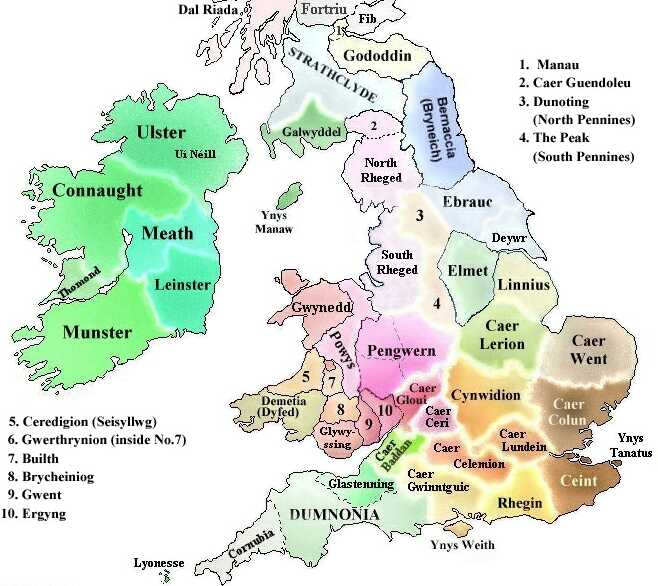
Once upon a time in the not too long ago, English School children and those that derived their existence from English history learned that the Anglo-Saxons invaded the island of Britain in 449 A.D., where they effectively moved in and took over everything.

As usual, the truth is somewhat less well defined.

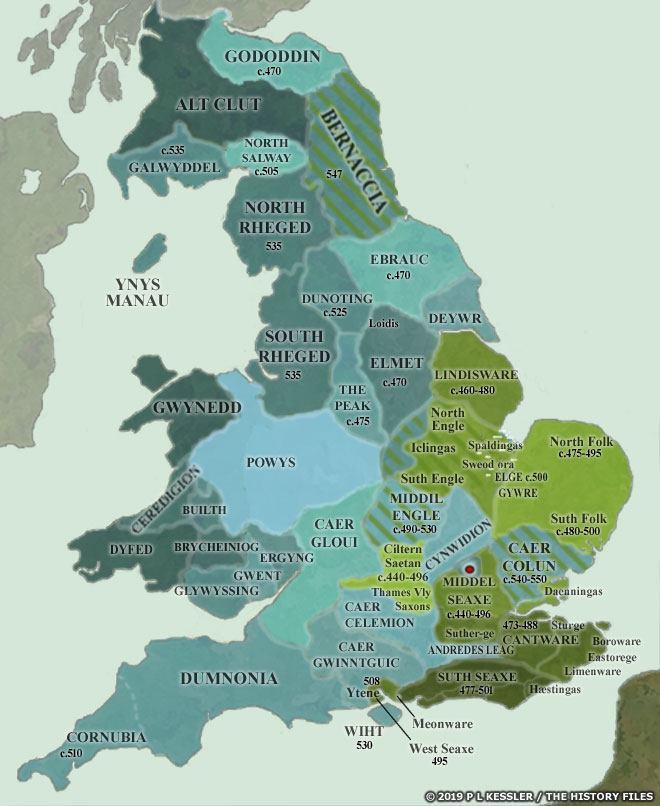
Map of Britain 450-475 A.D. - Source

Whether the Romano-Britons of 446 A.D. heard a response from the Emperor about the status of their land (The Groans of The Britons) or not is not recorded for us.  What is recorded is that actions that they took, which suggests the response was either "Look to your own defenses" or simply no response at all. So look to their own defenses they must.

The ongoing rebellion of the already hired Anglo-Saxons meant that hiring additional Angles and Saxons might not be a good idea.  The shadowy figure of Vortigern appears again when, to repel an attack of Picts to the North, he hires a different set of Germans, the Jutes (perhaps so-named from the Jutland peninsula) to assist.  We have the names of these leaders, Hengist and Horsa, although we have no idea if they really existed or were mythical figures (the word "hengist" in Anglo-Saxon is one word for "horse").  

Hengist and Horsa may not have been real.  Their landing in Kent likely was.

It does not seem that they were allies of Vortigern for long.  In 455 A.D. they are recorded as fighting with Vortigern.  Hengist was allegedly slain; Vortigern also falls out of the few records we have of him, perhaps slain as well.  

Map of Britain 475-500 A.D. - Source

From these humble beginnings, the true invasion of Britain commenced.

Initially the Romano-Britons had a hard go of it.  Theirs initially is a history of defeats of four battles over 25 years (456 A.D to 473 A.D.) - which perhaps makes sense if we look at the wider historical record:  the invaders (Angles, Saxons, Jutes) had the ability to come and go at will and seek allies as their highway, the sea, was to their backs; the Romano-British had no such ability.

And then, something of a miracles happened: There was a Romano-British resurgence.

Map of Britain 500-550 A.D. - Source

All of our written knowledge of this comes from the monk Gildas, writing in the 550's A.D.  He states that a leader, Ambrosius Aurelianus, a man he calls the Last of Romans in Britain, born to a family that "had worn the purple", lead a counterstroke and heavily defeated the combined Germanic armies at a battle called Mons Badonicus.  We do not know where this battle was, or specifically when it was, (although Gildas writes that even in his day, there was still peace from this battle, so the estimates run from 486 A.D. to 516 A.D), or even what the impact was from the battle, except that it halted the advance of the Angles, Saxons, and Jutes for a generation.

Ambrosius is a mystery as well:  we know nothing about him, his origin, or his ultimate fate.  We do know of him from legend, as his is the most likely origin story for King Arthur.

Map of Britain 550 - 575 A.D. - Source

But the tide, once started, could not be turned back.  In 552 A.D., the Saxons won a victory at Old Sarum.  in 556 A.D. they won again at Barbury.  In 571 A.D. they won again, taking parts of Bedfordshire and Buckinghamshire.  In 577 A.D. they took Glouceaster, Circenceaster, and the old Roman town of Bath.  They pushed north as well, winning parts of Northumbria in 590 A.D. and engaging directly with and defeating the Scots in 603 A.D.  By the time of St. Augustine's visit in 597 A.D., most of the middle and Southern part of Roman Britain had been conquered.

Map of Britain 575 - 600 A.D. - Source

What of the remaining Romano-British?  Some of them fled - first likely farther west into what would become Cornwall and Wales.  Some fled even further; the Byzantine historian Procopius writes from Byzantium that word of refugees fleeing from Britain to the old Roman province of Amorica reached their ears.  The province, depopulated by previous invasions and plague, became the province of Brittany (and explains why a Celtic language still exists in France).  The immigrants brought not only their language but their names as well:  Two of the Atlantic provinces were name Cornouaille ("Cornwall") and Domnonea (Devon), reflecting very directly where they had come from.

   Source

But for the Romano-Britons, this would begin their long, slow retreat the Celtic Fringes of Europe.  The future of Britain, or as it was coming to be known, Engle-land, would belong to the invaders, who would have little understanding of the history that had come before them, coming to believe that giants had built the great ruins they wandered among; it was impossible that men could have done such a thing.

Works cited:

Blair, Peter Hunter:  Roman Britain and Early England 55 B.C. - A.D. 871.  WW Norton and Company:  London, 1991.

Nicolle, David:  Arthur And The Anglo-Saxon Wars.  Osprey Publishing:  Hong Kong, 1984

Alcock, Leslie:  Arthur's Britain.  Penguin:  Great Britain, 1971

Wikipedia:  Amorica, Groans of the Britons

Tuesday, February 07, 2023

An Odd Dream - Church Restoration

 I am not a great "believer" in dreams.  They happen:  most of them I forget upon awakening, a very few I remember.  Even fewer of those impact me upon awakening.

It is not that I discount the potential of dreams.  Can God communicate through dreams?  Certainly.  I know people that would swear to you that He has.  Can the unconscious mind process information through our dreams in a way the conscious mind cannot?  That sounds reasonable to me, although I am conscious of the fact I do not have the background in neurology to assert that (extra points if you get the pun!).  Do I believe that dreams tap into a larger energy, a stream that moves forward and back in time, giving us visions and insights?  Well, not precisely yes - although even I have had more than one deja vu experience for which I can directly correlate to a particular dream.

So when I have the same dream twice in a night - and remember it - this is something worth taking note of.

In this case, both dreams (from Sunday night) involved the restoration of a church.

In some ways, it was a very vague dream.  It was definitely a church (as opposed to another building or a cathedral).  It was definitely a church made of stone.  It was definitely not in the United States - my sense was that it was in Europe, although why I cannot say.

But what was very clear - very clear from my impression - was that I was there to restore the church. I needed to.  That was my job.

One place I go when such dreams happen (and I actually remember them) is Dream Moods, which has various dream images and their "interpretations".  From the site, with relevant notes:

Church:  "To dream that you are inside a church suggests that you are seeking for spiritual enlightenment and guidance.  You are looking to be uplifted in some way.  Perhaps you have made some past mistakes which have set you back on your path towards your goals.  With proper support, you will get on the right track again.  Alternatively, the dream may also mean that you are questioning and debating your life path and where it is leading.  You are re-evaluating what you want to do."

Fixing (closest thing I could find to restoring):  "To dream that you are fixing something indicates that you need to re-evaluate and rethink a situation or relationship in your life."

Stone:  "To see a stone in your dream symbolized strength,  unity, and unyielding beliefs.  Look at the shape, texture, and color of the stone for additional significance.  If the stones are rough, then it represents your quest in recognizing and developing your self-identity.  Part of this quest is to also become aware of your subconscious and hidden thoughts. To place a circle of stones around yourself (maybe a restored stone church?) suggests that you are channeling a higher energy.  You are contemplating an important decision."

Now to be fair, I have spent a lot of time recently reading up on Romano-British/Anglo-Saxon history, so the fact an old church that needs restoring shows up may not be quite as mysterious as it might seem.  My mind has been on "old things" a lot recently.  

Still, it is rare that I wake up from the same dream theme twice in one night and have a strong memory of the dream and some sense that the dream actually meant something.

Monday, February 06, 2023

The Season Of Reviews

 We are entering the time in my industry where things like bonuses, raises, promotions and layoffs happen.  

I come by my wariness of this period of time naturally.  My layoff happened at the end of January.  My "reassignment" happened at the end of February.  Once upon a time, I looked at these times with an especial sort of hope.  Now, I hold my breath and hope for the best.

The timing of all of this has changed over the years, at least in my industry. When I started in the long ago, all of this happened before the end of the year with the mad dash to turn in assessments and get reviews completely by 31 December.  Somewhere along the line this changed - probably for the best, given what passes for the end of the year rush at this point - and while the reviews continued to have to be done by the end of the year, the actual decisions and announcements were pushed into the next year.

At some point, one gives up the idea that magical things happen during these cycles given that, at this time in the career cycle, such significant changes are few and far between and at some point become fewer and farther between (in my own experience, the years between 2017 and 2019 were an aberration of an otherwise staid career of cost of living raises and occasional promotions). One quietly waits for the conversation to occur, the review to happen (certainly my reviews now with my manager are pleasant affairs and there are no surprises), the financing to be expressed, and then we go on with our lives.

Except...

Except this year I am experiencing a sort of wariness. It is industry-wide of course - one reads more and more these days of smaller biotech and pharmaceutical companies laying off employees, but now it seems to be extending to larger companies as well.  It is not a surprise, or not really:  given the state of the Post-Plague economy, small companies are having a terrible time launching Initial Purchase Offers and larger companies are trimming down assets which are not performing or appear to have no future as an asset class (not just individual products).  

Can I project manage in other industries?  In theory, yes - the practice of project management is in theory industry agnostic.  At the same time, there are nuances that feed into any industry: I am more likely to be a better performer in a biopharmaceutical company than, say, an IT company simply because I understand the process and know the "language".  

But I would be lying if I said I was not approaching this week with a bit of trepidation.  Perhaps not "Something Wicked This Way Comes", but "Something A Little Disconcerting Meanders In".

Sunday, February 05, 2023

Lectio Divina: Glory

 "Holy, Holy, Holy is the Lord Almighty;

The whole earth is full of His glory."

- Isaiah 6:3b

This familiar passage, taken from Isaiah vision of the Lord "in the year King Uzziah died (~752 B.C.)", is one of the most well known of Old Testament visions of God.  We have liturgies and songs based on it, and likely if you have been in the Church long enough, you have heard one or more sermons on it.


The whole earth is full of His Glory.


That the whole earth is full of God's glory is easy enough to believe; I have traveled enough to see the wonder of His creation both here and in the near abroad.  The glory of earth - the untrammeled earth - easily reflects His glory.  The people in it, not so much.


If there would seem to be a single flaw in this assertion of the Seraphim as they hover before the throne of God with their faces and feet covered, eternally singing His glory, it is humankind.  Us.  If I look into Nature I easily see Him; if I look in the around me, not quite as much.

That would seem to be an inconsistency, would it not?  In Genesis, God states "Let us create Man in our image". God - at least at that moment - views mankind as the pinnacle of His creation. and yet to look around at ourselves now, we see little if any of God's glory.


It is easy enough, I suppose, to view Man's inhumanity to man as example one of how we fail at God's glory.  And those examples are as horrifying as they are self-evident.  But too often that is where the Church seems to stop:  the external manifestations of sin. 


But stare into the way the Church is itself, the way Christians are themselves:  do these represent God's glory as well?  Do the services we follow reflect Heaven, or do they appeal to our own sense of what entertains us and makes us feel "spiritual"?  One can make an effective argument that past glories of High Church are boring and out of touch, but does the all too often modern practice of pulsing bass, overpowered vocals, and emoting demonstrate His glory any more?


In our practices - what the Church celebrates, what it calls forth, what it glorifies - are we demonstrating the same radiance and beauty as the rest of Creation? Or do we merely reflect ourselves, what we think is important and matters and is relevant?


The Seraphim cry out that the earth is full of His glory - Are we?  Are our churches?


Do we - as individuals, as the bodies of Christ on earth - do we reflect this glory that Scripture assures us the rest of the earth is filled with?  Or have we become satisfied with less, that which does not call us out or challenges us only ways that we find acceptable to be challenged?


Would that we, too, might cry out "The earth is full of His glory - and that includes us".


Saturday, February 04, 2023

Stranger In A Warm Land

Thanks to all for their patience in my responses and posting this week.  There was, of course, an adventure involved.  And thus, the rest of the story...

I had an out of business travel appointment set since the middle of January to a contractor for a project review.  This was part of a larger team.  We would leave on a Monday and return on a Wednesday.  Everything was in place and we were moving along fine.

Around last Saturday or Sunday the weather reports, which had been predicting rain and cold, suddenly began to take a turn for the worst, predicting the potential for freezing weather and ice.  Even by Monday, when we were getting ready to leave, things were still not in alarm mode but the temperature was falling.  

As it turns out, I may have gotten out on one of the last planes to leave New Home.

Our meeting went off without a hitch - but New Home, caught in the midst of an ice storm, did not.  We followed the news, got updates from spouses and coworkers of the low temperatures, building ice, and resulting power losses and falling branches.

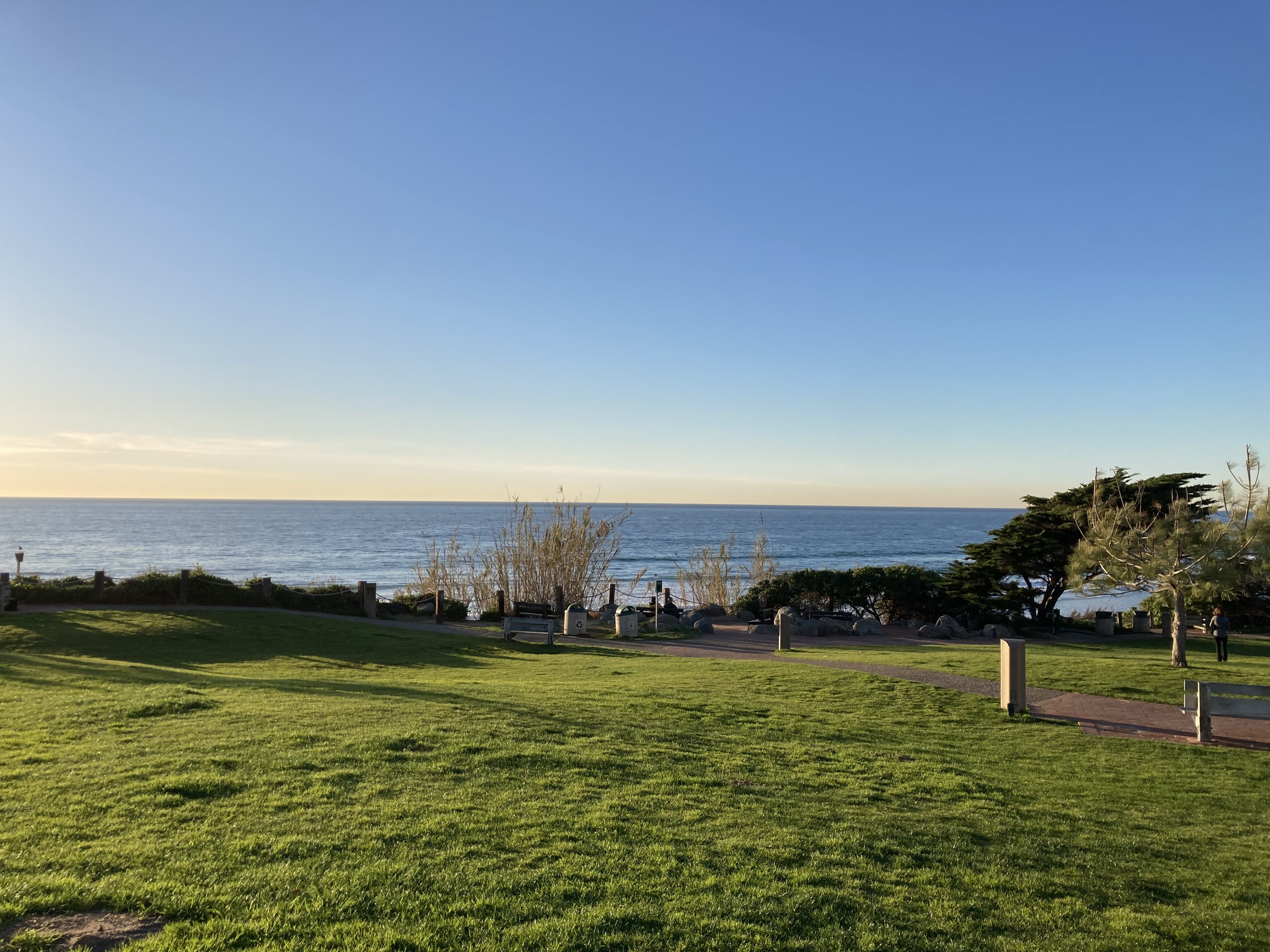
All of this, while we continued to "endure" the weather in San Diego.

Our flights home Wednesday were either canceled by Tuesday evening or Wednesday morning; like other refugees we rebooked our flights - and then needed to find a new hotel.  Four of us were stuck in town for another day and headed 5 miles up the road for one more night.  Fortunately we were already all accomplished in working remotely and continued to manage ourselves even though we were a ways from home.

For An Taigh Thoirdhealbheach Beucail, everyone was okay.  School was canceled as was work, and so everyone sheltered in place.  Apparently they lost power Wednesday night which was not restored until Thursday afternoon (doubly fortunately, we have one of those almost illegal gas stoves, so they were able to cook).  Other than the cold and the popping and crashing branches, no serious harm done.

I arrived home Thursday night and thus could not look at the trees until yesterday afternoon.

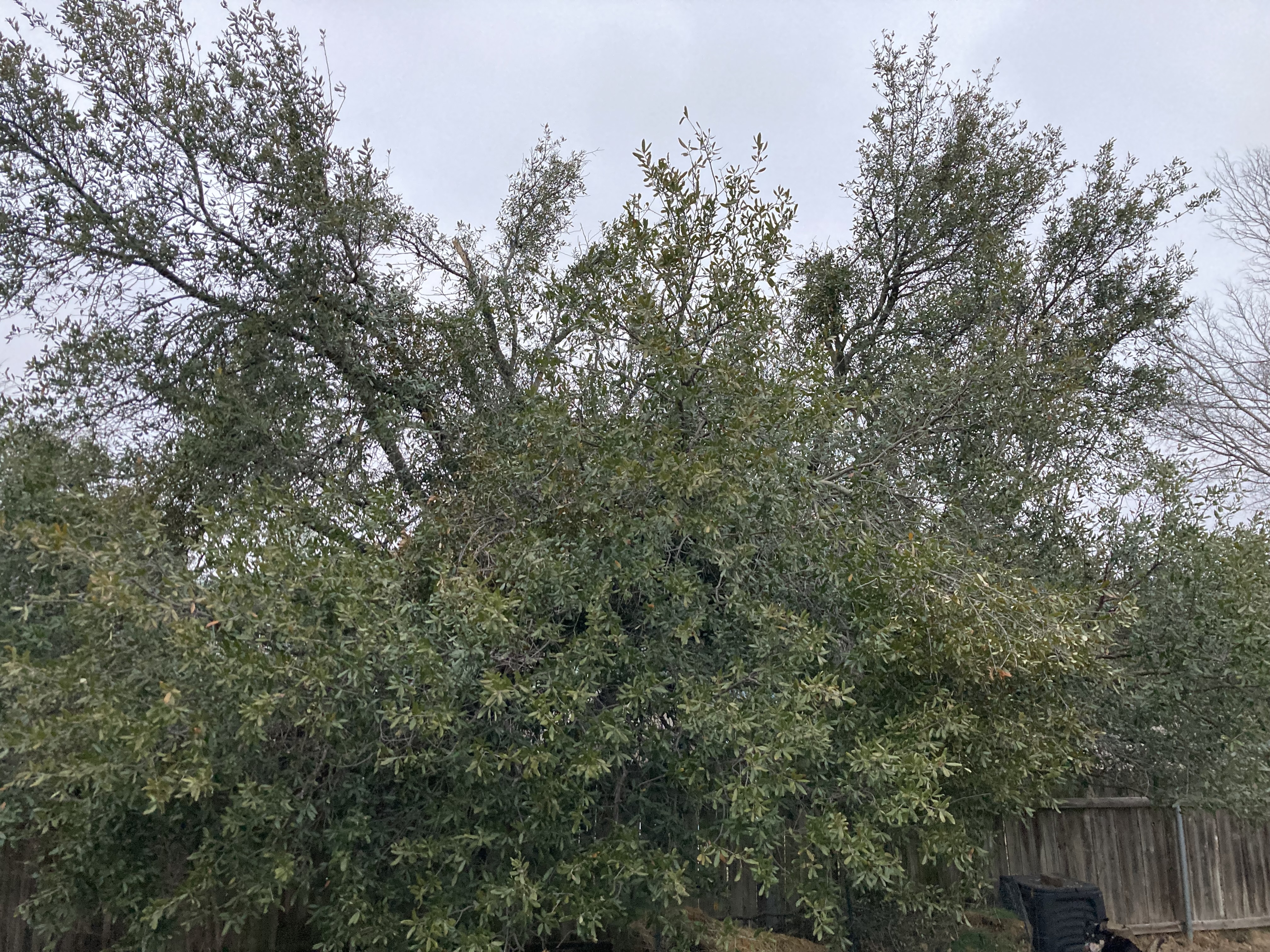
On the "bright" side, none of our trees split down the middle, but the three major oaks near us all lost more than one branch.  And we, of course, are not the only ones - estimates are around here that up to 90% of certain kinds of trees suffered damage.

There is now a growing tunnel along the streets as the branches stack up on the side of the road.


All of these pictures are from the front.  Yesterday, I was able to get all the branches out and all but one of the fallen branches still in the trees down and cut up.  The last one is within my reach and I should be able to do it today.


If you have never seen ice-encrusted leaves, the picture below is an example:

Hard to see, but the picture below is of the major tree in the backyard.  There is one branch weighting down another one on our side of the fence.  Unfortunately it is much larger than I think I can handle and likely I will have to find someone to do the work (perhaps mysteriously, tree services are currently 60 to 90 days booked out).

A couple of interesting lessons here.  The first is simply that being out when any kind of major event happens - a not great one - is something worth planning for.  Even if it is a regionalized issue, both you and the folks back at home may essentially be "on your own" (so remember to pack extra socks and underwear).  The second, of course, is to accept what you can and cannot control.

After all, I was pretty much a victim of circumstance.

Friday, February 03, 2023

Book Review: Dirt To Soil

 In an earlier blog post last year, were discussing Masanobu Fukuoka's One Straw Revolution and the practicality of organic farming.  Friend of the blog Leigh Tate from Five Acres and A Dream suggested a number of authors to review along with Fukoka.

Another book on agriculture by a new author.  I was up to the challenge (to be fair, I am up to any challenge involving buying a new book).


Gabe Brown is a rancher and farmer in North Dakota.  He and his family manage 5,000 acres of land near Bismark, North Dakota.  In his book Dirt to Soil:  One Family's Journey into Regenerative Agriculture he (with the very able assistance of a writer from Chelsea Green, Courtney White) chronicles their almost accidental stumbling into regenerative agriculture, the evolution of their farming business as a result of this journey, and the principles of regenerative agriculture and their application.

The background is that Brown and his wife, Shelly, entered farming by purchasing land from her parents and entering the traditional farming practices of his background and his in-laws.
Then, disaster struck.  A back to back to back run of bad luck - hail damage, hail damage, a blizzard - reduced him to almost quitting but also forced him almost accidentally to begin the process of regenerative agriculture simply because he did not have any other option.  It was during this time that he continued his study into soil and range management (Allen Savory's method).  At one point he heard a rancher from Canada, Don Campbell, speak at a conference and one line from that speech comes up several times in the book (and is actually a rather life changing statement):

"If you want to make small changes, change the way you do things.  If you want to make big changes, change the way you see things".

From this point, the first half of the book then relates his journey as they continued to modify their practices away from traditional agricultural and livestock management to regenerative agriculture and livestock management that more reflects how the American plains once looked with the great Bison migrations.  It also follows their journey as they modified and expanded their business practices to extract more income from the products they produced (in a comment elsewhere, I noted that Brown states that the average American farmer only receives around $0.14 of every dollar that their final product nets).

The second half of the book discusses the five steps that Brown calls "The Five Principles of Soil Health":

1)  Limit Disturbance
2)  Armor the Soil Surface
3)  Build Diversity
4)  Keep Living Roots In the Soil
5) Integrate Animals

He discuss each of this principles in depth, including data backing up the claims made by him and others on the practical, demonstrable improvements of their soil and their operations.

I have to confess, I really like this book.

In the preface to the book, Courtney White writes that Chelsea Green Publishers had approached Brown about writing a book, but time was always an issue - thus White's involvement.  And to that extent, it is somewhat hard to judge how much of the voice we hear is Brown's and how much is White's - it sounds like how I would imagine he would speak and if so, more kudos to White for her light touch. 

The style is engaging and has the sort of easy discussion that I find in other author's I like, such as Gene Logsdon or Joel Salatin.  Brown discusses his practices openly and gives examples.  It is clear that he is excited about the discoveries he has made and wants to share them with everyone he can because he believes in them and has seen their transformative power.

If his five principles sound a bit like Fukuoka, it is because they are similar to them - but adapted in some ways to the American plains.  And, Brown thinks a great deal of Fukuoka.

It is clear from the book as well that Brown is a man of continual learning, even if he may not have the philosophical insight of a Logsdon or Wendell Berry.  He is constantly discussing reaching out to government bodies dealing with soils, university professors, other individuals in the fields, and conferences to gain more knowledge.  And he encourages the reader to do the same.

The last chapter of the book is simply entitled "Do Something", and relates the guideposts that he and his family have lived by:

- Trust God
- Keep an open mind
- Do not be afraid to fail
- Understand your context
- Do something

It is really not a bad list not just for regenerative agriculture, but for life in general.  

I highly recommend this book.  It is not only practical, it is inspirational.  Almost makes me want to take a trip to North Dakota to visit his farm.

Thursday, February 02, 2023

Solar Energy Machine


 (Apology friends - Due to inclement weather I am still away from home and on my phone.  Thanks for your patience!)

Wednesday, February 01, 2023

Old English: A Historical Background - From Abandonment To Groaning

(Author's note:  History is a wide ranging discipline which in some senses can be fluid as we learn new things and in some cases is solid as we choose to interpret events and findings in light of our own day, not the day in which it happened.  Individuals spend their whole lives studying these things.  My very concise overview is meant as nothing more than that:  an overview to give background.  All errors and omissions remain my own.) 

The Province of Britain - increasingly abandoned by Rome over the latter part of the 4th Century with a few bright points of occasional reinforcement from a Roman government that was increasingly concerned more and more with events much closer to home - saw as part of this slow retreat the establishment of client kings and client kingdoms.

This sort of thing had been practiced in other parts of the Empire throughout its history and dating back even to the Republic days:  it allowed Rome to continue to exercise overall control while sparing itself the expense and drain of day to day management.  In the case of Britain as well, it had been "Romanized" for well over 300 years at this point.  There was likely still a functioning bureaucracy and remaining fortifications such as The Saxon Shore (Eastern England) had been turned over to local militia that had likely been trained in the Roman way of war.  Given the circumstances, it was likely the best the Empire could do.


(Source)

But the world was in the throes of the great changes that would eventually fracture the Empire:  great movements of people, generals fighting either for control of the Empire or, as things progressed, setting up their own smaller fiefdoms.  Britain was not immune to this, especially as the coast remained open for raids from across the English Channel from the Jutes, the Franks, the Saxons, the Frisians, and the Angles.

Our knowledge of this period of history is sadly lacking; the fifth and sixth century are poorly documented from around 410 A.D. to the arrival of St. Augustine in 597 A.D.  We have a  On the Ruin and Conquest of Britain, written by the monk Gildas around sometime in the early to mid 500's (likely not later than 540 A.D.) which chronicles the history of Britain from the Roman invasion to the writer's present day.  We have a series of documents known as the Historia Brittanica, a series of genealogies, Easter tables, and small history.  We have a record of a visit of St. Germanus in approximately  (largely to confront the Pelagian heresy).  We have the Venerable Bede's Ecclesiastical History of the English People (based on Gildas' work as well as other history).  And  we have the Anglo-Saxon Chronicles, which is was formalized on or about 891 A.D. but likely incorporated earlier versions.  

In other words, it is if we had the first 150 years of the history of the United States and only 4 documents of questionable historical value to inform us.

What is known is that Britain remained under threat of piracy and raids from the Picts in the North, the Irish in the West (this is the period that St. Patrick was captured and taken to Ireland), and the various German tribes in the East.  And while the settlement of German tribes had been happening for almost 200 years or more, apparently even their reinforcement was not enough to meet the need. Using the idea that the easiest way to defend against a thief is to hire a thief, a Sub-king who comes down to us in history as Vortigern hired Saxon mercenaries (traditionally in the year 428 A.D.) to defend against the pirates.  He offered them land in Eastern England in return.  

This was a fine arrangement - and historically quite sound, as this is something that the Roman Empire had done for hundreds of years.  What was not anticipated was a payment dispute that got out of hand and the following revolt of the Saxons (442 A.D. to 446 A.D.), where great destruction occurred as the Saxons (at least according to our records) burned and pillaged their way across Briton.

Added to the revolt of the Saxons was the continuing and the renewed raids of the Picti and Scoti from the West and North.  Rather obviously to the Britons of that time, the current "hire a thief to catch a thief" strategy had left them wanting.  And so, in 446 A.D., the Britons reached out one last time to a Rome that was increasingly consumed with its own problems on the continent. The communication has come down to us as "The Groans Of The Britons":

"To Aetius, thrice consul

The barbarians drive us to the sea, the sea drives us to the barbarians;
between these two means of death we are either killed or drowned". 

(Source)

We do not have Aetius' response, if there was one.  What most likely became apparent was that the British could no longer look to Rome for any assistance.  They were on their own.

Works consulted:

Blair, Peter Hunter:  Roman Britain and Early England 55 B.C. - A.D. 871.  WW Norton and Company:  London, 1991.

Nicolle, David:  Arthur And The Anglo-Saxon Wars.  Osprey Publishing:  Hong Kong, 1984

Alcock, Leslie:  Arthur's Britain.  Penguin:  Great Britain, 1971

Wikipedia:  Groans of the Britons