Showing posts with label Old English. Show all posts

Wednesday, June 21, 2023

Old English, A Historical Background: Final Thoughts

 Friends:

Thanks for your patience over the last five months as I have walked through at least a high level review of Anglo Saxon History.

(Offa's Dyke - Source)

This project became a lot more involved than I had originally anticipated. My initial thought was that this was a way to help me keep a commitment to study Anglo-Saxon this year with an eye towards performing a reference-free translation.  What it turned into was a 700 year review of British History - a pretty ambitious goal for someone with a small blog that writes this in his free time.

(The Alfred Jewel - Source)

In reviewing history, there is so much we did not touch on.  Anglo-Saxon artists produced metallurgy and art the equal of anything else.  Anglo-Saxon governing institutions set in place certain practices and beliefs that in some small fashion continue down to our day.  Anglo-Saxon literature (which we will hopefully touch on) remains as fresh and insightful as it did back in the day.

It strikes me that last month is the 30 year anniversary of my cessation of formal tertiary education and since that time, I have not undertaken a research project to this extent or this depth.  It comforts me to know that those skills are not entirely lost and, when prompted, the art of performing research is still something I can access (Using new tools, of course; in my day the InterWeb was barely a thing for research).

   (Anglo-Saxon Sword Belt End Ornament, Sutton Hoo Burial - Source)

At heart I am a historian and, like all historians, believe that the present can only be understood by the past - not the past as we wish to find it, but the past as it really happened. Hopefully this less than brief excursus can shed some light on how England came to be England and where some of the traditions and beliefs of even our own day date from.


(First page of the Beowulf Manuscript circa 975 - 1025 A.D. - Source)

Next steps?  I am still thinking this through.  A brief review of the language might be in order (although Old English is technically "English", it has a number of characteristics which are as foreign to us today as any other foreign language).  And certainly touching on the literature, the main vehicle of Old English, is worthwhile, as the Anglo-Saxons were as skilled writers and observers as any in the modern era.

(Chapel of St. Peter-on-the Wall, built 654 A.D. - Source)

In closing of this segment, I offer a quote from The Battle Of Maldon, which describes a battle in 991 A.D. between Anglo-Saxon troops and Viking Raiders.  The Anglo-Saxon leader,  Byrtnoth, has allowed the Danes to cross an estuary for a fair fight and both sides are now prepared for battle:

 “Nu eow is gerymed; gað ricene to us,
guman to guðe; god ana wat
hwa Þære wælstowe wealdan mote.”

"Now the way is clear for you, O warrriors,
hasten to the battle.  God alone knows
how things  will turn out."

Wes Þu Hal!

Tuesday, June 13, 2023

Old English, A Historical Background: The What-Ifs

I suspect among the fantasy lives of historians, one of the deeper darker secrets is the engaging in the examinations of the What-Ifs, those forks in history where something went one way when there were two (or more) options to take.  We practice this in our own lives, of course;  what if I did not go to this school or move here, which means I did not meet this person and then we did not become friends/get married/become enemies for life.  

It is perhaps a trifle harder on the historical scale, as the variables are far greater as almost no historical event exists in isolation from all other historical events.  But even with that, there remain significant inflection points where an outcome which was different, regardless of the surrounding events, would likely have made a significant impact on following events.

And so, in an almost paroxysm of "fun" (or as much fun as historians can have), we will spend a few minutes on the What-Ifs of Anglo-Saxon Britain:

1)  Britain does not fall:  I list this as a potential item, but it is (among all of them) the least unrealistic.  Even if the legions had not departed in the early 5th Century, the Western Roman Empire was still in collapse.  Legions in Britain may have held off the onslaught for a bit longer, but ultimately someone would have arrived - even if the legions remained, there would have been no reinforcements.

2) The Anglo, Saxons, and Jutes were not initially defeated:  One theory is that the Romano-British were the victim of their own initial successes: had they not defeated and held the Angles, Saxons, and Jutes to a smaller, self contained area, the cultural cohesion would not have developed and the area become thoroughly "germanized".  Had the initial invasions pushed through as they did in virtually all of the remaining Western Empire, likely a Germanic elite would have ruled over a Celtic-Romano population much as they ruled over a Gaulish, Italian, or Celtiberian populations - and have been subsumed by it in due time.  An Ambrosius Aurelianus may have indeed arisen at a later time - to conquer the invaders, not just stop them.

3)  Wessex is not the ultimate reigning kingdom: This one is harder to assess.  Certainly during the period of the Heptarchy, Wessex was not the leading contender for power.  It was their neighbor Mercia.  There were differences in dialect between Mercian and West Saxon Anglo-Saxon and undoubtedly small cultural differences as well.  Would a united Anglo-Saxon kingdom under Mercia or Northumbria have looked different, and if so, how?

4)  The Viking invasions are successful:  At multiple times in its history Anglo-Saxon England was threatened with conquest by Danes or Norwegians - literally up almost to the end of its existence.  What would this have looked like?  We have a bit of a vision in the North Sea Empire under Canute the Great, but in that case England was only a part of a larger empire.  What would a single Danish or Norwegian kingdom looked like, especially if (earlier in history) the Anglo-Saxons had much less of a unified culture?

5)  Alfred the Great fails:  Later Anglo-Saxon England owes its continued existence to Alfred the Great; had he not pushed back the Vikings at Ashdown or succeeded but been killed, it is likely to say Anglo-Saxon England would look very different and we would not have near the history or records that we do from the simple fact that a unified Anglo-Saxon Chronicle would likely not have been started or exist.

6) Canute the Great does not die early:  As we have discussed before, the North Sea Empire did not significantly outlast Canute the Great.  Had he lived another 10 or 15 years, how much stronger would the North Sea Empire have been?  Could it have weathered a transition of power more successfully and remained whole instead of falling into its constituent parts?

7)  There is a direct heir to the House of Wessex upon the death of Edward the Confessor:  As you may recall, part of the issue with the succession after Edward the Confessor was that there was no direct heir of age.  If Edward had a son or if Edmund Ironside's son Edward had survived instead of dying, there would have been far less uncertainty and concern about the succession.  Yes, William the Conqueror may have still tried to invade as he had a small claim on his mother's side, but his reasoning would have been much less persuasive and his cause much more mercenary.

8)  William the Conqueror is not successful at invading Britain: This could have taken a number of forms.  The weather could have prevented his crossing the English Channel (it was already late in the year, as you recall).  William loses the Battle of Hastings instead of winning it.  In either case, the Anglo-Saxon power structure would have remained firmly in place.

9)  King Harold does not die at the Battle of Hastings:  One of the reasons that resistance fell apart after the defeat at the Battle of Hastings was that there was no unifying figure for the Anglo-Saxons:  the sons of Harold were untested and young and Edgar Edmund Ironsides' son was the same.  Had Harold survived the battle, even in defeat, it is possible he could have rallied resistance in a way no one else could have.

It is amusing, in my off moments, to wonder what a Anglo-Saxon England which was not Normanized might have looked like in Medieval Europe.  Would Anglo-Saxon England have invaded Ireland as Norman England did?  What would the border wars between Scots and Welsh have looked like.  Would England have involved themselves in Continental wars?  And culturally, the 12th and 13th Century have little Middle English literature due to the Conquest - what works would we have that were never written?

And perhaps most importantly (for our discussion), without the Norman influence, what would the English language even look like?

I have to admit - and in doing so, admit I am odd - that I find such potential scenarios engaging.  A world where we had so much more Anglo-Saxon literature would be a great world indeed.

Wednesday, June 07, 2023

Old English, A Historical Background: The Survival Of English

 By the late 1080's A.D., the Norman control of England was complete.  Anglo-Saxon power was broken completely and the new power structure was definitively Norman.  And yet, I am writing (and you are reading) in English instead of French, and in fact English is a global language while Norman French remains a regional dialect in France.  

Language survival, especially in the face of conquest, is never a given thing (as the Celts ancient and modern would tell you).  So how is it that Anglo-Saxon English survived to eventually become modern day English?

The following represent my own personal opinions (philologists and actual historians probably have better views):

1)  Conquest Not Colonization

By the time of William the Conqueror's death in 1087 A.D., about 8,000 of his supporters - largely Norman stock, but also Breton - had settled in Britain.  The guess of population in that time of English (Anglo-Saxons, Danish) was 2 to 3 million.  Although the Normans and Bretons were an elite, they were definitely a minority.  And William and his successors did not encourage mass migration between the two territories -after all, each inhabitant in each region represented potential taxes.  Thus the Normans always remained a minority and though the Norman Language became the language of the court and law, it never sought to replace (by language or population) the native Anglo-Saxons.

2)  The Plantagenet Empire

William the Conqueror, as it should be recalled, was not just the King of England.  He was also the Duke of Normandy and other territories as time went on, in feudal relationship to the King of France.  The Kings of England and Dukes of Normandy eventually came to build what was known as the Plantagenet Empire, with lands stretching from Ireland to the Spanish Pyrenees.

(The Plantagenet Empire - Source)

Thus, as under Cnut the Great, England was a smaller part of a larger empire. As such, the King's attention was focused not just on England, but on the domains on the other side of the channel. What mattered (where possible) was stability and tax payment, and for both of those it mattered not what language one spoke.  The fact that they were ruled as separate units helped as well.

3) Trilingualism And Beyond

Early Medieval England became a sort of trilingual society with Latin, Anglo-Norman French, and Middle English being used regularly, along with other regional languages such as Danish, Welsh, Cornish, and Cumbric.  Latin remained the language of the learned and the Church, Anglo-Norman French the language of the court, those that would make their way at court, and legal and financial.  English remained the language of the countryside.  Trilingualism is a difficult thing to manage in any age so individuals spoke the languages they needed to in order to communicate with those they needed to:  likely some of the nobility knew English but just as likely most of the rural population did not know Anglo-Norman French except those that directly needed to speak with their overlords.

4)  Population And Time

As noted above, Anglo-Saxon England always had a much greater population (in the thousands of percent) above Anglo-Norman French, which just continued to grow.  The elite did as well; just not in the same numbers.  At some point (the 15th Century) English became the majority language of the nobility and the commons, while Anglo-Norman French existed in specific realms such as the legal and diplomatic and continues to exist today in specific set statements used in the parliament of the United Kingdom.

Of course, Old English itself was not left unchanged.  It had already been impacted by the influence of the Norse and Danish invaders and had begun transforming even in the 9th and 10th centuries: for example, the complicated inflectional system of nouns had begun to diminish and a new simplified definite article "the" had began to be adapted.  Old English gave way to Middle English (circa 1100 - 1500 A.D.) , which in turn gave way to Modern English (1500 A.D. and following). 

The last entry we have in the Anglo-Saxon Chronicle is in the year 1154 A.D.  It denotes the travels of the then current monarchs, King Stephen and Queen Matilda.  The last entry is not in Old English but in Middle English; fitting perhaps as the world of the Old English Anglo-Saxon had passed as well.  Only someone well into their 80's or 90's at that point would remember a day when an Anglo-Saxon speaker sat on the throne of England.

Old English, like those that had used it as a living language, had faded into memory and history - yet ironically it has in large measure outlived those that overcame the culture that initiated it.

(Old English Posting Page)

Works Cited:

Wikipedia:  Anglo-Norman French

Wednesday, May 31, 2023

Old English, A Historical Background: The End of Anglo-Saxon England

 Duke William of Normandy's victory at the Battle of Hastings on 14 October 1066 A.D. did not inherently mean that that William would be king - kings had fallen in battle and their victors had not replaced them in the past.  A member of the royal house of Wessex - Edgar grandson of Edmund Ironsides - remained alive although a minor.  The Earls of the North were willing to fight as were the archbishops - but in the absence of a clear leader (militarily or politically) to lead, the coalition began to quickly break up.  By late October - within two weeks of the victory - the English leadership had submitted and William was crowned King in December 1066 A.D.

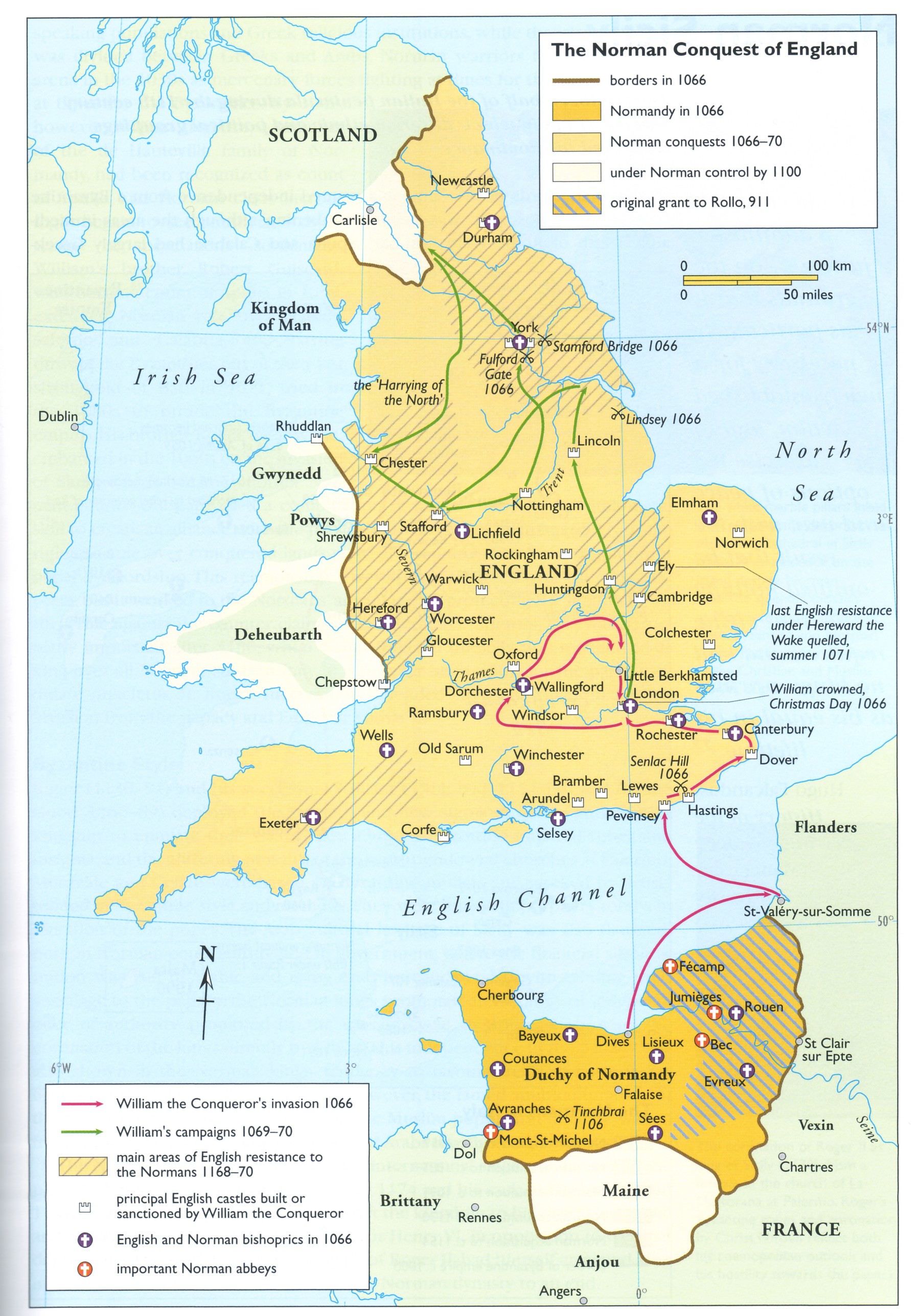
(William The Conqueror's Conquest of England - Source)

William returned to Normandy in 1067 A.D. laden with treasure.  He had already begun granting lands in the south to his followers.  But a delayed reaction set in:  his followers began to usurp land and churches and began building their own residences.  The Normans, unlike the Danes and Norwegians, spoke a language completely unlike Anglo-Saxon, and followed different manners.  A movement began growing to support Harold's son Godwine, who although young and inexperienced had the power of his father's name.  A somewhat disorganized resistance began to grow and burst into flame.  It was centered at Exeter, which was laid siege to and overrun by William.  Harold's sons Godwine, Edmund, and Magnus fled - to the Hiberno-Norse kingdom where their father had fled in 1051 A.D.  Gathering mercenaries, they reinvaded England in the summer of 1068 A.D. with a series of raids along the coast until they were caught in open battle in 1069 A.D. - they escaped, but the bulk of their troops did not.  

This ended the active attempts by Harold's family to regain England; his mother and sister fled to Flanders.  Some of  his sons and one daughter ended up in the court of the Danish King Swein.  We hear nothing of the sons after 1075 A.D. but Harold's daughter Gytha was married to Prince Vladimir, a prince of Smolensk in the land of the Rus.  He, as well as his son Msistislav became Grand Princes of Kiev.  One of Msistslav's daughter's married a Danish noble whose son became the Danish King.  The current royal houses of Denmark and England are descended in part from this line; thus in a way King Harold's legacy lives on.  Another son Harold fled to Norway and disappears around 1098 A.D.; another daughter Gunnhild became a nun until kidnapped and marrying not one but  two earls.

The rebellion which Harold's sons had set off in 1068 A.D. continued to burn into 1070 A.D. especially in the North.  William invaded with brutal force and devastation, so depopulating the North that it had to be re-populated in the 12th Century.  By 1071 A.D when the end of guerilla warfare ended under such men as Herward the Wake, Anglo-Saxon resistance was essentially done.

Among the upper echelons of Anglo-Saxon society, the dissolution was almost complete.  After 1075 A.D. there were no Anglo-Saxon Earls and only a few mid-level authorities such as shire reeves.  Most Anglo-Saxon noble families were dispossessed of their properties, by 1086 A.D. only 5% of land south of the river Tees in Northern England was in the hands of Anglo-Saxons.  By 1086 A.D. no bishopric was held by an Anglo-Saxon, and only a few abbots remained.

In the 1070's, a fleet of 235 ships left England, carrying warriors and families to the Byzantine Empire and Constantinople.  Byzantium is need of warriors and the Anglo-Saxons could fill that need.  The Varangian guard, the elite unit originally formed of Vikings and the Rus (Harald Hardrada had served there) came to be heavily replaced by Anglo-Saxons, where the "axe bearing barbarians" and their descendants loyally served the Byzantines Emperors through at least the Fourth Crusade (1204 A.D.).

A final historical note:  In 1100 A.D., Henry the 1st, Duke William's grandson, married Matilda (Edith), the daughter of Margaret of Scotland and Malcolm III.  Margaret was a daughter of the Athling Edward that had returned to England in 1057 A.D. With this marriage and the children of Henry and Matilda's marriage, the royal house of Wessex in some sense regained the throne of England.

(Old English Posting Page)

Works cited:

Brooke, Christopher:  From Alfred to Henry III 871-1272.  Norton Library:  USA,  1961.

Hollister, C. Warren:  The Making of England 55 B.C. to 1399.  D.C. Heath and Company:  United States,  1976.

Trevelyan, G.M.:  History of England Volume 1:  From the Earliest Times to the Reformation.  Anchor Books:  USA, 1953

Walker, Ian:  Harold:  The Last Anglo-Saxon King.  The History Press;  Gloucester, United Kingdom, 1997

Wikipedia:  Norman Conquest, Varangian Guard

Wednesday, May 24, 2023

Old English, A Historical Background: The Battles of Stamford Bridge and Hastings


(England September - December 1066 A.D. - Source)

When King Harald and Earl Tosti came ashore in September of 1066 A.D., it appears their plan was to first take York as a base (which had Viking roots as you may recall).  Harald's ships would provide the potential to move up and and down the coast at will, far more quickly than King Harold's troops could move on horseback and foot.

The earls of the North, Edwin and Morcar, moved to block Harald and Tosti at the banks of the Ouse River and on 20 September 1006 A.D. fought The Battle of Fulford. The battle, from the records and sagas, was longer than expected but resulted in the victory of the Norwegians and the defeat of the Anglo-Saxons.  King Harald and Earl Tosti moved to take York, gather supplies.

During this time, King Harold gathered an army and quickly began marching north.  We do not have specifics on the number of troops he had or their progress, but Ian Walker hypothesizes that King Harold left London on 16 September, gathering troops as he went and arrived at Tadcaster, 13 miles away from Stamford bridge, where King Harald and Earl Tosti were encamped following resupply in York, on 24 September.  More importantly, they were inland and 13 miles away from their ships.  On 25 September Harold and his troops arrived at Stamford Bridge.

From the records, there is no conclusive estimate of the number of troops the Norwegians had; if there were 300 ships, less attrition from the Battle of Fulford and garrison troops in York and at their ships, there may have been 4,000 Norwegians and possibly the same of Anglo-Saxons.  The Norwegians were caught completely off guard:  in Harald Hardrada's Saga (not an Anglo-Saxon favoring source) they are noted to have left their mail coats at the ships.  They perhaps expected small parties giving hostages; they did not expect an army.

The Saga relates that prior to the battle, a single man rode up to parley with King Harald and Earl Tosti.  He offered Tosti the return of his earldom if he would turn against Harald.  When asked what he would offer Harald, the response was "Seven feet of English ground, as he is taller than other men".  The rider then rode away.  When Harald asked Tosti who the rider was, the response was "King Harold".

The battle then commenced.  There is a legend that a single Norwegian Beserker held the bridge against 40 men until finally someone floated down the river and stabbed him with a spear from underneath (it may be a later addition).  The Anglo-Saxon charged across the bridge to where the Norwegians had formed a shield wall.  The battle was hard; by the end of it King Harald and Earl Tosti were dead and their troops pursued back to their ships.  King Harold offered generous terms of peace; of 300 ships that came, only 20-25 returned.

Although no-one knew it at the time, this effectively drew an end to the Viking age.  There would still be Norwegian attacks of England and Scotland, but these would be kingdom against kingdom, not freebooters and mercenaries.

Two days later, late 27 September, the winds turned and Duke William of Normandy crossed the channel and arrived on 28 September.  

He immediately began building a fort at Pevensey and spent the next 17 days fortifying and strengthening his position.  He was helped in the fact that King Harold was in the north fighting the Norwegians; had he remained in London (and on watch as Harold knew of the invasion fleet), he would have likely not had the luxury of over two weeks to consolidate his position.

It seems King Harold was notified on 29 or 30 September in York of Duke William's landing.  He then started south, bringing with him the remnants of his Stamford host as well as calling up more troops as he headed South.  By 8 or 9 October he was back in London, where he spent three days.

His time in London is one of the great "What Ifs" of history:  Some historians argue that Harold had no reason to wait that short a time and that had he waited longer, he would have had a larger army.  Others argue that he waited longer, the chances were that Duke William would further entrench himself and had the possibility to gather even more troops and expand his territory.  

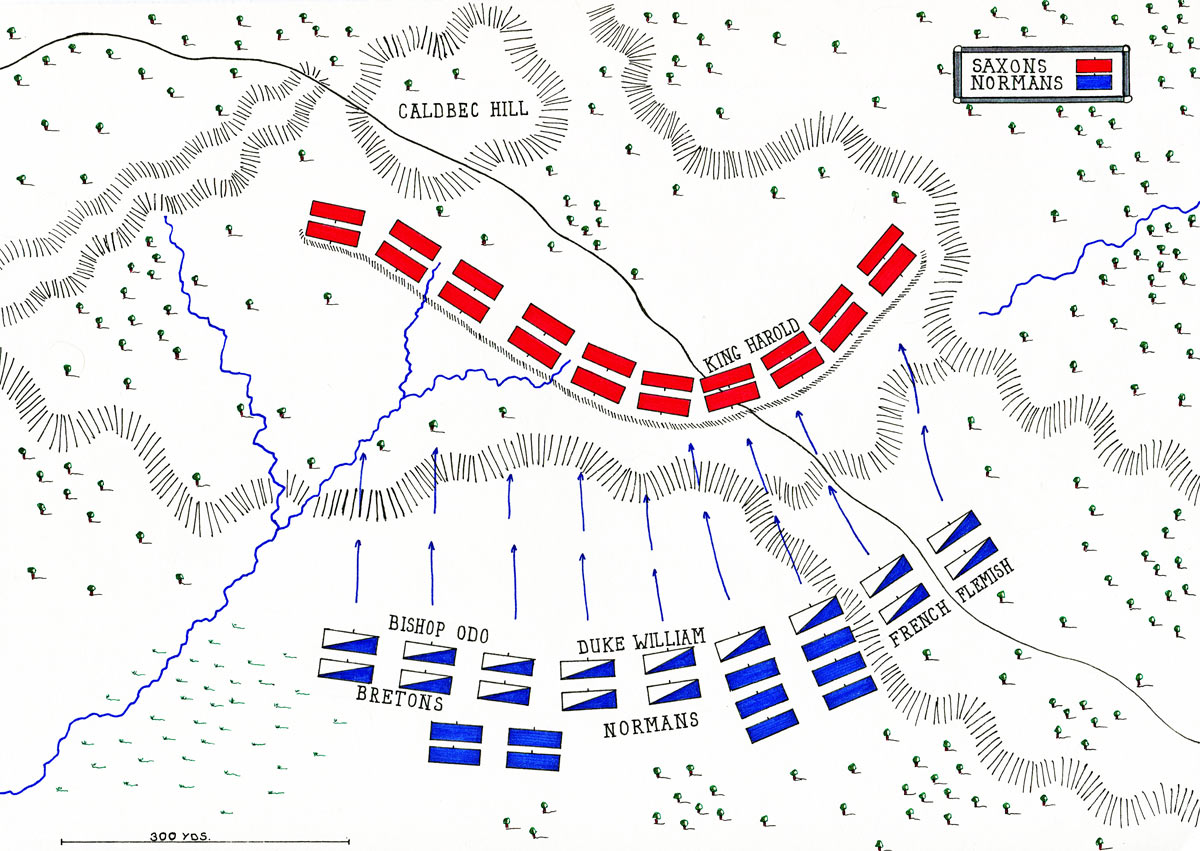
On 13 October 1066 A.D. King Harold and his army emerged in Sussex at Hastings.  Messages were undoubtedly exchanged:  Duke William calling on King Harold to honor his oath, King Harold calling on Duke William to return back to Normandy.  Neither side budged and on 14 October 1066 A.D., battle was joined at or around 9 A.M.


(The Battle of Hastings, 14 October 1066 A.D. - Source)

Looking back of course, it is easy enough to say that the end was foreordained.  That was not clear on the day of battle;  the Normans were thrown back on their initial charge. Their left wing broke and a rout almost occurred when a rumor went out that Duke William had been slain.  He re-appeared and rallied his troops.  English losses were also heavy.  By afternoon, the English still held their lines and the ridge and it appeared that if nothing changed, Duke William would likely be defeated.

And then - from the Bayeux Tapestry, it is recorded nowhere else - an arrow pierced the eye of King Harold.  

The Anglo-Saxons broke quickly after this and were routed and ridden down by the advancing Normans.  The body of King Harold lay surrounded by his huscarls  and his brothers Gyrth and Leofwine.

Ian Walker describes the outcome:

"Thus the battle reached its fatal climax for King Harold, but as we have seen, it had been a very close run thing.  The fact that King Harold did not seize the opportunity offered by the collapse of the Norman left wing and the rumor of William's death has puzzled many.  However, we should remember the conditions of his army.  A basically cautious man like Harold would be unlikely to take unnecessary risks by advancing from a position where all he really needed to do was stand his ground and force William into submission.  If he had held the field at the end of the day, William would have been finished, and he almost succeeded in this, falling just before nightfall.  That he ultimately failed was largely because of the fortune of war, and the evidence suggests that it was King Harold's fall to a chance arrow which finally broke English resistance and left the field to the Normans.  We must remember that what in hindsight was to prove such a decisive defeat for the English, was in fact balanced on a knife's edge throughout the day."

(Old English Posting Page)

Works cited:

Brooke, Christopher:  From Alfred to Henry III 871-1272.  Norton Library:  USA,  1961.

Hollister, C. Warren:  The Making of England 55 B.C. to 1399.  D.C. Heath and Company:  United States,  1976.

Trevelyan, G.M.:  History of England Volume 1:  From the Earliest Times to the Reformation.  Anchor Books:  USA, 1953

Walker, Ian:  Harold:  The Last Anglo-Saxon King.  The History Press;  Gloucester, United Kingdom, 1997

Wikipedia:  Harald HardradaBattle of Stamford Bridge, Battle of Hastings

Wednesday, May 17, 2023

Old English, A Historical Background: Harold Godwinson, King of England

 Upon his accession of King of England after 05 January 1066 A.D., Harold Godwinson found himself simultaneously at the height of power and the height of risk.

As a king, he was likely the logical choice for the Anglo-Saxon nobility:  for 21 years he had served Edward the Confessor. He was a demonstrated victorious general on land and sea.  He was a skilled negotiator.  His family was one of the most powerful in England, now holding four of six earldoms.  The fact that there were no known revolts against Harold during his reign suggests that from the nobility and the common folk, all accepted the fact that the throne was not retained by the house of Wessex.

We do not know a great deal about the reign of Harold, largely because his time on the throne was brief - in fact, generally the history books I have seen dedicate almost no time to him.  We have single verified document (Writ) from his reign.  From all records, he essentially continued the policies and advisors of Edward and there was little, if any, change in his reign.  

The issues he faced largely came from outside.  In April of 1066 A.D. his brother, the former Earl Tosti, returned with a fleet supported by his brother in law, the Count of Flanders.  He was, perhaps, trying to recreate the invasion of Godwine in 1051 but met with much less successful results; the people did not rally to him and King Harold raised a fleet to harry him.  Tosti fled to his former earldom of Northumbria where, defeated again, he headed for Scotland and then for parts North.

But the invasion of Tosti was a warning sign to King Harold.  If Tosti could cross, others could as well. 

Yet there was risk.  One, as have already discussed, was that Duke William of Normandy laid claim to the throne and, whether by made ups story or actual fact, used it to force Harold to swear that he would support William as King of England.  The fact that Duke William was working to assemble an invasion force did not go by the spies of King Harold, and he took steps to raise an army, strengthen his navy, and prepare to defend against a potential Norman invasion.

Duke William's ability to conduct the invasion was less definitive than it seems in hindsight.  He had to get the support of his barons, supply a fleet, and then sail across the English Channel.  His fleet was likely made ready in mid July 1066 A.D., but contrary winds kept him on the French Coast into August and September.

The other was Harald Hardrada.

Harald Hardrada (or Harald Sigurdson, or Harald III) had led an almost exemplary Viking life to this point.  He and his half-brother, Olaf Haraldson (St. Olaf) had been defeated in 1030 A.D. in an attempt to regain the Norwegian Throne.  Olaf died; Harald went into exile, serving as a mercenary leader among the Kievan Rus (The Viking/Slavs of the East) and eventually becoming commander of the Varangian guard.  He served throughout the Empire, from the Mediterranean to the Holy Land to the Black Sea.  He returned to Norway in 1042 where he negotiated a joint rule with his nephew, Magnus the Good (Magnus had replaced Canute's son Svein as ruler of Norway). Magnus died the next year and Harald became sole king of Norway, which he ruled into 1066 A.D.  It was at this point Tosti, Earl Godwin's son and King Harold's brother, arrived in Norway and suggested to the King that he invade England.  It was a claim that Harald had been pursuing himself, as he considered himself heir to Hardecanute, the last Danish King of England.

King Harold was forced to release the bulk of his army and navy on 8 September, as they had reached the limit of the time of their required service. The fleet sailed back to London, and the army returned to their homes.

The timing could not have been worse:  on 8 September 1066 A.D., King Harald Hardrada and Earl Tosti joined forces at the mouth of the Tyne river in Northeastern England. King Harald brought 300 ships, Tosti 12.  

The re-invasion of Anglo-Saxon England had begun.

(Old English Posting Page

Works cited:

Brooke, Christopher:  From Alfred to Henry III 871-1272.  Norton Library:  USA,  1961.

Hollister, C. Warren:  The Making of England 55 B.C. to 1399.  D.C. Heath and Company:  United States,  1976.

Trevelyan, G.M.:  History of England Volume 1:  From the Earliest Times to the Reformation.  Anchor Books:  USA, 1953

Walker, Ian:  Harold:  The Last Anglo-Saxon King.  The History Press;  Glouster, United Kingdom, 1997

Wikipedia:  Harald Hardrada

Wednesday, May 10, 2023

Old English, A Historical Background: Edward The Confessor And Earl Harold Godwinson

 When King Edward ascended the English throne in 1042 A.D, he was in a weak position.  His dynasty, the House of Wessex, had been out of power for the previous 26 years, superseded by Canute and his sons.  He himself came to the English throne having spent most of his life in Normandy among Normans and Norman clergymen; it is more than likely he spoke Norman French more readily that Anglo-Saxon.

Additionally, Edward commanded no inherent base of power in England; he was heavily reliant on the earls of England, Godwin Earl of Wessex among them.  It was Godwin that had brought Edward's name forward as King; it was Godwin who supplied his daughter Edith as Edward's wife.  But Godwin - and all of the earls -were also jealous of their own administrative authority within their fiefdoms; a powerful king did nothing to advance that agenda.

As Edward moved into power, he began to outlaw and dismiss men put in place by Canute and his sons and recruited Normans into his retinue as well as into some higher clergy; this was not surprising as to Edward, these men would have represented trustworthy men to the king - and an alternate power base.

In 1046 A.D. Earl Godwin's eldest son, Swein, was outlawed for kidnapping an Abbess and keeping her for a year.  Swein ended up in Denmark, but returned in 1048 A.D. only to be driven off again.  Earl Godwine continued to pressure the King for the return of his son, even after Swein had killed his own cousin (1048 A.D.).  The continued pressure of Godwin for his son's return, compounded by the appearance of control by Godwin and his sons of a fleet to protect England from German raiders and the fact that Edward's marriage with Edith was proving to be barren, provoked Edward into action.  In 1051 A.D. Godwin and his sons were outlawed, their lands taken from them, and his wife Edith was to be divorced.

Godwin and his sons fled:  Godwin to Bruges, France, Harold and his brothers to Dublin in Viking Ireland.  Both father and sons began recruiting a mercenary army.  They re-invaded in 1051 A.D., first as small piracy raids, then sailing up the Thames through London.  Edward's lack of support was revealed and he was forced to negotiate.  Godwin was restored to power and he and his family to his lands and Edith was restored to her position as queen; some of the more odious Norman bishops fled, eventually back to Normandy, taking with them Godwin's  which had been offered as hostages for their good behavior.  All was as it had been before the outlawing, with one exception: the inability of Edward to enforce his will and the power of Godwin and his sons was apparent.

Godwin did not long outlive this victory and died in 1052 A.D, as his did his eldest son (and bone of contention) Swein.  Harold Godwinson ascended to the title of Earl of Essex - at Edward's decision; Edward and Harald did not have the contentious relationship of Edward and Godwin.  The service of Harold and his family during this time, as far the records show, were what was to be expected between sovereign and earl. 

In the mid-1050's, with the issue of the childless marriage at hand, Edward came up with what was perhaps a novel idea for an heir,  A member of the royal house - an athling - remained alive:  Edward the son of Edmund Ironsides.  He had been exiled when Hardecanute had become king and had - at least to England - been lost to knowledge. It now appeared that he as located in the Kingdom of Hungary. In 1056, a retinue - seemingly including Harold Godwinson - was sent to Hungary to retrieve the future king.  It was a task that would have required great diplomatic skill as the party had to make its way across the Channel to the Holy Roman Empire, then to Hungary, then back to England.  This, the party accomplished - all to have Edward die in 1057 A.D. shortly after his arrival.

By 1062 A.D. the power of the Godwinsons' was at its height;  they controlled five of the six earldoms of England. Harold led an invasion of Wales in 1062 which successfully ended in the head of Gruffydd King of all Wales being delivered to Harold, who sent it on to King Edward.  Harold demonstrated tactical ingenuity, using a fleet to invade Wales and then drive the Welsh into the mountains, denying them the countryside (a strategy to be used successful by Edward I in his conquest of Wales).

In 1064 A.D, for reasons which now remain unclear, Earl Harold sailed to Normandy. It is unclear why he sailed to Normandy; history is largely silent and Norman sources (given following events) are highly unreliable.  It is possible the trip was simply a rescue mission to plead for his brother and cousin; it is possible he was just "blown off course".  No matter what happened, he was captured and transferred to William, Duke of Normandy.  The Duke feted Harald; they undertook a campaign together in Brittany.  Upon their return, William revealed that he wished for Harald to support his claim as King of England upon the death of Edward the Confessor.

Where could William, a man only distantly related to Edward, get such an idea?  Historians guess that one of the fleeing bishops in 1051, Robert of Jumieges, came to the King with a story of Edward's wish to make him his heir. Whether this was real or just a story spread by a bitter man who had to flee the country, William chose this opportunity to use it to his advantage.

Harold, faced with the choice of imprisonment and possible death, swore the oath in a cathedral on holy relics, an oath that was considered binding in Medieval European and Catholic eyes.  Possibly he was offered to retain his position as Earl of Wessex and marry William's daughter; he was given gifts and his nephew Hakon and released to England, burdened with an oath.

Harold returned to England, now clearly understanding that William of Normandy intended to claim the throne of England.

The last two years of Edward's reign  became complicated.  Northumbria in 1065 A.D. rose in revolt against Tosti, Earl of Northumbria and Harald's brother, due to a tax increase.  The rebels rose up, ravaging their way South until they were met by Earl Harold.  A civil war seemed possible, King Edward and Queen Edith and Earl Tosti against the thegns and men of Northumbria.  Harold came down in his negotiations on the side of the rebels and against his brother; Tosti fled to Flanders and the old laws under King Canute were restored.

But time was running out for King Edward.  His health began to fail in late 1065 and it appeared likely that he did not have much longer.  Edward Athling's son Edgar was alive, but too young to become king. As the Christmas court came into being, the King, the Queen, the bishops and archbishops, and the great nobles of the realm were present.  If Edgar was too young to be king and William was undesirable, only two other potential claimants remained.  One was with them in court and there is no doubt that Harald Godwinson lobbied all heavily on his own behalf.

On 05 January 1066 A.D., Edward the Confessor died.  As he lay dying, he transferred the kingship to Harald Godwinson.

(Author's note:  I would not have been able to provide near the detail about Earl Godwin, Earl Harold, and the Godwin sons without Ian Walker's book Harold:  The Last Anglo-Saxon King.  It focuses on this period and these people in a way other works I consulted did not.)

(Old English Posting Page)

Works cited:

Brooke, Christopher:  From Alfred to Henry III 871-1272.  Norton Library:  USA,  1961.

Hollister, C. Warren:  The Making of England 55 B.C. to 1399.  D.C. Heath and Company:  United States,  1976.

Trevelyan, G.M.:  History of England Volume 1:  From the Earliest Times to the Reformation.  Anchor Books:  USA, 1953

Walker, Ian:  Harold:  The Last Anglo-Saxon King.  The History Press;  Glouster, United Kingdom, 1997

Wednesday, May 03, 2023

Old English, A Historical Background: Normandy, Edward The Confessor, And The Earls of Essex

 To move forward in the history of Anglo-Saxon England, we have to move backwards a bit in time and a little South and East in geography.  To Normandy.

Normandy, as you might vaguely recall from your history, was a territory that belonged to the Frankish Empire and was settled by Vikings under Rollo (The viking, not Rolo the caramel filled candy).  The actual story, of course, is a bit more complicated.

Rollo (Old Norse Hrolfer) was the leader of a group Vikings that raided not to the West and Britain but to the South the Kingdom of West Francia.  He is associated with a raid on Paris in 885 A.D. and remained apparently successfully there, having secured territory (with other Viking settlers) in the areas of the lower Seine Valley in what is now France.  In 911 A.D the King of West Francia, Charles III ("Charles the Simple") signed a treaty with Rollo, granting him the lands of the old church boundaries of Rouen in return for fealty to the Frankish King (on Charles' part, quite possibly trying to end the raids by effectively buying Rollo out).  The new territory was called Normandy from origins of the now settled peoples (Northmen).

Rollo and his now ex-Vikings were successful in their new province:  by 922 A.D. they had achieved supremacy over the other Viking settlements in the Seine valley.  Rouen, the capital, became a trading port for Scandinavia and the Viking territories, including the Danish parts of England.  The Old Norse they spoke was largely abandoned in favor of the Gallo-Roman French of its inhabitants (but with the addition of Old Norse words not otherwise present).  By 996 A.D. Normandy was French speaking, Catholic, and busily working on expanding its territory.  It also, as you may recall, continued to be associated with Viking raids in England, resulting in a treaty between Normandy and England in 991 A.D.

Familial links between the two geographies came as well.  In 1002 Æthelred Unræd King of England married the Duke of Nomandy's daughter Emma.  They had two sons, Edward (The Confessor), and Alfred.  Upon Swein Forkbeard's conquest of England in 1013, Emma and her two sons fled back to Normandy.  Edward and possible Alfred returned upon Æthelred's restoration in 1016, but then fled again upon the death of Æthelred and his son Edmund Ironsides.  Emma, as you may recall, then married King Canute and bore him Hardecanute (and a daughter, Gunhilda).  

Edward remained in exile in Normandy throughout the reign of Canute, Harald Harefoot, and Harecanute.  He and his brother attempted a return in 1036; his brother Alfred was captured by Earl Godwine of Essex and blinded, resulting directly (or indirectly) in his death.  Edward returned back to Normandy, seemingly consigned to a life of waiting.

Meanwhile, in England...

In 1009 A.D. Wulfnoth cild, a thegn of Essex, was exiled by Æthelred Unræd.  Wulfnoth had a son, Godwine, who stayed in England to try and rebuild the family's fortunes.  In this he was successful, regaining the lands of his father and expanding them.  He supported Æthelred's son Edmund Ironsides and, somehow, upon the accession of Canute in 1016 as King of England, became one of the few Anglo-Saxons to not be purged by King Canute.  In fact, he was raised to the status of an earl.  In the earl 1020's he was raised to Earl of Wessex and married Gytha, King Canute's sister in law.  He served Canute loyally during his reign and in 1035 A.D. declared Hardecanute against those that declared for Harald Harefoot. It is possible that Godwine's capture and blinding of Alfred was to gain the favor Harald Harefoot (which, apparently, it did).  When Harald died in 1040 A.D. and Hardecanute came back to power, Godwine managed to survive the power transfer (again).

In 1041 A.D. Hardecanute invited Edward back to the kingdom, possibly to share the rule and perhaps bolster his popularity with the Anglo-Saxon community.  Before this could be truly put into place Hardecanute died.  It is said that Godwine, Earl of Wessex, led the call for Edward to ascend to throne and thus, in 1042 A.D., Edward Æthelred's son, exile, became King of England.

Undoubtedly at the accession of King Edward, his children were present, among them his second son who was around 20 years old at the time.  His given name was Harold; history would know him as Harold Godwinson, the last Anglo-Saxon King of England

(Old English Posting Page)

Works cited:

Brooke, Christopher:  From Alfred to Henry III 871-1272.  Norton Library:  USA,  1961.

Hollister, C. Warren:  The Making of England 55 B.C. to 1399.  D.C. Heath and Company:  United States,  1976.

Nictolle, David:  The Normans.  Osprey Publishing:  Hong Kong, 1987.

Trevelyan, G.M.:  History of England Volume 1:  From the Earliest Times to the Reformation.  Anchor Books:  USA, 1953

Walker, Ian:  Harold:  The Last Anglo-Saxon King.  The History Press;  Glouster, United Kingdom, 1997

Wednesday, April 26, 2023

Old English, A Historical Background: Harald Harefoot and Hardecanute

After the death of King Canute in 1035, Anglo Saxon history falls into a bit of an odd tranche.  The North Sea Empire was really the creation of a single man who was in some ways unique:  a strong personality, no imminent rivals, and the ability to manage multiple groups to his benefit (so for example, Canute's ending of the Viking raids).  Had Canute lived longer, or perhaps had a single strong heir, things might have been different.

To be fair, the collapse had already started prior to his death.  His designated heir in Norway, Swein was first forced to leave the-then capital in 1033 and Norway itself in 1035 and Magnus Olafsson (Magnus the Good) returned. Swein died shortly after his return.

His heir in Denmark, Hardecanute (or Harthacnut), was forced to remain in Denmark for three years in fear of a potential invasion by the now-restored Magnus.  The Anglo-Saxon council, the witan, decided that a regent in place of King Hardecanute was in order and so Harald Harefoot was named as regent.  But the decision was not totally supported, and so Harald became King with the support of Earl Leofric of the Northern half of England North of the Thames; Earl Godwin held the south in the name of Hardecanute supporting the claims of Emma of Normandy, Canute's second wife and mother of Edward and Alfred from her previous marriage to Anglo-Saxon King Æthelred. in 1037 A.D., Godwin was forced to concde and Harald crowned as king.

It was also during this time that Alfred and Edward returned from their exile in Normandy. It is unclear if the return was a visit to their mother or an attempted uprising; in either case it was not successful, and perhaps showed that the ascendancy of the Anglo-Danish nobility was fully in support of the house of Canute and against the house of Wessex.   Alfred was captured by Earl Godwin and given to supporters of King Harald, who transported him to the city of Ely. During this transfer, Alfred was blinded and then died soon thereafter. This death created a rift between Edward and Godwine, a rift that would continue to blossom in the years ahead.   

Hardecanute had not taken this lying down and was apparently preparing an invasion until hearing from his mother, Emma, that his half-brother was in ill health in 1039 A.D.  In 1040 A.D. Harald Harefoot died and Hardecanute became King of Anglo-Saxon England.

Hardecanute arrived as a potential invader in 1040 A.D. (taking no chances although he expected to become king); the crews had to be bought off (again) with a Danegeld of 21,000 lbs of silver and gold. Apparently as one of his first acts (and horrified, at least publicly, at the death of Alfred), he put Harald on trial, exhumed his body, and then had it beheaded.  Queen Emma also demanded that Godwine be brought to trial:  arguing he was forced to follow orders of Harald, he escaped punishment (along, as it turns out, with a healthy bribe to the King in the form of a ship).

Hardecanute, upon his arrival, attempted to rule as he had in Denmark:  autocratically. This did not work well with the evolved Anglo-Saxon way of kingship, where the king consulted the witan and the great nobles of the realm.  He was equally unpopular by the fact that he increased taxes to support a fleet to protect other parts of his realm, including destroying the town of Worcester after townsfolks killed two of his tax collectors. 

Apparently he, too, could see his death coming, and so in 1041 A.D., perhaps under the influence of his mother Emma, invited his exiled half brother Edward back, most likely as his heir.  

In an interesting side note, Hardecanute's death was somewhat spectacular.  In 1042 A.D., while at the wedding of his standard bearer, the King "Consumed great amounts of alcohol" and, as drinking to health of the bride, "died as he stood at his drink, and suddenly fell to the earth with an awful convulsion; and those close by took hold of him, and he spoke no word afterwards".  Likely, it seems, a stroke.

The House Of Wessex had returned.

(Link to previous works)

Works cited:

Brooke, Christopher:  From Alfred to Henry III 871-1272.  Norton Library:  USA,  1961.

Trevelyan, G.M.:  History of England Volume 1:  From the Earliest Times to the Reformation.  Anchor Books:  USA, 1953

Hollister, C. Warren:  The Making of England 55 B.C. to 1399.  D.C. Heath and Company:  United States,  1976.

Wednesday, April 19, 2023

Old English, A Historical Background: King Canute And The North Sea Empire

Canute (Cnut in Old Norse or Canute Cyning in Anglo Saxon), was the sort of man that - like Alfred the Great - comes along once in in a generation. Medieval historian Norman Cantor has referred to him as "the most effective king in Anglo-Saxon England" - ironic in that he himself was not Anglo-Saxon at all.

Canute inherited inherited Anglo-Saxon England from his father upon the his death in 1014 A.D.; driven out  supporters of King Æthelred, he returned in 1015 A.D. and upon the death of Æthelred, continued the struggle with Æthelred's son Edward Ironsides, supported by his older brother King Harald of Demark and variety of troops including Danes, Poles, Swedes, and Norwegians.  Likely this army was composed largely of mercenaries - not coming to settle, but to conquer and get well paid for it.

The campaign climaxed in the Battle of Assandun in 18 October 1016 A.D., where the Anglo-Saxons were defeated when a key leader left the Anglo-Saxon side at a critical moment, causing defeat.  Canute, still apparently respecting Edmund's battle prowess (or perhaps still concerned about his position) signed a treaty with Edmund separating England between them, Canute hold all land north of the Thames, Edmund the land south of it.  Could there have been another period like that of Alfred the Great, where Wessex would again reconquer all of England?  We will never know, because a month later Edmund died.  Canute became the sole ruler of England and was crowned as such in 1017 A.D.

To tighten his control, Canute executed or drove off any remaining members of the house of Wessex and married Emma of Normandy, the widow of Æthelred.  In 1018 he gathered the colossal sum of 82,500 pounds of gold and silver as a Danegeld to pay off most of his fleet and send them home, leaving himself a small (40 ship fleet) - with this, the Viking threat to England was almost completed abated and the country in a position to enjoy peace and prosperity as it had not since the earliest days of Æthelred.  He also reorganized the administrative rule of England:  Ealdormen were replaced by Earl (Anglo-Saxon earl) and the territories made larger:

(Earldoms of England circa 1025.  Source)

In 1018 A.D. Canute's brother King Harald of Denmark died and Canute returned to Denmark in 1019 A.D. to claim his throne.  He took with him some of his Anglo-Saxon subjects: one, an earl named Godwine, earned the king's favor by leading an attack on the Wends.  Godwine we will also see again, as will we see his son, Harold, the future king.

His kingdom secured in 1020 A.D., Canute returned to England to rule, but spent time between the two states, overwintering in one or the other and leaving his representatives (the earls in England or the jarls in Denmark) to manage affairs.  In 1026 A.D. the then current kings of Norway and Sweden, Olaf Haraldsson and Anund Jakob, launched attacks against Denmark.  Canute responded and in 1027 defeated both at the Battle of the Helgea. Canute was now the pre-eminent king in the Norse world.

(Lands ruled by Canute the Great - Source)

In 1027 A.D., Canute was invited to attend the accession of the Holy Roman Emperor Conrad the II in Rome.  This was a triumphal trip for Canute as he was now recognized among the greatest kings of Europe.  He met with the pope and negotiated down the cost of a bishopric, complained about the tolls levied of pilgrims, and hit it off with the Emperor - so much so, that the Emperor granted him a strip of land that for years had been contested between the two powers. 

In 1028 A.D., fresh off his success at Rome, Canute invaded Norway, causing the then current king Olaf Haraldsson to flee . Crowned the same year, he now claimed himself as King of England, Denmark, Norway, and part of Sweden.  Unfortunately for Canute his conquest of Norway was not as successful as his conquest of England: plagued by the unexpected death of the jarl designated to managed the kingdom in his absence, his attempts to rule through his wife and older son did not yield the same results as England.  


(North Sea Empire.  Red are lands ruled by Canute, Orange are vassal sates, Yellow are Allied states.  Source)

Canute struggled in his relationship with the Church:  A baptized Christian and supporter of the church (He built a church at the site of his victory at Assandun), he also killed a rather large number of people (including, by indirect command, his brother-in-law).  His marriage to Emma of Normandy was his second marriage; he never divorced his first wife Ælfgifu but rather kept her on an estate in England (until he sent her and his son to Norway).  

Canute - at least for Anglo-Saxon England - should be adjudged a good king.  He kept the peace and the Vikings away.  He supported the hundred courts and the laws and richly endowed the Church.  Under his rule, trade with the North Sea flourished.  He also gave rise to the class of warriors known as Housecarls, a warrior caste with their own courts and brotherhood and regulations who served the King and his successors as bodyguards.

Canute's death in 1035 (12 November) passed the North Sea Empire onto his sons (whom we will visit with next week).  As a preview, neither of them could keep the Empire together and by 1042 A.D. all the countries controlled by Canute had reverted to individual rulers.  The North Sea Empire was an ephemeral thing, the realm of a single individual through the force of his personality.

The historian in me wonders: what if?  Canute died at a relatively young age of 45; what if he had been able to make it to 50 as did Alfred the Great or even longer?  What if his designated lieutenant in Norway had not died in 1030 A.D. but had lived, even for those five years he was still alive?  Surely Norway could have been more directly and better managed (The Norwegian had actually killed Olaf Haraldsson when he tried to return in 1030 A.D.; the re-establishment of his dynasty under Magnus the Good in in 1037 A.D. may have been more of a reaction to Swein Canuteson's rule).  What if his dynasty had lasted more than 10 years and his daughter Cunigund had married the Holy Roman Emperor Conrad II and become Empress instead of dying?  History might have been very different indeed and the locus of power would have shifted in ways I cannot even imagine.

(Old English Posting Page)

Works cited:

Brooke, Christopher:  From Alfred to Henry III 871-1272.  Norton Library:  USA,  1961.

Trevelyan, G.M.:  History of England Volume 1:  From the Earliest Times to the Reformation.  Anchor Books:  USA, 1953

Hollister, C. Warren:  The Making of England 55 B.C. to 1399.  D.C. Heath and Company:  United States,  1976.

Wikipedia:  Cnut, North Sea Empire

Wednesday, April 12, 2023

Old English, A Historical Background: Æthelred Unræd and Vikings III.0

 Of all the the Anglo-Saxon Kings of England, a few may have heard of Alfred the Great, perhaps even a few might remember King Harald, who lost to William of Normandy.  But perhaps the most "famous" is the one with the unfortunate sobriquet Ethelred the Unready (Æthelred Unræd)

"Unready" is a misunderstanding of the actual term "Unræd", which means not "unready" but rather "ill-advised - his name Æthelred meaning "well advised".

Æthelred's story actually begins with the death of his father, Edgar, in 975 A.D.  Edgar had two sons, Edward and Æthelred.  Edward, Æthelred's half brother  was elevated to the kingship in a contested succession (Æthelred  being only 7 years old at the time of his father's death).  We do not know a great deal of his reign:  there was an anti-clerical reaction and only a few charters issued.  In fact, the thing we know most about the Edward is his murder.

Like all really good historical murders, we do not know a great deal.  We know it near Corfe Castle on the evening of 18 March 978 A.D.  We know that he was buried without ceremony - and it is written that when his body was exhumed a year later, it was noted to be uncorrupted and Edward became Saint Edward the Martyr (a saint, although never formally canonized).  What we do not know is who performed the act or why it was performed.

Blame, for better or worse, fell up on the remaining son of Edgar, Æthelred, who was now 10 years old.  Whether done at his instigation or on his behalf or perhaps just a beneficiary of events, his reign started on an unfortunate note.

What made it more unfortunate was the return of the Vikings.

In 980 A.D., the Danes were back - first a small series of raids from 980 to 982 A.D., then larger ones in 988 and 991 A.D.  The raids themselves were not devastating in the way the Great Heathen Army of the last century had been, but they did introduce one interesting and previously unknown relationship:  It was said that the Vikings sheltered in Normandy upon their return from England - perhaps not surprising, as this was still within 100 years of the Normans having gone a-viking themselves.  It created enough of an issue that the current pope of the time, John XV, engineered a peace treaty between England and Normandy (Treaty of Rouen, 991 A.D.).

Normandy.  That might be a name that comes up later....

After the raid of 994 A.D., Æthelred came up with a familiar (to us) policy:  The Danegeld, or payment for peace.  22,000 pounds of gold and silver were paid to relieve England from the attacks. That worked...until three years later, when the raids began again: 997, 998, 999 A.D. - the Danes returned, then left in 1000 A.D. (leaving time for Æthelred to attack Scotland) before returning in 1001 A.D and receiving 24,000 pounds of gold and silver in 1002 A.D. to depart.  

Æthelred's solution to the issue?  Call for a massacre of all men of Danish descent on the Day of St. Brice (13 November 1002 A.D.).  Obviously not everywhere was strong enough to kill Danish-descended men (or wanted too), but some locations did.  One location, as it so happened, executed Gunhilde, the sister of King Sweyn Forkbeard of Denmark (son of Harald Bluetooth, whom he revolted against, and for whom the runic letters of his name are used in the Bluetooth symbol).

Sweyn did not take this well.

Sweyn invaded in 1004 and left in 1005 A.D. after a tactical defeat, but the Danes returned in 1007 A.D. and were bought off with 36,000 pounds of gold and silver.  They returned again in 1009 A.D. under Thorkell the Tall and harried England until 1012 A.D, when they were bought off with 48,000 pounds of gold and silver.

The next year, Sweyn Forkbeard invaded England with the intent to conquer it - which he did in 1013 A.D.  Æthelred and his family were forced into exile in Normandy - but then in 1014 A.D. Sweyn Forkbeard died, and Æthelred returned to England, where - with exception of parts of Lincolnshire - he successful reconquered the country.  Swein's son, Canute, now whose older brother was now King of Denmark retreated - but then returned in 1015 A.D. to find the country at war with itself:  Æthelred's son, Edmund "Ironside", had revolted against his father and claimed power in the Midlands and North, who remembered Æthelred's re-invasion following his return.  Canute rolled in and then began the Danish reconquest of England all over again, undoubtedly assisted by a memory of the Anglo-Danish nobility and commoners of the St. Brice Day Massacre.

Æthelred died in April of 1016; his son Edmund began king and continued to battle against the Danes until the Battle of Assandun in October of 1016 A.D.  It was a strong victory for Canute but, apparently in respect of Edmund's reputation as warrior, he split the country: Canute would hold all of the country beyond the Thames, Edmund would hold Wessex.  The agreement barely lasted a month:  Edmund died on 30 November 1016 A.D. and the whole of the country passed to Canute.

England, in the first time in her history since the retreat of Rome, had become a part of a larger empire.

One final note on Æthelred:  in 1002 A.D. his first wife Ælgifu died.  The king remarried - to Emma of Normandy.  Her brother was Richard the II of Normandy, whose grandson  William of Normandy we will meet soon enough.

(Old English Posting Page)

Works cited:

Brooke, Christopher:  From Alfred to Henry III 871-1272.  Norton Library:  USA,  1961.

Trevelyan, G.M.:  History of England Volume 1:  From the Earliest Times to the Reformation.  Anchor Books:  USA, 1953

Hollister, C. Warren:  The Making of England 55 B.C. to 1399.  D.C. Heath and Company:  United States,  1976.

Wikipedia:  Edward the Martyr, Athelred the Unready, Sweyn Forkbeard, Harald Bluetooth

Wednesday, April 05, 2023

Old English, A Historical Background: Conquest of York And Peace

Upon the death of Æthelstan (ruled 929 - 939 A.D.), power passed first to his brother Edmund (ruled 939-945 A.D.) and then to his other brother Eadred (ruled 945-955 A.D.).  Their time was spent largely working both to consolidate their control of the Dane law as well as trying to conquer - or reconquer - the Norse Kingdom of York (Old Norse:  Jarvik). Twice during the reign of Eadred it was briefly reconquered and twice it was retaken by the Norse ( by the renowned former King of Norway Eirik Haraldsson, more charmingly known as Eirik Bloodaxe) until in 954 A.D., Eirik was expelled (read "killed") and the kingdom of York incorporated into Anglo-Saxon England.  Eadred himself died a year later, king of "all England".

(Britain 900 - 950 A.D.  Source)

Rule of Anglo-Saxon England then passed to the son's of Eadred's brother Edmund's sons, who were both minors at his death.  The first Eadwig, was likely 15 years old at the time of his accession and reigned only four years (ruled 955 - 959 A.D.) in total, two of those having to split the kingdom with his brother Edgar along the line of the Thames.  The verdict on Eadwig as a king remains a matter of discussion: the records of his reign are not conclusive and a likely quarrel with the church hierarchy may have giving him the proverbial "bad press".   Upon Eadwig's death, his brother Edgar became sole ruler.

Edgar (ruled 959 - 975 A.D.) has come down to us in history as "Edgar the Peaceable".  Edgar himself is a bit of a mystery to us, as we have so very little information about him:  there are only 10 entries related to him during his reign in the Anglo-Saxon Chronicle.

Why was he the Peaceable?  Part of it was an accident of history:  the Viking raids and interventions that had been a part of the preceding 100 years did not occur during reign (although quite likely having little enough to do with Edgar himself).  He promulgated two revisions of the law codes, focused more on execution of the law than administrative and recognizing the different legal practices of the former kingdom of York (keep in mind the Danelaw had its own recognition as well).  He reformed coinage.  But his largest contribution to Anglo-Saxon England was supporting church reform, moving the Anglo-Saxon church from a secular clergy to that of a monastic clergy, largely that of the Rule of St. Benedict (The Benedictines).  The movement also sought to vigorously reform the existing monasteries.  He also continued the work of Alfred the Great in terms of supporting writing and literature; in some ways his reign is considered the height of Anglo-Saxon literature, art, and culture. And while there were no Viking invasions and only a few conflicts with neighbors to the North and West, the fleet started by Alfred the Great had grown into what was referred to as a powerful navy under Edgar.

(One historical note of interest:  It is recorded in 973 A.D. that 8 "kings" of Britain submitted to Edgar at Chester.  One of these was the King of Scotland.  In return for the submission, Edgar granted to Scotland district we now know as Lothian, too far to the north of England to be readily governable in those times.  By this, Edgar essentially established what became the border between Scotland and England)

By the time of his death in 975 A.D., the Anglo-Saxon kingdom rested on a relatively even keel of peace, learning, religious reform, and prosperity - at least one historian has called Edgar's reign the apogee of Anglo-Saxon culture.  Sadly, this was all about to come crashing down.

(Old English Posting Page)

Sources:

Keynes, Simon and Lapidge, Michael:  Alfred The Great:  Asser's life of King Alfred and Other Contemporary Sources.  Penguin:  Great Britain, 1983.

Brooke, Christopher:  From Alfred to Henry III 871-1272.  Norton Library:  USA,  1961.

Trevelyan, G.M.:  History of England Volume 1:  From the Earliest Times to the Reformation.  Anchor Books:  USA, 1953

Hollister, C. Warren:  The Making of England 55 B.C. to 1399.  D.C. Heath and Company:  United States,  1976.

Nicolle, David:  Arthur And The Anglo-Saxon Wars.  Osprey Publishing:  Hong Kong, 1984

Heath, Ian:  The Vikings.  Osprey Publishing:  Hong Kong, 1985

Harrison, Mark:  Viking Hersir 793 - 1066 AD.  Osprey Publishing:  Hong Kong, 1993.

Wikipedia: Eric Bloodaxe, Eadwig, Edgar

Wednesday, March 29, 2023

Old English, A Historical Background: Consolidation By Wessex, Vikings II.0, And The Battle Of Brunanburh

The death of Alfred the Great in 899 A.D. undoubtedly was a great shock to the entire territory controlled by Wessex - he had been the King for almost 30 years and had singlehandedly inspired and led the country back from almost complete occupation by the Vikings (mostly Danes).  An entire generation grew up knowing nothing but Alfred as King.

And the challenges still remained:  While Alfred had forced the Danes into a treaty in 886 the land they inhabited still remained outside of the control of Wessex.  Nor had the Vikings stopped their raiding merely because turn of the century was almost at hand.

(Map of the Danelaw 886 A.D.  Source)

Fortunately for Anglo-Saxon England, Alfred had left both a legacy of a defensive network, a strong army, and a set of strong descendants to implement the strategy.

Upon Alfred's death, his son Edward (known now as "Edward the Elder) became King of Wessex while his older sister Ethelfleda and her husband Æthelred, the Ealdorman of Mercia ruled Mercia in concert with the policy of Wessex.  After fending off a threat to his power by a cousin Æthelwold in 901 and 902 which ended in the Battle of the Holme and the death of Æthelwold and an ally in the Danish King of East Anglia, a peace was signed with the East Anglians and Northern Danes. A tit for tat developed:  In 909 Wessex and Mercia invaded Northumbrian Danish territory; in 910 the Northumbrian Danes returned the favor, but were caught in their return and heavily defeated at the Battle of Tettenhall.  The defeat was significant enough that the Northumbrian Danes would not cross the Humber for a generation; Edward and his associates could concentrate on the Southern Danelaw.

In 911 A.D. Æthelred died; his wife Ethelfleda (who has come down in history as "The Lady of Mercia") administered Mercia until her own death in 918 A.D.  As part of Æthelred's death, Wessex inherited the lands around London and Oxford.  Both Edward and Ethelfleda began building forts (burhs) based on the initial strategy of their father Alfred and as they began leapfrogging eastward.  Besides building there was fighting; by 918 A.D. all the Danelaw had submitted to Edward.  Ethelfleda had died as well in 918 A.D. and the Mercian territory was now brought fully under the control of Wessex.

Meanwhile, in the North a new threat re-appeared:  The Vikings of Jarvik (York)

To go forward, we have to go back a bit:  As you may recall, during the Invasion of the Great Heathen Army in Alfred the Great's day, Northumbria was invaded by the Danes.  The city of York (Norse: Jorvik) was captured and administered as a kingdom until 901 A.D. when the above mentioned Æthelwold briefly ruled until his death in battle and replacement by another Viking King.  An uneasy series of submission and invasions to place as the King of York would submit to the Anglo-Saxon King, then turn around and invade.  Thus the threat from the north continued for years after the Danelaw had been integrated under the ruling house of Wessex.

(Map of Anglo-Saxon England 900-950 A.D Source)

Edward The Elder died in 924 A.D. and his son Æthelstan took the throne after some years of dispute.  He conquered the kingdom of York in 927 A.D.  As part of this conquest, the kingdoms of Scotland, Strathclyde, Bernicia, and part of Wales submitted to him, making Æthelstan the first ruler of all the English lands.  The submission lasted until 934 A.D., when Scotland broke the treaty.  Æthelstan invaded Scotland in return.  The invasion in return called forth an alliance of Scotland, Strathclyde, and Hiberno-Norse Vikings from the Kingdom Dublin.  In 937 A.D. all sides met at the Battle of Brunanburh.

Brunanburh is attested to by multiple sources in Anglo Saxon, Welsh, Scottish, Norman, and Irish sources.  The date of the battle is guessed to be in October, but we do not know that - nor do we fully know where the battle itself took place.  We do know that the battle was an all day affair and terribly costly.  We do know that it inspired a poem in the Anglo-Saxon Chronicle.  And we do know, after the terrible slaughter, the Anglo-Saxon army held the field and chased the survivors away.  

The outcome of Brunanburh to history is disputed.  Æthelstan would die within two years and the Kingdoms of Strathclyde and Scotland would remain independent.  The Hiberno-Norse were perhaps less of an immediate threat, but that did not end the Danish or Norwegian Viking threat.  However, it did preserve the Anglo-Saxon portion of the kingdom as a whole unit; one can imagine that if Æthelstan had lost, there was a very real chance the kingdom could have dissolved back into some level of its component units.  The unity of Anglo-Saxon England was still a relatively new things, and beneath the surface the old independence of Mercia and Danelaw undoubtedly lurked.

(Old English Posting Page)

Sources:

Keynes, Simon and Lapidge, Michael:  Alfred The Great:  Asser's life of King Alfred and Other Contemporary Sources.  Penguin:  Great Britain, 1983.

Brooke, Christopher:  From Alfred to Henry III 871-1272.  Norton Library:  USA,  1961.

Trevelyan, G.M.:  History of England Volume 1:  From the Earliest Times to the Reformation.  Anchor Books:  USA, 1953

Hollister, C. Warren:  The Making of England 55 B.C. to 1399.  D.C. Heath and Company:  United States,  1976.

Nicolle, David:  Arthur And The Anglo-Saxon Wars.  Osprey Publishing:  Hong Kong, 1984

Heath, Ian:  The Vikings.  Osprey Publishing:  Hong Kong, 1985

Harrison, Mark:  Viking Hersir 793 - 1066 AD.  Osprey Publishing:  Hong Kong, 1993.

Wikipedia:  Edward the Elder, Scandinavian York, Æthelstan, Battle of Brunanburh

Wednesday, March 22, 2023

Old English, A Historical Background: Alfred (The Great) II

(Editor's note:  I have assembled the entries to date (and going forward) onto a single page, Old English, which I link directly in future posts for ease of reference.)

 When we last left Alfred (still not quite The Great, but at least The Quite Remarkable), he had succeeded in defeating the remains of the Great Heathen Army at the battle of Ethandun (Edington) in 878 decisively enough that they retreated to East (and, as luck would have it, the defeat was resounding enough that it drove off a second fleet of invaders).  Parts of Wessex had been held and other parts reclaimed.  But it was a tenuous peace at best.  There was a kingdom to be rebuilt and who knew where or when the Vikings might reappear?

Alfred took the learnings he had seen from the defeats of his brothers and himself to heart. He reorganized the kingdom by creating the burh, fortified locations located within twenty miles of each other.  These burhs (eventually our Modern English word "Boroughs") provided a defense network in the event of another invasion.  Indirectly, these also ended up become the nuclei of towns and cities which would spring up around them.

(Source.  Note that this is from the 10th Century Burghal Hidage; not all of these would have been built by Alfred but by his successors as well.)

He also reorganized the fyrd, the standing army of all military aged men.  He simplified it and organized it such that at all times, some men were available for service and others for campaigning. This also directly or indirectly began to emphasize the responsibility of the nobility and their standing retinues to take a more active role in defenses.

Finally, he is recorded as also designing ships - "neither Frisian nor Danish, but as seemed to himself to be most serviceable".  While earlier Anglo-Saxon kings (such as the Sutton Hoo ship) had existed, and Wessex had possessed a navy (Alfred had commanded some of those ships), We know little enough about those ships although there is one ship, the Graveney boat, that has been dated to 895 A.D.  It interesting to speculate (though completely ridiculous, of course) that some part of that boat was influenced in some small way by Alfred's ship building program.

His preparations were the tonic that was needed:  A follow on invasion by Guthrum and the Danes from the Danelaw in 886 was turned back and a formal treaty put in place between Alfred and Guthrum.  London was reconquered by Wessex.  As a part of this recapture, parts of Mercia were recaptured:  Edward created an Ealdorman (Modern English Aldorman) named Æthelred to act as as sort of royal officer or sub-king of Mercia (and promptly married his daughter Ethelfleda to him). The future of Mercia would be that as determined by Wessex.

A second thing happened as a result of the reconquest of London.  For the first time, as Asser the Chronicler records, "all the English people that were not under subjection to the Danes submitted to him  (Alfred)".  By the late 880's and into 890s charters style Alfred as "king of The Angles and The Saxons" or "king of the Anglo-Saxons".  For the first time, the concept of a king of all the Anglo-Saxon peoples - not just a breatwalda, a sort of "first among equals - appears.

Another Viking army returned in the year 892 A.D. and did not leave until 896. During that time the defenses that Alfred had built in the burhs held back the Vikings to the outer defenses of Wessex In a series of battles across those years - Farnham, Benfleet, the Siege of Exeter, Buttington - Alfred, his son, and his ealdormen harried and defeated the Vikings until in 896 A.D., threatened by Alfred blocking the River Thames, the Vikings fell back, first to Southeastern England, then to the Continent.

But Alfred was not only a great leader, military strategist, and naval designer.

Previous Anglo-Saxon kings had issued law codes but they were fragmentary and specific at best.  Alfred undertook a comprehensive law code update, the first in over a century.  By doing so, it "...would have represented a dramatic assertion of his role as the shepherd and guardian of an amalgamated English people" (Keynes and Lapidge, p. 39).  Basing his on the Bible, previous law codes of older Anglo-Saxon kings, and his own thoughts - "Then I, King Alfred, collected these together and ordered to be written many of them which our forefathers observed, those which I liked; and many of those which I did not like, I rejected with the advice of my councillors, and ordered them to be differently observed".  For the first time since Romans rule, a law code was introduced for the country (Less those in Wales and the Danelaw - for now).

Finally, there was Alfred The Reviver of Knowledge.

Alfred was, from childhood (so his chronicler Asser tells us) a lover of stories and when young although he could not read, he could memorize.  He memorized a book of English poetry (with the help of a teacher) that his mother had offered to give to whichever of her sons could learn its contents first.  He learned the daily Christian services, some psalms and prayers.  He had the favorite passages from them copied out for him into a small book which he carried.

After the initial victories over the Vikings, Alfred realized that that great age of Anglo-Saxon learning - the Age of Bede The Venerable and the world of the 7th to 8th Century - was decayed and nothing had come up to take its place.  He is recorded as saying "So completely fallen away was learning now in the English race that there were very few on this side of the Humber who would know how to render their service book (from Latin- Ed.) into English, and I doubt that there would be any on the other side of the Humber.  There were so few of them that I cannot think of so much as a single one south of the Thames when I took the realm".

Alfred at some point had learned to read Anglo Saxon.  He then undertook to learn Latin - this, while planning for defenses and conducting campaigns and leading armies and generally rebuilding the realm.  He gathered a group of scholars - first as many as he could find from the neighboring former Anglo-Saxon kingdoms and Wales, then across the continent to the Kingdom of The Franks.  Most of these men were bishops and monks - Asser, Werferth, Plegmund, Werwulf, John the Old,  Grimbald, Æthelstan.  These men taught - and they translated.

Alfred wanted learning to be made available - not just to the clergy but to his own royal officials as well, as he expected them to be educated.  And so a series of translation took place not only of religious works, but of secular works that Alfred thought would be useful.  Four of the books so translated - Boethius' Consolation of Philosophy, Gregory the Great's Pastoral Care,  Augustine of Hippo's Soliloquies,, and a prose translation of parts of the Psalms, were done in part or in whole by Alfred himself.  In some cases they were not word for word, but more of idea to idea, reflecting what the king felt were the needs of the his subjects (and their educational levels).

To Alfred as well we owe the formalization of the Anglo-Saxon Chronicle.  While the chronicles had likely existed in older forms, it was Alfred that commissioned a gathering of the other Chronicles which were collated and turned into a single documented distributed to several monasteries.  Henceforth, there was a common starting point for Anglo-Saxon events.

He believed in personal development as well.  The book that he recorded passages in as a child he continued to carry all his life - his chronicler Asser records at one point the King asking for more entries than could be held so he asked for a new book to be made.  (An interesting side note:  the book actually was known to have existed as late as 1204 A.D., although it was lost to history after that.  Oh, to see what a man like Alfred would have considered worthy of recording in his own personal journal.)

Alfred's last few years (897-899 A.D.) we know little about; his newly created Chronicle records nothing of the era.  We can imagine him continuing to work away on his translations and strengthening the kingdom's defenses against future attacks, working on implementing his revised law code, counseling his son Edward (his heir) and his son-law Æthelred  and daughter Ethelfleda  about the eventual reconquest of the Danelaw, attending divine office almost every day as he had for years, until he passed away on 26 October 899 A.D.

Alfred remains unique in the history of England and in some ways, perhaps the world.  A man who saved his country from invasion multiple times, instituted defensive measures and redesigned an army, legislated a law code, and not only encouraged learning but translated books from one language to another after learning that language late in life - any one of these would be worthy of admiration; the fact that he did all of them - and before he was 50 - is truly astounding.

Of all the Kings and Queens of England, he certainly is worth to be called "The Great".

Sources:

Keynes, Simon and Lapidge, Michael:  Alfred The Great:  Asser's life of King Alfred and Other Contemporary Sources.  Penguin:  Great Britain, 1983.

Brooke, Christopher:  From Alfred to Henry III 871-1272.  Norton Library:  USA,  1961.

Trevelyan, G.M.:  History of England Volume 1:  From the Earliest Times to the Reformation.  Anchor Books:  USA, 1953

Hollister, C. Warren:  The Making of England 55 B.C. to 1399.  D.C. Heath and Company:  United States,  1976.

Nicolle, David:  Arthur And The Anglo-Saxon Wars.  Osprey Publishing:  Hong Kong, 1984

Heath, Ian:  The Vikings.  Osprey Publishing:  Hong Kong, 1985

Harrison, Mark:  Viking Hersir 793 - 1066 AD.  Osprey Publishing:  Hong Kong, 1993.

Wikipedia:  DanelawAlfred The Great