Monday, March 13, 2023

The Speed Of Economic Failure

In case you missed it last Friday, there was a bank failure.

Not just any bank failure of course, but the 16th largest bank in the United States failure.  Pretty much in the course of 24 hours.

I had vaguely heard of Silicon Valley Bank the way I had heard of other banks - I suppose at some point in time or space I saw an advertisement or even a branch - and then put it out of my mind.   There are always banks, and I try to need them as seldom as possible.

By Friday evening, everyone had heard of Silicon Valley Bank.

Note that the bank did not just have a bank run and fail - it had a bank run and went into receivership on the cusp of failure on the same day (emphasis mine). One can only often seem to get the minimum amount of alacrity out of the State and Federal Government for many issues.  The fact that they acted so quickly in this case is indicative of something.

From what I read, there are two real issues.  The first is that most depositors (93 to 95%) had way over the FDIC $250K insurance limit in the bank, so there is a question of what if any money those depositors will get back - and this leads into the fact that this is tied up in companies that need that money to do business - you know, things like pay employees and pay bills.  The second is that as of Friday, the money could not be accessed (although that may be completed now).  Had a direct bill on Friday?   Someone did not get paid (and likely, you now have a late fee to boot).

I am not a financial individual - but the speed of this is stunning to me (and we are fortunate there was a weekend to buffer all of this.  Imagine if it happened on a Monday.).  And it should be an instructive lesson - to me first, of course - that when the failure comes, it will not be the fanfare and panoply, but it will simple happen.

Or as the quote goes on how one goes bankrupt:  Slowly at first, then all at once.

Saturday, March 11, 2023

2023 Gardening: Buying Seeds

 Of course with getting ready for gardening and land re-design, one needs seeds to do it.

It would be fair to say that I have all the seeds I could possible need at this point from previous years of growing or previous purchases.  It would be fair.  But I think it is a form of (helpful) mental instability that almost every gardener I know always buy more seeds  anyway.  

Part of it is to try different or new plants we have not grown in the past

Part of it, I suspect, is also the fact that we like looking through seed catalogs and then ordering.  It combines garden therapy and retail therapy into a nice package - and hopefully, with crops at the end.

As longer term readers may recall, last year my previous long term seed supplier made a decision to be political about an issue they had no need to be political about.  I tend to be a lazy shopper, and the only thing that will encourage me to change vendors is either 1) Bad product and unsatisfactory service; or 2) Choosing sides on things you have not need to and so disrespecting your customer base.  Thankfully, I was able to find the good folks at Baker Creek Seeds:


I have made at least two orders with them to date (and the third one is on the way).  They are prompt, have a wonderful selection and great seed packets, and they send an extra packet of seeds.  They also do non-political sorts of profit sharing for things like agricultural improvements and programs, something I am 100% on board with.  They are good folks, well worth your time and money.

They do not not, however, really carry a large selection of grain or pasture grasses, two things I was also looking for.  Grain is just a habit that I enjoy; although I never really get a huge harvest, it makes me happy to grow it.  And with my work to develop/restore my lawn this year, I needed to find something that was bit more native than the usual Johnson Grass/Bermuda Grass and certainly more drouth resistant.

In the past I have received e-mails (and visited the sites) of Prairie Nursery  and Prairie Moon Nursery. They both have great websites and I would encourage you to go there and look around.  There is a lot in the alternate field/lawn covering and habitat restoration arena I had no idea was out there.  They seem like the sort of companies I need to order something from, if for no other reason than I support the sorts of things they are doing.

Unfortunately, for this initial effort, they do not have anything which seems to immediately fit my bill, as I am slightly outside of the growing zones they target.  So I had to keep looking.

Then, after a fair amount of slowly drifting on the ebbing tides of InterWeb searches, I found the good folks at Native American Seeds:


Also seem like fine folks:  same mission as the folks above, covering a set of different planting zones.  Turns out they did have some of what I needed (what I bought will have to wait for the first few restoration products [I am told this sort of thing is a useful device to build tension and lure readers back]).  They also - thankfully like everyone else - send you a catalog.  In this case, one with a pretty righteous pictures of a puma on the cover:


Because nothing says "I like gardening" like an apex predator on the cover!

This is not to rule out my local non-big box nurseries, and I do need to take some time next week (before Spring gets away from me) to stop by at least one of those as well (they need my support too).

I love this time of year, if for no other reason than the anticipation of growing things has not yet given way to the reality of trying to grow things.  

That, and not matter how much I fail, gardening fills some hole in my soul that nothing else will.

Friday, March 10, 2023

2023 Garden (And Others): Small Spaces


Much like Seneca in yesterday's post. the season for Spring planting is virtually upon us - for better or worse, Spring appears to have already sprung.  The best I can hope for at this point is that Summer does not start in April and extend through October.

As I think I have mentioned previously, between last year's Face Of The Sun event and this Winter's Arctic Blast From The (Glacial) Past, most of what we had as landscaping - to be fair, not much - is pretty much trashed.  On one hand, that is pretty depressing.  On the other hand, it is the opportunity to resign things.

The "redesign" has two elements.  The first is that whatever I do, it needs to be able to manage striking heat, Arctic cold, and periods of drouth.  The other is that rather than try to remake everything, I am going to try to do things in smaller chunks (simply put, I do better with smaller chunks).

What does that mean?

The garden area will be refocused into my two strips, the one that I typically use and the one along the house:


The strip along the house.  Long time readers will note that the lime trees have been pulled out - they did not make it this year, so I made the call.  Of note for both of these areas is that I intend to to use a small scale irrigation system this year - the cost is not much and it will undoubtedly cost me less overall than last year's hose and sprinkler system on a timer.


This stretch is is in front of our house at the front door - not as important to me, but it does matter to The Ravishing Mrs. TB, so I will need to figure out something within the confines of overall guidences.


This last area is directly outside our front window.  Originally there were bushes that grew in the open space there, but they died out in the storm two years ago - however, the outer hedge has maintained itself rather nicely, so it almost a sort of "hidden garden".


My current "office looks out it as well, so improving it will help me as well.


For the larger "lawn" spaces, I am working on locating a drouth-resistant grass that is relatively native that can make do with no formal irrigation system (the cost of installing one is probably daunting enough, but especially in this economy, probably unwise as I will likely not get the value out of it). 

Thursday, March 09, 2023

The Collapse LXXXXIV: Warm And Cold

 03 May 20XX +1

My Dear Lucilius:

One of the most “annoying” things about living here is the fact that gardening has to start so late.

Our temperatures here in general during the day firmly say “Spring”, but our night temperatures firmly say “But not quite yet”. It is not that the overnight drop would inherently be bad, but is a problem with the overall soil temperature.

I have never been “good” at timing the time to plant. It was easiest where I first grew up of course: I clearly knew the seasons and precisely when to plant. It was less easy in the place we made our home for years: the weather was often too variable and “too early” often turned into “too late”.

Here, of course, I have had to completely start over with learning when and where. And in the past, I have managed to get it wrong even more than before. The rather unfortunate part, at the moment, is that now more than ever, I need to get it right.

I have help now, of course. Young Xerxes and Staeira and Pompeia Paulina have proved very valuable in this (as in so many ways). I had my books and my notes from previous years; this year I have taken the trouble to actually ask – thus, much of the Spring/Summer planting remains in the greenhouse, waiting until what likely seems much more like the end of this month to be moved out. They are usually rather kind about their suggestions, commenting in the roundabout way that strangers suggest things without being intrusive: “You were not planning on putting that out, were you?”

“No no” I awkwardly reply, “just moving things around in the greenhouse”. I then shuffle things a bit, trying to look as if this all was planned.

On the bright side, the increase in temperature (and length of daylight) continues to benefit other areas. The Winter holdovers are moving right along with growing (Leeks and Garlic and Onions and such). The Winter Wheat and Barley I planted have resumed their growing patterns, looking towards two months or so hence when I will harvest them. The bees are enjoying the continued good weather as well; I have not quite pulled the hive entrance restrictors out, but will likely do so in another two weeks.

And, in a stroke of what I can only consider good fortune, it appears I may have broody quail. I have asked Xerxes to see if anyone in the larger network has any other quail, and what if anything they would be willing to trade for them.

It is perhaps presumptuous to say “Things are looking up” given the current circumstances, but at least the increase in temperature and light means that they at least have the appearance of doing so.

And sometimes, even the “appearance of” can work wonders.

Your Obedient Servant, Seneca

Wednesday, March 08, 2023

Old English, A Historical Background: Gathering Information (Or, When Things Get Wildly Out Of Control)

As you may recall, one of my 2023 goals  was "Study Old English:  Be able to translate a text by December 2023".  This mostly was a personal vanity project for me, and like many of my personal vanity projects I can lose momentum pretty quickly.  But as wise men have said (and as reminded most recently by friend of this blog Eaton Rapids Joe), what gets measured gets managed.  

And so I came up with a supporting plan: I would do a blog series on Old English.  This would meet the need of keeping my momentum up and essentially holding myself accountable at some level to someone - in this case, my audience.

As can be imagined with someone whose undergraduate and graduate degree are in social sciences, the first place I inevitably start is background, specifically history. After all, if you do not know where you come from, you will have very little idea of how you got there and lack context for how things turned out.  

Initially I felt pretty confident:  I had at least three books (below) to guide me on my initial writing.  Sure, I thought, I might need one more book to get us to the Norman Invasion and the tail end of post Anglo-Saxon England, but likely that was it.

Fair enough, I said.  I found the second book in "The Norton Library History of England" and bought it (below).  Conveniently it went through the second half of Anglo-Saxon England and past. 

Wonderful, I thought.  I am ready.


And then, of course, I actually started writing.

My pre-455 A.D. history was pretty solid and I knew fairly well.  Even that next period was known to me; collapsing civilizations have an odd and special interest in my heart and I have been at least a passing student of Celtic history and The Celtic Twilight for over 30 years.  But really, that only got us up to 597 A.D., when St. Augustine arrived on British shores.  Suddenly my "Defining History in Six Easy Blog Posts" became a lot more difficult.

I do not suppose this is a surprise, of course - after all, around 600 years is a lot of history.  And when I hit something I do not know about, my first reaction is 1) Buy a Book; and 2) Study.  And so I started reading, trying to catch up on something like 400 years of history on an era that I knew very little about in detail but definitely impacted the Anglo-Saxon language (my actual project).  Suddenly, the books I had did not seem like enough.

And then, randomly, I looked at my bookshelf in the "British History" area (yes, I have the organized by areas and interests):

Low and behold, not one but two general general British histories.  On the one hand, general histories are simply that:  general.  On the other hand, every author has a slightly different take and thus every book contains slightly different interpretations (they are also, thankfully, pre-2000's; I find older books more useful even if I have to supplement with more modern materials).

But then, the writer in me jumped up:  I should not just include bland history.  History is made up of personalities and as we continue into the later period of the Anglo-Saxons, we have more written materials and thus at some level, we start to see individuals as more than just simple actors.  One of the personalities we know more about than almost any other is Alfred the Great (coming soon).  The books I had talked some about him, but not really at the level I was hoping for.

Then, again, I looked at my bookshelf - not at the "British History" area but at the "Medieval Literature" area (also a thing).  There, sitting there as it had been since we moved in 2009, was this:


Yup.  The biography of Alfred the Great (one of two "biographies") we have from the period.  I have probably looked past it a hundred times in the last 10 years, largely because I was not doing any thinking of Anglo-Saxon England at the time.

But wait!  There was more:


You might remember that The Ecclesiastical History Of The English People by The Venerable Bede was one of the two major works we have on the history of early Anglo-Saxon England prior to the formalization of the Anglo-Saxon Chronicle in the late 9th Century.  And here I had not just that work, but other works of the period to give a flavor of the writing of the period.

As we are now fully into Viking Age England, if only I had a book on that:


In all fairness, I remember that I owned this one.  It is actually a quite good book that I acquired likely 35 years ago just because it had a discussion of "The Battle Of Maldon" (which we will get to eventually as well).

Which then led two the great opponents of the Anglo-Saxons, the Vikings (who they turned back) and the Normans (who they did not):


God bless Osprey Publishing.  On a personal note, the book on The Normans was the very first Osprey book I bought - Dublin, Ireland, 1989.

One of the other pivotal figures in Anglo-Saxon England is, of course, Harold Godwinson, the beater back of one (but not two) invasions and the last Anglo-Saxon king.  There is much less about him specifically in the historical record (if for no other reason that he was not anticipated to be king).  

Thanks, 2014 me for thinking ahead:


Suddenly the project that was going to be a thing to keep me on course for a project has become a project all on its own.

This is what I love about things like history (and philosophy and geography and agriculture and, well, really anything):  they are interlinked.  One thing leads so easily to another:  I start with a simply study of history and suddenly I am reading up on literature and invasion routes and 9th Century agriculture and where the Vikings succeeded (and where they did not) and how the establishment of the fortified areas known as burhs became our modern English word borough and Dear Lord, I may still need to buy another book.

In short, this turned out to be a lot more than I intended.  But I am loving it.

Of course, one hanging thread is the fact I do not recall how much the Norse literature mentions their interactions with Anglo-Saxon England.  No worries.  I have it covered...


Tuesday, March 07, 2023

On A Work Ethic

 Friend of this blog Nylon12 made a fascinating comment in yesterday's post which (as these things often do) sent my mind down different paths as soon as I read it.  The comment is thus:  

"Agree about colleges/universities., how many prepare their students for the real world?   How many teach the process of  how to think/analyze/learn? How many employees give a full days effort for a full day's pay?

The place that mind went was "Where does one learn a work ethic?"  Perhaps more intuitively, "Where did I learn a work ethic?"

If look at myself at least, it would have to start at home, especially with my father TB The Elder.  All of my growing up years and even beyond when I left home, he worked at the same job.  He left the house by 7:30 and arrived home by 6:00 PM.  Perhaps as is usual with children growing up, I had a very vague idea of what my father did.  I knew he worked for a utility company in the gas division, but was pretty vague on what that meant.  I know better now;  it meant days in the hot sun and rainy cold days, digging trenches and checking pipes and meters and dealing with emergencies as they came up.

Even at home, he had a work ethic likely drilled into him by a combination of poverty and his own father.  The amount of time I remember my father just "sitting around" is fairly brief.  He was always about something, be it around the house or at The Ranch on the weekends.  The three breaks from that were:  1)  Church on Sundays (which I suspect he grudgingly attended more often than not for many years); 2) and 3)  When his beloved Dallas Cowboys or Los Angeles Dodgers were playing.

My work ethic "extended" itself when I got my first job at a fast food restaurant.  Fast food was hot and greasy work and is on a pretty tight timeline (oddly enough, customers seem to prefer their food hot).  Work was a series of tasks to be completed in a specific order - and as one got good at those tasks, one "graduated" to other tasks ( and for everything I have forgotten from that experience, I still cook a pretty mean burger).  One did not leave until one's tasks were complete - and if I wanted to get off on time, I worked hard to make sure they all were done.

In my current line of work (let us be kind and call it "intellectual"), school helped a great deal. I have always been good at school for some reason because school made a lot of sense:  study, learn the material, pass the test, move on.  Classes, especially as one goes into high school and college, become much more defined.  How to succeed was clearly known (generally speaking, at least in the day, it showed up as the "syllabus" on the first day of class).  Understand what to learn, understand how to apply the knowledge and pass the tests, and one moved on - oddly enough as I think about it, much like what I do for a living now.

So what changed?

I am not a social scientist nor a trainer nor a labor consultant so I feel fairly unqualified to comment beyond a personal observational level - but I, at least see elements of the following:

1)  Examples:   This is a hard one for me to quantify as I have a limited pool of people (we all do), but it does occur to me that experientially, the biggest impact happens in the home, whether by direct family or other family members or close friends.  Are those examples as strong as they were?  If not at home, where are those examples coming from?

2)  Experience:  I would argue that my 1.5 years in fast food were some of the most formative in both my work ethic and my desire to get a better job (smelling like grease every day when you come home gets old pretty quickly).  I knew that working hard was important; now I had to apply it in a real fashion.  Effort without direction is just wasted effort (otherwise known as "flailing about").  

Our children all held jobs through part of their high school and most of their college experience. We never really told them what job to have, especially in high school - two babysat very regularly (and made good tax-free money doing it) and one worked at a grocery chain - as what the job is was (to me at least) less important than learning the basics of showing up on time, commitment to the task - and learning how to save and pay for things.  But how many children or even adults are gaining that experience now?

This extends, of course, to getting out of school and into the work force as well:  a key component to reinforcing a work ethic is to gain the benefit of one's labors.  Work and get nothing for it except the bare minimum and a tax bill and your desire to work can quickly dwindle.

In every generation, even the ones after mine, there are those that have a work ethic, that are working hard and well and succeeding.  Every time I keep feeling depressed about such things, I read another story that stirs my resolve.  Not everything is lost, and not all of a generation is doing the minimum amount required.

But there is one more thing about a society that loses its work ethic.

Those that lack the ethic can do so only as long as those with a work ethic continue to do what they are doing, and the society has the finances to support it.  Drop out that bottom, either by those with a work ethic removing themselves from the labor force  or the ebullient "we can pay for everything" financing collapsing and all of a sudden this surfeit of drafting ceases. 

At that point, everyone will suddenly discover they either have a work ethic - or need to get one.

Monday, March 06, 2023

On Employee Overhead

 One of my first jobs out of college was working at my cousin's convenience store.

I launched out of college with a degree fresh in hand - and no idea what I was going to do with said degree (this was not a thing my college excelled at, preparing its students for the real world).  My father, out of the kindness of his heart (and likely not wanting me aimlessly wandering around the house), suggested that I talk to my cousin about a job.

Working at a convenience store was, as full time jobs go, not terrible. Yes, I am not a fan of working with the public, but my math skills got much better (I could make change like a boss) and my job of stocking the cooler at the end of the shift was actually something I came to look forward to.  I would put my sweatshirt on, put on my Sony Walkman and headphones, and start loading beer onto the shelves as I listened to Essential Latin.  "Tempus fugit" (Time Flies) I would mutter to the Keystone and Old Milwaukee 12-packs as I put them on the shelves.

At one point I asked my cousin why he was always there.  "Money"  he replied.  "The easiest way for me to make money on this place is for me to work instead of paying an employee.  Employees are overhead and expensive; I am not overhead and much cheaper."  I nodded my head, the way the oblivious always do, and pulled down the pack of Marlboros for the next regular customer walking up to the counter.

-----

I have never been a Twitter user.

I tried Twitter once many years ago when I was going to be a famous blogger who would only be doing this long enough until the contract came in and I was on The New York Times Best Sellers' list, but I did not find Twitter that useful (nor, might I add, did the offers for greatness come pouring in).  As a result, I killed the account.  Since then I have almost never checked it except as someone else has provided a recommended link.  It strikes me as useful for sharing certain kinds of information, but reading about the "Twitter Wars" is enough to push anyone like myself that shudders at uncomfortable situations back into just writing.

I have, however, been following the company itself with some interest since its acquisition by Elon Musk - not from the political and ideological accusations point of view (which - as per usual - is not what we discuss here) but simply from the business model point of view.  The company was losing money and appeared that Musk had overpaid for it.  These sorts of things are always interesting to me:  can the ship be righted to a profitable company.

It was thus with interest that in the course of reading a recent article about additional layoffs at Twitter, the rather astounding figure was trotted out that approximately 75% of individuals employed at Twitter when Musk took over - a mere four months ago - are no longer with the company either through layoffs, termination, or choosing to self-separate.  The most recent layoffs (200 individuals, link here) leaves the company with about 2,000 employees out of an estimated 7500 prior to the layoff (not including contractors, of course). 

The InterWeb is full of the various commentaries by the incoming Musk and his staff about what they actually found - not in terms of political or social related items, but just in terms of productivity and overhead expenses.  Certainly my parents would never have recognized the sort of workday and perks that seem to have been an expected part of the job; I barely do.  It is unfair to say that everyone worked that way or did not work hard; it is fair to say that those are all overhead expenses which are at best something that costs money and should be justified by increasing revenues, not decreasing ones.

The jury is still out on if Musk will be successful, but one cannot help but imagine that cutting that much overhead cannot help but to somehow improve the bottom line.  I will watch with interest.

-----

The question of adding value should always be in the mind of an employee:  Am I adding value?  Am I making myself invaluable?

I recognize that in our age of "Me-Centrism", this is often a question not considered.  The thought process - at least the thought process as I see it demonstrated in the commentary and writings of others, often a generation or three behind me - can be that employees deserve a certain level of service (for lack of a better word) for them to give their best efforts to the company.  The relationship is about myself - the employee - and how I am served and improved, not the employer.

This is by no means to say that employers are either always right or always good.  They are not: there are companies that miserably drive their employees or create incredibly unhealthy work situations and justify it by "perks".  I have worked in both situations and they are as miserable as the sound; all the coffee and doughnuts on Fridays will not make up for an environment that grates on and destroys the personality and spirit.

But neither is this to excuse employees showing up with an attitude of "If all this is what I deem to be sufficient, I will work at capacity - or really at all".

In times of great economic uncertainty - and I suspect no thinking person can argue that we are not in such times currently - companies will scrutinize every expense. That scrutiny will extend the employees that provide the labor and the costs associated with them.  And it is a far easier conversation to have when one's boss can say "This is everything this person provides and how they are providing value to the company" rather than the conversation of "This person...I think they do this?"

Employment - like health, sunny weather, and good coffee - should never be taken for granted.


Sunday, March 05, 2023

Snowfall - A Final Thought

Thank you for putting up with a week of snow.

As a writer, sometimes I struggle with what I am going to put up for the next day - yes, I know:  this is a self-imposed problem as no-one requires that I post something every day but myself.  But I find the exercise to be a good one for at least enforcing consistency in effort if nothing else (and, maybe, I am getting a bit better at actually being able to write).

But there are times - like with snow - that suddenly the subject presents itself and all I have to do is write.

As a follow-on, after I departed The Ranch there was a day of rain, then another three days of heavy snow.  The snow continued; maxing out at about 2'.  Power has been out since last Tuesday (and not expected to be restored until this coming Tuesday; Uisdean Ruadh and his mother have sought warmer climes until the return of power.

The video below was shot just before I left on Saturday.  The change in the surroundings after the snowfall had ended - from complete silence to melting and slipping of snow off trees - was noticeable.


I continually am amazed how - in every season, The Ranch has its own beauty.

Saturday, March 04, 2023

Sudden Silences

 One of the unusual things following the essential completion of my project at work is that I rather suddenly have a great deal of "free" time.

It is not surprising of course:  When one is on a single project, especially at the end, one's time becomes consumed with meetings and follow-ons and timeline updates and e-mails (the bread and butter of the project manager).  

And then, very oddly, it all stops.

It is an odd silence, the silence of the power going out at one's home:  one almost realizes it as an after effect, that thing in the back of one's mind that is not immediately obvious: "Why is the refrigerator not running?", and then it hits one that all the little bits and pieces of an electric home - not just the refrigerator but the appliance clocks and power indicator lights on smoke alarms have all suddenly stopped working.  

It is very much like that.

The first few weeks are not too odd - there are still items to closeout and files to be filed and timelines to be updated.  But all to soon, those tasks are done.

Where the calendar used to be chock full of meetings - 7 + hours a day - there is now only maybe 2-3 hours at best.  E-mails slow to a handful, to be immediately responded to and filed. One starts to catch whiffs of other ongoing projects that themselves have taken critical path of which one is not involved in, mentioned in passing references with colleagues or "we will discuss it at XXX meeting" references in other meetings.

Snow brings silence.

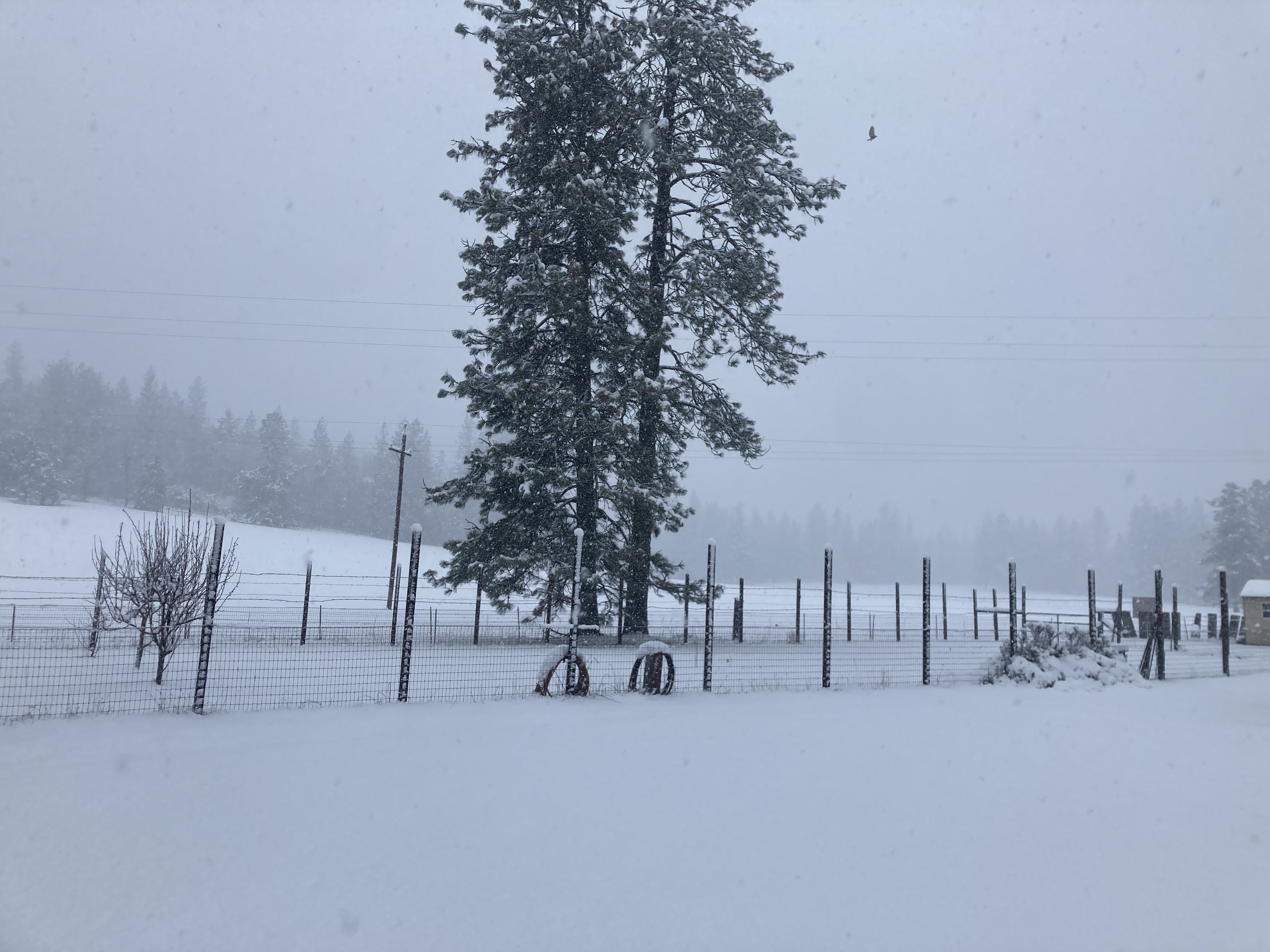
Above is the approximate view from the office window at The Ranch.  This is about as deep as the snow got (5"/12.7 cm) today.  This is my view every morning that I work from here.

Stepping outside to just watch it (I could watch it fall endlessly, but then again I do not have to deal with it as anything more than a novelty), I am always struck by the silence that snow brings.  Part of that has to be due to the fact that when it is actively snowing (at least here), not much is going on.  There is even less traffic from over the hill than usual.  The outside animals one can here - dogs, chickens, cattle - is gone.  There are no birds about of course, the only thing on the wind are the flakes which fall, more quickly or slowly as the wind moves them.  The snow seems to eat the sound.

Why is it that one set of silences disturbs me while the other is soothing?  It is not as if the snow is "task free" - for all of my sitting here watching it, I will need to go out soon and shovel it to make sure I can get out the following day to get back to the airport.  At the moment the snow is as omnipresent as my continuing seeming lack of work - yet I accept the shoveling and preparation as another task to accomplish.  The work situation has equally no tasks, yet I cannot escape the guilt of not having tasks in my mind.

The e-mail box behind me sits and shimmers, a white screen with files that does not change.  The snow equally sits in front me - not shimmering, but almost glowing as it continues to gather on the ground.

Only the fire pops in the background, quietly burning low.


Friday, March 03, 2023

Watched


 Hopeful cattle stand
dusted in the falling snow:
Have you some hay, Friend?

Thursday, March 02, 2023

The Collapse LXXXXIII: Regrets

 01 May 20XX+1

My Dear Lucilius:

As I was puttering around in the greenhouse and in the garden area at least eyeing where I will be planting things, I felt a tinge of unfortunate memory pour over me.

This used to happen to me from time to time, especially in that period of time after my wife had passed away and then the rather unexpected break with my children had occurred. I had anticipated the loneliness; what I had not anticipated was the replaying of all the events that had brought me to this point.

In retrospect, Lucilius, it is easy to look back on the situation we find ourselves in currently and in some shape or fashion be able to trace back exactly how we got here, at least in broad trends and terms. In our own lives it is possible to see the same, if we are willing to look deeply enough.

Perhaps unsurprisingly, we are far more willing to look at national and international events than into the depths of our human hearts.

I wonder about my children, Lucilius. I had vague ideas of where they were before everything ground to a halt, but even in those last few months, no contact – not even, I suppose to check in on me, although that went both ways of course. I failed to check on them either.

In the former world of the InterWeb, to not contact a person meant (largely) that one did not want to be contacted – after all, the information was out there literally for the taking. If someone did not contact you, it was because there was an active desire not to contact you.

The argument can be made that final little bit of collapse happened so quickly that it could not have been anticipated and thus any contact was not possible. That is true, of course – but it is also a lazy excuse for something which should have been done but was not. As individuals, we always have a choice to look at what happened and move on or look on it and dwell on it. Sadly, I fall into the latter category.

Young Xerxes was by for his semi-regular check-in during the afternoon and I mentioned vaguely the thoughts going through my mind as I was busy moving plants in the greenhouse and shuffling quail from one side to the other. He did not say a great deal – but within twenty minutes of his leaving, Pompeia Paulina “magically” arrived with a Thermos of tea and biscuits and insisted that I take a break.

Wisely enough (or wisely enough for a man who spends a great deal of time not speaking), she let me do most of the talking.

The words, the regret suddenly poured out of me as if that “dam” we all read about inside of us crumbled under the combined factors of undermined substructure and water pressure. It has been a long time since I have been able to speak about such things, or even been willing to speak about such things, or even had an audience to listen to such things (at least in my opinion when one relocates, it is the height of poor taste to respond to a friendly “How are you doing?” with the undigested remains of your life’s story).

I am not sure that anything was solved this afternoon: the facts remain what they remain and the world remains as it is. I have no more ability to contact any of them than I do to fly at this point, although in the unlikely event that some normalcy returns that will be the first item on the list.

Rabbits are good companions so far as they go, but the only gift that they lack is the ability to respond with words when spoken to. For that, we need people.

Your Obedient Servant, Seneca

Wednesday, March 01, 2023

Old English, A Historical Background: Vikings I

 Of all of the history and lore that has come out what we sometimes call The Early Middle Ages (circa 476 to 1000 A.D.), some of the most interesting and exciting are the Vikings

The Viking Age (793 - 1066 A.D.) saw a great movement of the peoples of Norway, Sweden, and Denmark throughout Europe to Russia and across the seas to North America (establishing colonies in Iceland and Greenland in the process):

Why they left when they did it is largely beyond the scope of discussion we have been engaging in, but in short it appears it was a combination of swelling populations and decreasing land availability in the lands of Scandinavia and, oddly enough, by the destruction of the Frisian Pirates by Charlemagne, which - much like Byzantium later in history - removed the buffer between Europe and those that would raid it.  The seas to much of Europe at this time (including Anglo-Saxon England) were more like moats; to the Vikings they were boulevards, allowing travel almost at will.

The first recorded Viking attack on Anglo-Saxon England (we assume; no one questioned them) was in 787 A.D. when three ships appeared on the Dorset coast of Wessex.  The local royal official, the port reeve, came to the shore to question their business.  Their response was to kill the port reeve and sack the town.

Now the English Heptarchy had two issues:  jostling among themselves and trying to defend themselves against the increasing tempo of the Viking raids.

By the beginning of the Viking raids, as you may recall, the consolidation of the smaller kingdoms into the "Big Four" - Wessex, Mercia, Essex, and Northumbria - was proceeding apace.  In 814 A.D. Wessex conquered Dumonia, thus conquering the last Celtic independent kingdom in the south.  In 825 A.D., Wessex defeated Mercia and conquered Kent, Sussex, and Essex (apologies, I having problems coming up with a map - if you could use the one above and "fill in as needed", I would be indebted).

But the Vikings kept coming as well.

The monastery of Jarrow was raided and burned in 794 A.D., the monastery of Iona in 795 A.D.  The Vikings came in small groups and raided.  But after a time their practices changed as well, as the moved from hit and run raids to beginning to raid stay and settle where they raided.  Across the Irish Sea, the Vikings attacked and largely over-ran the clans and kingdoms of Ireland, and in 841 A.D. the town of Dubh Linn (Black Pool, or as we now know it, Dublin) was founded.  This started in England as well: in 850 A.D., Viking raiders overwintered on the island of Thanet (off Kent) rather than return to Denmark in the Winter.

And then, in 865 A.D. disaster struck.

A large Danish Army (known as The Great Viking Army, the Great Heathen Army, or The Great Danish army, take your pick) arrived in 865 A.D. (As a historical note, the recorded impetus for this invastion was revenge on the king of Northumbria for the killing of Ragnar Lodbrok by at least three of his sons, he of the show "Vikings" fame). They came not to raid, but to invade and found a Kingdom.  Arriving in East Anglia, they marched north and conquered the city of York, destroying the kingdom of Northumbria. From there, they moved south in Mercia  andEast Anglia and Wessex, conquering and taking territory as they went.  The Heptarchy was destroyed, the royal houses of all but Wessex destroyed.  Every year in this period The Great Heathen Army overwintered in Brian instead of retuning home. They were a problem that was not going to sail away as had happened in years past.


By 870 A.D, the world looked a bit bleak for the Anglo-Saxons as a political entity.
 
Works cited

Blair, Peter Hunter:  Roman Britain and Early England 55 B.C. - A.D. 871.  WW Norton and Company:  London, 1991.

Hollister, C. Warren:  The Making of England 55 B.C. to 1399.  D.C. Heath and Company:  United States,  1976.

Nicolle, David:  Arthur And The Anglo-Saxon Wars.  Osprey Publishing:  Hong Kong, 1984


Tuesday, February 28, 2023

0200

 Last Friday morning I woke up at 0200.

This is not terribly uncommon when I am at The Ranch.  The change in time zones means that I am always ahead or behind myself both in waking and in sleeping - which makes for days in which one can get a lot done, but nights that can be quite short.  Added to that was the fact that the wind was howling and making the branches of the oak at the back of the house creak and rattling something on the outer wall - the fuse box cover to the HVAC unit?   I lay there after looking at my phone - 0200.  I lay there until I realize I am not going back to sleep, and then get up.


The fire still has active coals in it.  This has not been the case all the time this week; the wood I am burning is the free wood that I got in the Summer.  It is not what we usually burn, oak and pine and sometimes madrone.  It is softer - cedar, maybe?  The advantage is that it will burn with the damper completely closed almost all the time; the disadvantage is that it burns far more quickly than oak does.  This week in general I have barely had enough coals in the morning to coax a fire forth, having to rely on paper and kindling.  My luck this morning; I have plenty of coals to work with


I need more wood of course, and so go out the back door to the firewood.  The wind is still howling, occasionally blowing snow around but nothing is coming down from the sky yet.  There are tracks by the bird feeder; something small ran up to the edge of the house.  What would be out in this kind of weather?  Too small for anything but a fox or even a bobcat as a predator, or perhaps a rabbit if prey.  The tracks do not seem to head back at all; it either ran along the sidewalk or more mysteriously disappeared.  A mystery that will dissipate with either more snowfall or the melting of the same.


I grab several pieces of firewood to bring back into the house.  I am the sort of person that dithers about how much I should bring in at one time and how big the individual logs should be.  This is reflective of my decision making in general:  I tend to dither about everything.  I finally pick out five or six pieces of firewood, one that I think that will burn long enough until the time I am actually supposed to get up.  As I am grabbing the wood, I give myself a little mental victory lap for filling the ricks up when the weather was much better this week; I do not often feel like I think ahead as I should.


I put the wood on the hearth, put one or two pieces in, and shut the stove door.  The fire almost immediately ignites; there is always something reassuring to me when it does without my direct intervention.  At a loss for what else to do, I decide I should probably pray, if nothing else:  Surely I am up for a reason?  Having no idea what else to pray, I grab my phone and in one of my Orthodox apps.  There is a prayer set called The Hours; I open it and there are choices.  Which hour is it?  The First, the Third?  I randomly select one and pray it.  I am not Orthodox, but praying at night seems like something that needs structure.  


Finishing, I settle into my father's chair by the fire and turn off the light next to the chair.  The living room is now lit in flickering light by the blazing fire as the logs I have brought in break forth into blossoming flame and catches the wood grain of the antiques my father had purchased over the years and the glass of the pictures of  my parents' dead (and mine) on the wall.  I remember him doing this as well, gathering logs in the evening to feed to the fire at night when he would wake up from sleeping out in here.  He worried in  later years the fire wood go our; I have apparently lapped him in worrying much earlier in age.


Buried under on of the many quilts that my parents owned, quilts that I have no idea of their provenance or history, I eventually fall back to sleep.  This is the way it can work, if I force myself to do it.  The sleep is never as restful as an actual sleep earlier in the night, but I have learned that if I can somehow manage to gain that extra 45 minutes to an hours, it will make the difference between being completely exhausted from the moment I get up to being manageable exhausted or even possibly refreshed.  The chair is not the most comfortable to sleep in; I am a bit surprised upon waking that I slept.


When I wake up, it is completely silent.  The wind has died and the fire has burned low.  Getting up to feed the fire, I look out the window.  The front that was blowing in has arrived and now the night sky is filled with fat, drifting flakes everywhere I can see.  I close the stove door again and go back to the chair and re-cover myself where I can see the snow falling while the orange light of the fire begins to refill the room.  This contrast - fire, snow, crackling, silence - makes for a pleasure I can almost not express as it is both too private and too sacred to put into words.  It is a measure of contrasts, presented here for me to see and experience, an unexpected gift.

Monday, February 27, 2023

A Walk In The Snow: Part II

One of the amazing things to me about snow is how it turns objects and places I see all the time into bizarre shapes and works of art.


Sunday, February 26, 2023

A Walk in the Snow: Part I

After the first day of snow, Uisdean Ruadh (for whom snow is more novel than I), wanted to go for a walk.  This is the road down to the main road - no words, just pictures.  Enjoy!