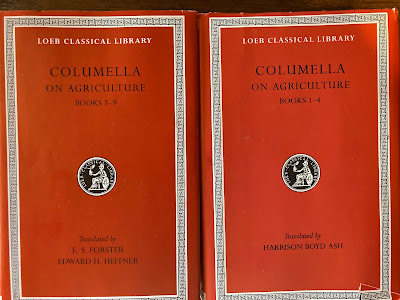
You are reminded (yet again) that you have married the right girl when, for Valentine's Day, she gets you what you really want:
These are the first two books in the Loeb Classical Library of the three set volume of Lucius Junius Moderatus Columella's works, De Re Rustica (On Agricultural Affairs). Along with Marcus Porcius Cato The Elder's book De Agri Cultura (On Agriculture) and Marcus Terrentius Varro's book Rerum Rusiticum Libri III (Agricultural Topics in three books), it forms the bulk of what we know about Roman agricultural practices in the late Roman Republic and Early Imperial Periods.
Of Columella himself, we know very little and it is all from his writings. We know he was from Baetica Hispania (Modern Spain) and probably born in Gades (modern Cadiz). We have evidence he was a tribune in the Roman army from a monument in Tarentum (modern Taranto, Italy), possibly having served in Syria. We can guess, based on other references, that he was born sometimes in the latter reign of Augustus Caesar (~ 4 B.C.) and probably died sometime in the latter part of Nero's reign or in the Year of Four Emperors (~ 68 to 70 A.D.). He had an uncle, Marcus Columella, whom he praises as a good farmer and who, it is a likely guess, he spent some amount time with. We know he owned farms in Caresoli, Ardea, Albunum, and Caere.
And we know from his works he was a keen student of agriculture.
His work is divided into 12 books: Preface, Selection of land and management of farm staff, Soil enrichment/ploughing/crops, Cultivation/pruning/grafting of vines, Cultivation/pruning/grafting of fruit trees and olives, Animal husbandry and care (cattle/horses/mules), Animal husbandry and care (sheep, goats, swine, dogs), Poultry and fish ponds, Apiculture, Gardening, Duties of the farm overseer, and Duties of the farm overseer's wife (including recipes for pickling, preserving, and making wine) - in other words, everything one should know to run a successful farm in the 1st Century A.D.
The work is one of those sorts of historical miracles: known and quoted by Pliny the Elder, Cassiodorus, and Isidore of Seville, it somehow got lost in history only as fragments until copies were found in monastery libraries in the early 15th Century (proving again, by the by, why the idea of creating small communities to preserve knowledge really matters and things like The Benedict Option really matter in the modern world).
I know what you are thinking: Why such interest? This is written for a system and way of life that disappeared (literally) centuries ago. What could it possibly teach us, other than some obscure Latin phrases and give Latin practice.
The first reason, of course, is I simply love a good book, and from what I have read so far (I have completed Volume 1 and am in Volume 2, Book V), Columella is a careful writer. He knows exactly what he is writing about in great detail and although, for example, I only understand a bit from his chapters of viticulture, I am willing to bet that an actual practitioner would recognize many of the techniques mentioned from his description 2,000 years later.
The second reason is simply that I am interested in low input agriculture. While the Romans had some technology (including concrete we still cannot replicate), they also were working with very basic conditions: they were largely dependent on weather as it occurred; Inputs to the fields were only those they could grow or gather themselves: green manure, animal manure, even human manure and urine. There were some exotic plants, but at the same time no farmer was going to "bet the farm" (literally) on an unproven technology or crop.
The third reason is that to me, it reads like a travel log. Columella writes of grapes that we know nothing of, other than potentially the region they were originally from: Massic, Surrentine, Alban, Caecuban, Bituric, Aminean, Basilic. These names, their descriptions, what they imply - to me, they excite me as much as the name of foreign civilizations long dead, that we only know through their architecture and writing. It becomes an agricultural journey in the Ancient World.
Not all the information is useful, of course. All authors - Columella, Cato, and Verres - presume the use of slaves to complete the work instead of small independent yeoman farmers (which would eventually become the large Latifundia farms of Italy), so there is also a less savory side to the writings - but quite reflective, given the times. And it makes some of their advice not applicable at all in current times, as most people (like myself) that are reading such things and even trying to do such things would not have such a labor force available.
Does that make this work (or these works) less useful? I do not think so. In modern times, we keep trying to find ways to farm more productively and less destructively. It turns out - be in in Rome or China or Japan - people had actually been doing this for thousands of years, where maintaining the fertility of the land was a paramount need as one needed the land to produce.
We need only look back to look ahead.