Monday, March 17, 2025

Mid-March 2025 Grab Bag

Thanks again so much for your patience with my absence and delay in responses (and, apparently, my ability to actually type on small screens without either making huge spelling errors or being auto-corrected to death).  It was a great time and, as I realized, the longest time The Ravishing Mrs. TB and I have spent together in the at least the last year and may be in fact the longest vacation we have had without children in 25 years.

In terms of writing it all up, the next two weeks will be finishing out Turkey (if you can believe it) and the following month (more or less) catch-up from Japan and Switzerland/Germany on Tuesdays and Wednesdays while I try to get my thoughts and pictures in order.

---

One of the surprising benefits of being "away" is that one can be completely isolated from the day to day news cycle (or at least the discussion of it; every tour I have been on we are very much encouraged to "not discuss U.S. politics", a rule that everyone pretty much holds to).  As a result, one gets both a blessed relief from the 24/7 news cycle as well as the rather constant volley/counter volley which has come to constitute virtually every communication here.

While this is not an invitation to delve into politics, it is an observation that the term "First World problems" really is a thing.  A lot of what seems to be consuming all of the oxygen in the room here and in the greater "First World" is not a thing that happening in the rest of the world.

Everyone on both sides who is hyperventilating about "the news" should go abroad. The issues that people are concerned with there are quite different from what "we" are concerned with here, or at least believe we should be concerned with here.

---

Somewhat connected to the point above, I may be taking a relatively permanent break from Social Media.

One of the outcomes of the election is that more and more people have been posting about such things at The Book of Face.  To be consistent with my practices here, I never comment.  I also started taking the measure of not having their posts appear in my daily feed - for both sides:  I try to be consistent if nothing else.  As a result, a surprisingly few people appear in my feed at this point; it is mostly groups I follow for things that are cute or interesting and a lot of advertisements.  At this point, it is adding little (if nothing) to my life.

Instapic is slightly better as it is just pictures and quotes (a fair amount of the quotes which I use here).

But I can easily see a day where Social Media is something I used to do, not do now.

---

To no-one's surprise more than myself - tomorrow represents one full year of being at my new job in New Home 3.0 (my official "one year date living here" was 15 March).  I find it shocking that it has been a complete year, but given the amount of things that have happened in the past year, perhaps less shocking than I might think.  

In terms of work, the job is going well. In terms of life - especially with the advent of The Ravishing Mrs. TB here permanently (more or less), I am looking forward to what is essentially the next chapter of our lives.

I also look forward to finally unpacking some boxes and hanging some pictures that have essentially been undisturbed since I moved here.

---

Somewhat fascinatingly along with my ongoing review of Greg McKeown's Essentialism, I have been reading two books by Cal Newport - The End of E-mail:  Reimagining Work in an Age of Communication Overload and Deep Work:  Rules for Focused Success in a Distracted World - as well as two in the reading slot by Matthew B. Crawford, Shopcraft as Soulcraft:  An Inquiry into the Value of Work  and The World Beyond Your Head: On Becoming An Individual in an Age of Distraction.  The fact that all of these texts with the emphasis on focus, attention, and spending one's time meaningfully and accordingly are not, I think, by chance.  

The outer location of my life has changed; it appears the next part is the inner practices of my life as well.

Sunday, March 16, 2025

A Year Of Humility (XI): The Story Of Ruth

 As we have discussed earlier in this series, as the word "humility" is not nearly as prevalent in the Bible as we might think it is due to its importance to Christianity, it might be a useful exercise to see humility put into practice in Scriptures.  One of the examples - I hesitate to say "the best" because we still have a year ahead of us - is the book of Ruth.

The Book of Ruth is undoubtedly a text that most of my readers have heard preached on by far more skilled expositors than what you will get here.  In a way, it is one of the "Cinderella" stories of The Bible:  Poor woman with good heart chooses to support her mother-in-law in a foreign land, meets local well-to-do-landholder who is impressed by her care and devotion to her mother-in-law and industriousness, and marries her.  You know, the typical Hallmark holiday special.

Rather than recount the entire story (to be fair, all four chapters of it), I would draw your attention to three instances where Ruth put the practice of humility on display:

1) Ruth's departure with her mother in law 

As you might remember, we first meet Ruth and her mother-in-law Naomi and her other daughter-in-law Orpah in the land of Moab.  Within the first few verses, all of their husbands die and Naomi decides to head back to Israel, having no other options in Moab.  Her daughters-in-law start to accompany her but Naomi tries to shoo them off, pointing out that she has no future to offer them.  Orpah goes, Ruth stays.

Ruth declares to her "Entreat me not to leave you or return from following you, for where you go I will go, and where you lodge I will lodge; your people shall be my people, and your God my God: where you die I will die, and there I will be buried".

To our modern ears this sounds extreme.  Ruth is giving up everything she had known - her former life, her family, her culture, her religion - everything - to be with her mother-in-law.  She would perhaps die a stranger in a strange land.  She heads to an unknown future, purely for love of her mother-in-law.

To go, in love and in support of another, abandoning all hope or expectations for yourself.  This is humility.

2)  Ruth in the fields.

Once they arrive in Bethlehem, Ruth gets to work.

By Old Testament law (Leviticus 19: 9-10, 23:22), fields were not to be gleaned to the point of every grain.  The Israelites were to leave some amount of grain product to be gleaned "by the poor of the land".  The grain was there; it just had to be gotten.

And so, Ruth heads out to go glean.

I have never been the position where I was truly desperate for a job, but at least once I was "highly motivated" to get the job I was interviewing for.  I only found out later from a coworker that became a friend that I apparently came across as very nervous and a little desperate.

Imagine:  You show up at a field.  Is there grain there?  If there is, can you glean it?  In theory yes, but given human nature you are likely to get yelled at (or worse).  And even if you can, imagine working under the eyes of the paid help and owners,  All to get enough food for a day, so you can go out to do it again tomorrow.

And from what we read, Ruth does it.  Without complaint.  Without "What did I get myself into?"  She works, not just to feed herself, but to feed her mother-in-law, whom she literally has no connection with except the bond of love.

Picking the leftovers of the harvest, dependent on the charity of others, to support someone you love.  This is humility.

3)  Ruth and Boaz:

Ruth, as the story continues, is fortunate.  The first field she comes to is that of Boaz, a relative of Naomi's deceased husband.  He has heard of Ruth and what she is doing for her mother-in-law. He encourages her to stay in his field and not risk going to others.  He encourages her to glean with his own servants, to eat and drink the noon meal with them - in fact, he makes sure she leaves with leftovers and makes sure she has access to the harvested sheaves themselves.  She works like this through both the harvest and barley season.

Finally, her mother-in-law comes up with a plan:  Boaz could take the role of redeemer-kinsman, standing in the place of the dead and taking up his legacy.  But to do this, Ruth will first have to ask for this.

Imagine, as the text records:  Going to the house of the man who has been your benefactor, creeping in after he has gone to sleep, waiting at his feet all night, and then effectively saying "Save us"?  Not knowing whether the answer would be yes or no?

Making yourself low to save the life of others (and yourself).  This is humility.

---

Ruth's story has a happy ending:  married to Boaz, she bears him a son who becomes the grandfather of a child named David who goes on to do some pretty big things in Israel - including, of course, being in the Messianic Line.

A little mind blowing if you dwell on it:  a non-Israelite woman, through her obedience, love, and humility, enters the genealogy of The Messiah.

You never really know where a life lived humbly might lead.

Saturday, March 15, 2025

Back From The Far Abroad, Cambodia/Vietnam Edition


Dear Friends,

As you are reading this I am either 1) Sleeping; or 2) Doing laundry.

Cambodia and Vietnam were amazing.  I do not know what I expected, but I did not expect this.  As I have 1900 pictures and videos to digest, it may take some time (and sleep) to digest it all.  I offer you this as a very basic taste.

Merlion, Singapore

Royal Palace, Phnom Penh Cambodia

Bayon Temple, Siam Rep, Cambodia

Angkor Wat - Siam Rep, Cambodia

Sampan Ride, Mekong Delta, Vietnam

 Saigon, Vietnam

Japanese Covered Bridge, Hoi An, Vietnam


Imperial Citadel and City, Hue, Vietnam


Thien Mu Pagoda, Hue, Vietnam


Lăng Tự Đức, Hue, Vietnam

Lăng Khải Định, Hue, Vietnam

 Ha Long Bay, Vietnam

Traditional Water Puppets, Ha Noi, Vietnam

Friday, March 14, 2025

Essentialism (X): Essence Of The Essentialist: Trade-Offs

 At the time of the publishing of the book Essentialism (2014), author Greg McKeown asks a question:  If you were able to travel back in time to 1972 and invest $1 in every company in the S&P 500, which company would have gotten you the biggest return?  It is a trick question; the answer is none.  The correct answer is Southwest Airlines.

How did they do it?  By acknowledging the reality of trade-offs.

McKeown creates a phrase later in the chapter which I list here as a guide: "We can do anything, but we cannot do everything".

In the case of Southwest, it meant choosing to fly to set destinations (not every one), not having assigned seating, no first class seating, and no meals.  The trade-off was that they were a low cost airline which could offer stellar service.  Said Herb Kelleher, the founder, at a talk "You have to look at every opportunity and say 'Well, no...I'm sorry.  We are not going to do a thousand different things that won't contribute much to the end result we are trying to achieve."

The other option is straddling, trying to keep all the current options while introducing new ones.  This is not a sustainable position for two reasons. The first is simply that there are not enough time/resources to do everything.  The second is that by doing all things (or trying to), one cannot truly have select a strategic vision - worst case, one has two incompatible strategies one is trying to execute.

Have you ever, asked McKeown, spent time with someone who is always trying to fit one more thing in?  Their logic is that of "I can fit one more thing in".  The reality, posits McKeown, is that this is a false logic:  by saying "yes" to one thing, we are saying "no" to other things.  Trade-offs are the reality of life: it is only we who fool ourselves about this.  

The nature of tradeoffs is complicated (perhaps in our own minds) by the fact that both (or multiple) options are things that we want; scarcely do we struggle about doing something pleasing versus something we have no interest in. More vacation or more pay?  More time with family or more time with activities?  Faster or better?

A Non-essentialist asks the question "How can I do both?"  The Essentialist asks "Which problem do I want?"  The Essentialist consciously and knowingly makes choices; as Thomas Sowell has said "There are no solutions.  There are only trade-offs."

But trade-offs, says McKeown, represent a significant opportunity.

By forcing us to actually think, weigh options, and select (hopefully strategically) what is the best choice for us, we "significantly increase our chance of achieving the outcome we want.  Like Southwest (above), we can enjoy the success that comes from making a consistent set of choices."  By switching the question from "What do I have to give up?" to "What do I want to go big on?", we change our thinking from that of scarcity ("What am I losing?") to potential ("What can I do that has the biggest impact?")

In closing, McKeown says "Trade-offs are not something to be ignored or decried.  They are something to be embraced and made deliberately, strategically, and thoughtfully."

Application:

Of the three areas (Choose, Discern, Trade-offs) of the core of the Essentialist, I feel like this is by far my weakest link.

I am painfully aware of the nature of trade-offs.  In a great many ways, that has lead to the fact that I am one of the worst decision makers I know, because I never want to close options down. It is also not helpful that I have a broad range of interests; the idea that somehow I have to have some level of choices is not one I come to willingly.

Yet the results are clear enough in my life.  I spend time running from activity to activity or interest to interest without increasing my ability in any of them.  I will try to map out every moment of my day to somehow be a constructive activity, thus depriving myself of both sleep and any down time.

And this is point - right at this moment - that God seems to be hammering me over the head.  Have too many things going and interests going on, to the point of now openings anywhere?  Fine.  Let us completely remake your life and pull you away from all of that.  Let Me, God seems to be saying, give you an empty slate to consider everything that is in your life.

You can indeed do anything, but you cannot do everything.  Choose wisely.

Thursday, March 13, 2025

The Collapse CLXXXIII: Gifts

20 October 20XX+1

My Dear Lucilius:

Winter continues its landing approach: the temperatures are definitely trending in a single direction with nights starting to become such that one does not want to linger out in the evening. The days continue their run towards night as well, shaving off small splinters of useful daylight with every passing sunset.

I have not written since the fire as there has been little enough to write about.  True, I have perhaps been a bit more reclusive than my usual self, leaving for foraging rather early and being home earlier than I would usually be, so the likelihood of seeing anyone has diminished even below its usual odds. But I have sincerely made an effort to stay here on my own small piece of property.

While nothing has happened, there is no sense in pushing things to where they might happen.

The last few days would be rather unremarkable until a rather strange thing happened: a bag of coffee showed up on my doorstep. The next day, a ziploc bag of jerky. This morning, three pieces of seasoned firewood.

The coffee was some brand I had never heard of: “Strong like the Mountains” ran the logo on the advertising for a tourist town far North of here. The jerky was very clearly homemade, firewood of a quality I have not seen or burned in over a year.

I asked Young Xerxes about them; he professed to know nothing but said he would “look into it”. I have become acquainted with him well enough now to fully expect he will not look into it.

I also fully expect he knows where these gifts came from.

It is hard to accept such things, given the situation that we find ourselves in and that these represent real sacrifice on the part of their givers. The jerky can be remade of course and perhaps the firewood could be re-seasoned (you should see these logs, Lucilius; I will try and save them for Yule logs). The coffee is effectively irreplaceable.

But as my mother always reminded me, to not accept a gift or accept it with poor grace is to denigrate both the giver and the intention behind it.

Perhaps even I have been made a bit cynical by the world we now live in.

Your Obedient Servant, Seneca


Wednesday, March 12, 2025

2024 Turkey: Anatolian Museum of Civilization (III)

 Finally, we get to the stone, some of the most enduring work we have of old.

These soldiers mounted the walls of the Neo-Hittite walls (12th - 8th Century B.C.):


Warrior Procession (900-700 B.C.):


The last king of the state of Kargmis is seen here giving a speech (900-700 B.C.):


Originally mounted over a gate (900-700 B.C.):


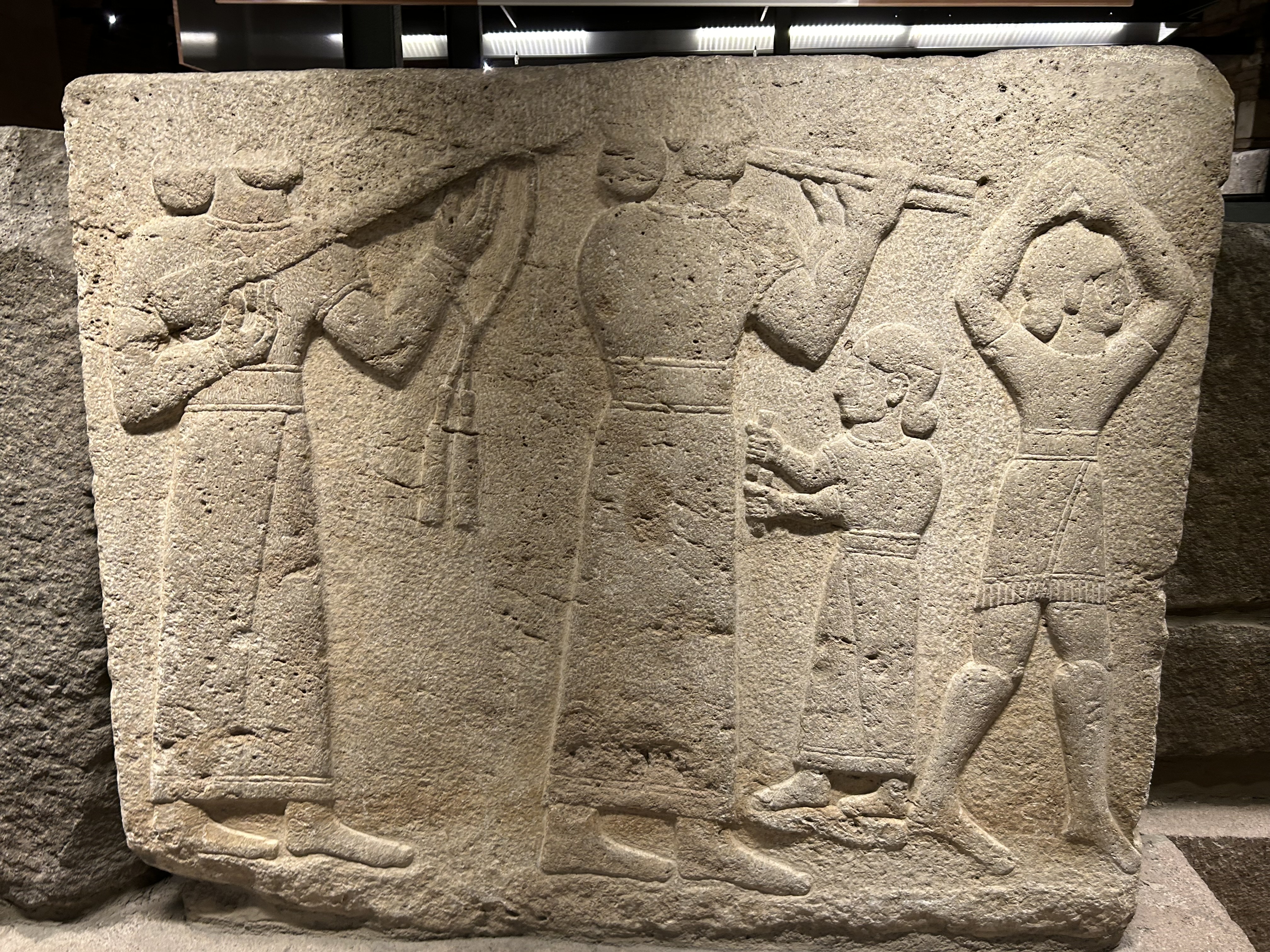
Procession of musicians (900-700 B.C.):


Procession of female characters, perhaps nuns (900-700 B.C.):


A King (900-700 B.C.):


Bird-Headed Lions (900-700 B.C.):


Griffon (1200-700 B.C.):


Stone Lion, 900-700 B.C.:

Tuesday, March 11, 2025

2024 Turkey: Anatolian Museum of Civilization (II)

 A collection of spear points and scrapers:


Sun disc, 1900-2230 B.C.:


Representation of an early forge:


Bull Statue:

Hammers, Jewelry:

Animal figures:


Clay Tablets from Hittite times. This one is a certificate of debt (because debt never really goes away):


A diplomatic latter between two kings:


A certificate of divorce...


And a marriage certificate.


Pottery:


Bulls:


The circular wine vessel is the same as we same being made at Venessa Seramik thousands of years later:


Animal pottery


Monday, March 10, 2025

The Magic You Are Looking For

As long-time readers of this blog may recall, every training session I have with my headmaster has been one of self discovery - not always good self discovery of course, but self discovery.  

I say "not good".  What I mean is "not good for my feelings", not "not good for correcting myself".  This time, the learning was around my willingness to do the work.

Do The Work is actually the title of a book by Steven Pressfield (he of Gates of Fire fame), the point of which is that in order to make progress, one has to push aside the resistance (The Lizard brain, he calls it) and start doing the things one needs to do to move forward.

And to be fair, that is part of what I was confronted with.  But the other thing, the deeper thing, is simply that I do not fully "do the work" I need to.

Perhaps because I did so well in school (I was, and am, a very good student as the whole "learn/study/test" thing works for my mind), I somehow picked up the belief that not only can I do anything (which is helpful) but that I can do it without necessarily having to invest the time and energy to fully master the thing - to "do the work".  Whether by bouts of intellect or a jovial nature, I have - in more cases than I tend to think - managed to "bend the rules" to do things.  Sometimes that looks a lot like having some but not all of the qualifications to do a thing (like, for example, my current line of work where effectively I have "grandfathered in" simply by the amount of time I have been in it).  Sometimes it is by knowing the outer shell of a thing but not the whole thing, yet projecting as if I do.  Sometimes it is being agreeable and personable and carefully avoiding having to display any actual knowledge.

This manifests itself in a lot of ways.  The most visible is simply making pronouncements based on what I can recall or believe to be true instead of following up to find out the facts.  Sometimes this is me doing things my own way and trying to fit it into the task that I have been asked. Sometimes, it is me simply using a very basic level of knowledge and trying to extrapolate to the more advanced concepts.  Sometimes, this is trying to rush through something I do not know well or fully in hopes that speed will carry me through to the parts I know well.

This all works, of course.  Until it does not.  And, as it turns out, the longer attempt to stay on a glide path instead of a flight path, the more obvious it becomes.

I want advancement in things - Iaijutsu of course in this context, but other things as well.  And I am guilty more times than I care to accept or think that I have attempted to find the easy way, the "magic way", to get it done.   Why?  Because "the work" is often boring.  It is repetitive.  It is time consuming. And progress often does not appear as the noticeable progress that fuels me:  there are no good grades.

Just the work.

But there is a magic to making all of this happen, of course.  It is, as the picture above notes, simply doing the work that I am avoiding.

The odd thing is that I know precisely - for every thing I am not making progress in - what that work is.  It means investing time - and by investing time, it means that I will end up doing less of some things because there is only so much time I have and can invest.

For years I believed there is "magic" to success.  There is; the question is whether I am willing to do the magic - which is everything that I have been avoiding to this point.


Sunday, March 09, 2025

A Year Of Humility (X): Direct Transmission

 One of the the things that separates my martial art from many others is the idea of direct transmission.

The idea of direct transmission - that one learns directly from the head of the school is embedded in our school (as it is in other schools as well), even to the extent that it is included in our name. The concept is that transmission occurs best (and only) from the head of the school to the students, who then take it back to their own schools to transmit.  Every training with the headmaster becomes an opportunity to recalibrate one's self against the standard (and believe me, I have had plenty of opportunities to "recalibrate").

The idea of distance learning - now made somewhat ubiquitous by the InterWeb - is not something that is considered as acceptable. It is only by the physical presence and observation that the true essence of the art is transmitted.

(Somewhat surprisingly to me, there are schools that offer online lessons in sword martial arts.  I cannot attest to their effectiveness; I only know that this is not the teaching of my school).

How, you might be asking yourself, does this relate to humility?

Part of the concept of direct transmission is that the headmaster, as the transmitter, is directly providing me with the input on the correct technique and application of it.  I, as the student, am to conform myself to the direct transmission.

By "conform", the expectation is exactly that.  I am not to make it "my interpretation of the art", or "my take on the technique".  I am to learn and execute the technique precisely as I am shown it.

Do not think this is an idle idea.  We spent far more time that we should have during my most recent training on me doing a technique that I was clearly doing wrong, at least to everyone but me.  I arrested the flow of class several times over the course of 5 days because I was simply not doing it right - I was doing how I saw the technique, not how the technique actually was to be done.

To do the technique precisely as shown - without my add-ons or interpretations - is to humble myself to the authority of my headmaster.  

In a similar fashion, our relationship with God and His commands should be no different.  God is not looking for personal interpretation or personal "flair" when He gives us His commands.  He is expecting us to execute on them as written.

Yes, I know.  God did not make us all the same, and the application of His commands can be very different for different situations.  But "different for different situations" is a very different things from "I think that God really meant this when He said..."

Like myself and my training, God has given us direct transmission in the form of Scripture.  And like my headmaster, I very much suspect His expectation is less "How did you interpret it?" and more "Did you do what I asked in the way I asked it?"

Saturday, March 08, 2025

Spending Time


One of the things I have become more conscious of through a variety of sources - the move to New Home 3.0, doing a study of Essentialism, the reality of the passing of my parents, and even just reading on things as varied as sleep and e-mail - is the nature of my time and how I use it.

Time consciousness is something that we as a society seem to both cultivate and completely ignore. One the one hand, ever since the Quality and Productivity movements of the 1950's and 1960's, we have been on a quest to improve how we use our time at work.  Technology has assisted us even more in this progress:  we now track things down to the second and work to eliminate every obstacle to getting something done as efficiently and quickly as possible, whether through providing a thing "Just-In-Time" or using communication technology to communicate and inform 24/7.

On the other hand, we seem to never train ourselves in the use of time away from that structure environment.  We work productively so that we can have more time to ourselves, yet somehow manage to fill that time with things that may or may not be productive.  "Productive" is a subjective word to be sure:  what may productive to someone by relaxation (for example, sports or movies or on-line games) to me may not resonate at other activities.  Yet I suspect that all of us, were we to be honest with ourselves, would find that we are too often letting large swaths of time slip through our fingers.

I had never really thought of the idea of "spending time" before I read the quote above.  But that is really the point, is it not?  We can use time thoughtlessly or thoughtfully, by wild abandon and laziness or thoughtful planning.  Either way the time is gone; it is up to us to determine whether it was well spent.

What is the difference to me?  Simply asking the fundamental question of "How am I consciously using my time?" before I being anything.  And not just the usual things:  sleep, lunch, even writing.  "Thoughtfully" is not the same as "productively" per se; for example, I am making an effort to get the 7-9 hours of sleep a night that most adults still need.  That may be "thoughtful"; the "productive" part only comes by the benefit of that sleep.

The more I go on this journey, the more I wonder how I have managed to unconsciously go through life.

Friday, March 07, 2025

Essentialism (IX): Essence Of The Essentialist: Discern

"Most of what exists in the universe - our actions and all other forces, resources, and ideas - has little value and yields little result; on the other hand, a few things work fantastically well and have tremendous impact" - Richard Koch

Most of us of a certain age remember Boxer, the plodding and patient work horse from Orwell's book Animal Farm.  When confronted with yet more tasks, he simply says "I will work harder" - until the day, of course, Boxer simply disappears and is never spoken of again. Like Boxer, says McKeown, we have the same tendency:  when presented with even more tasks, we simply say "I will work harder".   But for anyone, especially capable people, McKeown posits the following question:  Is there a limit to the value of hard work?  Is there a point at which doing more does not produce more?

McKeown's example - an example we likely have made in different ways - came when as a young lad, he delivered papers.  He knew what he got paid and came to associate that rate (in number of papers delivered and time) with what it would buy him.  Then one day he discovered he could wash neighbors' cars for one morning instead of delivering papers for six mornings a week to get the same money but have more time.

Later, as a customer service rep, he learned the same lesson.  When asking himself "What was the most valuable result I could achieve at his job?", he realized that it was winning customers back who were going to cancel. Since non-canceled customers yielded a bonus, he "learned more, earned more, and contributed more".

Working hard, he notes is important:  "But more effort does not necessarily yield more results.  Less but better does".

Less but better may be hard for most people to adjust to - after all, rewards in the past (in the Western Economy at least) tend to track directly between doing more and more and more.  But more and more more eventually yields less and less and less.

Most people have heard of the Pareto Principle proposed by Vilifredo Pareto, where 20% of anything contributes 80% of the results (and the contrary, that 80% of anything contributes 20% of the results).    People may be less familiar with Joseph Moses Juran, an engineer and one of the fathers of the modern Quality movement, who discussed the idea of "The Vital Few" - simply put, that one can improve the quality of a product by resolving a very small fraction of the problem (In an interesting "might-have-been", he attempted to disseminate his ideas in the Post-WW II US, but they were not well received.  They were quite happily received in post-War Japan, which sky rocketed from a reputation of poorly made products to trend setters in terms of quality and technology.  Over time, we know how that story ended).

McKeown notes "Distinguishing the 'trivial many' from the 'vital few' can be applied to every kind of human endeavor large or small and has been done so by Richard Koch (see the quote above), author of several books on how to apply the Pareto Principle (80/20 Rule) to everyday life".  The example he gives is Warren Buffer, who limits his investments to a small number of thing that he understands - and then invests heavily in them.

"The overwhelming reality is:  we live in a world where almost everything is worthless and a very few things are exceptionally valuable.  As John Maxwell has written, 'You cannot overestimate the unimportance of practically everything'".

Application:

It is pretty easy for me at my place of work to identify things that are those "vital few" which truly contribute to making progress.  It is much more difficult for me to do it in my personal life.

Why?  I suppose I could argue that a personal life is much less clear than that of a work life; feelings and personal relationships make clinical decision making difficult.  But if I am truly fair, that is simply a cop out for not being willing to do the hard work of looking into things and evaluating, for each major stream or activity or relationship, what the truly "vital few" are in that thing that would significantly change the outcome.

In other words, I tend to laziness.  And Essentialism, if nothing else, is not for the lazy.

Thursday, March 06, 2025

The Collapse CLXXXII: Fire

17 October 20XX+1

My Dear Lucilius:

Last night the RV Bar burned.

By all guesses (based on the fire) it was set in the evening, a convenient enough time as it both allowed the fire to grow while people were not out and would have frustrated any attempts to fight it, were any to be made.

By the time Young Xerxes and Staterra pounded on our door and alerted us, it was well aflame, orange tips rising about the housing line about a quarter of a mile away. I dressed and headed out with Young Xerxes leaving Pompeia Paulina and Stateira at The Cabin.

Likely not anything but a fire, of course. But no sense in taking risk.

By the time we got there the whole building – clad mostly in rustic looking weathered wood at one time – was engulfed. There is a large enough dirt parking lot about it that any immediate damage to structures was low; that said, there was a small group there with some visually tracking sparks as they were carried aloft.

It is seldom that I have stood close enough to a structure fire to see it in any detail. The flames whirled and swirled, flickering smoke and cinders into the sky. The interior of the building was hinted at through the holes and cracks in the outer building. Occasional cracks and crashes echoed from the outside.

It burned. And burned. And burned, late into the morning, the cracks and crashes becoming more and more frequent until large portions of the structure settled down.

We were blessed last night with an almost complete lack of wind, which at least lowered the risk of floating embers. The distance from all other structures reduced the immediate fire risk; from all that Young Xerxes heard today, there were not other fires, or at least nothing that was significant.

I took a walk with Pompeia Paulina to the site this afternoon. It was still smouldering and smoking, charred wood in shambles with bits of metal from tables and silverware and kitchen appliances peaking through. I would use the word “total loss”, but I have no idea what was in there in the first place.

Could it have been a true accident? I suppose, yes – but given the fact we have had no power for over a year and the building was abandoned this week, the chances that something just spontaneously happened seems, while not impossible, extremely low.

I do not enjoy mysteries Lucilius, especially ones that hint of things under the surface that I cannot see.

Your Obedient Servant, Seneca

Wednesday, March 05, 2025

2024 Turkey: Anatolian Museum of Civilization (I)

 As hopefully you have seen from these past months, Turkey is a country rich in history - in some ways, perhaps the richest in history I know of (or have certainly been to).  Its history goes back at least 12,000 years, dwarfing anything I have ever been to.  


An attempt to bring that history together is found at the Anatolian Museum of Civilization in Ankara.


The museum encompasses artifacts from all parts of Turkey:  Neolithic, Bronze/Iron Age, Phrygian, Lydian, Greek, Roman - all have representatives here.


Uratu column element, 7th Century B.C.:


Neolithic Tools and weapons:


Reconstruction of an early sedentary house, 9,000 years or so B.C.:


Cave drawings: