Friday, August 23, 2024

On Industry Closures

 Although I have not really discussed it here since securing a job in February of this yearI have continued to follow the developments of layoffs and company closures in my industry.  Part of that is purely a professional interest:  directly or indirectly I am impacted by the health of the industry. Part of that is the same reason people troll the obituaries - to see if anyone they know has died.

As you might imagine given the rest of economy, things are not great.

The kicker for me was last week when at least one company a day from Monday to Thursday (two on Tuesday and Wednesday of that week) announced layoffs and or closures.  For the close as of yesterday, that was 128 companies to date.  That does not include the unannounced layoffs that many companies have which are either too minor or not required to be reported.

The week's layoffs were a mix of reasons as they often are:  FDA refusal to approve with a request for more data the company cannot financially afford to fund.  Failed clinical trials that result in not moving forward with late stage drugs thus pushing the company back to the beginning of the process.  In one case, being thrown out of their headquarters because they failed to make a loan payment.

It is not unusual for this to happen to small companies:  start up biopharmaceutical is very much a high risk-high reward business.  But it was not just smaller companies.  Larger companies with what seemed like sufficient funds or even very large companies with products on the market are making cuts now.  

Why? That math does not seem very hard to follow.  They see the future, perhaps far more clearly than our economic experts or policy pundits do.  They see straightened and diminished cash flows and are taking pre-emptive action now.

My opinion?  This will get worse.  As we continue to the end of the year more of the smaller companies that are on the edge will close up shop in a financial market where funds are not forthcoming.  And larger companies will continue to respond in advance to the market they see coming - not the markets the economists or politicians say exists, but the real one that does exist.

The problem with believing your own press releases is eventually you get caught in them.

Thursday, August 22, 2024

The Collapse: CLVIII: Worry

17 August 20XX+1

Dear Lucilius:

It’s Pompeia Paulina.

I had to make Seneca promise to 1) let me write and 2) promise not to read it. He was agreeable to the second but the first one – let me write to you or, as he put it, “Write a letter to a person we will likely never see”, seemed to confuse him to no end.

Men. Always thinking there has to be some greater purpose and that people cannot just write to talk. How you made it without us remains a mystery to me sometimes.

I worry about him, Lucilius. He has been hyper-focused on almost everything seemingly not here at home. He kept calculating and talking about wheat for almost three weeks straight: how much would it be, how many would it feed, how would it get here. It got so bad I finally had to say something – well to be honest, I cried. That finally seemed to get his attention in a way that my hints did not (I am not surprised by that – so many men I have known seem clueless to things that my girlfriends I would instantly pick up on. Then again, Seneca has commented on other things that completely passed me by. It all balances out I suppose.).

Seneca is worried about food. I am worried about food too, but my circle of worry is a lot smaller than his. Mine extends primarily to my daughter and son-in-law and my husband. The rest of the world is much less to me at this time.

I know. Seneca often rambles on about our obligations to the larger whole and about somehow saving a sliver of civilization. And don’t get me wrong – I admire that sort of devotion to something greater than one’s self; it’s one of the things I find so attractive about him. But there has to be a limit to altruism.

And that limit for me is a pretty small circle.

I worry this Winter will be worse than the last one – not only because we were still living off the end of being able to buy things but because there is something in my heart that tells me it will be. A cast to the sun, a smell on the wind. I can’t define it more than that, other than to tell you that my ability to tell when Winter is coming – and a bad Winter at that – has been spot on almost since we moved here.

I think I have managed to pull Seneca’s attention back here at last: his efforts in the garden and greenhouse have been focused and we are getting a small stock of food set aside. Protein is my biggest concern right now: the quail eggs are nice but small and not as reliable in Winter. We have made trial runs of sun-drying fish; it was okay but not great and we really could use more salt to make it better.

I need to find more somewhere.

And I worry about Pompeia Paulina and Young Xerxes as well – Xerxes has the same sort of “community mindset” that Seneca does but to a larger degree. Sooner or later he will have to get his focus settled where it needs to be – although I will leave that to my daughter as she is more than capable enough.

I don’t know if writing this down means some sort of psychic emanations flow from it to you; I certainly hope they do and that you can spare a thought for us, as I know we (and especially Seneca) do for you.

Your friend, Pompeia Paulina


Wednesday, August 21, 2024

2024 Turkey: Sultan Abdul Hamid II Türbesi

 During our first full day in Istanbul which involved some just wandering around, we stumbled upon the Türbesi (tomb) of Sultan Abdul Hamid II (A.D. 1842-1918, deposed 1909).  I had only ever been to one türbesi before that of Gül Baba in Budapest.  

The tomb, as it turns out, was originally completed in 1840 and contains the tombs of Sultans Mehmed I, Abdul Aziz, and  Abdul Hamid II as well as well as other family members.

The outer courtyard is a cemetery.  Traditional Muslim burial rites include inhumation not cremation.


The interior of the türbesi.  From what I can find online above ground burial is not part of Muslim funerary practices, so I am unsure of the significance of the covers.  I would have guessed "coffin covers" but that apparently coffin burial is not a thing.


The dome above the burials:


To enter here was really no different than entering any other religious place I have been.  Be quiet, be respectful, and no-one notices.


Tuesday, August 20, 2024

2024 Turkey: The Spice Bazaar

 The Spice Bazaar, also known as The Egyptian Bazaar (Turkish:  Misir Ҫarşisi, The Egyptian Bazaar) was built in A.D. 1660.  The name "Egyptian Bazaar" stems from the fact that the building was financed with the revenue from the province (eyalet) of Egypt.  At the time the building was constructed it sat very near to the docks of Constantinople (even now, the Golden Horn is 100 meters away). 

Originally named for the variety of spices (and foods) that were sold here - and in many cases still are - it is now becoming more infiltrated by shops selling tourist goods and a rathe surprising array of cheap leather knock-offs.

The entrance to the Spice Bazaar:


The Spice Bazaar is laid out on a long single alleyway which is intersected by a cross alley farther up.


Picture of the ceiling:


At one time, I believe this is where the call to prayer would have been issued from:


Typical display of spices:


Monday, August 19, 2024

I Miss Adults


(Author's Note:  I can now confidently confirm that the failure of the keyboard is a hardware issue after testing with a second keyboard.  I plan to lurch forward at the moment with research and videos on repair; The Ravishing Mrs. TB will bring a USB keyboard in a week or so to get me through the gap.  Thanks for your patience.  I do consider this to be an act of discipline in the meantime.)

I miss adults.

You might say "That sounds like a pretty ridiculous proposition.  After all, the world is largely filled with adults".  And you would be right, at least in a superficial sense:  of an estimated current population of 8.1 Billion, 5 Billion more or less are called "adult" (thought oddly enough, only the ages of 18 to 64 or "the working age adult".  You over-64 people are apparently invisible to modern statisticians because you apparently do not work).  That is 62.5% give or take a couple of hundred million.

And yet to me this seems like we live in a desert of adults.

Back once upon a time and within my memory, we had adults.  Yes in positions of power but also sort of just "around".  There was something somewhat indefinably different about them, especially as a child.     I did not know what that was at the time but I do now (discussed below).  

What did that mean?  As a child and even young adultit meant at some level there were many things I did not worry about because the right decisions for the short term and long term were being made.  I would never have thought about it that way growing up - just that things seemed to happen as if there was a plan.

Were somehow adults more serious back then?  I have no methodology to assess that now.  TB The Elder was, in his latter years, quite a wit; I assume that was there before but I never saw it as such.  And my mother was always quiet and reserved.  It was not as if we did not have fun as a family - we did - but but there was always a seeming distance between us and our parents and really all of the adults in our lives, something that seemed invisible but immeasurably distant.  It was not until high school and my band teacher that I met an adult that was not quite an "adult" - but the distance was still there.

Being - or at least posing as - an adult, I understand what that is now.  It was - and is - planning for the future and not operating solely on feelings or instincts.

Neither of my parents' families were well off, and both sets of my grandparents had come through the Great Depression.  As a result their financial decisions were based on what they could do with what they had, not with what they did not have.  Did they all get there to some extent eventually?  Yes, in their own ways.  But that was because they planned their way into it instead of borrowing into it.

But the same was true of the other parts of their lives.  To my memory I never saw any of my relatives out of control whether behaviorally in general or with alcohol in particular.  In some sense they were so not out of control that I had trouble imagining them as being my age.  In every sense - with my father caring for my mother after her Alzheimer's diagnosis, my maternal grandfather visiting my grandmother every day for a year after her stroke, my paternal grandfather doing his work as a general laborer (the same could be said of my maternal grandfather and indeed TB The Elder) - they ultimately did "their duty".

This seems to no longer be the way the world works.

Yes, it is easy enough for me as a "Person on the cusp of Senior Citizen" status to be the equivalent of "Local old man shakes fist at cloud" and blame the young.  But it is not just the young.   It is all age brackets.

Nor it is not specifically an age related or sex related or party affiliation related or religious affiliation based thing.  It feels like every I look whether in business or religion or politics I see people making decisions based on what they feel or for the moment instead of the future or banking on things that they think will happen but may not.   

The pinnacle of our combined childishness, at least here in the U.S.?  A Federal Debt now over $35 Trillion which is rapidly becoming a major (if soon to be not the major) line item we pay.  Brought to us by both parties, who have precisely zero plans to address it.

Apply that same "logic" to any other endeavor in the modern world.  You will find the same.

Does it end well?  History pretty much suggests "No".  Child and child-like monarchs and leaders have a pretty lousy track record.  Those who can neither control their spending nor their emotions do not show much better.  And generally speaking, the societies that the lead or are part of suffer badly if not coming apart at the seams.

But in making this examination, I must first and always judge myself.  And I find myself lacking.

Too often I have also chosen the easy path of not thinking of the future and seeing the world as I wish it to be.  Too often - way too often in the past - I have operated based on feelings or emotions instead of logic and rational thought.  The fact that there have been few if any truly bad consequences is a testament to the grace of God, not to anything I have done.

In condemning all I condemn myself.

Can I fix the world at large?  Not really.  But I can work on myself and perhaps - perhaps I can serve as an example to what the true power of being and thinking like an adult can be.

Saturday, August 17, 2024

Friday, August 16, 2024

A Trip To Costco

During her most recent visit, The Ravishing Mrs. TB raised the question of our Costco account - a fair question given the last 12 months we have had.

Costco, as most may know, is a warehouse style membership shopping chain.  Its claim to fame is that for a fee, one gets a discount on many sorts of common items, anything from food and paper goods to electronics to household goods to tires and medicines and glasses and fuel.  There are three catches:

1)  It is a membership service and thus there is an annual fee;

2)  The items are typically sold "in bulk" or in larger packages;

3)  They do not always have the best prices.

The question came up due to a fourth factor, that of location.

Costco suffers from two other potential detriments.  The first is that the farther away one is, the less convenient it is.  The second is that their parking lots are all seemingly ill designed: getting in is a struggle, getting out is a struggle, and it is never ever not busy.

For the last few years we have suffered from the latter issues:  we are not terribly close and it is never convenient.  Add to that the fact that with Nighean Bhan and Nighean Dhonn still employed at Produce (A)Isle and getting both a regular 10% discount and a periodic 25% discount on store brands, we have scarcely had a reason to go.

With the move to New Home 2.0 that has changed.  We are now close enough that it could function as our regular fueling station (and with prices about $0.50 cheaper on gas than anywhere else close it is worth our while).  And so to evaluate the current "value" of our membership, I stopped by.

I am well aware - perhaps as aware as any - about the increase in prices over the past two years.  What I did not expect was the percentage of that increase.  

Almost everything was up from things we used to buy there.  It has been too long for me to remember percentages, but I would easily estimate 20%.  Certainly my stalking horse protein powder was up that much (20% right on the nose) -  enough of an increase that the days of it as a regular supplement are now long in the past.

I had already been making changes to my diet, based on a combination of following Orthodox fasting practices (no meat or dairy on Wednesdays and Fridays) and ease of preparation.  A third factor is now present:  the simple cost of food.

If this is a good economy, my hands are too small to grasp it.

Thursday, August 15, 2024

Nighean Gheal Abroad

 As you are reading this, Nighean Gheal is either in-transit to or has arrived in South Korea.

Longer term readers may recall that in January of this year she moved home after having realized that a career in the big world of business was not for her (or at least, not now).  She applied for - and was accepted - into a government program teaching English at primary and middle schools.  She is arriving in Seoul but will go to Incheon with other participants for initial training and then be assigned her school (which she still does not know yet).  She does know she will be in the province of Chungheongbuk, which is not quite the Seoul I think she was hoping for but sounds like a place of natural beauty and unique cuisine.

It is likely we will not see her until Christmas, if that.

We are, of course, proud of our daughter.  She applied for this program all on her own and navigated the application process (which was pretty extensive, including an FBI background check). The commitment is twelve months:  nothing is certain of course, but my money is on her being there a while.

What I am most proud of her for is figuring out that what she was doing was not working.

I am in a career field that I sort of stumbled into, and while it is been a very good one it has never been my passion.  My children - be it in teaching or speech pathology or archaeology - seem to have found their way.  Which makes me glad - there are few things worse than finding yourself locked into a career that can be endurable at best.

I will update as I get information; if you could spare a thought or prayer I would be deeply appreciative.

Your Most Obedient Servant, Toirdhealbheach Beucail

Wednesday, August 14, 2024

2024 Turkey: The Istanbul Archaeological Museum II

 More sarcophagi from the Istanbul Archaeological Museum.

The Sarcophagus of the Mourning Women:  Dating from the mid 4th Century B.C., it is believed to be the resting place of Strato, a king of Sidon (died 360 B.C.).  It contains a total of 18 female figures standing or sitting in various stages of grief.   The top contains a frieze of a funeral procession (indirectly telling us about funeral practices at the time.  For perspective, it is 2.97 m high by 2.54 m long by 1.37 m high (9.74 ft. high x 8.3 ft. long by 4.5 ft. wide).


The Lycian Sarcophagus:  Dated from 430 B.C. to 420 B.C., it resembles tombs called ogival tombs in ancient Lycia (a location on the southern coast of modern Turkey).    It is believed to have belonged to King Baana of Sidon.  The long sides bear scenes of hunting; the short sides bear centaurs.  If you look at the cover, the first side has sphinxes, the second griffons.  Lions point out from the sides.


The Sarcophagus of Tabnit:  Likely originally taken from the Egyptians after the Battle of Pelusium in 525 B.C. it became the resting place of Tabnit King of Sidon. Unearthed in A.D. 1887, the body of the king was found perfectly preserved floating in embalming fluid - which was then dumped out by the workmen, after which the body immediately began decaying (and so was lost a great piece of knowledge of the ages).


The greatest thing about this sarcophagus is the inscription that was found with it:

"I, Tabnit, priest of Astarte, king of Sidon, the son of Eshmunazar, am lying in this sarcophagus.  He who finds my tomb, whoever you may be, do not open my sarcophagus and do not disturb me.  For there is no silver, nor gold, nor treasure buried with me.  It is only I who lie in this sarcophagus.  Do not open this sarcophagus which is my grave, for such would be a great insult to Astarte.  If you fail to heed my caution, open this sarcophagus and disturb me, may you have no lineage among the living and under the sun, nor a resting place amidst the dead!"

Even in the ancient world, "Get off my lawn" was a thing.


The Sarcophagus of the Satrap:  Believed to have been manufactured in the 5th Century B.C. in the Persian Empire, it shows scenes of hunting, feasting, and taking a journey - all activities which a Persian Satrap would have partaken in.


Tuesday, August 13, 2024

2024 Turkey: The Istanbul Archaeological Museum I

 The Istanbul Archaeological Museum is one of the hidden gems of Istanbul.

Tucked away next to the Topkapi Palace, it was originally founded in A.D. 1869 based on a visit Abdulaziz made to London in A.D. 1867.  Impressed by what he saw, he decreed a similar museum be created in the Ottoman Empire to house the items that had been building up during the last 350 years or so in the former church of St. Irene (Haghia Irene) which was used as an arsenal and storage facility.  The museum currently consists of three different facilities, the Museum of the Ancient Orient, the Museum of Islamic Art, and the Archaeological Museum.


The first curator of the museum in A.D. 1881 was Osman Hamdi Bey  (A.D. 1842 - 1910).  Considered the first modern archaeologist of the Ottoman Empire (and thus Turkey), his curatorship and work from A.D. 1881 contributed greatly to the collection of the museum.  He was also a well respected painter; up to A.D. 2019 his painting The Tortoise Trainer held the record of the most valuable Turkish painting.


The museum itself was a foretaste of what we would realize about Turkey:  There is a great deal of history in Turkey and the Anatolian plateau, far beyond what likely most Americans associate with "Turkey".  The sculptures above and below are all drawn from Greek/Roman times, for example.


A tomb of purple marble.  This sort of stone was known as porphyry (purple) in Greek. In the Byzantine Empire, there was a room in the palace which was completely made of this stone.  Those born in the room were considered porphyrygennetos, or literally "born to the purple" (e.g. of royal lineage).


One of the more innovative exhibits was this wall replicating soil layers.  Artifacts were placed in the layers below modern ground that they were discovered.  You can see someone in the back left hand corner to give some idea of scale.


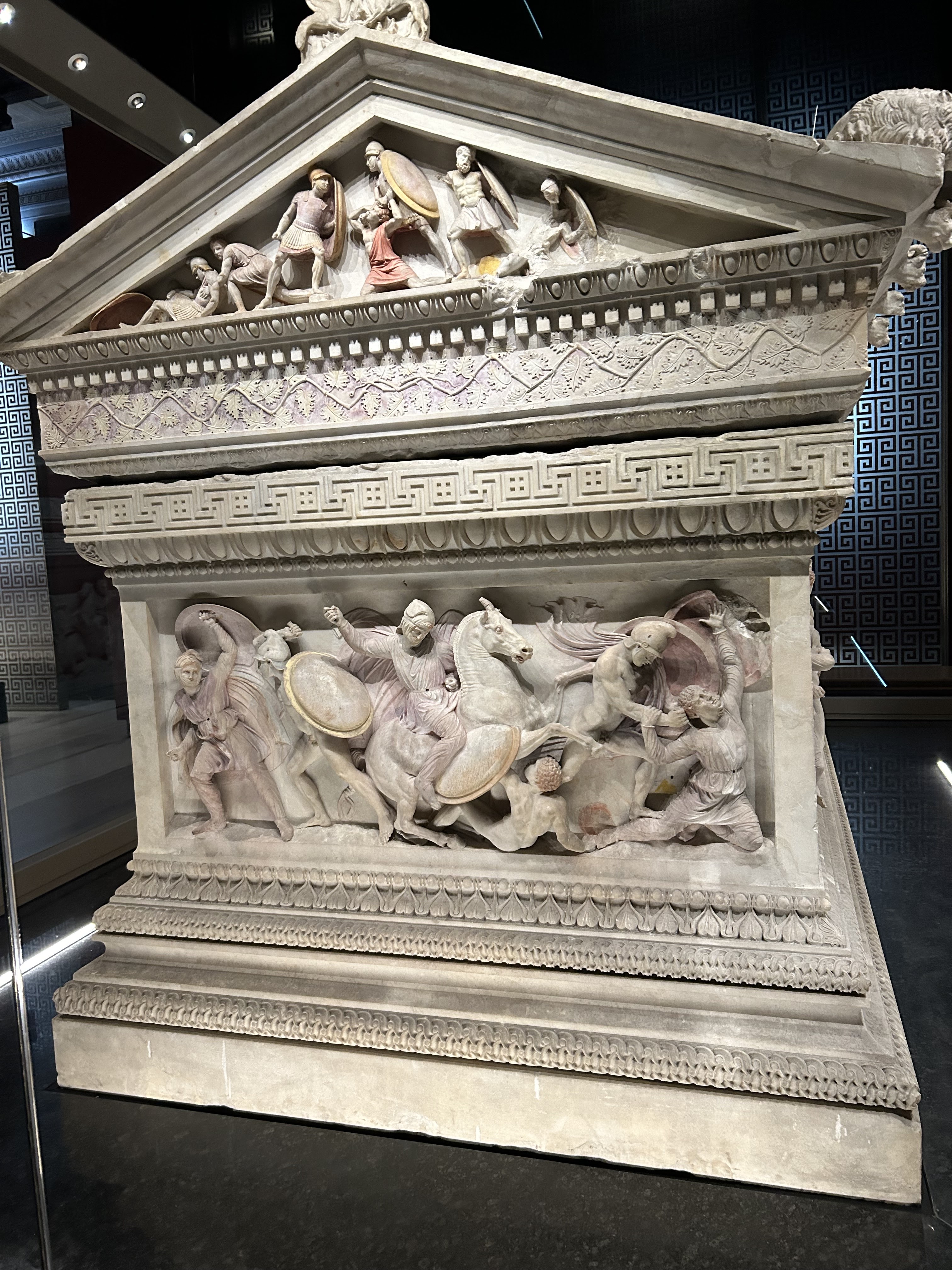
The jewels of this museum are the Sarcophagi.  A total of 21 were discovered at the Royal Necropolis of Ayaa near ancient Sidon (current Lebanon) of the royalty and nobles of Ancient Sidon.  They cover a swath of history in the Ancent Mediterranean.  What was even cooler was that I realized that I had seen pictures of some of these.

Below is one of the more famous and well photographed, the so-called Alexander Sarcophagus.  It is estimated to have been constructed between 331 B.C. and 311 B.C. and made for either Abdalonymus, King of Sidon appointed by Alexander, or Mazeus, a governor of Babylon.  


This side possibly represents the Battle of Gaza (320 B.C.) in which Abdalonymus was slain.


One side shows the Battle of Issus (331 B.C.) and includes Alexander.


A lion hunt, with either Abdalonymus or Mazeus:


The other side shows a lion hunt.  


An interesting note is that this coffin was originally painted (you can see traces in the first photo). Below is a picture of a recreated paint scheme:


Source


Monday, August 12, 2024

I, K, 8, Comma

 My computer has started having an issue.  Specifically, the i, k, 8, and comma keys are not consistently working.

The problem manifested itself first with "i" key.  I was happily typing along and suddenly I got notified of a mis-spelling.  "Oh" I thought to myself, "I missed an i".  Hit the key and nothing happened.  Then after a bit, an "i" populated.

"Maybe the key is stuck" I thought to myself.  I tried to clean out under the key, first with a paper clip and then with canned air at work.  No such luck.  And as I paid attention, I realized it was not just the i key, but the 8, k, and comma keys as well (which make a diagonal line down the standard QWERTY keyboard).

The odd thing is that it is not consistent.  Sometimes it can take 30 seconds for a character to appears.  Sometimes they start flowing as if nothing happened.  Sometimes I wait and then all of a sudden I get five of the same character.   It is very frustrating.  And for capital "I", only the Cap Lock button seems to work.

The number "8" is not often used.  "K" more so.  Commas even more and "i" - well, it turns out a lot of English words used "i".

The inconsistency of it makes me wonder if it is a driver issue (those "i's" just all came out fine for example).  Research online does not suggest something particular in that direction and all general updates seem in order.  It seems consistent across multiple browsers but less pronounced in Libre Office.

Deep thoughts may be slightly delayed during this interval until I find a solution.

Saturday, August 10, 2024

The Price Of Anything


Going through the rubble of a relocated life gives one a good reminder of the amount of stuff we tend to accumulate in the modern world. 

 I tend to be a person that keeps a lot of things: I still have my 4-H books on raising chickens stored away somewhere and still have some of the books from my childhood.  A lot has gone over the years but a lot has stayed here.  But quiz me on the cost of most of these things and I will have little idea what I paid for most of them.

I became more conscious of this as years went by.  In some cases it is the keeping of a receipt that goes with object (they make great book marks, for example):  looking back and realizing not only how much something was (inevitably less than it is now) can be both a humbling and frustrating experience.  In some cases it is because the cost of the item is more memorable: A 20 figure set of Gamma World figures was about $112 six years ago and has doubled in price and the price of finishing out my sword exists in my brain.

But the connection I failed to make was that of the actual cost - until Produce (A)Isle, when the cost of things against my wage became very clear indeed.  Knowing what I know now, the thing I failed to fully account for is the cost of life that involves.

Money in our modern world is time and time in this world is life - our lives.  That $6.00 cup of Frappacappacoffee?  Depending on your salary, that represents one half of a work hour to thirty seconds of a work hour.  That book?  A new one will easily be over an hour for a minimum wage employee, and ever for higher paid folks it can be not an insignificant amount.  

The correct question is was it worth it?

Value remains in the eye of the beholder:  to a collector a high price can represent the pinnacle of a collection while to the common person it seems far too much.  And the pleasure of owning a thing may outweigh the apparent cost of it.

But it does leave a question:  Is it truly worth the life that it cost use? Or - given that we will leave all at some point, like it or not - was it a foolish investment in a passing thing that, while it cost a great deal of money, was not worth the cost of our life?


Friday, August 09, 2024

That Which Is Your Own

 "If all this is true and we are not silly nor merely playing a part when we say 'Man's good and man's evil lies in moral choice, and all other things are nothing to us,' why are we still distressed and afraid?  Over the things that we seriously care for no one has authority; and the things over which other men have authority do not concern us.  

What kind of thing do we have left to discuss? - 'Nay, give me directions.'

What directions shall I give you?  Has not Zeus given you directions?  Has he not given you that which is your own, unhindered and unrestrained, while that which is not your own is subject to hinderance and restraint?  What directions, then, did you bring with you when you came from him into this world, what kind of an order?  Guard by every means that which is your own, but do not grasp at that which is another's.  

Your faithfulness is your own, your self-respect is your own; who, then, can take these things from you?  Who but yourself will prevent you from using them?  But you, how do you act?  When you seek earnestly that which is not your own, you lose that which is your own."

- Epictetus, Book 1.25 (Modified layout for emphasis, highlight is my own)

Said a bit more succinctly, no-one can cause you to give up your self respect and faith except yourself.  I often forget that, chasing after - as Epictetus states - those things that are not owned by me, those things that I have no power or control over:  not only world events, but even how other people view me.  How often I have surrendered my own faith and self-respect in such fruitless pursuits.

Thursday, August 08, 2024

The Collapse CLVII: Honey Harvest

 14 August 20XX +1

My Dear Lucilius:

Today I harvested the honey.

To be honest this was a little earlier than I have harvested honey in years past, almost up to a month some years. It derives from a sense of caution this year that I have not had in years past: before, recovering a hive was (in the worst case) a matter of ordering a new nuc of bees or re-queening or simply supplemental feeding over the Winter. This year, I have none of those options.

The harvest itself is a straightforward task: honestly set up and break down are longer than the actual process itself. Besides gowning up for the battle, one has to get the uncapping tool ready, the honey harvester – a cylindrical tube with a rotary mechanism inside and three frame holders, as you might recall – set up on its stand, the honey pail bucket and strainer cleaned and the bottles prepared and ready to fill. Something to hold the honey supers while unloading them (like a table) is a great idea as well. Most important is to have a clear path to all of this.

One fires up one’s smoker, lifts the outer telescoping lid and inner lid, and using the bellows start sending smoke in. The bees – those that do not fly off – will scurry down to the lower levels of the regular deeps; when enough are out one uses one’s hive tool to pry the super off and place it two one side. I had two supers mounted on each hive, so two each got pulled off. That finished, I will smoke the bees down some more. remove the queen excluder that keeps the queen in the Deeps and not in the supers (besides not risking the queen, it keeps eggs from being laid in the valuable honey real estate), then put the inner lid and outer lid back on. It is good to inspect the bees as we get closer to Winter, but I would just as soon let them calm down for a few days.

If one can get away with it (I can), having the processing area removed from the beeyard by distance is wonderful as it keeps most of the bees away.

The harvest itself is straightforward: once upon a time one could use an electric knife to remove the outer cap of the honey but given our current lack of power I had to made do with a kitchen knife and follow using the uncapping tool for any missed cells. One should do this in a tub of some kind to catch the wax cappings as this will be the yield of wax for the year. One then places them in the harvester in groups of three. The rotary force as it spins pulls the honey out; at the end one has honey in the bottom and empty frames. Pull the frames out and replace them in the super, rinse and repeat. Several times during the process the honey has to be drained out from the harvester through the colander into the bucket, a five gallon plastic one with a pouring spout at the front.

When all the cells are scraped and the honey strained one pours the honey into bottles. Given the situation, I scraped down the inside of the harvester with a spatula to get every last drop.

Cleanup is simply – because the bees will take care of it. Simply lay out the frames and harvester and the bees will scoop out every last drop of any residual honey. Tomorrow or the day after I will take the frames, clean them of propolis and any burr wax and put them back into the super, and then bag them up (to prevent wax moths or other pests from ruining the supers). The wax I captured from the cappings will be rinsed and then melted down into a single container for use later and any propolis will be set aside for further processing (Terribly useful stuff, propolis. Traditional uses range from tinctures to a component of violin varnish).

Having Pompeia Paulina was a great help – besides just being fascinated with the process, we were able to get things done in half the time that it usually takes me.

The yield? About 25 one pound bottles or jars or honey (whatever was at hand to fill) – not my biggest harvest by far, but not my least either. I likely could have gotten more if I waited longer but as discussed above, there are other concerns to give heed to. And what better way to spend the day than bottling honey with one’s honey?

Sadly in these troubled times Lucilius, these are the only sort of jokes that I can muster.

Your Obedient Servant, Seneca 

Wednesday, August 07, 2024

On Breaking: Thanks

 One of the things that I have been a fan of over the years is something that smart people call The Social Internet.  It is the idea that, unlike how the InterWeb is used often these days to attack and belittle, it can actually act as a unifying force to both to share information and give support, especially in a world where due to mobility the standard sorts of connections of family and friends we had in yesteryear are pulled apart.  When it works, it works beautifully.

And so, thank you.

Thank you for letting me effectively collapse on line.  Thank you for taking the time to read and comment (and I know everyone that reads is not necessarily comfortable commenting).  Thanks for the encouragement and support.

As always, thank you for the support of the blog.

I consider myself to have one of the best commentariat (And readatariat as well, although I just made that up) who conduct themselves accordingly per the rules of the house. And can be really decent when opinions diverge.

Thank you for giving me a reason to get up and write every day.

Tuesday, August 06, 2024

On Breaking

One of the commitments I made to myself and this blog some years ago was the fact that to the greatest extent possible, I intended to be as honest as I could in my writing (especially easy after surrendering any hope of commercial success; it is easier to be honest when there is no hope of earning money by your words).  I would write as a felt, preserving only the names of the innocent to at least keep them from any of my own mis-steps.  Even as late as yesterday morning, I had started posts for this week's update from Turkey (The Istanbul Archaeological Museum, a pretty cool place).  Pictures were uploaded and everything.  I just needed text.

Somehow, something broke in me between then and the time I am writing this.

I have no idea what it was fully.  Partially, it is going through a season at work where there is not a terrible lot for me to do and I feel like a third wheel (or fifth wheel, depending on your choice of transportation or dates).  Part of it is the fact that, like it or not, our income has changed somewhat drastically over the last year and the ramifications of that continue to make themselves felt.  Part of it is the fact that, with the wedding complete, the paperwork for the estate is starting to trickle in and I am having to start to consider truly impactful decisions.  And part of it is world which, no matter how little I try to follow it, seems intent on descending into madness.

I go through these phases sometimes, as longer time readers of this blog will remember.  It is not quite despair, unlike younger me who could feed on this sort of thing for weeks.  It is more the sense that there is a wrongness that, no matter how I try, things will never really be whole again.

I think about my father and maternal grandfather at these times.  

My maternal grandfather graduated on the cusp of the Great Depression; his post graduate life was finding a job at a utility and working through the Great Depression and World War II (he was not allowed to enlist as his job was considered critical, something which always bothered him), and Eisenhower's 1950's and the eruption of the 1960's.  I am reasonably sure that by the 1970's he had no idea what had happened to the world and with retirement retreated to a world of fishing and working in the yard and Lodge business and going abroad with my grandmother.  His world shrank.

Likewise with my father; by his 50's the world had passed him by as well, or as much of it as he wanted to understand.  He, like my grandfather, became a man of his family and The Ranch and his local community.  He watched the world, but it was the view of a man who did it more to try to stay abreast of things that had moved beyond his own understanding as well.

And now, I find myself in their place.

I have become lost in these things, lost beyond my ability to understand or even care about them.  My concern about work has shrunk to "Will I continue to have a job?"; my concern about my larger life has shrunk to a family who even now are going off on their own adventures and a much smaller span of interests and even contacts.  And the world?  It is safe to say I no longer understand what is going on or why, merely that by every sign I see we long ago left the world of common sense and have ventured into a place where people pretend to know the way based on maps that were written with only the vaguest ideas of the world they claimed to portray.

Sure, likely some rest and rabbit time will put some of this to rights.  But buried down inside now seems to live this sense that somewhere, somehow, something changed about me, my view of the world, the world - or perhaps all three - that will not be set right again.

Monday, August 05, 2024

The Days of Future Past

 I have started running again.

It happened somewhat organically, partially driven by FOTB (Friend-Of-This-Blog) Eaton Rapids Joe's ongoing efforts to improve his own physical fitness and partially driven by morning walks which sort of turned into morning runs.  A great additional incentive to all of this is the fact that most mornings here it is far cooler than it would be at this time in New Home (which of course also raises the specter of what to do when the cold and rainy season comes - we will get to that bridge next month).

This is not like the last great running push I had 8 to 10 years ago:  I have limited speed expectations and distance simply is something that comes about:  I run as far as I run with the goal of trying to get a bit farther, then turn around and come home.  I do not anticipate ever trying to run any kind of race again, but have been pleasantly surprised at how relatively good I seem to be doing - frankly, running at a slow jog seems to do wonders for the knees (my biggest concern).

---

I have also been picking the harp back up.

Picking the harp back up (for me) is pushing through the inevitable two to three days where all one does is tune and retune the harp.  It is a bigger initial task than it sounds like: imagine a 25 string guitar where one has to check 3.5 octaves' worth of strings for tuning, with the knowledge that changing any one of the tuning keys (Delgán Beag in Irish Gaelic) will possibly set off your tuning on an already tuned string - for context, wire strung harps such as mine (and nylon strung ones as well, as I recall) use a combination of taper and friction to hold the strings in place, thus allowing them to flex instead of break. Fair enough that it becomes less and less over time as the strings stretch a bit to hold their positions, but it is a mental block I struggle with.

(The other issue is tuning replaced strings.  Often this can be a case of slowly bringing them up to tune over days or weeks as you allow the wire and peg to adjust.)

This is one of those things that has been "on my list" for years of things that I wanted to pick back up: I often harp (pun intended) on the fact that we lay down our hobbies and artistic endeavors as we grow older because we get too busy with the activities of life.  Arts and crafts (however you define that) becomes a luxury activity that we either practice rarely or not at all and/or admire in others with their skill.  We could have no less skill; at least in my own life I convince myself that other things I am doing somehow are more critical.  

Note to self:  One of the most famous harpers from the 1792 Belfast Harper's Festival was Dennis Hempson, who was 97 at the time of the festival.  Born in 1695 he played for Bonnie Prince Charlie. He lived to be 112 and was known to have played as late as two years prior to his death.

Like Iaijutsu, this is something I can do for years.  I can put forth a little more effort: true that Dennis did this all his life, but he was also blind from age 3.  I have no such physical impediment to excuse my lack of effort.

---

Why things such as this (and others that I have not mentioned)?  Why now?

Part of it, I suppose, is purely a survival mechanism:  frankly, all of this is free.  I have had my harp for many years and all of the music books I could learn from for the rest of my life.  Running requires only shoes at this point (which have to be replaced periodically of course, and cold weather gear to be considered) - but I can put a lot of mileage on shoes before they give out.  Between now and the middle of next year will be tight enough; no sense in layering on a new set of expenses.

Part of it as well is that I have a different schedule than I did, thanks to the move.  Between the addition of time formerly lost to a commute and not having Iaijutsu three times a week (as well as no part time job), I have to time to start dropping such things like this back into my schedule.

The final part is simply that I am appreciating more and more that the time I have is limited.  As Uisdean Ruadh and I were discussing last weekend, there is a limit to the amount of new things I should consider taking up simply because there is not much time left (short or in the long run).  Yes, we can pick up a thing at any time and become good at it; the question is does the cost/benefit ratio make sense?  Thus, a return to things that I know and can start from an elevated platform of knowledge.

How odd to find that moving in the Near Abroad would result in a return to the past in a way I could not imagine.


Sunday, August 04, 2024

On Hell

Friend-Of-This-Blog (FOTB) Eaton Rapids Joe posted a succinct yet pithy contemplation on Hell this past week (here).  It was both useful and timely, as it had mirrored some thinking I had been doing on the subject as well.

The consideration - as mentioned by ERJ - is that we as humans have badly misinterpreted Hell in a way that allows us disregard its full impact.

Hell as a location in Scripture, includes the following characteristics:

1)  A place of unquenchable fire (Mark 9:43)

2)  Where the fire is not quenched and the worm does not die (Mark 9:48)

3)  Where Satan and the fallen angels are exiled too (Matthew 25:41)

4)  A place of suffering where we are conscious of ourselves, alone, and without God (Luke 16:  22-26)

The last point is where I would argue the misunderstanding manifests itself.

Over the years authors have happily filled colored within in lines of the first three points:  Dante's Inferno does a splendid job of giving an imaginary view of the bare description we have.  And Jonathan Edward's sermon "Sinners in the Hands of an Angry God" will sober up almost anyone about the brevity of life, at least for a time.  And even in our modern era, Hell has become a place of entertainment scenarios (The Doom Franchise, the Escape from Hell series, the movie Event Horizon).

But what, really, is Hell?

From Scripture, it is clear enough that it is a place of tremendous - tremendous in "beyond our current capacity to comprehend" - place of suffering.  Most importantly, it is the one place where God is not.

The first point people can shrug off - "I can suffer" they say, perhaps not comprehending that it is suffering without end.  After all, people "know" pain.  But the second point remains something few of us can really comprehend.

The term "Common Grace" is something that has fallen out of use and something that today I would argue even many Christians do not fully understand.  It is simply that goodness of God that manifests itself in our daily lives to all people, whether saved or unsaved.  "God causes the sun to shine on the evil and the good and the rain to fall on the just and the unjust" says Christ in Matthew 5:45. It is His love for His creation that is meant to demonstrate to a world that may not otherwise know Him that He is there and He loves us.  Rain, sun, flowers, rabbits (my favorite) - all of this come from the Hand of a God that clearly says He desires no-one to perish eternally.

What happens when that presence is totally removed?

It is a hard thing to visualize in our lives.  Pale imitations might be when our parents both pass away and they are no longer there or a divorce where our former spouse no longer is in the picture at all or where a former friend completely cuts us off.  But even those are not completely accurate because we still have the memories of them to guide us.

What if every good thing and the very presence that underlined all of it was gone - not just for a little while, but for all eternity?

Alone. Completely alone.  Without anyone and without even the former things that were good, although we did not know them as such.

Randy Alcorn in his book Safely Home gives us a brief hint of this in the view of a nameless character (in the book, it is clearly Mao Tse-tung):

"Thirst without water to quench it.  Hunger without food to satisfy it.  Loneliness without company to alleviate it.  There was no God here.  He had gotten his wish.  On earth he'd managed to reject God while still enjoying His blessings and provisions.  But it was excruciatingly clear now that God was the author of good.  He could not have it both ways, not here.  No God, no good.  Forever.

He had wanted a world where no-one else was in charge, where no order was forced upon him.  He had finally gotten it.  He had secretly wondered if there was something beyond death but if he went to hell, he fully expected to rule there.  Yet here there was no king, for there were no subjects.  Only one prisoner - himself - in eternal solitary confinement.

He missed the sound of laughter.  There was no laughter here, nor could there be, for laughter cannot exist without joy or hope.  An awful realization gripped him.  There was no history here.  No story line.  No opening scene, no developing plot, no climax, no resolution.  No character development.  No travel no movement.  Only a setting of constant nothingness going nowhere.  Excruciating, eternal boredom. Nothing to distract him from the torment of the eternal now."

This is Hell, the true reality of it:  God's presence fully removed and with it removed, all that was good in the world. Not one single thing of goodness, in a place where only Satan and the fallen angels were originally intended to inhabit.  Made only more awful by the fact that each one will know that they were the ones that condemned themselves to this.

I do not know how communicate this in a way that would make sense.  Only that to dwell on the horror of such a place is enough to drive me to my knees.


Saturday, August 03, 2024

Psalm 135

 Rambling through The Tube of You on Thursday,  I came across a video of Greek monks from Simonopetra Monastery in Mt. Athos, Greece.  Run time 2:26.


Longer version 8:42 Run Time (also, with lyrics and a different key):


Friday, August 02, 2024

Evening Walk, 2130

 I try to take an evening walk here in New Home 2.0 as often as I can.

Evening walks are much more pleasant here on the whole than they were in New Home.  Beyond just the temperature differential at that time of day - as much as 20 to 25 F - there is a lovely breeze that carries the cool, sometimes almost cold air, along.  The days are still long here, so even at 2130 the street lights are lit but not needed as I step out along the sidewalk.

---

We live on the side of the tracks (literally) that is far more residential; a half mile away the main road that leads to the more business portions carries the traffic of diners and shoppers and those getting off work.  Our traffic here is much less, residential dwellers returning to their home - if there is any traffic at all.

Our apartment complex is the only one on this side; across the light rail tracks are the higher value apartments and the live/work/walk/dine option that one so often hears about.  Our apartments are simply older and less modern, not less well maintained.  But we remain the island here on the edge of the residential neighborhood.

Walking along the southern edge as I leave, one passes by the floor units and the windows and balconies of the units rising to the third floor.  At this time of night most of the window shades are closed and the windows cracked, not fully open - something that genuinely surprises me coming from New Home.  There, we take advantage of every cool breeze that is not humid that we can get:  electricity costs money, cool breezes are free.

Punctuating the sea of window shades is the occasional open window, allowing me to look into the lives of my fellow inhabitants.  This is another novelty, or at least a novelty I have not experienced in well over 25 years:  in Suburbia in general and New Home in particular, shades are drawn and lights off more often than not.  Here, one gets glimpses into the lives of others:  flickering screens, the occasional person reading a book, people out talking on their balcony. For them, there seems to be an acceptance that there is a certain loss of anonymity living in this sort of group setting.

---

As I leave the edge of the complex I start to get into the residential neighborhood, a combination of row houses with faux fronts and alleyways with garages for backs and stand alone homes separated by mere feet built on postage stamp lots.  The row houses remind me of something one sees in pictures of Old European cities without their charm, the small houses are something that I have become much more used to even in New Home with newer building - packing the maximum amount of home into a minimum amount of space.

I have no idea how old the development is, although I have yet to see a home in disrepair and only one or two that look like a rental.  They almost remind me of some mythical idea of New England Homes that I have in my head from some source I cannot fully recall, a sort of Andrew Wyeth sense that defies the memory but I know is there.  The front yards - not more than 4 feet wide and perhaps 20 feet in length - are filled with an assortment of small lawns and ornamentals, some rather elaborate in their planting.  There is not any indication of any sort of herb or vegetable gardens that I can see, even looking to the small backyards that the houses have.  Perhaps they are there and I cannot see them or perhaps people just do not garden in this part of town.

---

Likely all of this is what is a planned community; small parks - one could call them "parkettes" - are liberally spread around this area, and if I get slightly over to the West there are a few almost nature trails that can be had.  The streets are well planted with trees, mature trunks of what I think is birch or alder with their white bark and the leaves that shiver and shimmer in the breeze as I make my rounds.

There is really no-one else out at this hour except the occasional walker or phone-talker; we scarcely ever meet but seem to separate to different sides of the street in an unspoken communication that is as real as it is silent.  Most of the houses are themselves dark at what I would consider this early hour.  I wonder if these are commuters to the city nearby via car or those that take the light rail that periodically rumbles by in the background, a constant reminder that we are part of a large urban area that cannot be seen from this place.

As I start to make my way back up towards my building, it is almost always the same:  the southern approach that my living room window looks out, from which I get a view of trees and sky and can almost pretend - unlike my neighbors on the other side of my wall - that I am living in a far less urban area than I actually am.  As I cross the parking lot and its covered structures, I can see the windows of my third floor apartment:  shades up and windows aloft to catch the cool night breeze, but no lights - the darkness is cheap and even cheaper when I am not home and I can find my way in now as if I had lived there for years.

---

Coming back in and removing my shoes on the pseudo-laminate flooring before I step onto the new - but undoubtedly cheap - white carpet, I reflect as I often do on the all of this.  This is not the place I expected to be nor the living arrangements I expected to have.  

For all of that it has worked out well,  I think to myself as the breeze continues to rush in and the faintest of leave trembling can be heard even as the rumble of the train begins to overshadow it.

Thursday, August 01, 2024

The Collapse CLVI: Ripening

12 August 20XX +1

My Dear Lucilius:

The wheat is starting to turn.

I write this with not quite the sort of enthusiasm that I might have written this with only a few days ago, not so much from a lack of excitement (I am always excited about wheat ripening) as I am about managing my focus on the matter.

I have enjoyed growing grains for years, although the growing of such grain has mostly been in small quantities to perhaps make a loaf or two of bread and seed grain for next year. I cannot tell you why I love it so much; there is just something both about the nature of the growth itself as well as the play of watching the grains riffle and swirl in the breeze. More than once since moving here I pulled over at the place near Big City and just watched the grain move and blow.

Over the years I have grown any number of grains: Wheat (Winter, Spring, Emmer), Rye, Barley (Black and Regular), Sorghum, Buckwheat, all with varying degrees of success. Climate had a lot to do with it: where I grew up, I could get almost anything to grow to maturity. In the place where my wife and I had lived for years and raised a family, my go-to’s – wheat, barley, rye – almost never did well because the rain extended out through the Summer, which often introduced mold and a failure to ripen long before I could get to them. There, the most successful were either the ones that finished early (some strains of rye and barley or Emmer wheat) or Sorghum in the Summer (which was wildly successful, if I could keep the birds away). For some reason, Buckwheat and Oats have always been a total loss for me wherever I have lived (unfortunate as I eat a lot oats – or at least did so, in the past).

The processing of my own grains is not difficult; an afternoon with a hand scythe is enough to pull everything down and put it into small shocks to finish the drying process. Threshing is a pretty primitive affair: it is me, a plastic bucket, and a bat. After the initial thresh I drop the grains from one bucket to another, allowing the breeze to take most of chaff. I rinse and repeat once or twice and then move to hand sorting before rinsing everything and allowing it to dry. Ovens in the past worked well for that; I suppose now covering it directly in the sun will have to do.

Thankfully the grain mill I purchased years ago is not dependent on electricity; a small hand crank model, it does the job when one is grinding grain down at need for baking. It is a pleasant enough task, although one that requires two or three passes to reach the right consistency.

I know you did not ask, but all things grain are covered in Gene Logsdon’s book Small-Scale Grain Raising. We have talked about Logsdon much in the past and how much I admired his view on life and agriculture. His practicality, clarity of opinion, and sheer cussedness (A term that is used, I believe, for stubborn endurance) are things I have tried to emulate.

I passed the information on the state of the wheat along to Young Xerxes in the presence of Pompeia Paulina to clearly and concisely communicate the information – not commit. The information itself was straightforward: the Wheat is turning, I would likely give it the earliest of two weeks, someone should let everyone including Epicurus know.

Young Xerxes shot out the door. My wife seemed happy that nothing more was conveyed than information.

In the back of my mind, Lucilius, I know this is the best course, even as part of me chafes to do more. But the value of a thing is not just its inherent value, but the value with which we treat it. And I am at least able to recognize a very good thing when I have it.

Your Obedient Servant, Seneca