Saturday, June 15, 2024

Updates From Home, June 2024 Edition

 A big week of news this week at Taigh na Thoirdhealbheach Beucail.

1)  As some of you may recall from earlier in the year, our oldest, Nighean Gheal, moved back home from living in the Big Big City.  Her lease was up, she could work remotely, and there was nothing really holding her there.

One reason she moved home was to save money.  The second came to fruition this week.

From her sophomore year of college on, she has made money by doing online tutoring in conversational English, mostly for students and business folks in North Asia.  She enjoyed it, she was good at it, and it gave her extra spending money.

As she started her job a little over two years ago at (Insert Large Name) Consulting Firm, she found that she did not really care for the business world.  As she explained it to me in a conversation, when she left "work" she felt exhausted and drained but when she finished tutoring she felt excited and energized.  A sign, one might say.

The outcome of this was she applied for and has been accepted to be an English teacher in South Korea.

She has had a passionate interest in Korea since we located to New Home 15 years ago, perhaps originally driven by the fact that the school she was at had exchange students from South Korea.  Over the years she studied Korean, fell in love with culture (most especially the music, or "K-Pop" to the uninitiated).  She has been at least twice and minored in Korean Studies.

We do not know her departure date or where specifically she will be placed; we do know it will be in the province of Chungcheonbuk:

Source

This program (as I understand it) is some kind of extension program through the South Korean Government.  The program lasts for a year, but if you are good you can be extended.

I am obviously very proud of my daughter - not just that she was accepted (it was a pretty rigorous application process including a background check, a Letter of Apostille, multiple interviews, and a draft lesson plan), but that she had the personal awareness and foresight to realize was she was doing was not making her happy and making a change before she got trapped in a career that she hated (as happens to many people).

Needless to say, likely there are pictures of South Korea in our not too distant future.

2)  Nighean Dhonn, our youngest, has been accepted into a University at New Home.

Last year, as you may recall, she was accepted into the Archaeology program at the University of Evansville.  She liked the school and program well enough, but unfortunately a series of retirements from the department meant that her interest (Classical [Greek and Roman] studies) would no longer be offered as more than a general course.  She applied for a transfer; we were notified that it as accepted this week.

There are two major impacts.  The first is financial, although I am not certain of the difference - she had a very decent package at her previous school and her new school (being a state school)  is not nearly so generous.  The second impact - related to the first - means that she can live at the house in New Home which in theory will mean that we are not paying for university housing (it is a commutable distance).

Another, lesser impact, is that we will not have get her and her stuff back in the Fall.

3)  Not to overlook the middle child, Nighean Bhan, she has started the second year (Summer session) of her speech pathology program.  She remains on course to finish in May of 2025, after which she will do a one year internship.

---

The amount of change that has happened this year - correction, the first half of this year - continues to stun me.

Friday, June 14, 2024

A Lifestyle Not A Hobby

The Seminar with my headmaster - although sadly shortened this year due to the change in my location and the starting of a new job - was good; two days with a Grandmaster is better than no days with a Grandmaster.

The great joy of training comes not from the physical exertion - plenty of that - but of the small comments and vignettes that are woven into commentary as he observes us. I envy him his ability to seamlessly do this; I always seem to awkwardly approach such issues when I try to do the same.  

At one point during our training, he mentioned the fact that one of the great frustrations he had as a teacher was people who simply made no progress.  This could take one of two paths: the first, that they only appeared irregularly, trained but obviously had not improved, and then went away for another period of time - a sort of drop-in casual student.  The other was those that did train regularly, but only seemed to mark time in their position: they did not improve, but simply add years to the amount of time they were present.  The comparison was made to traditional Japanese arts and martial arts in Japan where the lifestyle is all encompassing and difficult to the point that many, if not most, wash out because they do not wish to make the level of commitment.

Iaijutsu, he said, is the same.  It is is intended as a lifestyle, not a hobby.

The thought flew from my headmaster's lips and profoundly smacked me upside the head.

Anyone that knows me or has followed this blog is aware that I am a hobby person.  My interests are wide ranging - and arguably, there is nothing wrong with that.  The gathering of knowledge can itself be a lifestyle of sorts.

But in my case, I have also chosen the lifestyle of Iaijutsu.

When I was accepted into the school and my headmaster became not just my headmaster but, in a real way my master (Note the small "m", not the capital "M".  I have only one Master.), I entered a contract:  This is how it was, back in feudal times.  I agreed to train in this art and not others.  Additionally, I agreed to other conditions, some of which I knew and some of which I did not fully understand until later in my journey.

I cannot just "display" my art; I need to ask for permission.  Training at another dojo (as I did over the weekend, as New Home 2.0 is now my new dojo) requires formal permission.  There are techniques I am not allowed to publicly display, knowledge I am not allowed to speak.  I am even forbidden from casually displaying my sword to other martial arts practitioners.

Somewhat to my surprise, I found I had started a martial art and acquired a lifestyle instead.

But frankly, it is a lifestyle that I do not practice as I should. In so many ways, I still treat it as a hobby, something that I can practice or not at will.  In point of fact, I have made the commitment.  For me to give up now would be to be cast out in a literal sense:  my name would not be spoken, my sensei (plural) shamed because of my failure (it has happened).

But really, this true of my life in general as well.  A lifestyle of hobbies prevents one from really become skilled simply because one is not willing to commit in meaningful ways.  It means choosing not to do some things.  It means training when one is tired or bored or just not feeling it.  It means - at some level - measuring all of one's activities against the standard of "What best advances me in this lifestyle?"

Does this mean I will stop making yogurt and cheese or studying Old English or half a dozen other things I do?  Hardly.  These things fill useful niches of my life, either by the products I get from them or the simple enjoyment derived from them.  But it does mean that some things have precedence over others and that my time and indeed all my activities need to be viewed through the lens of how this impacts the path of swordsmanship I have chosen.

For me, I was reminded that the musha shugyo - the warrior's pilgrimage - is not just a saying.  Even now, for some, it remains a way a life.

Said differently, it is a lifestyle not a hobby.

Thursday, June 13, 2024

The Collapse CLI: Smoldering Stalks

 30 July 20XX +1

My Dear Lucilius:

Pompeia Paulina sleeps away behind me in the other room.

I write this in the darkness of night, by the light of the almost full moon, awake from a dream as I have been for the past three nights.

Each night it is the same: We are in the field of wheat where we met Epicurus and Themista. It is later in the year; the wheat is brown and dry and bowing down slightly in readiness. The winds of September, bearing on them the hint of Winter that will come in less than a month, whirl fleeting ripples into the ocean of grain.

Pompeia Paulina is there. So is Young Xerxes and Stateira. We are sitting on the rise of the hill, a picnic of fruit and cheese and wine on a blanket.

Then- soundlessly - the field suddenly erupts into flame.

It is not as the movies of wildfires that I have seen, an advancing wall of flame driving all before it. It is a singular eruption into a fireball without an explosion. I smell the scent of scorched hair; my own, I see by the withered hairs on my arms and the ashen eyebrows drifting into my eyes.

They are all gone – Pompeia Paulina, Young Xerxes, Stateira. It is just I and the picnic blanket, undisturbed by the fire.

One of the wine glasses pings and shatters. From nowhere, everywhere – gunfire erupts.

I fall to the ground, wildly looking for a weapon. There is no weapon of any kind, except the cheese knife that sits idly on the plate of cheese, now stained with red wine from the shattered glass.

A hand shakes my shoulder – startled, I turn and look. It is Blazer Man out of nowhere, handing me a rifle. He smiles bleakly at me, then takes aim at unseen enemies who cannot be seen on the road or in the smoldering field of wheat that is now naught but black stalks and seared grain heads.

With that, I awake. Every night, the same dream, at the same moment.

I am no soothsayer to see the meaning of this. The things are real, the facts are not: Pompeia and Paulina have never been to the field of wheat, it is not September, and Blazer Man has handed me no rifle – or anything else for that matter, fields do not spontaneous erupt into flame, and weapons are only shot by people using them.

It troubles me, Lucilius, more than I care to admit. There is no horror in the dream, just confusion and fear and a lack of understanding as my surroundings collapse into flame and death and last stands.

And yet sitting here I can still smell the smoldering stalks and see the drops of the dusky red wine staining the cheese beneath it.

Your Obedient Servant, Seneca

Wednesday, June 12, 2024

2024 Turkey: Columns and Walls

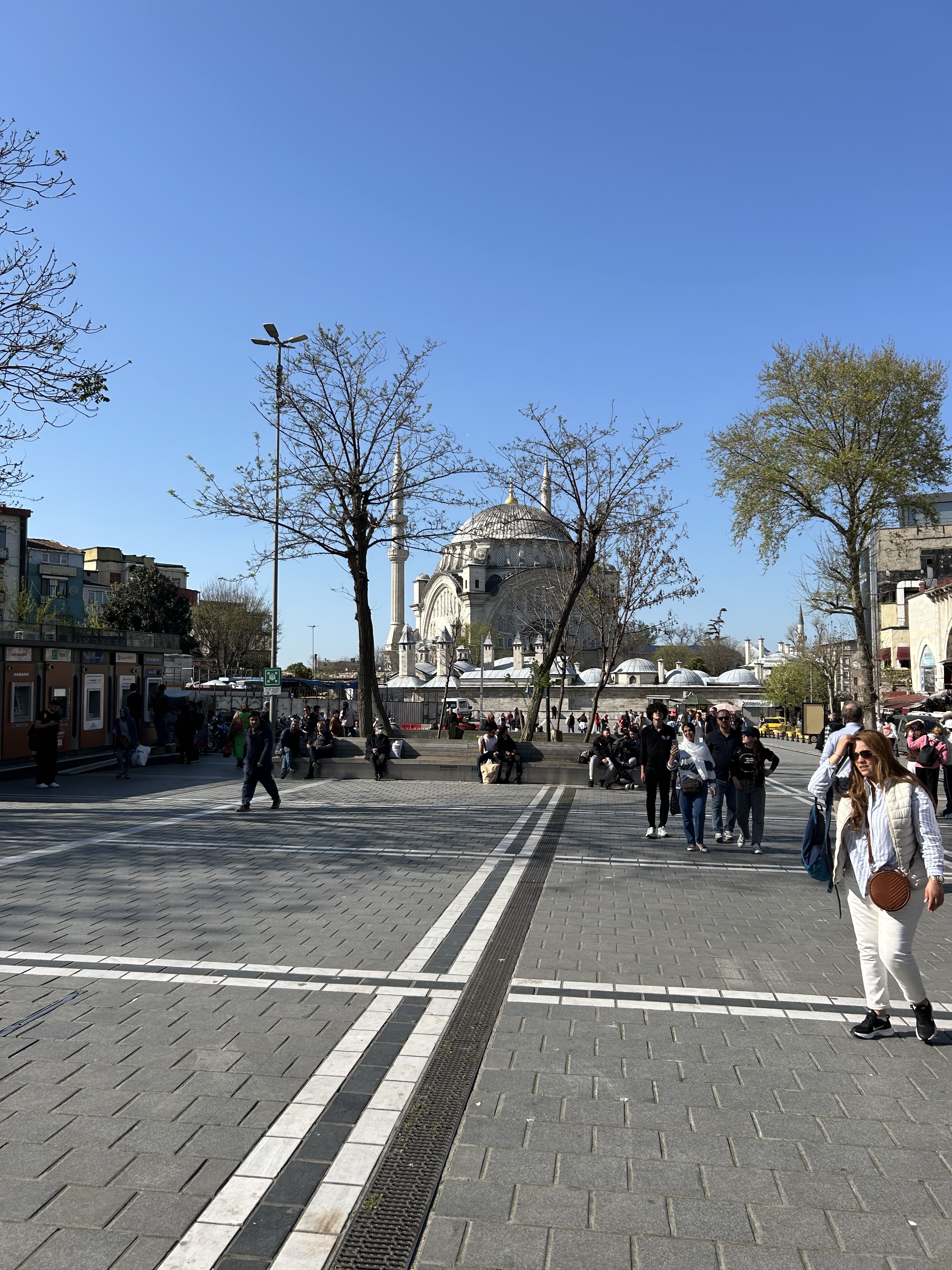
 Peppered throughout Istanbul are isolated items of her Roman and Byzantine past.


The Column of The Goths is possibly the oldest remaining Roman monument in Istanbul.  Standing 18.5 meters high, it may date to the reign of Claudius II (Emperor A.D. 268 - 270) or the years A.D. 331-332 of Constantine I.


An A.D. 6th Century writer notes that the column at one time had a statue of Tyche (Fortuna) on top.


The script, now much faded, suggests a memorial to a victory over the Goths.  


The Column of Constantine was moved by Constantine I in the year A.D. 330 from the temple of Apollo in Rome. Originally surmounted by a statue of Apollo, it was replaced over the years by statues of Constantine, Julianus, and Theodosius.  Destroyed in A.D. 1081, it was rebuilt and a cross placed on top by Alexius I Comnenus.  The cross remained until A.D. 1453 and the Ottoman Conquest.  In the late A.D. 1600's to early 1700's, the column was damaged by fire.  A wall was put under the column and iron rings bound it.

Interestingly, at least one story has relics of Christ being buried under the column.


(Source)

Byzantium and Constantinople were protected by walls through most of its history; it was these walls that allowed it to survive multiple sieges (it was ultimately the gunpowder era that overcame them).  The walls of the original Acropolis were expanded by the Emperors Severus and Constantine I and his son Constantius (A.D. 317 - 361).  The walls were a single wall - which the expanding city quickly outgrew.


The single Constantinian walls was replaced by the Emperor Theodosius with an inner wall, an outer wall, a low wall and a moat.  


(Source)

The walls, once built, secured the city - but were often prey to earthquakes, needing multiple repairs.  After the sack of Constantinople in A.D. 1204, the walls were more often than not in disrepair.  Only the threat of attack was enough to get them in better condition.  And yet, even at that, they withstood a 53 day siege before the Ottomans took the city - almost 1,000 years of service.


These walls are part of the Old Inner City and stand by the Topkapi Palace.  All of the Walls - or what was left of them - stood throughout the Ottoman Era.


These last set of walls were not half a mile from our hotel.  I have no idea what walls they are - there was no indication on any map and no marker.  A small park is there now and a small mosque.  The day I came the sun was setting and families who had make a picnic of the day were preparing a barbecue or packing up to leave.

As they had for perhaps 1600 years the walls stood, silently watching.


Tuesday, June 11, 2024

2024 Turkey: The Hippodrome

The traces of Roman and Byzantine Constantinople are few and far between in modern Istanbul.  One of the largest remaining is the Hippodrome of Constantinople


Originally built during the Roman Era, it was expanded by Constantine to hold 100,000 viewers.  At its height, it was estimated to be 1476 ft/450 m long and 427 ft/30 m wide.  Here up to 8 teams of 4 horse chariots raced the course.  Originally there four teams (Red, Whites, Blues, Greens) which raced (as in Rome), but eventually there were only two:  the Greens and the Blues.  The center of the hippodrome - The spina - was once filled with statues of all kinds, almost all of which were looted in the Fourth Crusade (A.D. 1204). 

Here, too, came the end of the Nika revolts in A.D. 532, where over 30,000 were killed in the hippodrome


Of the many items that decorated this area, only three remain.  One is the Walled Obelisk.  Likely built by the Emperor Theodosius, it was covered with brass plates which were stripped off during the Fourth Crusade of A.D. 1204, leaving only the inner core.


Another is the Obelisk of Theodosius, brought by the Emperor Theodosius in the 4th Century A.D. from Luxor in Egypt.  The column itself is a memorial of Pharoah Thutmose III (reigned 1479 - 1425 B.C.) commemorating a military victory.


Beneath the column a pediment displays scenes from the reign of Theodosius.


The third is an old friend:  The original of the monument of the Greeks from Delphi celebrating their victory over the Persians in 479 B.C. at the Battle of Platea.  We visited Delphi and the original site of this column last year.

(Note the wall around the column.  The base is placed on what would have been the ground in A.D. 300.) 

The Hippodrome was, following the Fourth Crusade, never returned to its original glory.  Eventually its ruins were used for stones for other buildings. Now it is a long flat oval called Sultanmehmet Square.

There is, however, one other landmark.


In 1898, the German Kaiser Wilhelm II paid a visit to the Ottoman Sultan Abdulhamid II.  Two years later, to honor that visit, a Fountain - The German Fountain - was constructed to memorialize that visit.


The German Plaque memorializes the visit.


The fountain stands alone, a memorial to two dynasties that were swept away.

Monday, June 10, 2024

Linking Out 2.0

 Last week I closed down my Linked Out account.

I did this once before as in turns out in January of 2017; my logic at that time was combination of leaving my professional information out there to be contacted by old organizations, its function as a  sales channel, a lack of real benefit, and leaving myself "out there".   Times change of course - being laid off will do that to you - and so last year I dusted off the old account and fired it up.

A little over a year later, I am re-powering it down.  Likely for good.

Some of my reasoning has not changed.  

Linked Out (now a wholly own subsidiary of Microsoft) is, on the one hand, the premier career linking and information site. Its competitors are either industry specific or not in the same league.   But for that size, it is surprisingly bland.  Part of that is due to a conscious movement to "Not Make Linked Out The Book Of Face" (e.g., limit or completely exclude typical social media fare). To that extent, it does not generate controversy.  But what it also brings along with it is a form of content uniformity that both (in my mind) supports a particular world view as well as likely subverts any meaningful discussion.

That is fine of course; I do not go to a career site inherently to discuss something like economics or my view of the decline of society or methods of making yogurt at home.  But neither do I go to a site to find that there is simply one view, and one view only, of the world.

A second factor - as before - simply that the site does not do anything for me.

Yes, it is useful to follow up with contacts from previous companies - but likely those contacts only ever reach out in the event that 1) They are looking for a job for themselves or another contact at another company; or 2) They are trying to leverage you for information on a current employer.  In terms of actual conversation, it is at a minimum at best.

Additionally, in terms of actual results for the reason I renewed - job searching - its results were minimal at best.

Of the 86 jobs I applied for during Hammerfall 3.0, the bulk of them were through the Linked Out Portal.  Some went directly to the employer's in-box, others sent me to the employer's website to complete the application there (e.g., I really could have found it on my own).  Of the four job listings that went farther than a rejection, only one came from a contact there.  One was through personal contacts and two were through directly applying at the employer's website (including the one I took).

In other words, I could have done just as well by searching websites and applying directly (as, it turns out, I did).

A third factor is simply the lack of different it makes in my life.  The postings are, for the most part, people getting jobs, leaving jobs, or talking about aspect of their companies (mostly about how great they are) with some "Why employers are failing us" sorts of lists and memes.  99% of these have no impact on my life and since I gained employment, I have done quite well without those sorts of updates.

The final reasons are personal.

The first personal reason is as before:  simply put, it is one more way to pull my personal information back into myself.  Yes, that posting is out there on the Wayback machine if someone wants to go to the trouble, but in principle on such things, it is probably better to make it as inconvenient as possible.

The second personal reason is that this is an extension of my policy in Responding To The World At Large II in that Microsoft (arguably) does not really support the sorts of things I believe in or my world view.  Yes, my puny single account going away (and a free one at that) will not impact their bottom line - except.  Except that that is one less marketing dollar they can get for me, on less "Out-mail" someone has to buy to contact me.  Not much, I grant you, but a philosophical victory all the same.

The third personal reason is simply that I intend this to be the end of the job line.

I do not know how long I have left to work (or how long left to live, if you get right down to it), but certainly my desire is that this current job in New Home 2.0 is the last formal "job" I hold.  In that sense, my canceling of Linked Out is the equivalent for me of burning the boats.  There is only, ever forward on this track.

Will I miss Linked Out?  The open secret is no - and I would bet that most people, if they were honest, would not.  Outside of the rarified atmosphere that permeates anyone that needs regular social media updates (and be clear:  Linked Out is a form of social media like every other), most people at best need it like that tool you need every six months to fix a particular problem:  nice to have, but not something that is front and center in your life.

Saturday, June 08, 2024

Thoughts On A Car

 My car has developed an oil leak of sorts.

It does not seem bad at this point, but being that I am in a new apartment and a new city it means that certain issues have to be dealt with.  For the new apartment, I am laying down a piece of cardboard to catch the drip.  For the new city, it means I have to find a new mechanic.

Sigh.  I really hate starting over.

I have solicited my coworkers for suggestions and will consult the InterWeb reviewing service as well; in a perfect world, the most desirable mechanic is 1) Reliable and well rated; and 2) Not so far that I cannot get to work (alternatively, that I can work from home).  But it did bring to mind the idea of how much longer I may want (or need) to hold onto this car.

The car is at this point a shade under 1.5 decades old. It is a standard transmission with reasonable (26 mph or so) gas mileage.  It seats four comfortably, six uncomfortably, and has a drop down back seat such that I can fill it with things like 40 lbs of rabbit litter or hay.  It has some general mechanical issues:  the driver's side slide door does not quite latch without a hip thrust and the passenger's side sliding door (replaced in the accident of last year) takes a bit to get in place, but the car runs.

More importantly, it only has about 219,000 miles on.

I checked my mileage this week. Currently I drive less than 10 miles a week (excluding any weekend jaunts).  Even when I get a bit more established here and likely have an Iai class to attend and a place to volunteer at, I cannot see my driving at more than 50 miles a week.  At my current gas mileage, that is 1.5 months a tank.  And were I to keep that kind of mileage up, I would accumulate something like 100,000 miles over what I estimate is the rest of my driving "career".  

That means, in theory, I could continue to drive this car for the rest of my driving life with care and luck,

We do have a "nicer" car of course; it belongs to The Ravishing Mrs. TB.  It is the one we use for drives and going out and has all the nice bells and whistles.  Once upon a time, her old car would be my next new one; given the state of car costs now, I suspect it will be hers for a long time as well or will transfer to one of Na Clann at some point (this is what we do in both of our families, shift cars around until they fail beyond repair).

Financially of course it makes a great deal of sense:  we have been without a car payment now since the mid 2010's and I have zero interest or need (or, to be honest, ability) to save for a down payment and get another one let alone afford monthly payments.  And given my new work commute, one could argue that we need only one (although one never knows where one will end up).

Can I "keep" my car until I can no longer drive?  I do not have complete control of that, of course:  I could get hit by someone at any time (and very much would likely have the car totaled at that point) or Our Political And Social Betters (OPASB) could simply outlaw the thing, as they seem intent on doing to everything that is not an Electric Vehicle.  But that could take time, and every day that is delayed in that respect is a day less I have to buy a new vehicle.

Does there come a point at which the cost outweighs keeping it?  I suppose there is. But then I keep looking at car prices and thinking about monthly payments and suddenly keeping the old car running seems like a better than average investment. 

In fact, at this rate it may be one of the few used things I own that continues to accrue in value.

Friday, June 07, 2024

A Brief Trip To New Home

Friends:

As  you read this post I am either on my way to the airport (No, really.  I quite booked the early flight) or am winging my way through the air towards New Home.  This will be the first time I have been back for more than a day on either side to go to Turkey since I left on 15 March, so a little shy of three month. 

My purposes in going are twofold.  The first - the original reason I booked the trip - was to take advantage of the head of my sword school being present for a week of training (in years past I would have attended the full week; currently I can only manage two days).  However, as we looked at the time required (it is essentially a full day to travel if one includes the loss of time zones and the fact that few direct flights exist) and the fact that the pack-up of the house (or what we will be taking, anyway) was only a few days after that, we elected to get me there earlier and extend my stay through Monday to help do one more assessment of what is going as they will be present to pack the day after my return.  This was a sensible extension as, now having been in this space for over a month, I have a very clear sense of what amount of space is available and what will fit and what will not.

The mixed feelings I have about returning are a surprise to me, frankly.

On the one hand, it will be nice to see my family (and pets) again.  Although I have adapted to the fact that I am alone here, it is an odd experience after spending more or less than last four years with most of my family in the house.  It is not the sort of thing that I consciously considered until it disappeared.

On the other hand, the return to New Home seems unreal.  That surprise me as it has not been that long since I left.  Three months since I departed - and suddenly it almost like a foreign place to me, with people and places I recognize but have not nearly the significance of my life that I would anticipate that they should.  This location was essentially the sum total of my experience for almost 15 years, and now it feels as little more than a footnote in my daily life.

This feeling will only undoubtedly increase, of course: after this trip, I have a trip booked in early July to move the rabbits.  After that, my visit back remains undefined as of today.

Will I need to go back?  At some point yes, if to see Na Clann at some point as well as A The Cat and Poppy The Brave. But that now adds its own issues, and I-Bun and Joy will now be here and need their own care and sooner than later, The Ravishing Mrs. TB will be here in New Home 2.0 as well.  

Beyond Christmas of this year, that crystal ball becomes very hazy indeed.

It is odd as well because, unlike Old Home, I have little attachment to the place other than a location that I lived and the people and activities that I did.  It was not a "home" in that sense of word, the way I feel when I go back to Old Home and The Ranch. 

But that is for me:  for Na Clann, it was part or all of their childhood in that one location.

How odd, to realize a place can have two such different meanings for the same amount of time.

Thursday, June 06, 2024

The Collapse CL: Loafing

 27 July 20XX +1

My Dear Lucilius:

Where does the time go! My sincere apologies for the delay in writing (I say “delay”; it is not as if I have any idea when or even if you will read this); these last four days have been an odd collection of recovery and action.

The “recovery”, of course, has been that of a man in his later years recovering from what can only be generously called a cross country hike. The day after we arrived was the worst; three days of on the road finally caught up with me and I was – slowly – able to make my way around the house and out to the garden to see how things were going for the first time in a week. They are going well, if that is of interest – my wife has years of experience here, compared to my relative handful of years and in fact, this may be the best the garden has looked.

The following days were all a little better: a little less sore, a little more agile. I suppose on the bright side, I am now aware of where points of pain and even arthritis will continue to develop over the next ten years. Not that it is helpful information of course, but it is information of sort.

The “action” is simply doing the things here that need to be done, as much as we can: continuing to work the garden and the small plot of grain we have, caring for the quail (and burying a couple; two years really is their lifespan), even checking in on the bees once (they are doing fine, thank you). Pompeia Paulina has pulled my dehydrator drying racks and put them into the sun with a window screen to dry as much as we can outside; our living room now holds the earliest of peppers, slowly drying as well. It is a big push, but she (and I) are conscious of the fact it is the end of July; within two months we could be facing snow already. And unlike last year, there is little enough of a previous year’s shopping bounty to bolster us.

The wheat? I will be honest in that I have been forbidden to mention anything about the wheat for a full week. When I tentatively raised the question – once – I was firmly told that “Young Xerxes was seeing to it and I am to do nothing but recover and spend time with your wife”. I gather that something is in motion somewhere; I may gently push again in a few days.

As Pompeia Paulina did point out, I have been gone a bit lately and she would like to see me. And so we have spent the last four days more or less by ourselves, confining ourselves to the small and regular chores on the property.

It strikes me as odd, Lucilius, as I sit here this evening as I have for the last three. There remains enough light to doing things: Pompeia Paulina sits on the couch working away at the stitching of something and I sit here at the table writing to you now. Both of us have cups of tea by– reused tea bags of course, so the tea is very weak but tea none the less. The smartphone is playing Handel’s “Music for Fireworks”: except for music and photos, it has little use without connectivity and remains easy enough to recharge. It remains a reminder of a world where something of beauty existed beyond what we can see in front of us.

As we sit here, I am struck by the fact that I had seen my grandparents doing the same thing so many years ago, my grandmother doing a crossword or reading or crocheting while my grandfather sat in his chair and read one of the books they left here for that purpose or the thin local newspaper that was published once a week. Music would be playing – music of the ‘30’s, ‘40’s, and ‘50’s in this case, the songs that they knew or perhaps the local AM station, crackling with static and local news and community events. My grandfather would fall asleep and then snore and my grandmother would nudge the chair enough to wake him up. In their retirement this was their Summer life, up here fishing and playing cards with neighbors and hosting their children and grandchildren when they came to visit.

How odd, Lucilius, that this seems nearer than ever and yet so far, far away.

Your Obedient Servant, Seneca


Wednesday, June 05, 2024

2024 Turkey: An Introduction To Istanbul

 I would suspect - though I have no hard data on this - that almost every trip to Turkey starts and ends in Istanbul.  Part of that is simply due to the fact that Istanbul airport is the largest airport in Turkey and, in 2023, was the second busiest airport in Europe - so every flight likely touches down here.  The other is that, well, Istanbul is Istanbul.


The current city of Istanbul is huge, both internally to Turkey as well as to the world at large.  Currently almost one of every five inhabitants of Turkey lives in its environs (15 million in a total population of 85 million), making it the largest city in Turkey; the next, the capital city of Ankara, has 5.1 million inhabitants.  It is also the most populous city in Europe as well as the 15th largest city globally.


Although the area of Istanbul was likely settled in the Neolithic era, the city itself was founded in the 7th Century B.C. by colonists from the Greek city of Megara.  The legend of the founding is that the leader of that expedition, Byzas, consulted the Oracle of Delphi prior to leaving and was told to build his city in the land opposite the blind.  He sailed to the Bosporus Straits and realized that another Greek colony - Chalcedon - had been founded on the Asian side of the Straits and had completely missed the geographic advantages that the location of Byzantium offered: A sheltered harbor and a defensible site.  Deciding the "blind" were the Chalcedonians, he founded a colony and married the daughter of a local lord. The city became known as "Byzantion".


The colony prospered: the tibes of Thrace needed trade goods and, as time went on, ships traveling for trade to the Pontus Sea (Black Sea) needed a port as well.  Byzantion was well situated for both of these needs.  Although subject to those passing through - The Persian Empire during The Greco-Persian Wars and The Athenian Empire during the Delphian League, it became independent in 335 B.C. and remained so until 73 A.D., when it became part of the Roman Empire


The dominant feature of Byzantion (Byzantium/Constantinople/Istanbul) is the Bosporus Straits, the narrow waterway (31 km/19 miles) that connects the Black Sea with the Sea of Marmara and eventually the Aegean/Mediterranean Seas.  This narrow sea lane - incredibly strategically important almost since the founding of the city - comes to with 700 meters/2300 feet of the two continents of Asia and Europe within the limits of Istanbul.  This has two impacts:  the first is that Istanbul is the one of the few cities that is on two continents.  The second is that Istanbul has always been in a place - even, apparently, in pre-history - of trade and human contact.


When Constantine the Great (A.D. 272-337) gained control of the Roman Empire, he sought out a new capitol away from Rome, a recognition that the Eastern Half of the Roman Empire had gained in power and importance.  The city of Byzantium already existed; he took it and made it into the Imperial Capitol of Constantinople.  Officially "founded" in A.D. 324, it would serve as the capitol of what would become the Byzantine Empire until A.D. 1453.


Traces of both Greek, Roman, and Byzantine Byzantium and Constantinople seem hard to come by, at least in modern Istanbul.  2800 years of human habitation combined with multiple building programs (Greek, Roman, Byzantine, Ottoman, and Turkish) combined with a region given to the earthquakes has reduced many such buildings to either ruins or markers indicating their location in the modern world.


The Byzantine Empire lasted for just about 1,000 years following the loss of the Western Roman Empire.  Under Justinian I (A.D. 482-565) it tried to regain the geographic range of its predecessor but the world had changed.  Over the next 1,000 years it essentially fought a long, rearguard action against newer peoples and kingdoms that sought to replace its power and geography.


Coveted for its wealth, Constantinople fell first not to the invading nomads or Vikings or warriors of Islam who all tried and failed, but rather to its Christian co-religionists in A.D. 1204 during the rather poorly named Fourth Crusade.  Almost 1,000 years of wealth and culture were stolen or despoiled.  The successor states - The Latin Empire of Constantinople (A.D. 1204 - 1261) or the revised Byzantine Empire under the Palaiologos Dynasty (A.D. 1261-1453) were at best empires marking time, subject to the whims of its more powerful neighbors.


In the case of Constantinople, its nearest neighbors (as we discussed last week) were the Turks, initially the Seljuk and then the Ottoman.  In A.D. 1453 the Ottomans realized a Turkish ambition of almost 400 years in their conquest of Constantinople.


Under the Ottomans, the city - which was still called a version of Constantinople until the 18th century, when the colloquial word "Stambul" began to enter formal usage (based, interestingly enough, on the Greek term "in the city"), Constantinople being the only city of note in the region), remained a capitol.  The Turks adopted the Byzantine bureaucracy and made it there own. From the Topkapi palace (and later, the Dolmabace Palace), the Ottoman Sultan ruled an expanding empire until A.D. 1683, and then a declining Empire until A.D. 1923.  Through all of this - the expansion, the retreat - the Turks built and made Constantinople their own, even as their predecessors had done.


Following the defeat of the Ottoman Empire in A.D. 1918, the Allies negotiated with the Sultan and his government.  An independence movement lead by Mustafa Kemal Ataturk, was declared in Ankara. With the dissolution of the Ottoman Empire in A.D. 1922, the final chapter of Byzantium/Constantinople/Istanbul as a capitol city after almost 1600 years - finally closed.


But although its history as a capitol may have closed, its existence as a crossroads of cultures and the lure of exotic lands continues to this day.  Even though stripped of its title as capitol, it maintains an attraction far beyond just a center of power.

One would like to think Byzas would not be displeased with the outcome of his vision.


Tuesday, June 04, 2024

Responding To The World At Large II

Anisthenes

Yesterday I touched, on a personal philosophical level, of how I am managing my response to The World at Large.  And a basis is important for having a reason for doing something.  But basis without practice is merely a set of ideas.  So practically, what does someone do who is seeking to thread the needle of living according to one's principles and mores in a world which is at best thinks poorly of them and at worst is vehemently opposed to them?

I have had to put some thought into these to bring them into the form of a written form, as it is not something that I had done before consciously.  I do not know that they rise to the level of a manifesto, but certainly the represent my current thinking and to the best of my ability my current practice.

1)  Do Not Engage

This principle can take many different forms.  It appears in simply to refuse to engage in certain conversations and activities - much like traffic law, as a citizen or organizational member or employee I will do what it asked of me - read the document, attend the training - as long as it does not undermine some belief that is a core principle (and trust me, few of these things rise to that level).  But that is all.  If conversations start on such subjects, I do not offer opinions or thoughts.  If no more is required of me than "read and acknowledge" that is all I do.  

I find as a consequence of this, I simply tend to disappear from many people's radar and calculations.  This is an unexpected feature, not a bug.

One especial thing I personally have to fight in this matter:  the need to respond to things.  This is especially prevalent in the electronic world, where responding is as quick as a simple typing exercise.  I do not have to respond to every thing I disagree with or every bad comment I see.  I really do not.

2)  Do Not Support

This principle takes two forms.  The first is simply to not support, by my presence or involvement, anything that is outside of what I support.  This is actually much easier than it sounds:  Just do not go. Do not show up.  Do not follow the group or post or person.  Just walk away.  This denies them attention, something that the modern world and the movements in it desperately crave

The second form is that of the pocketbook, one of the real remaining powers that we possess - especially in a consumer based society.  Many if not most of the businesses that exist are somehow based on providing a consumer service or a consumer product.   Those businesses depend, ultimately, on someone buying something to pay for something.

I know what some may say:  "TB, the companies are too big.  My not-spending there does not make an impact or difference.  Boycotts do not work."

I agree that boycotts - generally - do not work in the modern world, but that is as much a function of the fact that the word "boycott" will immediately invoke a visceral response as due to the size of the companies.  But if we think people walking away do not make a difference, it may be that we are not looking in the right places.

If you have an hour or three, I might suggest doing a study about events in the entertainment and video game industries of late.  In short, they have chosen not to serve their markets.  And their markets are responding with a lack of support, both verbal and financial.  That lack of support has critical impacts for those companies and those industries.  

I suspect that as time goes on and economy continues, this lack of support will become easier for many (due to economic reality) and more impactful to those companies that remain.  Extend that to every sort of human endeavor and association and one can begin to see the potential for impact.  All done, I note, with any sort of formal declaration.   The reason people have left will become clear to any that have the curiosity to understand.


 3)  Do Become The Quiet Revolution

Since my last two points have been detractive in nature ("Do Not"), it makes sense to have something that is a positive action that I can take.  After all, someone who is only ever negative tends to drive people away instead of pulling them on.

Becoming The Quiet Revolution is going to look different for every person depending on any number of factors including location, economic position, relationships, etc.  And people will likely participate in all kinds of different ways that I cannot imagine.  Here, at least, is what I am trying to do:

1)  Become Independent:  Independence can mean a lot of things.  To some it means complete self sufficiency.  To others it means being able to do something which is not dependent on "The System" to do (even a single planter box in an apartment balcony or making yogurt is a step in the direction).    To others it means foreswearing social media to focus on actual human relationships.  But in all of these, it is taking action to free one's self in some way from a system that wants us to just "Go along" and "Be Dependent".

2) Make Money Count:  To some extent this is the opposite of Item 2 above (Do Not Support), but it is meant as more than that.  It may mean swearing off national chains or even local chains that do not comport with one's views and practices.  It may mean being willing to settle for not new items and going without certain things (A note:  In a society as rich as ours, "going without new things" is not hard at all if one knows where to look).  And it certainly means spending with those individuals or companies that we do find are compatible with our beliefs and practices, even if it costs a bit more.

3)  Become Intellectually Independent:  A subtype of the first item on this list, it could go there but I feel it important enough to break out separately.

We, as a society, have the knowledge of ages at our fingertips but for the most part limit ourselves to a paltry number of sources for our information.  This is something that I have had to actively work on for years myself, to give myself a second education  which 100 years prior would have been par for the course but even in my high school years was quickly fading.

What could it be?  Literally this is a choose your own adventure experience.  History, economics, science, public policy, philosophy, theology - literally any subject is out there for gaining more information on.  A small note here:  the closer information gets to our modern era, the less without bias it becomes.  So it has ever been, so it will ever be - even the great historians of old tended to write in a way that would not offend their current rulers.   And as a second note, expect this to take time.  Knowledge is not gained in a single short span.

4)  Be A Engaging Example:  The World At Large has a public image that they like to portray of people that will not fit in.  It is generally a cross of a Neanderthal savage with the learning power of the mob trying to burn the library at Alexandria clothed as the Spanish Inquisition and the economic sense of a miser on the day that rent is due.  It certainly not flattering and while by no means completely earned - but by actions in the past, we who do not fit in have made ourselves a target for this.

Be different.

Be engaging.  Be knowledgeable.  Be the man or woman with the pleasant demeanor and a quick hand to help.  Know things.  Do not make every event an opportunity to "preach" about the problems of The World At Large or what is wrong with them.  Be helpful and share what you know. 

And, of course, always be kind.

Because here is the thing:  listening to people talk and discuss in my own circle of contact, there is a sense that there is "something wrong with the world today", to quote those great purveyors of modern wisdom Aerosmith.  People cannot bring themselves to identify it but they know it is there.  It is staring them every day in their personal economics; it shouts from the current narrative where things should be better but are not;  it cries to them to them as the hint of things not quite right from history begin to resemble the current circumstances in which they live.

They do not need someone lecturing or shouting.  They do not need the equivalent of Pharisaical demands that demands complete adherence before forgiveness.  They do need someone - us - to show them a different way.  And that we can do not by the volume or decibels or vehemence of our words, but by the simple act of living a different and better life.

Gandhi is quoted as saying that we should be the change we want to see in the world.  If the world does not see it in us, in whom will they see it?

Monday, June 03, 2024

Responding To The World At Large I


I have often struggled with my response to "The World At Large".

I really do my best to keep anything of general political or social nature out of my writing, partially because of the fact that (as denoted in my thoughts about Relevance) I am not very good at it in general, partially because of the fact that writing about such things only divides and never unifies, and partially - indeed perhaps mostly - because of the fact that what I desire more than anything else as a result of this space is the promotion of thought and occasionally discussion about such things in a manner where things can be heard, instead of words hurled as weapons.

But even I acknowledge both that I myself have opinions about things and that we live in a world where things of general political, social, and even religious nature impact my daily existence.  In fact, they thrust themselves into my face on a regular basis.

However, I have also had the experience of both living long enough to see how the inception of things is often not the indicator of how things end and being some that loves to read history and so having an understanding of how things often end.  Perhaps to the surprise of no-one here, humans are not nearly as clever as they think themselves and most of their plans for multi-generational/multi-year building of anything tends to sputter out more quickly than they would have imagined (insert reference to Ozymandias here).

So, in a world that continually impinges on me to have opinions and take actions, what is someone like myself to do?

I am not inherently a person of violence - my one and only experience with "fighting" was in the 4th grade where, confronted with the potential for a fight, I hurled my skateboard at the parties in question and sprinted home.  This is combined now with many years of training in a martial art - Iaijutsu - which brings one to the swift realization that even training with wooden weapons can result in serious injury or worse; one comes to understand that potential risks any time force is used.

Nor am I a person of strong ability to debate. Long ago in college, the professor assigned to guide me through my program noted that I tended less to debate than hurl my opinions out there as if they were gospel and do the equivalent of what we now call a "mike drop", supreme in the "knowledge" I had proved my point.  That does not make for good debating of course, and it has taken me years (35 plus) to reach the point where I learned that I lack the qualities required of a good debater and more importantly that not every comment represents a disagreement.

What I can do, as it turns out, is live in a way that to the best of my ability and does not further enable those individuals and movements that are opposed to me intellectually, morally, economically, or religiously.

Which is why I found the above quote from Charlton Heston both such a surprise (I had never seen it before) and so pleasing.  Because I realize that is exactly the way I am trying to live my life.

Is it somehow surrender-driven and hopeless?  I can see that argument being made - after all, I am essentially committing to a non-violent long haul path of quiet disobedience.  And certainly the results are the sorts of thing that may not manifest in my life time.  But men like Vaclav Havel and Dietrich Bonhoeffer and Aleksander Solzhenitsyn suggest otherwise.  

Is it without cost?  No, not at all.  The costs can come in ways that only a modern bureaucracy can think of devising. Just beyond the simple issue of losing opportunities or losing positions or losing money, it can turn into the blacklisting of one in all of society (The Soviet Union knew much of this; Communist China knows even more).  

But ultimately, as a Christian, I have a Master beyond any on this earth. And His questions on His commands and my motives and practices are not something that I can hope to avoid or side step.  Perhaps said differently, God expects His work to be accomplished in His way by His people.

Note the repeated "His" there.  There is no second option given.

Saturday, June 01, 2024

Relevance And Obedience

One thing that I have written about here from time to time in the past is our current society's deep-seated need for relevance.

I have most often done this in the context of the Modern Church movement, which (in my opinion) has often pushed the historic Christian faith to the side in order to appeal (be relevant) to the current population (sometimes known as "seeker friendly").  But really it has become embedded in every aspect of our population, driven largely by a social media experience that rewards attention and novelty, sometimes to the detriment (even death) of those that participate in it.  Studies have come out where portions of the population of the young say they want to be a "social influencer" - someone who is relevant to the culture by creating content or even movements consumed and followed by others (often rather than creating something of value, be it a physical creation or any sort of actual existing work).

I would argue that it is a deplorable development.  Instead of encouraging others to critically think, we teach them that to be thought of as almost worshipped is the most important thing.  Instead of teaching others the importance of creating, making, and implementing things, we teach them that a high-level razor-thin depth of knowledge and practice of anything is more important as long as one can make it look good.  And we teach them that influence - on others, on the culture, on the world - is the only meaningful metric for success.

In my haste to critique the world of this, it has come to my attention that I suffer from the exact same need to be relevant.

The initiating action was both logical and silly:  over the last 1.5 months, there has been a steady reduction of "visits" to the blog.  Part of that, undoubtedly, was due to a spammer finally being blocked in a meaningful fashion.  But it continued to fall.  In my pride, I saw it as "significant".

The second factor that confirmed this was a comment on another blog.

On the whole, I have a pretty narrow ring of blogs that I visit and comment on - most of them are two the right there (all reliable and solid people over there) but there are also a few which, due to the sort of content we do not discuss here, I never link to but do visit.  In my haste one morning to perhaps be "relevant" and make what I perceived to be a deep and penetrating comment, I posted.  And was effectively cut down (by words, mind you) at the knees for the better part of the day.  If one could measure relevance by follow comments and discussion, I had "achieved" it.

But what it really did was make me question my own need for "relevance".

Oddly enough (as it turns out), "relevance" is not something that The Bible specifically speaks to.  Oh, it speaks to relevance in the sense of the relevance of God's word to our daily lives, but almost nothing about any command where we are told to "Be ye relevant".  There is, however, a great deal in there about "Be ye obedient".

Obedience is, obviously, not relevance.  If the two cross paths at some points - where our obedience makes us relevant - it is only by accident and almost, I suspect, never by choice or chance. We are called to be obedient as obedient children, as witnesses of the orderliness of the Christian live, to demonstrate our sanctification (holiness) through obedience.  It is even suggested that good things come from obedience.

Obedience is commanded, relevance never so.

It has certainly made me go back and re-examine my own life.

That re-examination has taken two paths.  The first is simply - for a lack of a better phrase - to "stay in my lane".  My ability to generate relevant posts, at least on other sites, is demonstrably minimal at best.  Better to simply let that go.

The other path is in my own writing.

Every since I started this blog (many years in the rear view mirror now), I secretly had in my heart that somehow this was going to be a "relevant" blog (of course, in those younger days "relevance" was also measured by the vain notion that people make money at this).  I let that part go, but secretly all these years it appears I have still cherished that desire in my heart. And when I feel like I am not hitting it, I try to go be "relevant" elsewhere - with predictable results.

It likely will not change how I write (although I have already asked God about why I am doing this anyway and is it what He still thinks is good).  It will, likely, change a little what I write about though - perhaps my personally worst blog posts are the ones where I try so hard to be relevant that the whole thing is forced: forced in reading, forced in understanding, and indeed forced in somehow pretending I did my best work.

What I reminded, as it turns out, was exactly what I have pointed out in others:  my call was and is never to be relevant.  It is to be obedient.  Because, as Scripture demonstrates, God works on and through the Obedient.  Almost never does He work through the Relevant - except usually as an object lesson.