Thursday, June 08, 2023

Gone Hiking 2023 Hetch Hetchy Day 2a: Rancheria Falls to Snow

Mileage:  11.83 miles/19 km

Elevation Gain:  3,412 ft/1040 m

The rising this morning was set with a bit of discussion. 

When we had come into the park, we had asked about making the Lake Vernon Loop. The recommendation from Ranger was neither Yay nor Nay.  Instead he told us a story about two groups the previous week, one group fairly inexperienced and an experienced hiker with snowshoes.  Both groups made it out at the same time, but the first group got to pay $4,000-8,000 for an aerial rescue when they got stuck in the snow.  The Outdoorsman and I talked, and our agreement was that we would hike until we no longer felt safe.  We were up and out by 0730.

This ascent rose much more quickly than yesterday's - it felt like we were hiking much more than doing a day walk with 25 lbs of gear on our back.  We quickly traversed the first ridge and then began to make our way over.


As the other hikes, the early morning start means that we were well ahead of any other hikers and thus we were surrounded by silence, sun, and birdsong.

As we started to cross the ridgeline and come down, we met a creek making its way down with us.


We also saw a newt, going about his business:


A patch of snow.  This is not foreshadowing at all...


The trail dropped us down into the Tiltill Valley, one of the most scenic and gorgeous places I have seen to date on my hikes:


The one thing above that video alludes to is that, like many High Sierra valleys in Spring, it is covered in water.  Not just a bit either, up to calf deep.  For about a quarter mile.  I am not a fan of water crossings anyway, but it was still early in the day and we would have plenty of time to dry.


As we climbed out of the Tiltill Valley, we met not one but two mountain stream flowing with decent force.  Water crossings were made (note previous comment above about not being my favorite), both times at about knee level.


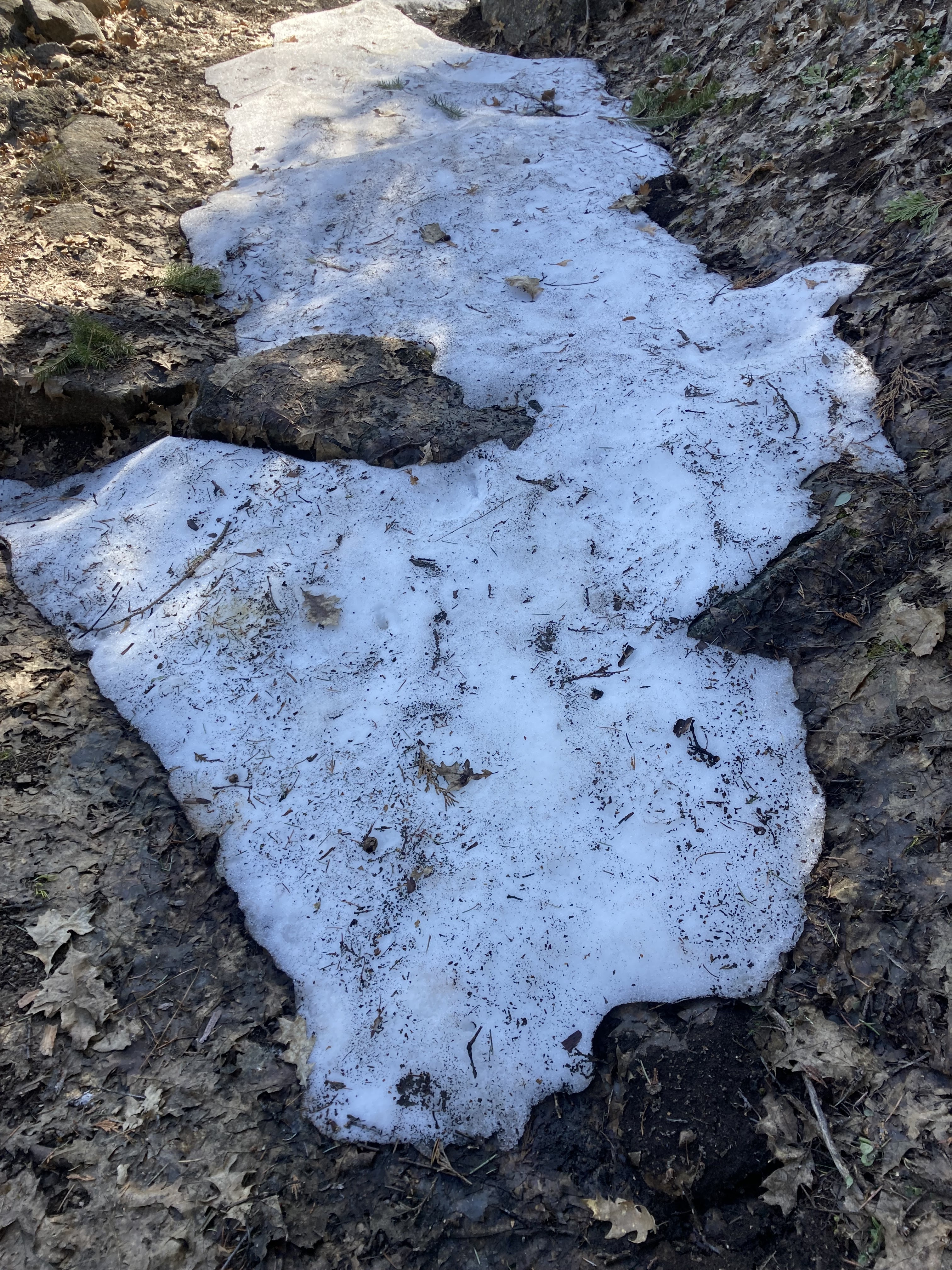
It was as we went up this second ridge that we hit the snow:


It started as small drifts but rapidly increased into nothing but snow.  Judging from the thaw points, it was easily one to two feet deep here.  How deep would it get?


About the time we broke for lunch, we were well into nothing but snow as far as the eye could see. I was feeling a bit of altitude sickness (and so was not very hungry but forced something down). My feet were quite cold and wet, but the temperature remained a solid mid-70's so everything else was quite hot.  "How was I feeling?"  asked the Outdoorsman?


Thinking back over the ascents, the two streams (which would undoubtedly be more full now as the melt increased), and the Tiltill Valley marsh and looking ahead, I thought long and and hard.


"I feel fine"  I responded.  "We press on".

The Collapse CV: Tourism

26 May 20XX+1

My Dear Lucilius:

As I was going about my tasks this morning – checking in the greenhouse (yes, it appears the quail brood did in fact hatch; ability to count the chicks is limited as they are scuttling about out of sight, but I have at least three), checking on the garden (we are having some rain, which is nice), and so forth – when it struck me that today would have been Memorial Day on the calendar. And as Memorial Day, among other things, it would have indicated the effective opening of Summer.

The tourist season is something that sustained many businesses and people here, as well as elsewhere in the world. I remember – perhaps you do too – when the big push came that “tourism” was the new way forward to economic prosperity. As other industries trailed out or died, it was tourism that would bring wealth, rather than the invigoration of existing industries or the creation of new industries. And there was no need for those new industries either: tourism was the panacea that would solve every regions economic problems.

Tourism, of course relies on several factors. It relies on a population that wants to travel. It relies on a population that has disposable income to enable travel. And it relies on a stable world where travel is a thing which can be accomplished.

Every Summer in years past, even last Summer when things began to look bad, the tourists would flock in from all of the country. They would not stop here so much as we are simply a stop between locations, but go to the towns on either side and you would find tourists filling the cafes and shops, wandering the streets, filling the bed and breakfasts and campgrounds, marveling at nature in the state and national parks. And every year, for three months, the surrounding communities would become flush with cash as the tourists came and went.

Tourism is one of those activities that I am of two minds about. On the one hand, I enjoyed going places as much as anyone else and seeing new things (although my deceased wife enjoyed it far more than I ever did). On the other hand, I am cognizant of the damage that an economy reliant only on tourism does. It fails to encourage the development of local industry except for very specific items. It eventually limits the opportunities that locals will have (server/cook, retail sales, or specific indoor/outdoor activities). And it makes the local economy incredibly dependent on the larger economy. If there is a hiccup – as there has been in more than one instance in our lifetimes – the tourism economy grinds to a halt.

This Summer the retailers, were they to open, would find not customers; the kitsch and “local products” would sit on the shelves. The restaurants would serve no food, the bed and breakfasts and campgrounds will go empty. When the cash economy ended, the tourist economy evaporated as well – and left nothing in its wake but goods and services that now have no meaning.

Throughout most of history, tourism or simply going anywhere remained the province of the military, government, the wealthy, and those such as merchants whose job required that they travel. For most, they remained where they were due to cost and risk.

I am fortunate that I was able to go many of the places I desired, Lucilius. Within a generation if nothing changes, such things will constitute the stuff of stories and pictures in books. “Here There Be Dragons” may once again become a legitimate geographic designation.

Your Obedient Servant, Seneca

Wednesday, June 07, 2023

Old English, A Historical Background: The Survival Of English

 By the late 1080's A.D., the Norman control of England was complete.  Anglo-Saxon power was broken completely and the new power structure was definitively Norman.  And yet, I am writing (and you are reading) in English instead of French, and in fact English is a global language while Norman French remains a regional dialect in France.  

Language survival, especially in the face of conquest, is never a given thing (as the Celts ancient and modern would tell you).  So how is it that Anglo-Saxon English survived to eventually become modern day English?

The following represent my own personal opinions (philologists and actual historians probably have better views):

1)  Conquest Not Colonization

By the time of William the Conqueror's death in 1087 A.D., about 8,000 of his supporters - largely Norman stock, but also Breton - had settled in Britain.  The guess of population in that time of English (Anglo-Saxons, Danish) was 2 to 3 million.  Although the Normans and Bretons were an elite, they were definitely a minority.  And William and his successors did not encourage mass migration between the two territories -after all, each inhabitant in each region represented potential taxes.  Thus the Normans always remained a minority and though the Norman Language became the language of the court and law, it never sought to replace (by language or population) the native Anglo-Saxons.

2)  The Plantagenet Empire

William the Conqueror, as it should be recalled, was not just the King of England.  He was also the Duke of Normandy and other territories as time went on, in feudal relationship to the King of France.  The Kings of England and Dukes of Normandy eventually came to build what was known as the Plantagenet Empire, with lands stretching from Ireland to the Spanish Pyrenees.

(The Plantagenet Empire - Source)

Thus, as under Cnut the Great, England was a smaller part of a larger empire. As such, the King's attention was focused not just on England, but on the domains on the other side of the channel. What mattered (where possible) was stability and tax payment, and for both of those it mattered not what language one spoke.  The fact that they were ruled as separate units helped as well.

3) Trilingualism And Beyond

Early Medieval England became a sort of trilingual society with Latin, Anglo-Norman French, and Middle English being used regularly, along with other regional languages such as Danish, Welsh, Cornish, and Cumbric.  Latin remained the language of the learned and the Church, Anglo-Norman French the language of the court, those that would make their way at court, and legal and financial.  English remained the language of the countryside.  Trilingualism is a difficult thing to manage in any age so individuals spoke the languages they needed to in order to communicate with those they needed to:  likely some of the nobility knew English but just as likely most of the rural population did not know Anglo-Norman French except those that directly needed to speak with their overlords.

4)  Population And Time

As noted above, Anglo-Saxon England always had a much greater population (in the thousands of percent) above Anglo-Norman French, which just continued to grow.  The elite did as well; just not in the same numbers.  At some point (the 15th Century) English became the majority language of the nobility and the commons, while Anglo-Norman French existed in specific realms such as the legal and diplomatic and continues to exist today in specific set statements used in the parliament of the United Kingdom.

Of course, Old English itself was not left unchanged.  It had already been impacted by the influence of the Norse and Danish invaders and had begun transforming even in the 9th and 10th centuries: for example, the complicated inflectional system of nouns had begun to diminish and a new simplified definite article "the" had began to be adapted.  Old English gave way to Middle English (circa 1100 - 1500 A.D.) , which in turn gave way to Modern English (1500 A.D. and following). 

The last entry we have in the Anglo-Saxon Chronicle is in the year 1154 A.D.  It denotes the travels of the then current monarchs, King Stephen and Queen Matilda.  The last entry is not in Old English but in Middle English; fitting perhaps as the world of the Old English Anglo-Saxon had passed as well.  Only someone well into their 80's or 90's at that point would remember a day when an Anglo-Saxon speaker sat on the throne of England.

Old English, like those that had used it as a living language, had faded into memory and history - yet ironically it has in large measure outlived those that overcame the culture that initiated it.

(Old English Posting Page)

Works Cited:

Wikipedia:  Anglo-Norman French

Tuesday, June 06, 2023

Gone Hiking 2023 Hetch Hetchy Day 1: O'Shaughnessy Dam To Rancheria Falls

Mileage:  6.76 miles/10.87 km

Elevation Gain:  1,332 ft/406 m

The start of our hike at Hetch Hetchy took us down from the overnight camping park lot across the O'Shaugnessy Dam.  This rises 430 ft above the floor of the Canyon.  It has been years since I have walked across a dam; looking down at the base of the dam and the force of the water coming out gave some perspective both of the power of the water as well as how "high" up we actually were on the hike.


Emerging from the tunnel that you can see on the far edge of the dam, we began our trek along the reservoir's edge.  The trail at this part was fairly level.  The temperature was in the mid-70's as we wandered up, passing by day high hikers going as far as Wapama Falls or even Rancheria Falls, where we would spend the night.


The trail began to rise away from the reservoir.  As one might expect, the rock here is largely various types of granite.  The views remained spectacular.


We were fortunate in that this has been a very wet year in California, so there was an abundance of water which fueled the waterfalls which the higher parts of the Sierra can be known for.  This is Tueeulala Falls, one of the highest waterfalls in the U.S.:


But even small, nameless falls contributed their own music:

The Kolana Rock:

Continuing along the trail, we came to Wapama Falls, a year round (or almost year round fall) that drops 1,100 feet. We had brought our rain gear in anticipation that we would either get terribly wet or that the bridge might even be impassable (it is, occasionally).  We were fortunate:  although definitely misted, there was no need to get our pack covers and raincoats out.


It was at this point that we lost many of the day hikers and continued on in more isolated circumstances, making a relatively gentle slope ever higher:


About 5 PM we reached Rancheria Campground, below Rancheria Falls:


After an after-hike cocktail (Note:  Bloody Mary can mix is better than Bloody Mary powdered mix),


We headed to the nearby outflow from Rancheria Falls to get water:


We made a fire and watched the evening happen:


Monday, June 05, 2023

Gone Hiking 2023 Hetch Hetchy: Hetch Hetchy Prologue

 The Hetch Hetchy Valley, located in the California Sierra Nevadas, is a glacial valley which is now located in what is Yosemite National Park.  The first European Americans reached the valley in the 1850's, not long after the Gold Rush; the Native Americans had lived in the valley for thousands of years.

(Hetch Hetchy Valley, early 1900's.  Source)

The name Hetch Hetchy is theorized to be from the Miwok word hatchhatchie, which meant "edible grasses".   The Tuolumne River wended its way through the valley. The valley itself was compared in its beauty to be similar to that of Yosemite Valley.

(Hetch Hetchy from the Valley Road, Albert Bierstadt, 1870.  Source)

When Yosemite was made part of a state park in 1864, Hetch Hetchy was not included.  It continued to be privately owned and was used for grazing, primarily sheep.  Even in the late 1800's the Valley was looked at as a potential source of water for a burgeoning San Francisco Bay Area.

Then the 1906 Earthquake happened.


(Location of the O'Shaughnessey Dam prior to construction, 1914.  Source)

With the resulting destruction from the Earthquake, the possibility of using Hetch Hetchy to supply water was investigated.  Despite significant arguments from naturalists including John Muir and the fact that by this time Hetch Hetchy was within Yosemite National Park, the project was approved 1913.  Work on the dam started in 1919 and completed in 1923.

(Hetch Hetchy Project.  Source)

After leaving the dam and flowing through two powerhouses which supply 20% of the power of the Bay Area, the water flows 167 miles through the aqueduct and supplies 265,000 acre-ft (327,000,000 cubic meters) of water each year to 2.6 million inhabitants of the Bay Area. (Source)

The reservoir remains a source of controversy.  The city of San Francisco pays $30,000 a year to access the water (yes, you read that right).  There has been a movement for years to remove the dam and restore the Valley.

Seeing the narrowness of the Valley, I can only imagine what it was like in its heyday.


Sunday, June 04, 2023

The Return Of The Prodigal Son: The Father Welcomes Home

 "When he (the Younger Brother) was still a long way off, his father saw him and was moved with pity.  He ran to the boy, clasped him in his arms, and kissed him...the father said to his servants, 'Quick!  bring out the best robe and put it on him; put a ring on his finger and sandals on his feet.  Bring the calf we have been fattening, and kill it; we will celebrate by having a feast, because this son of mine was dead and has come back to life; he was lost and is found.'  And they began to celebrate.....his father came out and began to urge him (the Elder Brother) to come in....The father said, 'My Son, you are with me always, and all I have is yours.  But it was only right we should celebrate and rejoice, because your brother here was dead and has come to life; he was lost and is found."

Henri Nouwen notes that Rembrandt's painting "The Return of The Prodigal Son" could just as easily be called "The Welcome by the Compassionate Father".  The Father is as much a focus as the two sons: the light falls on him, he is completely illumined and exposed by it.  

The father, proposes Nouwen, is based on Rembrandt himself, Rembrandt at the end of his life (he died soon after finishing this painting) when suffering has burned away the dross.  The Father is a compassionate father, who burns with desire to bring his children back to him, to "hold them close to himself so they would not get hurt"  - "But his love is too great for any of that.  It cannot force, constrain, push, or pull.  It offers the freedom to reject that love or to love in return.  It is precisely the immensity of the divine love that is the source of the divine suffering.  God, creator of heaven and earth, has chosen to be, first and foremost, a father."  He hopes that they will return as he has no desire to punish them for what they have done; they have already been punished enough by their own actions, outer or inner.  "The Father wants simply to let them know that the love they have searched for in such distorted ways has been, is, and will always be there for them."

Look at the father says Nouwen.  An observer pointed out to him that the hands are different: the right hand is larger and masculine, the left hand is smaller and feminine.  The Father represents God, "in whom both manhood and womanhood, fatherhood and motherhood, are fully present". The feminine hand parallel's the sandal falling off the foot to protect, the masculine hand reinforce the side with sandal one, perhaps to help the son get on with his life.


The father's red cloak surrounds him and the the Younger Brother, creating an environment of safety and welcome.  The father's half-blind eyes look, not just with failing physical vision, but with the eyes of the heart.

The father is filled with joy - filled with joy at the return of the Younger Son such that he calls for a feast; filled with joy such that he runs to call the Elder Brother in to celebrate.  The Elder Brother is lost in his own selfishness, seeing the Younger Brother as receiving more attention when in fact the father is focused on no such comparisons: he desires his elder son to come in and become part of his joy.

We compare ourselves, says Nouwen.  We compare ourselves to each other, grading and ranking, feeling put in or put out based on the attention we receive.  To us it is a zero sum game:  we cannot win except that someone else lose.  But to God, who welcomes all home with a divine love, there is no comparison:  "(He) cedes to all men and women their uniqueness without ever comparing."

Nowen reminds us of the parable of the Vineyard Owner who hired laborers throughout the day and paid them all the same.  There was dissension among those hired early who were paid as much as those who arrived late.  The boss had assumed his workers would be grateful to work for their employer and rejoice in his generosity - but the workers were focused on themselves instead of non-comparison.  "But that is God's way of thinking.  God looks at his people as children of a family who are happy that those who have done only a little are as loved as those who have accomplished much."

Here, says Nouwen, lies the great call of conversion:  "To look not with the eyes of my own low self-esteem, but with the eyes of God's love.  As long as I keep looking at God as a landowner, as a father who wants to get the most out of me for the least cost, I cannot but become jealous, bitter, and resentful towards my fellow workers or my brothers and sisters.  But if I am able to look at the world with the eyes of God's love and discover that God's vision is not that of a stereotypical landowner or patriarch but rather that of an all-giving and forgiving father who does not measure out his love to his children according to how well they behave, then I quickly see that my only true response can be deep gratitude."

 We do not choose God, God chooses us - thus for Nouwen, the questions become not "How do I find God?" but "How am I to let myself be found by him?", not "How am I to know God?" but "How am I to let myself be known by him?"; not "How am I to love God?" but "How am I to let myself to be loved by by him?".  God is not a passive father sitting at home hoping His children wander in but is actively watching and waiting for them, running from the house to greet them, urging them to come in and come home.

As odd as it is, says Nouwen, God wants to find us more than we want to find him, to the point that he is not passive in waiting for our return but active, leaving the house and leaving his dignity and running to us to embrace us and, setting aside our unworthiness, bringing us to the feast.

Do we believe we are that loved, asks Nouwen? Can we believe that we are that loved?  Are we will to accept that we are that valuable to God?

"Here lies the core of my spiritual struggle:  the struggle against self-rejection, self-contempt, and self-loathing.  It is a very fierce battle because the world and its demons conspire to make me think about myself as worthless, useless, and negligible.  Many consumerist economies stay afloat by manipulating the low self-esteem of their consumers and by creating spiritual expectations through material means.  As long as I am kept 'small', I can easily be seduced to buy things, meet people, or go places that promise a radical change in self-concept even though they are totally incapable of bringing this about.  But every time I allow myself to be thus manipulated or seduced, I will have still more reasons for putting myself down and seeing myself as the unwanted child."

Dare we believe we are so loved, so valued?

Saturday, June 03, 2023

Gone Adventuring 2023: Greece (And An Interview Update)

Friends - As you are reading this, I am either preparation on boarding a plane to go to....

Greece!


I know what you are thinking:  "Toirdhealbheach Beucail, am I wrong in remembering that you got laid off and this previous Monday was your last day?"

Well, yes, of course all of that is correct, but let me tell you a story...

The story actually starts during the initial start of The Plague in 2020.  We were scheduled to go to Italy in June to visit Nighean Gheal as she finished up her year in Milan, but that (and everything else) got canceled.  So we were left with four airline ticket credits to use "at some future date".  The Ravishing Mrs. TB carefully continued to monitor the credits and continued to extend them as The Plague rolled on.

When Na Clann were young, The Ravishing Mrs. TB promised each of them that she would take them on a trip wherever they wanted to go - after they successfully graduated high school.  When Nighean Dhonn was asked last year, she said she wanted to go to Greece - perhaps no surprise for someone that wants to major in Archaeology.

Although I have not been attendant on the past trips, there was no way I intended to miss out on a trip to the cradle of so much of Western civilization.  Impressions are blurred whether I was asked or "invited myself" - but we did have the airline credit (tickets have skyrocketed since last year when we booked, by the way).  And so The Ravishing Mrs. TB found a ten day tour to Greece and put down a deposit for the three of us and Nighean Gheal, who did technically graduate from college (although she already had a trip) and, after all, the rooms only book as doubles.

Which brings us to February of 2023, when we needed to confirm.  Not knowing any better, we put down the rest of our non-refundable payment.  Fortunately, nothing unusual happened or else it would be unfortunate...wait a minute.  I got laid off.

Note the "non-refundable" portion of the comment above.

I was (obviously) planning on being gone for the bulk of June when I was employed, so the fact I will be gone anyway is really nothing that was unexpected - in this case, I will have the added advantage of having no e-mails or tasks I need to follow up on.  I can simply go and enjoy.

We fly into Athens and have two days pre-tour there (including a special trip for me!), then fly up to Thessaloniki and work our way down through Thessaly (Pella, the ancient capital of the Macedonian kings, and Meteora) and over to the island of Corfu, Nauplion, Delphi, Mycenae, and back to Athens.

Simply put, it is going to be a lot of fun.

As per usual during these things, I will be delayed in my responses and appreciate your patience.

I am looking forward to this like you cannot believe.

Interview Update:  The interview on Wednesday went well.  I got to walk through the facility and speak with some different individuals.  My presentation was well received.  They asked if I wanted to wait for a reference check until an offer but I said there was no need.  The references checks (per my references) have scheduled for next week.  Also, I had an addition (different company) interview as well - so hopefully some kind of good news while I am away.

Friday, June 02, 2023

2023 Gardening: A's Garden Update

 You may remember that earlier this Spring, I tried an experiment by planting a smaller space in front of our house.  I called A's Garden in hopes it would attract birds:


Almost two month in, we have progress!


The fact that the one side has grown much more than the other is surprising to me.  I am not sure if this is due to seed distribution, watering, or sunlight.

And, we even got some flowers!


I am so used to such things not working in my favor that I am genuinely surprised when they do.


Thursday, June 01, 2023

The Collapse CIV: Footwear

 25 May 20XX +1

My Dear Lucilius:

In going through my weekly review of items in the house, I realized that at some point footwear is going to be an issue.

Footwear is one of those things (like many others) that I think many people took for granted in a world where it was available at their fingertips. Few knew where their footwear came from or how it got to them. It was made out of miracle materials that were lightweight and stylish (and highly artificial) or durable and rugged (and again, highly artificial). No matter what the size of the foot was, a pair of footwear was always available in just the right size and shape: regular, narrow, wide. We even had things to put in your shoes to compensate for the shape of the foot.

Was. Were. But no more.

The need for me is not acute, not yet. I have the work boots that I typically wear and a pair of sneakers for lighter walking and a pair of general boots for “going out”. But other than two pairs of backup sneakers (if I found something that works, I always bought more – once upon a time, one never knew when they would suddenly go “off the market”), a formal pair of Japanese sandals for my martial arts, and the “gum boots” for working in dirt and mud, the shoe cupboard is bare.

The practice of the cobbler is one of the skills that I have never even considered mastering (although of interest), nor does anyone I seem to have made contact with have the ability to make a pair of shoes. Apparently there is someone two towns away that can work leather, but the ability to manufacture footwear remains unknown. Perhaps because it has never been tried, perhaps because it has never come up before.

The sneakers, I assume, are done at some point. Even if I walk carefully, the materials will eventually rip, the soles become slick and eventual separate, the inside lining wear away. There will be no possible repairs. The same could be said for my work boots – artificial materials will wear away eventually, although the uppers may survive. Only my general boots, completely made of leather, have any chance of making it long term.

What will I do? The options seem limited. Perhaps I will get lucky and another set of footwear will “magically” appear, although given my shoe size/width ratio, that seems rather unlikely. In a question of large or small, large is always better as at least my feet are not confined to the point of pain – although they will rub. Sandals in this climate would be almost useless for anything other than traction during a long part of the year. Perhaps some version of moccasins – not unknown in this parts once upon a time – might make a comeback, but only if someone knows how to make them.

Such a simple thing, Lucilius. Yet all too soon, so sorely missed.

Your Obedient Servant, Seneca