| Pella |
Bust of King George of Greece, assassinated in Thessaloniki Greece in 1913. The White Tower is behind - Thessaloniki, Greece
| Pella |
Located not far from the ruins of Mycenae is a spectacular tomb.
The tomb itself is known by one of two names, either the Treasury of Atreus (the father of Agamemnon) or the Tomb of Agamemnon. Both of these are unlikely of course; the association with both characters dates from the the 18th Century A.D. and the 2nd Century A.D. traveler Pausanias believed both kings were buried in the ruins of Mycenae itself.
(Editor's note: While typically Thursday is the day the next installment of The Collapse is posted, due to the nature of the next post, it struck me as somewhat unseemly, given that it is Christmas week. We will pick up next week.)
One of things that happens as one grows older (especially) is the fact that one has to make a significant effort not to collect "things". This is true in many ways, but especially in the ways of souvenirs.
It probably does not come as a surprise that Greece was full of them - as a country that thrives on tourism, there was literally every kind of thing available. For example, I could have made a complete wardrobe out of the "This. Is. Sparta." shirts that were available everywhere (one wonders if the Spartans would be impressed that their civilization has been reduced to a graphic). And statues of gods, warriors and philosophers were literally everywhere.
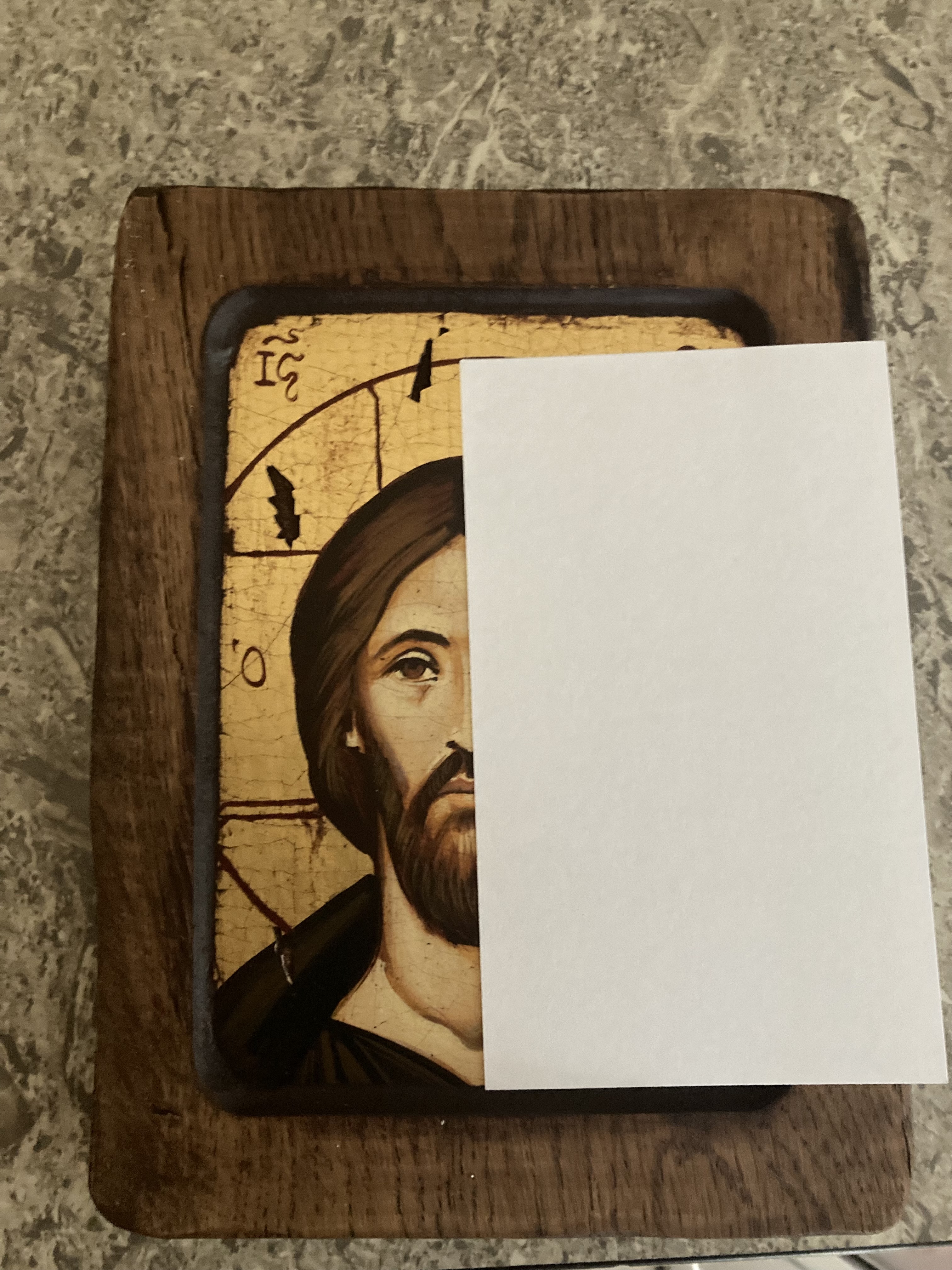
I had made the agreement with myself that instead of buying lots of little things at lots of places, I would confine myself to a few things (mostly purchases from the monasteries we visited and the smaller agriculture ventures - they need the support) and an icon - not a knock-off icon, but an actual traditionally made icon. Although not of the Orthodox faith, I have always admired them as artwork.
Conveniently, we stopped at an icon workshop on our way out of Meteora.
In traditional icon manufacture, the original drawing is created on a canvas by hand. Natural colors and egg tempura are used to fill in the lines (vinegar is used as well as an anti-fungal). The painted canvas is then attached to a hand carved wood piece depending on size. Gold leaf is pressed onto the finished product, which is held in place by a mixture of clay called "mixtion". The back is finished with a darker color.
There are different versions of this of course: one can get one where the painting lines were created by a drawing program or one that does not go through the entire traditional process (with decreasing cost, of course). But I wanted the real thing. This was my one present to myself for the trip.
As you can imagine, there was a great variety to choose from. I ended up choosing an icon of Christ:
On the whole, this represented more than I have ever spent on a souvenir in my life. But I am really pleased with it. It is hanging above my desk, a reminder of both Greece and Christ in my daily life.
"And upon his (Agamemnon's) head he set his helmet with two horns and with bosses four, with horsehair crest, and terribly did the plume not from above. And he took two mighty spears, tipped with bronze; keen they were, and far from him into heaven shone the bronze, and thereat Athene and Hera thundered, doing honour to the king of Mycenae, rich in gold." - The Iliad
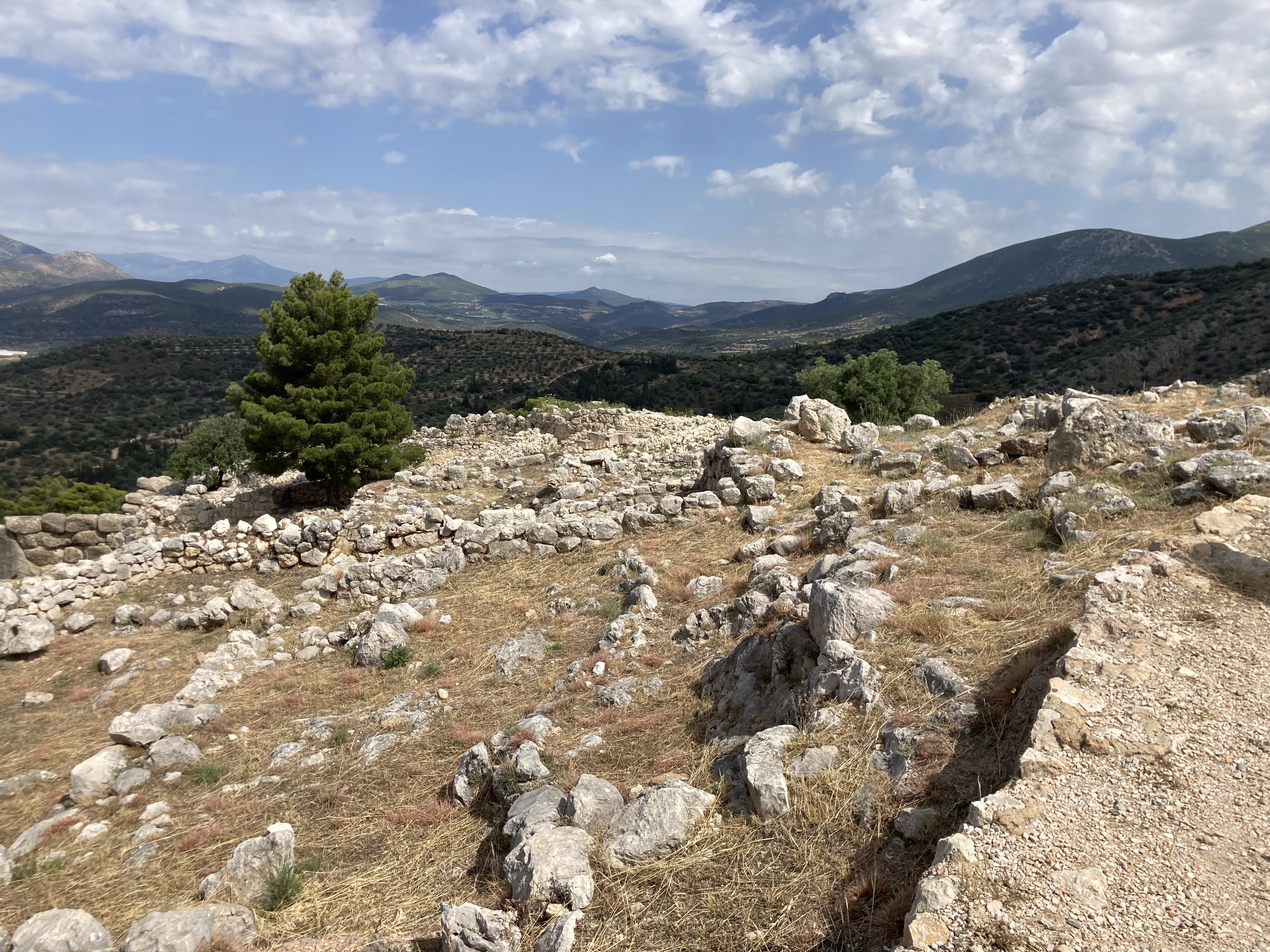
The city of Mycenae dates from the 2nd Millennium B.C., but the site itself (19 kilometers/12 miles inland from the Saronic Gulf, on a hill) has been inhabited since 5000 B.C. Its overall timeline dates from 1600 B.C. to approximately 1200 B.C. and from 1550 B.C. to 1200 B.C. Mycenae was the dominant civilization throughout the Aegean, having overtaken the Minoan civilization of Crete around 1400 B.C. , and records of its existence are found in Egyptian records circa 1400 B.C. Its success has given its name to this period, the Mycenean Age.
The city perished in the great Bronze Age collapse of 1200 B.C. to 1150 B.C. The city never recovered its former glory, passing into relative obscurity in the Classical Age, briefly reviving in the Hellenistic Age, and then slowly dwindling in the Roman Era.
Its most "famous" inhabitant was the king Agamemnon, the Commander in Chief of the Greeks in the Trojan War. The time of the Mycenean Age is the setting for Homer's Iliad, although the poem itself was written at least 400 years later.
The Bourtzi was originally built in 1471 by the Venetian engineer Brancaleone to protect and control the harbor of Nafplio. It was improved after the Ottoman Turk attack in 1473 and equipped with cannons. It sits in the middle of the harbor of Nafplio; at one time a chain and boulders linked it with the side of the harbor nearest to the picture.
Continuing on into the Peloponnese, we arrived at the city of Nafplio (Ναύπλιο). The shot below is taken from a rest stop as we crossed the Peloponnese.