Thursday, July 26, 2018

Your Education Does Not End On Graduation Day

Courtesy of the Art of Manliness.  The original article is here.  Key lines:

"Every man wastes more than time enough to make him famous.  Half an hour a day saved from the wasted moments of your life and devoted to any field of inquiry will make you a master of it in a dozen years.  Take the half hour that you wait for breakfast, save an hour in the evening and devote it to well-directed work and you will be astonished at the progress you will make in a single month.  The achievements of a well-stocked mind, thoroughly conversant with one or more departments of knowledge, are like a fortune; they are saved and accumulated by slow accretions.  Broad intelligence, sound learning, extensive reading, clear thought, lie within the reach of any man who has the will and patience to make the most of his opportunities and devote a leisure hour to reading and study."
“In School and Out of School”
From The Successful Man in His Manifold Relations to Life, 1886
By J. Clinton Ransom

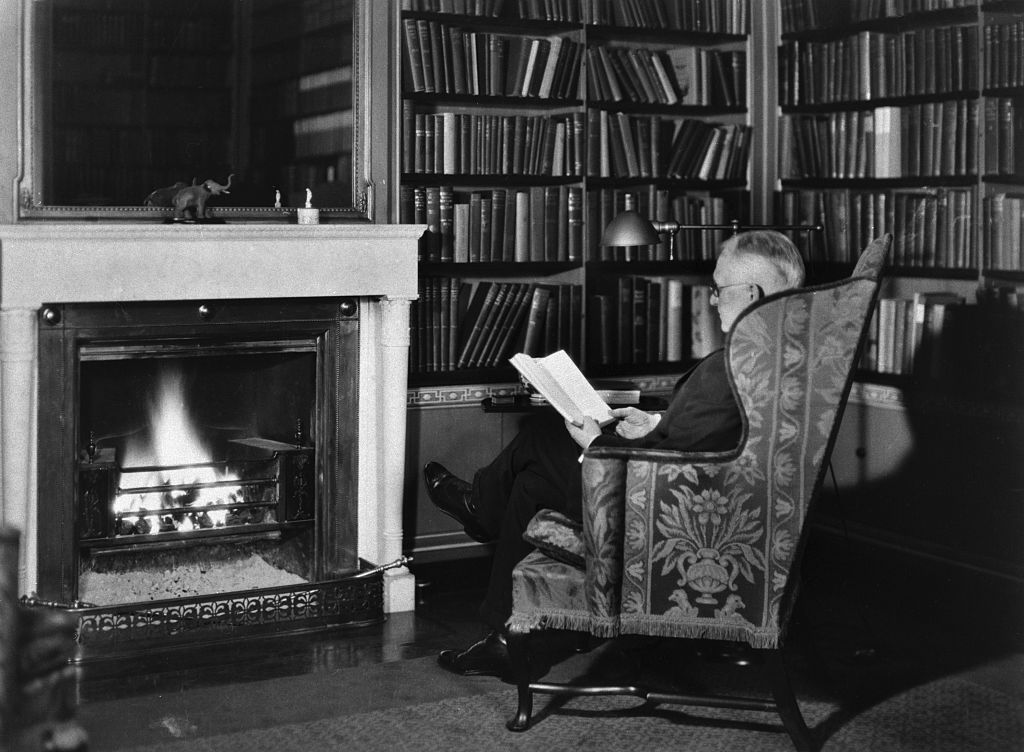
Graduation day is a great turning point in the lives of our young people. From childhood they have been at their books and exercises. They have pursued their studies with unwearied diligence, and have gone through many grades of promotion up to the last milepost of their school life. They have been crammed and dosed with language, numbers, science, and literature until they are glad to shake off the incubus of school work and step out into life with some of the rights and privileges of freeborn citizens. Fond parents and admiring friends talk of the finished education, and when the great day of graduation is over, the students of yesterday become the intellectual idlers of tomorrow. The boys go to their vocations, the girls to the idleness of home life or the frivolities of society, but neither of them ever study any more. They have done their books, received their diplomas and are through with their education. Rarely in later life do the “graduates” return to the studies of their youth. Still more rarely do they keep up their studies, after the last bouquets have fallen around the incipient orators of commencement day. There seems to be a surfeit of intellectual work in school and almost an entire absence of it out of school.
This tendency, we think, is all wrong and does much to bring discredit upon our present system of education. At present there is a pressing need of intellectual activity in our American homes. And I mean by this something more than reading novels and newspapers, magazines and continued stories. These may have their place and proper use; but they are very poor pabulum to nourish one’s intellectual life. There is a need of the continuation of the studies of our school-days. If the study of books is beneficial before graduation, it will be equally so afterward. If Political Economy, Botany, and History have a salutary effect upon the mind and life of the student this week, they will have the same effect upon him under the changed conditions of next week or next year. If the work of the senior year has been the most delightful and interesting part of your educational career, might not the same delights be extended indefinitely into the passing years? If the pursuit of knowledge had a charm for you under the guiding inspiration of the grand man whom you respect as teacher, can they be any the less so when you are permitted to wander at will into the rich regions of knowledge beyond you?
Graduation is but an imaginary line that ought to be regarded in no sense as a boundary. It should be only the beginning of a life-time devoted to pleasurable intellectual pursuits. It is hard to maintain an argument for sending a girl or boy to school for a decade of years, with the fact before us that he is justified in shutting his books at graduation and never opening them again. If Latin or Greek is worth studying in school, it is worth while to keep them up after we are done with school. If it is worth while to begin the study of history or literature, it is worth while to pursue them in the leisure hours of life, until we become well versed, in the knowledge and truth which they contain. We think it is unfortunate to make graduation day a “thus far and no farther” of literary culture and attainment.

One of the chief results of a true education is the cultivation of correct intellectual habits. Among these is a habit or taste for reading, that leads one continually to enlarge his fund of knowledge and traverse for himself the most delightful fields of literature. Another habit is that of reflection, by which the mind assimilates its knowledge and grows greater and greater as the years go by. With such habits formed, our education is only begun at graduation day. We hold then only the keys that are to unlock a vast treasure-house stored with the accumulations of ages.
But, says one, our busy lives leave no time for study and reading. Our energies are exhausted and our time consumed in the harrowing duties of daily toil. We have no time for your ideal of continuous study. In reply I have only to point you to some of the world’s great workers to show the utter falsity of such a position. William Cullen Bryant edited a New York daily for many years; but even under the pressure of such great responsibility he managed to write poems and translate the Iliad of Homer into matchless English verse. Mr. Gladstone has been three times Prime Minister of England, and, with the weight of English State upon him, he is one of the most profound Greek scholars of the world, and has published numerous volumes written with most creditable literary skill. Every man wastes more than time enough to make him famous. Half an hour a day saved from the wasted moments of your life and devoted to any field of inquiry will make you master of it in a dozen years. Take the half hour that you wait for breakfast, save an hour in the evening and devote it to well-directed work and you will be astonished at the progress you will make in a single month. The achievements of a well-stocked mind, thoroughly conversant with one or more departments of knowledge, are like a fortune; they are saved and accumulated by slow accretions. Broad intelligence, sound learning, extensive reading, clear thought, lie within the reach of any man who has the will and patience to make the most of his opportunities and devote a leisure hour to reading and study. Such a man is more capable, put him where you will. He will succeed where the empty-headed man that threw his books aside at graduation will fail. The education of the school should thus be followed by the education of mature years

Wednesday, July 25, 2018

BSFSH

BSFSH is based on an idea from Jocko Willink's excellent book Discipline Equals Freedom:  A Field Manual.  In it, amongst the very many other really good ideas he talks about, he speaks to the struggle against our worst enemy, our own lack of will - and how if something does not make you better, stronger, faster or smarter, it is something to be avoided completely.

And thus, BSFSH (Better, Stronger, Faster, Smarter, Holier - my addition) was born.

In a way, it is a very simple rubric.  Starting with my activities and my restated goals, I can query each and every one of them:

Will it make me better?  Will it make stronger?  Will it make me faster?  Will it make me smarter?  Will it make me holier?

If not, it is something I need to avoid, phase out of my life, or replace.

An example would be weight lifting - it makes me stronger.  Or Iai, which makes me better, stronger, faster, and smarter (almost the quinfecta).  Whereas something like eating doughnuts every day or choosing to watch things which neither recharge nor educate nor refresh do none of these things.

Try it.  Go through your life and ask the questions.  The answers might surprise you.

Tuesday, July 24, 2018

Middle Age Madness: Restating Goals

Yesterday I noted how I had come to understand how Middle Age Madness - that depression caused by the gulf of a man's aspirations and dreams and goals versus his life as it actually is - can come to be a factor and equally, how our society as a whole tends to ignore it, pretend it does not exist, or simply countenance it as "guys being guys".

Surely there is a solution here, one that is practically applicable.

In reviewing my own gulf, I realized that it was not that I never had goals - I set them every year - but the goals that I set and how I came about choosing them.

In the past, my selection process has always be around one of a series of paradigms:   The Rule of Five (in that we have a limited ability to focus), The Seven Traits of Personality, or simply making a list.  In each and every case, no matter what the model, I realized that they all contained the same inherent flaw:  they were a mixture of degrees of control.

I have set grandiose goals in the past around finance or career, for example -  numbers that I was going to hit or debts I was going to pay or positions I was going to reach.  What I realized is that I only have partial - or very little - control over such goals.  I can make all the efforts in the world but if they are dependent on other factors outside my control, my chances of accomplishing them can range from "possible" to "absurdly likely to fail".

On the other hand, the goals that I was most successful at achieving were the ones that were 100% under my control.  My weight, for example:  I 100% control my caloric intake, my exercise, and my aerobic practices.  A failure to meet such a goal means that I have 100% failed, as those factors are within my control.  Or Iai as another example:  I control how much I practice and how much effort I put into learning the katas.  I am 100% responsible of my success or failure in this area.

And so on.  Looking at my goals, I realized that I had stated those that I can completely control and those I cannot with the same force of words and expectation of achievement.  Thus, when I do not achieve those things that (due to something being outside of my control) I could never achieve, I become depressed.  Make and lose enough goals that way, one's life becomes devoid of meaning.

(In passing, I wonder if this is another factor of Middle Age Madness:  the fact that the activities that are chosen are 100% under the control of the individual).

The solution?  Start reviewing and restating goals.

I started this over the weekend, going through my list of goals for 2018 and ruthlessly cutting down or out anything which I could not completely 100% control.  The result was that I was left with a smaller list of goals, but one that is a great deal more achievable.

I do not wish to pretend that somehow restating goals is the cure to Middle Age madness.  To say so would be simplistic as there are many other factors (relationships, career, income) which contribute to such a thing.  But neither do I wish to pretend that nothing can be done, or at least attempted.  Perhaps my goals will become a bit less grandiose and more pedestrian for the remainder of my years - but it is equally certain I have a great deal better chance of attaining them.

Monday, July 23, 2018

Middle Age Madness

In a blinding flash of light last week, I suddenly understood why middle age people - mostly men- "suddenly" have affairs, buy expensive things, develop risky hobbies, or kill themselves.

(Note:  None of these things are actually occurring in my life.  Just had an epiphany, that is all).

It came last week in the middle of some rather long hours at work when, coming home one night feeling completed exhausted and burnt out, I chanced to mention my concerns.  "But this is what you wanted, right?" responded The Ravishing Mrs. TB.  "A responsible position, correct?"

Which was precisely true, of course.  But in the midst of feeling like my life was rapidly being consumed by work, that achievement suddenly did not seem like something of note.

She pressed me.  "I understand that it is a lot of work like now, but what would do if you were not doing this?  What are your goals? Maybe you cannot fit them into your work life, but you should work on fitting them into your free time."

I shrugged back. "I am not sure anymore what my goals are."

That statement took me aback.  And made me think a great deal more.

There comes a time in a man's life where the realization that you are closer to dying than being born.  A time when you suddenly realize that contrary to your hopes, goals, or dreams, the remaining portion of your life will (to a great deal) be governed by your career (which, at your age, is probably the career you will keep until the end of your work life - starting over at 50+ is difficult).  If you are lucky you can get 10 or 15 years of retirement - but truly, at some level of declining health and energy (for the most part). 

In other words, somewhere along the line you passed as good as it is going to get.  And you may have missed it.

How do men react?   One of two options:  the first is by trying to re-engage the "thrill" of the younger life.  They get a new risky hobby like skydiving or motorcycles or living dangerously or get a new girlfriend to make them feel younger - or in desperation, that decide that the future is simply not what they thought it would be and decide not to be in it.  In either case, they have decided to hit the "reset" button on their lives in the rather vain hope that somehow these things will either fill the gulf that has developed in their live or end it entirely.

The equally foolish part, of course, is that our culture does not address this fact at all.   Churches, for the most part, gloss over any sort of life event like this happening or paint a veneer of "season of life" over something which is far more profound.  Counseling will most likely either tell you accept the despondency or continue on with the wild behaviors.  And society - at least that part of society right now that sees men as merely one more kind of evil - will either cluck their tongues and shake their heads or wish that more men simply chose to disappear, figuratively in their madness or literally.

Do I have a solution?  Not fully, but partially (more on that tomorrow).  But even my partial solution will not address the very real issue of a crisis that we simply ignore or pretend is not occurring - even to those trapped inside of it.

Sunday, July 22, 2018

Seeking Righteousness and Justice

"Never look for righteousness in the other person, but never cease to be righteous yourself.  We are always looking for justice, yet the essence of the teaching of the Sermon on the Mount is - Never look for justice, but never cease to give it." - Oswald Chambers, My Utmost For His Highest

Saturday, July 21, 2018

A Few Words From...Tecumseh

"When your time comes to die, be not like those whose hearts are filled with fear of death, so that when their time comes they weep and pray for a little more time to live their lives over again in a different way. Sing your death song, and die like a hero going home." 
-Tecumseh, Shawnee Chief (1768-1813) 

Thursday, July 19, 2018

Change Is In The Air

Well, not in the big air anyway, but in the little air.

Both The Ravishing Mrs. TB and I have commented at different times upon the same thing.  All of a sudden it feels like we are slightly out of place here now.  Things do not seem to quite be as pleasing and pleasant as they used to be.  The jobs are meeting needs, but all of a sudden they are starting to feel as if they could go on forever and there would be no real sense of accomplishment.

Our friends, perhaps as if by design, have moved away - if not physically, than in closeness.  The activities that used to bring enjoyment (perhaps at this moment for me, with the exceptions of Iai and continuing to serve the rabbits) no longer bring the same thrill.  Everything has a certain pall cast over it.

We are reaching a change, of course.  This year will be the last year for the middle child, Nighean Gheal, to be in high school as well as the youngest, Nighean Dhonn, to be in grammar school.  Close to this time next year we will be a single child household.

But it does not just seem to be those facts.  The wind murmurs "Change".  Every time I drive to work, the landscape says "Change".  Even the moonlight that I sometimes practice under says "Change".

Change is, I think, coming.  And I think we are all ready.


Wednesday, July 18, 2018

Results and Roses


The man who wants a garden fair,
or small or very big,
With flowers growing here and there,
Must bend his back and dig.

The things are mighty few on earth
That wishes can attain.
Whate'er we want of any worth
We've got to work to gain.

It matters not what goal you seek,
It's secret here reposes:
You've got to dig from week to week
To get Results or Roses.”

- Edgar Guest (1881-1959)


Tuesday, July 17, 2018

On Incivility

We are facing a grave crisis of incivility.

"Civility:  Civilized conduct, especially courtesy, politeness" (Thanks, Merriam-Webster.com)

Civility, in other words, is the ability to conduct ourselves as a civilization.  To manage ourselves with courtesy towards one another, especially towards those with whom we disagree with.  To be polite even when we fundamentally feel like the other person is wrong.

That has been tossed by the wayside in large part, it seems.  People that we disagree with are no longer wrong, they are evil. They are not misinformed, they are willing believing and acting on the worst intentions. 

In other words, they are no longer our fellow citizens.  They are the enemy.

A society cannot long stand this sort of stress, of course.  Incivility picks away at every bond that binds a culture together.  It is the opposite of civilized of course, and given long enough, incivility gives way to uncivilized.  People choose sides.  And suddenly the side that started the incivility finds that the other side has adopted the same behavior and is acting just the same way.  And the cycle increases in intensity and speed.

How long can such things last?  I do not have a timer to tell this, of course.  I do know that from the time of the first revolution of the Gracchi to the victory of Caesar it was approximately 85 years or so, and 19 years to go from the 1905 disturbances in Russia to the rise of Stalin and that it only took 14 for Germany to go from defeat in WWI to Hitler taking power in 1932.  So things tend accelerate.

The difficulty with civilization, of course, is that everyone misses it after it is gone - especially those who enjoyed its benefits as they tore at its vitals.  For the natural, uncivilized world is a very deadly and dangerous place indeed.

Monday, July 16, 2018

"I Feel Like...."

Of all the phrases to emerge in the last 10 years, the one I cannot stand more than any other is "I feel like.."

It typically is used in the context where previously one would have used such phrases as "I believe" or "I think" or "I theorize" - in other words, where there is a sense that something is known or occurred but it is not definitively recalled as such.

But "I feel" indicates, more than anything else I can think of, the degradation of our ability to think and reason in our society.

Feelings are personal.  Feelings are also something that one cannot argue against:  my feelings are my feelings and therefore (in this current age) legitimate.  "I feel like"  often means I am intuiting that something happened although I cannot produce a more firm knowledge base

It means that feelings have reached the point where they have the same value and currency as knowledge.  " I know" almost sounds too harsh now, too definitive.  "I feel like" has a softer sound, allowing me to withdraw from an incorrect fact or understanding simply by realizing that my feeling was not real, either through mis-remembering or just having the wrong "feeling".

"I know", "I believe", and "My understanding was" are all phrases that point to a determination of mind and spirit that knows things as they are presented, not intuited.  They sound harsh and decisive simply because they are.  They deal in the world of facts.  Feelings, by contrast, live in the realm of the theoretical.

Be strong.  Be decisive.  Know.  Believe.  Understand.  But keep your "feelings" for the actual exercise of emotions, not facts.

Sunday, July 15, 2018

On Caring For One's Self

"You are under obligation to the wise and to the foolish; are you the only one to whom you deny yourself?  Fool and sage, salve and free man, rich and poor, male and female, old and young, clerk and lay, just and wicked:  all have a like share in you, all drink at the public fountain of your heart, and will stand apart and thirst?  If the man who squanders his portion is accursed, what of the one who wholly renders himself destitute?  Certainly let your streams of water flow in the public squares; let men and beasts of burden and cattle slake their thirst; by all means water even the camels of Abraham's servant; but make sure you drink with the rest the water from your own well.  The stranger, says Scripture, is not to drink from it. Well, are you a stranger?  To whom are you not a stranger if you are a stranger to yourself?  In a word, if someone treats himself badly, whom will he treat well?" - Bernard of Clairvaux to Pope Eugenius III

Saturday, July 14, 2018

A Few Words From...Robert Heinlein

“A human being should be able to change a diaper, plan an invasion, butcher a hog, conn a ship, design a building, write a sonnet, balance accounts, build a wall, set a bone, comfort the dying, take orders, give orders, cooperate, act alone, solve equations, analyze a new problem, pitch manure, program a computer, cook a tasty meal, fight efficiently, die gallantly. Specialization is for insects.” 

Thursday, July 12, 2018

A Visit to Home: Sutter's Fort

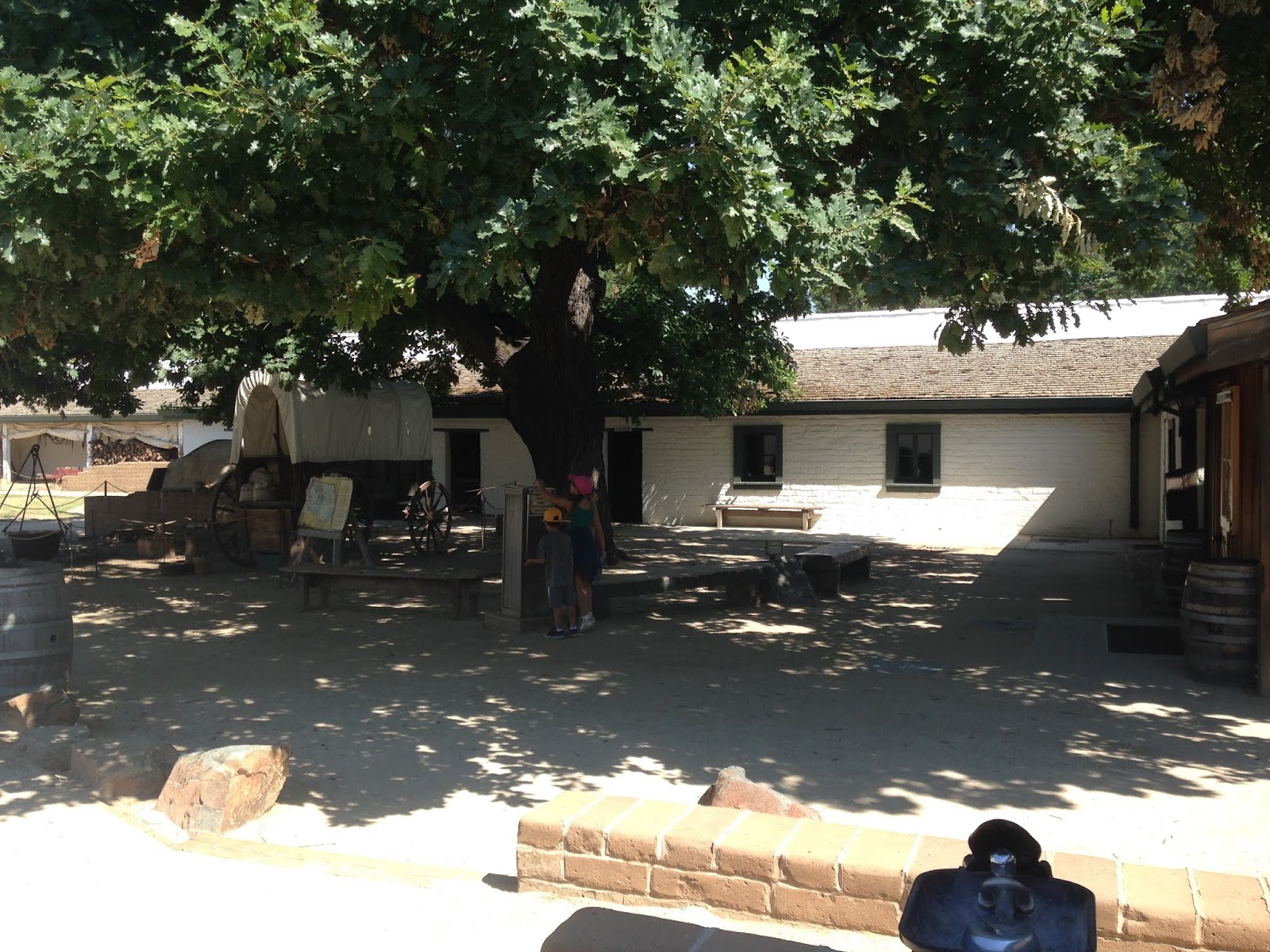
Sutter's Fort, located in Sacramento, CA, was the residence of Captain John (Johannes) Sutter, a native of Switzerland, from 1839-1849.  He had received a land grant of 48,000 acres from the Mexican officials and worked diligently to found a completely self-sufficient community.  His fort became the ending point for a number of wagon trains to California.

Approach to the Fort:


Inside the Fort:


Typical room for a pioneer family:


Cannon in a blockhouse:


The walls are 2.5 ft thick and 15-18 ft high (for an attack that never came)


Another shot for Reverend Paul and Glen:


Hoist for servicing and removing cannons from their carriages:


Kitchen:


Sutter had loom imported from Europe and had a rather good blanket manufacturing business going:


Sutter's other claim to fame, of course, is Sutter's Mill in Coloma California, where gold was discovered in the tail race of his mill in 1848.  Sadly, he was essentially wiped out in the ensuing Gold Rush and spent his declining years trying to receive restitution from the US Federal government for the loss of his lands (it never came).

Wednesday, July 11, 2018

Half A Score And A Little More Years Ago...

....there was a guy (that would be me) that decided he would make a splash in the then still relatively nascent blogosphere.  You know - write deep thoughts, be quoted, earn a living purely from the recommendations of recommendations from the vastness and depths of his thoughts.

Somewhat sadly, that guy's dreams expired rather quickly.  However, the remaining results have been somewhat entertaining, if nothing else.

Yes, this is my 13th anniversary here at TheFortyFive, keeping the InterWeb safe for...well, I am not sure for whom, really.  2900 posts and change at this point (ironically, I only had three posts in 2005.  Two on the same day). 

Originally (all joking aside) my original hope was to have one "those" blogging careers (The Forty Five, for which this blog is named, refers to the gallant but doomed uprising in Scotland which ended at The Battle of Culloden).  However, I quickly found that 1)  writing is hard; and 2)  I am not much for conflict, written or spoken.

What did come out of this - sometime in 2008 - was a sort of online blogging journal, the sort of thing I had been keeping since 1989.  It first became a practice, then a habit - a habit which has reached the point that if I do not account for posting at least five days a week, I feel unfinished.

The audience, I believe, has changed over the years.  Originally it was individuals that I knew locally (whom in some cases still lurk, but in many cases have moved on). What it came to be in many cases was a group of individuals, like-minded in some ways if not all and who (for the most part) blog themselves (and my father, who reliably reads every morning as soon as it is published).  I am been fortunate to meet people from (literally) all over the world, doing in there own small way a version of what I am trying to do:  personal independence of life and thought.

If you discount the occasional spikes of spammers (approximately once a month), I run 70-90 views a day.  Which are more eyes at least looking (and hopefully spending a moment or two in thought) than I could have ever hoped for.

The rules, which have been the same since around 2006, remain the same:  no profanity, no politics (but some political science -  there is a difference), no religion (except my own struggles in my Christian walk), but hopefully something to think about and chew on (or occasionally laugh at). 

I am not quite sure what all is in here at this point, but this blog has covered any number of lifetime sorts of events - my old job, losing my job, migrating to New Home, finding Throwing and Iai, with large splashes of depression and "I hate my job" thrown in, and then most recently my rather run of good luck.  So in a sense, it has surpassed the idea of a blog and has almost reached the stage of a life chronicle (which like most chronicles, will fade into dust or be viewed 100 years hence with a quizzical eyebrow from the researchers).

So, as always, thanks for stopping by.   We appreciate your patronage.  Please be sure to help yourself to a complimentary shot of homemade mead and some cheese at the door and come on it.  We still have a fair amount of ground to cover.

Tuesday, July 10, 2018

A Visit to Home: Fort Ross

Fort Ross was (Крѣпость Россъtr. Krepostʹ Ross) was the southernmost settlement of the Russian Empire on North American Soil.  It is located approximately 15 miles north of Bodega Bay in Northern California and was active from 1812-1841.  Originally founded to support the Russian-American company in its fur trading activities, it transitioned to an agricultural support location for the colonies in Russian Alaska.  It also served as a diplomatic point between the Spanish (and later Mexican) empires and the Russian empire.

Walking Up:


The main courtyard:

 Rotchev House:  House of the last commandant of the fort and the only original surviving structure:


Out the front gate to the Pacific Ocean.  The path goes down to a bay:


Inside the courtyard:

Inside one of the two blockhouses:


Cannon:

Orthodox Church.  It is still occasionally used;


Inside Kuskov House, the residence of all commandants prior to Rotchev:


Armory (For Reverend Paul and Glen):


These are a view of what the trading store would have looked like.  Keep mind there was probably nothing like this for several hundred miles in any direction:


From the window of the other blockhouse:


Outside the Fort:


A reconstruction of one of the two windmills at the fort (these were the first windmills in California).  This is a hand built reconstruction of Russian Pine by Russian craftsmen:


As you can guess from the amount of pictures, Fort Ross is just about my favorite state park in California.  I have always felt that this period of time, the intersection of Native American, Russian, and Spanish/Mexican cultures was one of the greatly unknown and underinvestigated parts of California history


Monday, July 09, 2018

Back Home

So we are back from our trip to home.  I have a couple of posts to make on where we went and some general thoughts that have come to mind, but those are for later.  The bullet points of things that occurred:

- I forgot how much I miss dry heat (instead of the murky humid goo we call Summer where we now live).

- Agriculture is still alive and well and growing, which makes me happy (means that the land is more valuable for growing things than it is for building houses on).

- That said, they are still building a great deal of housing.  Which strikes me as funny, because they are also complaining a great deal about water usage (Important safety tip:  You cannot more people that use water and then complain about the use of water at the same time).

- I realized that my current life is completely and totally lacking in scenic beauty.  You do not realize it until you make the same urban drive with no trees beyond 6' tall for two years.

- Likewise, silence - true silence with only birdsong and the occasional cowbell - is a wonderful thing.  And I do not have enough of that either.

- My incentive to feel like I was plugged into work over time decreased.  Really, it is not that important.

- On the whole, I miss home. 

Sunday, July 08, 2018

Rest

"Even as the sun was bestowed upon the world by God to give light
it still ought to turn aside fairly frequently,
to have a time for peace and quiet...
it ought to know how to set
and be at rest in the evening,
where it enters the embrace of leisure."

- John of Forde (1150-1214) (The Way of Simplicity, Esther De Waal)

Saturday, July 07, 2018

A Few Words From...Ayn Rand

"Whatever claim you have on me,"  he (Hank Reardon) said, "no human being can hold on another a claim demanding that he wipe himself out of existence."- Atlas Shrugged

Thursday, July 05, 2018

Automation And Centralization

I sometimes wonder, in my never-ending mental quest to predict the end of all things, what the signal event would be.

It strikes me as odd that the same society that is constantly looking for tremors of environmental catastrophes in s the changing genetics frogs and the movement of ice sheets would not see the same sort of issues occurring in the international environment around them.  Even now, we have smaller countries what have failed through dictatorships or broken economies or civil wars, the flow of peoples from one place to another.  If animals fled a forest fire it would be declared a disaster; when individuals flee failed states it seems to be ignored amongst polite company.

It also strikes me as odd that the twin forces of centralization and automation remain largely ignored.  For example, people largely laugh and mock at the ungainly and unlovely development of solar powered machines that scan fields and pick weeds or make and flip burgers - but what they mis is that at the beginnings of the automotive age the same thing was true of the early horseless carriages.  The ridiculous eventually becomes the functional and the functional the necessary.  And suddenly the labor we could never do without - the single greatest cost of any organization - is transformed into a single up front cost and many less people to support it.

And centralization - in an age of global competition and interconnectedness, the move to centralization - access to the markets, resources, and scales of economies of other companies - puts more and more companies into a life and death struggle.  Any way to keep and retain profits is eventually investigated - be it swallowing up other companies or figuring out ways to automate what is done to reduce labor.

The ultimate impact to all of this is on jobs, of course. and the bifurcation of jobs.  For some - the highly technical or highly mechanical - they will continue to do well.  For those that perform manual labor, they will increasingly find themselves relegated to the same roles of craftsman in the Industrial Revolution, adrift where their labor is no longer desired or needed except occasionally in a general sense.

My simple question - the one that I wonder if we are actually addressing - is if we see these trends and are acting on them or are turning away in hopes of some utopia which will never actually come to pass?

Wednesday, July 04, 2018

Happy Fourth of July 2018

I post this every year on this day.  Every year, it seems more and more vivid and alive and current.

When, in the course of human events, it becomes necessary for one people to dissolve the political bands which have connected them with another, and to assume among the powers of the earth, the separate and equal station to which the laws of nature and of nature's God entitle them, a decent respect to the opinions of mankind requires that they should declare the causes which impel them to the separation.

 We hold these truths to be self-evident, that all men are created equal, that they are endowed by their Creator with certain unalienable rights, that among these are life, liberty and the pursuit of happiness. That to secure these rights, governments are instituted among men, deriving their just powers from the consent of the governed. That whenever any form of government becomes destructive to these ends, it is the right of the people to alter or to abolish it, and to institute new government, laying its foundation on such principles and organizing its powers in such form, as to them shall seem most likely to effect their safety and happiness. Prudence, indeed, will dictate that governments long established should not be changed for light and transient causes; and accordingly all experience hath shown that mankind are more disposed to suffer, while evils are sufferable, than to right themselves by abolishing the forms to which they are accustomed. But when a long train of abuses and usurpations, pursuing invariably the same object evinces a design to reduce them under absolute despotism, it is their right, it is their duty, to throw off such government, and to provide new guards for their future security. --Such has been the patient sufferance of these colonies; and such is now the necessity which constrains them to alter their former systems of government. The history of the present King of Great Britain is a history of repeated injuries and usurpations, all having in direct object the establishment of an absolute tyranny over these states. To prove this, let facts be submitted to a candid world.

He has refused his assent to laws, the most wholesome and necessary for the public good.

He has forbidden his governors to pass laws of immediate and pressing importance, unless suspended in their operation till his assent should be obtained, and when so suspended, he has utterly neglected to attend to them.

He has refused to pass other laws for the accommodation of large districts of people, unless those people would relinquish the right of representation in the legislature, a right inestimable to them and formidable to tyrants only.

He has called together legislative bodies at places unusual, uncomfortable, and distant from the depository of their public records, for the sole purpose of fatiguing them into compliance with his measures.

He has dissolved representative houses repeatedly, for opposing with manly firmness his invasions on the rights of the people.

He has refused for a long time, after such dissolutions, to cause others to be elected; whereby the legislative powers, incapable of annihilation, have returned to the people at large for their exercise; the state remaining in the meantime exposed to all the dangers of invasion from without, and convulsions within.

He has endeavored to prevent the population of these states; for that purpose obstructing the laws for naturalization of foreigners; refusing to pass others to encourage their migration hither, and raising the  conditions of new appropriations of lands.

He has obstructed the administration of justice, by refusing his assent to laws for establishing judiciary powers.

He has made judges dependent on his will alone, for the tenure of their offices, and the amount and payment of their salaries.

He has erected a multitude of new offices, and sent hither swarms of officers to harass our people, and eat out their substance.

He has kept among us, in times of peace, standing armies without the consent of our legislature.

He has affected to render the military independent of and superior to civil power.

He has combined with others to subject us to a jurisdiction foreign to our constitution, and unacknowledged by our laws; giving his assent to their acts of pretended legislation:

For quartering large bodies of armed troops among us:

For protecting them, by mock trial, from punishment for any murders which they should commit on the inhabitants of these states:

For cutting off our trade with all parts of the world:

For imposing taxes on us without our consent:

For depriving us in many cases, of the benefits of trial by jury:

For transporting us beyond seas to be tried for pretended offenses:

For abolishing the free system of English laws in a neighboring province, establishing therein an arbitrary government, and enlarging its boundaries so as to render it at once an example and fit instrument for introducing the same absolute rule in these colonies:

For taking away our charters, abolishing our most valuable laws, and altering fundamentally the forms of our governments:

For suspending our own legislatures, and declaring themselves invested with power to legislate for us in all cases whatsoever.

He has abdicated government here, by declaring us out of his protection and waging war against us.

He has plundered our seas, ravaged our coasts, burned our towns, and destroyed the lives of our people.

He is at this time transporting large armies of foreign mercenaries to complete the works of death, desolation and tyranny, already begun with circumstances of cruelty and perfidy scarcely paralleled in the most barbarous ages, and totally unworthy the head of a civilized nation.

He has constrained our fellow citizens taken captive on the high seas to bear arms against their country, to become the executioners of their friends and brethren, or to fall themselves by their hands.

He has excited domestic insurrections amongst us, and has endeavored to bring on the inhabitants of our frontiers, the merciless Indian savages, whose known rule of warfare, is undistinguished destruction of all ages, sexes and conditions.

In every stage of these oppressions we have petitioned for redress in the most humble terms: our repeated petitions have been answered only by repeated injury. A prince, whose character is thus marked by every act which may define a tyrant, is unfit to be the ruler of a free people.

Nor have we been wanting in attention to our British brethren. We have warned them from time to time of attempts by their legislature to extend an unwarrantable jurisdiction over us. We have reminded them of the circumstances of our emigration and settlement here. We have appealed to their native justice and magnanimity, and we have conjured them by the ties of our common kindred to disavow these usurpations, which, would inevitably interrupt our connections and correspondence. They too have been deaf to the voice of justice and of consanguinity. We must, therefore, acquiesce in the necessity, which denounces our separation, and hold them, as we hold the rest of mankind, enemies in war, in peace friends.

We, therefore, the representatives of the United States of America, in General Congress, assembled, appealing to the Supreme Judge of the world for the rectitude of our intentions, do, in the name, and by the authority of the good people of these colonies, solemnly publish and declare, that these united colonies are, and of right ought to be free and independent states; that they are absolved from all allegiance to the British Crown, and that all political connection between them and the state of Great Britain, is and ought to be totally dissolved; and that as free and independent states, they have full power to levy war, conclude peace, contract alliances, establish commerce, and to do all other acts and things which independent states may of right do. And for the support of this declaration, with a firm reliance on the protection of Divine Providence, we mutually pledge to each other our lives, our fortunes and our sacred honor.

New Hampshire: Josiah Bartlett, William Whipple, Matthew Thornton
Massachusetts: John Hancock, Samuel Adams, John Adams, Robert Treat Paine, Elbridge Gerry
Rhode Island: Stephen Hopkins, William Ellery
Connecticut: Roger Sherman, Samuel Huntington, William Williams, Oliver Wolcott
New York: William Floyd, Philip Livingston, Francis Lewis, Lewis Morris
New Jersey: Richard Stockton, John Witherspoon, Francis Hopkinson, John Hart, Abraham Clark
Pennsylvania: Robert Morris, Benjamin Rush, Benjamin Franklin, John Morton, George Clymer, James Smith, George Taylor, James Wilson, George Ross
Delaware: Caesar Rodney, George Read, Thomas McKean
Maryland: Samuel Chase, William Paca, Thomas Stone, Charles Carroll of Carrollton
Virginia: George Wythe, Richard Henry Lee, Thomas Jefferson, Benjamin Harrison, Thomas Nelson, Jr., Francis Lightfoot Lee, Carter Braxton
North Carolina: William Hooper, Joseph Hewes, John Penn
South Carolina: Edward Rutledge, Thomas Heyward, Jr., Thomas Lynch, Jr., Arthur Middleton
Georgia: Button Gwinnett, Lyman Hall, George Walton
Source: The Pennsylvania Packet, July 8, 1776

Tuesday, July 03, 2018

Trying A Different Style Of Writing

Over the last few weeks I have been experimenting with a different sort of writing process:  instead of writing things every day, I have been writing them for a full week at one sitting.

The past few months have been rather busy, with work becoming more and more of a time consuming machine (followed by the catch up at home).  What I found is that the quality of my output was not really rising to my satisfaction and I was stressing out about creating the next day's article.  Writing had become not fun any more.  And when something is not fun, it needs to be reviewed and either changed or discarded.

Now, I write on Sunday afternoons for the whole week.  I have started to put things into buckets as well:  A Few Words on Saturdays, God Thoughts on Sunday, etc.  I found that this format relieves my stress of "what will I write about?" as well as giving me the ability to look out into the world and have a little fun.

Thanks for your patience.  Hopefully this will result in me producing a better product and enjoying the process of creating as I used to.

Monday, July 02, 2018

An Unexpected Turn of Conversation

During a recent conversation about a current event, I was brought into close quarters with the threat of ending a relationship - something that has not happened to me in a very long time.  It occurred at a discussion of general nature, but somehow turned to a specific event  in the current media.  The phrase "This answer is really important to our relationship" was used. 

My mind froze.  I had no answer ready at hand.

I have read of these circumstances occurring and more lately in certain circles, the ending of friendship and relationships over a particular political or religious belief.  And I suppose that in all fairness these things have materialized in my own life as well, albeit as a simple drifting apart to maintain the peace.  I can honestly say this was the first time in a very long time  that it has occurred.

Ultimately, of course, this sort of conversation goes nowhere.  Very few people are willing to immediately and right there end a relationship in the midst of a discussion, perhaps a heated one to boot.  What will happen - at least what happened to me - was an instinctive and immediate curling of the soul into a ball that in some ways I do not know if I will ever come out of.

Finding another person's boundaries at the wrong moment is always a terrifying thing.  In one second the genteel facades we all maintain to stay in communication falls away and we are forced to recognize that there is a limit which we will never be able to go beyond - perhaps more importantly, will never be willing to even test again.  The world of that relationship shrinks a bit and from then on, only the safe and non-controversial topics are discussed - until often they, too, fall by the wayside in the general loss of communication.

This has happened once before with someone else, from an angle and a place I did not expect.  And sadly - tragically perhaps - nothing was ever the same.  In the rush and passion to prove a point, the long term goal of relationship - authentic trust and sharing - is shattered, perhaps never to return fully.

Sunday, July 01, 2018

Turning From Sadness

"Therefore my advice to you, friends,
is to turn aside from troubled and anxious reflection
on your own progress,
and escape to the easier paths of remembering the
good things God has done.
In this way, instead of becoming upset by thinking
about yourself,
you will find relief by turning your attention to
God....
Sorrow for sin is indeed a necessary thing,
but it should not prevail all the time.
On the contrary, it is necessary that happier
reflections of God's generosity
should counterbalance it,
lest the heart should become hardened through too 
much sadness and so perish through despair." 

- Bernard of Clairvaux (The Way of Simplicity, Esther De Waal)