So today we went through another corporate reorganization.
I was not caught in the major reorganization, which was significant. But I was caught in a minor one, which was significant enough for me.
I have changed reporting structures again. The dual form of reporting up was not working, so there is a new single line of communication - essentially what we had for almost 7 years until about a month ago. That system worked, apparently - just not with me.
There has been a "leveling". I have been stripped of 3 of my 4 team members, who are now reporting on equivalent level up - a team I have spent 7 years building. My job responsibilities, while not quite redefined, are shrinking in scope to well under half of what they used to be. And instead of reporting directly to The Head, we are all reporting to a Subhead who reports to The Head.
I have, in other words, been practically demoted.
I am not happy. I have indicated this, both to The Head and to The Subhead. I am essentially capped: I am precisely one level below The Subhead so the chances of moving up are rather limited. Even more so arguably, as with reduced areas of responsibility come reduced abilities to make the sorts of impressions and do the sorts of work that get the sorts of attention that makes such things possible.
Everyone is sympathetic, of course: of course we understand, it is for the betterment of the company, there will more opportunities for growth and expansion, do not feel like you have been put aside, it is really for the better. You are doing a fantastic job, keep up the good work, and we are 100% behind you.
I am really, really trying not to be bitter about this. Really. It would be lying to say it is not hard - except I have no-one to direct the bitterness at.
There is little enough to do about the situation, of course: what is done is done and to be anything less than 100% supportive will brand you in ways not good to consider. On the positive side, I am still employed.
But all that echoes in my mind is the ringing sound of echoes getting closer as the potentialities of my current position - and perhaps my career - shrink in like an old volcano sinking in on itself, leaving only a crumbling cones and broken lava tubes to mark its passing.
Friday, May 20, 2016

Thursday, May 19, 2016
Memories and Images
Sometimes I wonder what has happened to others.
It used to be quite a mystery, of course: people would leave our own circle of living, leave our own geographic area, and then would disappear off the face of our known earth. Perhaps we would hear of them from a friend of a friend or a relative, but they had effectively moved beyond our own orbit. We might picture where they were or what they were doing, how their lives had gone.
Now, of course, we have the Internet. And Facebook and Linked In and 40 other ways to keep in touch with other people. And yet, I still find myself wondering what has happened to others.
Oh, I can find them of course. They will pop up as soon as you search for them. But all it is now is a carefully crafted image, what one wants everyone else to see.
To be fair, I do this as well. My "On-line presence" (sounds so official) is in some ways very different from the way I would present myself in my more personal space. Part of it is essentially image management - after all, everybody (including your company) can find you now.
But the mystery is gone, in a way. No longer does one wonder where those others are or what they have done. It can easily be found out - or rather, the image can be found out. But them, who they were or who they are, has become submerged beneath that image.
Which makes it sadder, in a way. Before one had to imagine. Now one has the outer image without the core.
It strikes me as strange that in this world of interconnected technology, we find ourselves more isolate dfrom such memories than we perhaps ever thought possible.
Wednesday, May 18, 2016
Drained II
An epiphany of sorts today.
I realized, as I sat at my desk balancing visitor after visitor with requests for information or questions and e-mails clamoring for attention amidst coming and going to meetings, that I simply do not have the energy to maintain this sort of working life. I have no time to recharge.
I am, by every test I have ever taken, an introvert - so much heavily so that I almost always top out the chart. This surprises some people when they see me interacting in social settings - I can be witty, personable, engaging - the life of the party. This works, as I have come to understand, because that is not a taking of energy by others but exchanging of energy with others.
But what I am doing in my workday now is completely different.
Everyone has a need. Everyone has a question. Everyone wants something from me - if not in person, then via e-mail. This has become my day, a steady stream of individuals coming with questions or requests. They are most good natured about it of course, and I suspect scarcely any of them wish me ill will, but still they come. And ask.
There is no exchange of energy in these interactions, no building of excitement - just a steady drain of energy as one after another, people come with their needs.
And leave me mentally and psychically exhausted. Literally. I have nothing left to give by the time I leave for home. Add to that a commute approaching an hour or more and then another group of people at home who have a different set of requests and needs for interaction and you can see where this ends up.
I have often wondered over the years why I can stand commuting to the extent that I do. I truly do not mind the concept of long drives - and now I know why. It is a small chance to recharge from the daily drainage of energy. It also explains why I set such aggressive goals at the beginning of year yet always seem to lose steam, or how I can come out of a weekend ready to go and find myself with nothing by Wednesday. I have given myself time to recharge via vacation or weekend - but the batteries do not have enough regular down time to maintain that level of energy.
What to do about the situation, that is the question. It is not as if I can wall myself away from everyone (oh, how I wish!) and recharge time seems no more likely to appear now than ever.
But it is the germ of a concept and realization, the fact that I require a more balanced approach to my interactions to pace myself and (really) make myself the most functional me that I can. People are not going to like it.
On the other hand, I surely do not like the way I feel now and how my life is working out. Ultimately, that should trump all.
Tuesday, May 17, 2016
Iai On A May Evening
Last night I went out to practice iai.
Yesterday was a Monday, the sort of Monday that has you swearing that you will submit your resignation letter in the first 10 minutes after arrival and never really improves after that. The sort of Monday filled with meetings that never really seem to resolve anything and a commute that leaves one drained just in time to try to generate something of a personality.
And so I went out to practice iai, increasingly my refuge (along with writing) to maintain my sanity in a life seeming gone not so bad as bland and tasteless, a sort of endless poi dish that one takes day after day knowing it is nutritious but having no other redeeming qualities.
At first I began almost going through the motions, doing the most basic of kata to warm up; then, I began to notice the world around me.
The sky was that blue-green that almost defies description, the color that only appears right at evening and right before morning, transient as the moment just before sunrise and just after sunset. The weather held its coolness from the morning rains with a light breeze, mocking the fact we already halfway through May.
Our yard is exceptionally green this year, an outcome of the rather large amount of rain. Our new resident hare, Joey (so named by Nighean Dhonn) was out about an evening silfay, cautiously eating the grass while watching me practice. Fireflies began to pepper the yard, far more than I have ever seen any year since we moved here, their yellow-green luminescence moving in and out as if they were teleporting across space instead of moving through it.
The crickets (or frogs, I am never sure) sang their background chirps as the high pitched squeaks announced the evening bats out for the hor de' oeuvres of the night. A random toad, as pale as the concrete he hopped across, appeared out of nowhere on his way to a rendezvous with a nameless appointment he did not seem inclined to share.
All of a sudden I found myself practicing iai not alone but in the midst of world going on about its business - or rather, kindly welcoming me into its business. I was no more a stranger to this dance of movement and sound and light than any of the other creatures there.
In a sense, I think it was iai in its most pure form, of being one with nature as one practice the forms, sliding in and out of the fireflies, not alarming the hare, seen as nothing more than a thing of shadows not to be feared by a toad. The sky in its strange and seldom appearing color reflected the purity of form to which the apprentice always strives: memorable yet not standing out, unique yet blending into the balance of whole.
I cannot say that this moment made up for the day before. I can say that it gave a sense of peace and serenity where none previously existed.
Monday, May 16, 2016
Saturday, May 14, 2016
May 2016 Garden Update
So how is the garden doing in May?
You will remember my citrus from last year that were overwintered (with not great results)? Well they are growing:

Even the ones I thought I killed

are showing new life (This is a Mexican Lime. Apparently they will reproduce from the root stock, one of the few citrus trees that will):

Overwintered (by accident) peppers (Bell and Jalapeno) are growing - if you look down, you can see the peppers:


The garlic is starting to fall over and the leeks are coming up.


Volunteer pumpkins have returned:


And the grain and onions are doing well:


Overall very happy!
Friday, May 13, 2016
Blogger or Wordpress
Greetings to The Fortyfive Nation (all eight of you, anyway)! I have a global question that I would like to throw out there and see what the feedback is.
Do I stay with Blogger? Or do I go to Wordpress?
I have been with Blogger since I started blogging in 2005. Overall the interface is okay and I have had very little to complaint about - except the fact that Blogger is owned by Google, which I sort of do have problems with.
If you have ever had or held a blog, you know the rather daunting task when you are considering creating a new one - let alone updating and migrating the one that you have maintained for any number of years. It is a pain, I imagine - just updating the links to other people's sites alone is going to be a pain.
But still, I am at the point where I wonder if it is the right thing to do. Certainly my friend Otis has said his wife's new blog (Saturated In Seattle) has gotten a great deal more traffic since she moved over there.
Thoughts? Opinions? Experiences?
Thursday, May 12, 2016
Saturated in Seattle
So ordinarily I do not link other stories in place of my own for a posting. It is a poor blog author that constantly relies on others for their material.
Today is an exception.
My friend Vintage Chick, who has been working on a different sort of blog journey, posted something today that is definitively worth sharing.
You know I do not do politics here and religion as a rule, and this post edges over into that. But it deserves to be read and considered.
Read the words of someone that can actually write.
Saturatedinseattle
Wednesday, May 11, 2016
"Available At Your Local Bookstore"
Last week as I was driving around, I heard an advertisement for a book on the radio (small bit of irony right there). The narrative, driven by dark sounding dramatic music and telling us that the novel was ripped "right from today's headlines" ended with the statement "Available at your local bookstore, Amazon.com or iTunes."
Which made me think "Local Bookstores?"
I remember the bookstores of my youth. There were two, beyond the library where we got to check things out. One was a local, single store in a strip mall (I still have some of those books). The other was "Citadel of Books". It was this store that formed my impressions of what a bookstore should be: Towering shelves of books in pine shelves of varying heights with long rows, wandering up and down the aisles lost in literary wonder.
How times have changed.
I lived through the growth and essentially the death of a medium. I remember the first time I went to a Walden's books. "Wow", I thought, "so many books". Then I went to a Barnes and Noble. "Wow, it is so big" I said to myself. "They must have everything." And then I went to Borders and had a similar experience. "Wow, so much more like Citadel of Books" I said.
But Borders is now gone. The small independent bookstore of my youth is gone. All that remains is Barnes and Noble as a new book seller.
I do not really enjoy going in Barnes and Noble at all. The selection is limited. The prices are high (stupidly high). And the atmosphere - green themes with dark brown bookshelves - is hardly the sort of adventure I experienced once upon a time.
I shop the used book stores now. There is far more of a sense of adventure in finding something that you are looking for or even finding the unexpected - and the prices are a sheer luxury. Sure, I very seldom get the latest books, but those are (generally) not the books I am looking for.
Or Amazon.com. Cannot beat the selection and the prices -if you shop carefully - are just as reasonable as a used book store.
(No Kindle or iBooks for me. I simply cannot enjoy reading on a screen. I think this may partially stem from having to look at a computer screen all day. And the fact that the book is an object, a familiar thing I can manipulate and highlight and easily go back to).
A final thought hit me as I rolled the radio station over to something else. I have seen the bookstores go, first the independents, then the local chains, then the national chains. Will I live to see the day that, like a beached whale, the last great bookstore chain goes under leaving only ghostly remainders in the form of empty big boxes and the remains of a once thriving industry to be found only in the kiosks of airports?
Tuesday, May 10, 2016
Accept And Unrealistic Expectations
So now that I have these unrealistic expectations, what the heck do I do with them?
This is the other side of acceptance - not just that one accepts the way that certain things are but that one actively works on the expectations that one was clinging to, that one finds something to do with them. Because they sure do not seem to want to be dealt with of their own accord.
They constantly speak in your ear, suggesting that you are "surrendering" or "caving in". They try to push you towards success related literature, pointing out that you are giving up perhaps at the point that success is about to become yours. Anything, they suggest, except abandoning them to the cold.
I have my own secret weapon, of course. I call it "Failure".
I have remind these sweet siren singers of the times that I did follow their unrealistic promises down the rabbit hole of dreams, of what happened when the bottom dropped out of the hole and down I fell into the rocks. Of the countless times as a youth I "fell in love" only to embarrass myself horribly. Or the time I took a position based on other people telling me that I would be a great leader, only to be a terrible one and leave after half a year. Or the time I was going to be wealthy as Midas and only ended up losing a great deal of money and eventually having to lose the house we never should have bought.
I bring these failures to the unrealistic expectations and point to them, saying "Look at this. This is where following you gets me. Off with you now. Join forces with those things that I can impact. Or abandon me to whatever you think my fate will be. But what you promise will never come to pass."
They always seem to abandon the cause and slink away, of course. Because if one thing is true of unrealistic expectations, it is that they is that they are very proud and demanding. They would rather expire than join the energy with those things that can be accomplished.
Monday, May 09, 2016
Accept
Sometimes you come to the realization that there are simply things which you have to accept.
This tears at the fabric of our societal understanding, of course. We have been taught that we are able to make our own fate, to chart our own course, to turn any situation or circumstance into the one that we desire. In fact, I would go so far as to say that it is almost considered a failure to not be able to do such a thing.
But sometimes, the reality is that some things simply cannot change.
Some of these things depend on circumstances beyond our control, things which we can neither directly nor indirectly impact. Some of these depend on people who will not change, not have we the power within us to make it so.
Either way, the initial realization can be a crushing blow - after all, we interpret the failure to be something caused of our own inabilities, of our weaknesses, of our lack of trying. We may try to fight this blow by redoubling our efforts. And perhaps then we try to go to the other side of ignoring the situation, or even acting out against it. Perhaps we may sink into a depression over it.
And then, one day, we learn to accept it.
Acceptance does not change it, of course. The situation is still the same. The relationship is still not what we wanted it to be. But in acceptance comes the ability to move on.
Maybe the thing will not change. But let it not be an anchor to weigh us down in the rest of our life.
Friday, May 06, 2016
Commit
I have a long term problem in the practice of my iaijutsu, specifically when I am asked to attack. I always aim to the side, never directly at the target.
This is something that I have done for years. Why, you might ask? It is a legitimate question. I carry with me a very old reluctance to risk hurting someone, an aversion acquired many years ago but still as fresh in my mind as it was the day it happened.
And so I aim beside the target, not at the target.
This creates issues for my sensei on two levels. On the first level, of course, it is very difficult to demonstrate a technique when your attacker is never cooperating in the attack. The second - the one that just entered my awareness tonight - was a frustration with me, or rather a frustration with the fact that I have studied for almost 7 years and still am reluctant to strike.
"Commit" he said tonight as I once again moved my attack to the right. All of a sudden, that word became one of the profoundest things I had heard in years.
Commit. Drive out all doubt. Drive out all extraneous things. Drive out the hesitation and reluctance. Commit. Strike. Cut with authority.
Understand the profoundness of this moment. Not just in iai. In life. Choose - we cannot all do everything. And then when you have chosen, act with authority. Remove doubt from your mind. Strike every time as if you mean to win.
I am not sure that I know what enlightenment feels like. But tonight I received a very dim taste of it.
Thursday, May 05, 2016
Wednesday, May 04, 2016
Silence
The bridge hangs,
suspended over the gorge,
cables twanging in the rushing air.
You walk forward,
eyes trained on the other side,
carefully ignoring the yawning gap beneath you.
In the center you stop and look up:
the azure blue sky speaks a tale of peace,
the clean warmth of clouds above the spires.
And then it happens:
The high pitched snap of cables
coming undone.
And at that moment,
suspended above heaven and earth,
you realize all the support under you has vanished,
leaving only the silence of the clouds
to catch your fall.
Tuesday, May 03, 2016
A Place of Service
Sometimes I forget my place in my life.
I am a supporter, a believer in others, a servant. My job, my task, is to lift others up - to help them see in themselves what they cannot see. Often it is buried in the muck of a life where circumstances or others have buried them or not treated them well. My goal is to clean up those dreams and skills and aspirations, recall them to what is possible, and help them to believe and then move forward.
It is a task. It is something that I enjoy doing. But sometimes I forget my place in life.
When this happens, I get myself too involved in the life of others (Trust me, I have done this). I have made their happiness and their success as much about me as it is about them. Rather than just being a supporter and second violin in the orchestra, I try to make myself a lead character and first violin.
This never goes well, of course. The point of believing in people and lifting them up is that they will take wing and fly to new heights - not that their stories somehow entwine with mine.
The end is actually always the same, of course - they find their way up and onward (that is what I am trying to help with, of course) and I find myself feeling left behind and isolated. No reason to feel that way of course - what I thought and what was actually going on were two very different things indeed. Yet I always somehow am surprised at the end even though it is the same every time.
It is not that I regret what I do. It a necessary thing, not only for those who need encouraging but for me - I need to do it. The problem is the unrealistic baggage I bring along with it.
To serve - to truly serve - is to remember that the very best of service is the one that exists as a memory in the back of the served's mind, the sense that they really did do it without the recollection of any expectations or demands that were placed on them by the ones serving.
Monday, May 02, 2016
The Second Act of Second Marriages
I am now apparently in that phase of living (and apparently have been for several years) where many of my friends are in the "Second Marriage" stage of life.
Most of them were divorced the first time for various reasons. I do not always know the reasons and do not always ask, of course - people share what they feel they need to share when they need to share it. Some seem to have ended relatively pleasantly, others with a level of animosity. Most, on the whole, have moved on to at least acceptance and moving on with their lives.
But here they are.
It is interesting because lots of them are in that "first stage" of second marriage where everything is newly wed bliss and extreme happiness. It is odd to myself, who have been married over two decades, to see and experience this. After all, up to this point most of my acquaintances were either unmarried or had been married for a considerable time. Odd to think that suddenly I am greatly exceeding the span of peoples' relationships. I am used to dealing with younger people in the throes of a new relationship. Not so much the older ones. It is as if I have been planted into a new scene with familiar players but a plot from a previous act.
It does make one think a great deal about one's own marriage. After all, it feels like (no statistical data) here that I am in the minority. And those who are in the second round seem to be at a relational place I am not and have not been for years. The simple fact of the living through a marriage with its accompanying children, finances, and events has a way of drawing everything into the "life is so ordinary for me" scenario.
Which is why I have to constantly - and forcefully - remind myself that it is not about the simple act of relationship. It is a picture, a picture of Christ and His church. I do not know that it is always helpful to me in the most positive of ways. But it does keep me on the track of remembering that to fail here is not just a failure for me, it is a failure for my outward facing witness to Christ.
I can fail myself. I cannot fail Him.
Friday, April 29, 2016
The Conundrum of Consultants
So today we had a consultant on-site.
We get consultants from time to time. This one seemed to be a good one: knew the material, had plenty of experience, spoke the language, had a plan.
The individual in question also went through our current program: strengths, weaknesses, changes we will need to make. And therein lies the issue.
After the suggestions, the "you will need to do this", the "this is what my experience indicates", there were nods around the room, agreement. Senior Management present of course indicated that this was the course that we would need to take, immediately and with all effort.
The frustrating part, of course, is that a great deal of this has been previously suggested. And ignored.
Suggested by internal employees of course. By us, those charged with trying implement such things a a basis.
What is it about organizations that completely value the same advice if it comes from an external person than an internal person? Presented with the same facts, the same rationalizations, the same justifications, the one at the task day in and day out is ignored and put down, while outsider - for whom one is paying a considerably larger sum of money - is taken as almost god-like in their advice.
It eludes me, this willingness to pay more for advice and guidance that already exists. Are companies so lacking in trust in their employees that they must validate those opinions outside? Or is that employees are only expected to be able to X, while consultants do Y?
I am not completely sure. But I am reminded of two things:
1) To treat employees as if their experience is irrelevant and useless is to suggest to them they have no value where they are.
2) To bring in consultants and see what they do and how they are treated is to suggest to employees that there may be other options.
Thursday, April 28, 2016
Wednesday, April 27, 2016
Weather Watch
So tonight we are sitting under the mother of all weather watches.
The weather today was hot. And foolishly humid the sort of weather I call "Voodoo Weather" for no other reason than that it feels wrong and mysterious, the sort of weather in which bad things happen. The weather extended into the evening, in which the clouds were a sort of misty color lit by the sunlight in a way that I cannot fully describe and have certainly never before seen.
The wind is whipping along now (around 10 PM) blowing the humid weather through. The expectation? "Severe Thunderstorms, possible grapefruit sized hail, damaging winds, tornadoes (not likely for us)". Add fun with lightening strikes and we have all the making of "fun" around 3 AM, when the first front blows through.
This is not the weather that I grew up with at all.
It is all vaguely concerning of course - the thought of hail being the most exciting (or concerning, take your pick). Tornadoes are unlikely and, given the rain we have had of late, the chances of a lightning strike starting a fire are pretty minimal. Wind is a concern of course, but most of the big trees (maybe three) would fall away from the house; the fence would be toast (but that is an insurance item). Hail remains the single largest danger.
I will let you know how the weather goes.
Tuesday, April 26, 2016
Of Dream Jobs and Scut Work
This popped up in my Facebook feed:

It made me think a lot.
On the whole, I am a fan of Mike Rowe, or at least what I have read and seen of him. He espouses a good work ethic and the value of labor and skills, not just college.
And his quote spoke volumes to me.
I am, I suppose, like Millennials in at least one way: I want to have a dream job. The engaging career. The thing that lifts me out of bed in the morning and drives me to work all day. The job that pays more than enough and allows for the time to do the other activities that I truly want to do.
Sounds great, does it not? The operative word in the phrase "dream job", though, is "dream".
The reality is that I, like lots of others in my age cohort, have a career. Perhaps not the one we had dreamed of. Perhaps not the one we planned on when we were children ("When I grow up, I want to work in a cubicle farm and sit in front of a computer screen all day" - said no child ever). But it is a a career. It pays the bills - it may even leave us a bit to fund what we want to do.
My problem - my own, not anyone else's - is I have allowed myself to believe the idea that there is that dream job out there, that perfect career that I have somehow been denied and forced instead to endure the lesser thrill of necessity. In the back of my head, that career is out there for me - if I just search a little farther I can find it.
The reality, though, is I am rapidly running out of time - in fact, it may be too late. As I have written years ago, if I am very fortunate I will be able to finish out my effective working life working in the career field I am in without having to "start over" in a new line of work not of my primary choosing.
The one change I need to make, as I sit here vaguely disappointed with the oncoming train that is Reality, is how I spend my time. The reality is this: I spend most of my time desperately trying to not do anything remotely related to work. The reality is - especially in this global environment - it is necessary that I spend at least part of my time on tending to that part of my career, to continue to make myself at least employable if not promotable.
There is the rub of course - by doing that, I invest more of my precious time not at work in work instead of in the things I really want to do - in some cases, on the things that in my mistaken belief I think will come to replace the work (maybe, someday, in a retirement pocket money sort of way).
But - and this comes back to Rowe's statement - it is part of the scut work. And while it may not be magnificent, it at least fills the time in a way that might result in an improvement to my bottom line. Which indirectly pays for me to do the things I really like to.
It is called growing up - something which almost, constantly, I seem to struggle with in my work.
Time to hang the dreams up with the nightshirt.
Monday, April 25, 2016
All I Needed To Know In Life I Learned From Rabbits
1. There is never not a good time for love.
2. When you are out, run like you never intend to be put back in.
3. Always be grateful for the little gestures like snacks. Even if they are the same every day.
4. Sometimes we are meant to be with others. Sometimes we are not. Never force the issue.
5. Always kiss the hand that feeds you.
6. Remember to groom. Look your best at all times.
7. Hopping is a perfectly acceptable means of locomotion.
8. Always eat enough roughage. Good dietary health is very important.
9. Sleep - be sure to get enough of it.
10. Everybody loves a snuggle bunny. If you do not have someone that fills this role, be someone that fills this role.
Friday, April 22, 2016
Thursday, April 21, 2016
Of The Small And Silent
Today
as I was driving to work in the rain, I got to thinking about all of
the great things that I was supposedly going to be and do in my life.
I
was, at various times after college, destined (I use the term
loosely) to be a performer, a professor, an import/export business
owner, a pastor, a real estate broker, an elder/deacon, a writer.
When I say “destined”, I mean that this was the thing that was
going to be the focus of my life, that would be the vehicle for my
success. Big things, public things, visible things. I was to be
important and respected, a man of parts in a world that sorely needed
one, to set policy and solve problems and be the visible leader of
great things and great change.
None
of that, as you know, worked out. Every one of those avenues ended
up leading to a dead end and the thing that I had chosen after
graduate school, the industry that I am currently in, – mostly for
desperation of a steady paycheck and benefits - became the one that
has essentially been my constant companion for 90% of that time.
This
thought wove itself in and out of my head until, at work, a small
discovery was made. An error, an oversight -not vastly significant
but one that should have been caught by several (including me) but
was not.
And
all of a sudden I realized my life has become of the small and the
silent, of the details that underlie the main focus of activity –
critical work, necessary work, but the quiet work of the backstage at
the play, of the editor on the author's work, of the lineman that
provides power to the coder.
I
have resented this role, to be sure. This is the role not of the
great, of the mover and shaker, of the significant but rather of the
shadowed, the small, the silent. But if I look at all the time past
since I graduated from school, every road that lead to a cliff
forcing me to retrace my steps, my life keeps coming back to this.
There
is a message here for me, I think. And not necessarily a message I
have always wanted to hear.
Maybe
this is really is my role. Maybe the path to my success or
influence, to whatever degree it will exist, is to be based not on
being grand and doing the great things but quite the opposite: the
filling of small gaps, the completion of the silent tasks, the
completion of the minor tasks that make the thing complete even when
no-one else realizes that those are the things that made it happen.
Maybe it is less about how that success or influence is achieved and
a lot more about my ego in the whole matter, the fact that I may be
effectively invisible and largely unacknowledged except as part of
the grand summation, not as the great individual.
But
that is really my problem. The question is, will I let my perceived
need for greatness and recognition get in the way of actually doing
the sorts of things I was perhaps put here to do?
Tuesday, April 19, 2016
Why My Focus Is Hard To Communicate
Sometimes I forget, in my constant world that seems to always focus on the alarming and the final failures of civilizations, that not everyone focuses on the same thing.
It probably does not surprise you that (for the most part) the individuals I interact with on a daily basis have little idea of what my concerns are about the nature of things - one or two perhaps, but I suspect many have simply departed in the frantic pace of life into other things. By and large, they are concerned with things in the here and now - entertainment, sports, the goings on at the places where we congregate, occasionally a natural disaster or two.
But the proposed and ultimate goals of my life are, for the most part, invisible. Why is this?
It is not (I hope) from some sense of lack of concern for those around me. These are individuals whom, on the whole, I care about. And certainly not from some misguided attempt (again, I hope) to conceal any knowledge of upcoming events - of which I have none - from them in a sort of evil twisted genius plot.
I suspect that it is mostly because it simply takes too long to explain. And it too often seems to veer into matters political. And even if you make it that far, it is even more difficult to explain how that impacts what you are doing.
Think about it: without being a "tin foil hat" guy, it is hard to make an argument that the world is getting to be a better or more stable place. That involves no thinking that there is some sort of giant government cabal, simply an admission of the fact that the world is a very complex place that is inter-related in ways that impact us all. Instability somewhere really does create issues elsewhere and economies of trade and efficiency assume populations that are able to buy and earn money. The one thing - the only thing - I really learned in Macro Economics is how true fragile the economic system is - not fragile from easy breakage but fragile from the sheer number of factors that can impact it to its detriment.
Without that assumption, the idea that people would consciously seek to pull away from any part of the system seems less of a calling or necessity and more of a personal interest sort of thing: "I like soccer. You like building a complete gardening and making things from wood. I just buy the things of wood. Why do you waste your time?"
It is difficult in such moments to verbalize the words "I do it now because I can, before I have to because it is all I can do" without sounding like a completely ungrounded fool, a wild eyed fanatic looking for the end of the world to come.
But it is not really the end of the world so much as the end of our world, at least the world we know. Always hard to communicate in a surrounding of climate controlled comfort and with coffee and snacks so close at hand (was it the same in June 1914 Austria? Rome in 409? Constantinople in 1452?) So I generally sigh, give a little self depreciating smile, and am thankful for the comments on cheese or whatever else I have made.
It is, in the end, much easier. And perhaps it is the actual only meaningful way I can communicate such things, not in what I see but in what I do.
An Eternal Purpose I Cannot See
Sadness.
Deep, abiding sadness.
Clicking on the keyboard,
Hit "Enter".
Watch the circle spin, waiting for the next step to complete.
Click over two tabs, see if the document moved on.
Sigh, and start the process over.
E-mail flashes:
"Can you do this?"
"Why did you do that?"
"I need."
"I want."
Endless brake lights,
creeping along a wet road.
Turn the radio on, then turn it off:
Get drawn into an issue you cannot solve
then resolve to turn it off again.
Sadness.
Deep, abiding sadness.
It is not that I question that You are here, Lord,
it is that I question how any of this accomplishes Your will:
how a day spent in the trivia of information
that will be useless in five years,
and sitting in traffic that moves slowly
does anything of eternal meaning.
Sadness.
Deep, abiding,
lost,
sadness.
Deep, abiding sadness.
Clicking on the keyboard,
Hit "Enter".
Watch the circle spin, waiting for the next step to complete.
Click over two tabs, see if the document moved on.
Sigh, and start the process over.
E-mail flashes:
"Can you do this?"
"Why did you do that?"
"I need."
"I want."
Endless brake lights,
creeping along a wet road.
Turn the radio on, then turn it off:
Get drawn into an issue you cannot solve
then resolve to turn it off again.
Sadness.
Deep, abiding sadness.
It is not that I question that You are here, Lord,
it is that I question how any of this accomplishes Your will:
how a day spent in the trivia of information
that will be useless in five years,
and sitting in traffic that moves slowly
does anything of eternal meaning.
Sadness.
Deep, abiding,
lost,
sadness.
Monday, April 18, 2016
"Are You Willing To Surrender Everything?"
So I think God spoke to me last Friday driving home from work.
As I have explained before, this sort of event when it happens - and that is rarely - is not the Thunderous Voice From Above or Pillar Of Fire experience. It is that simple moment where something comes into the mind and soul and one knows - definitively - that God has spoken.
The question was really "Are you willing to surrender everything?"
This is an ongoing discussion I have had within myself for some time, mostly with staying here where we are now. Not just the usual discussion about schools and churches but rather things about my own personal life and the activities I am in: Highland Athletics for example, or Iai (especially Iai). The thought has been "I can endure or even should stay in place because these activities make certainly other elements of my life bearable."
But I got a very direct challenge to that concept last week. And all of a sudden, my intense need to think I should do these things forever is challenged.
Do I need to immediately give all such things up? I do not think that was the point of the question. What I do think it involved was my tightly holding such things to myself and perhaps not being open to what God is asking of me.
In response to someone who asked about holding things tightly in their life, Corrie ten Boom replied "...I've learned we must hold everything loosely, because when I grip it tightly, it hurts when the Father pries my fingers loose and takes it from me!" (Charles Swindoll, Living Above the Level of Mediocrity)
Not a bad piece of advice for myself, either.
Friday, April 15, 2016

Thursday, April 14, 2016
An Amicable Dissolution?
Some three years ago or so, I posited (on a now defunct blog) the concept that perhaps it was time for the United States to seriously consider the idea of peaceful dissolution. Now more than ever, I am convinced that this is an idea worth considering.
The reality is not only that we are a nation deeply divided. The political atmosphere alone should show that. The more concerning issue, at least from my position, is that we no longer have much holding us together.
We do not really share much in common at all. We happen to live together. There is that.
But in reality, we are really not the same any more. Much like a married couple that has grown distant over the years, various groups within the country have found interests far more compelling - in some cases, they have verbally said things to other members of the union that they would never say to outsiders.
Were this situation to exist in a relationship or marriage, we would urge our friends and loved ones to leave it before things got out of control. It happens in a political entity, we simply sigh and say " Well, we are one people."
But we are not any more, not really. We are sets of groups that define ourselves by our differences, not by our similarities.
A break up need not be angry or disastrous, you understand. Countries in recent memory have done so peaceably - The Czech Republic and Slovakia, for example, or even the greater separation of Scotland from Great Britain. These were peaceable enough separations. Sure, there would be disruption and undoubtedly many people would choose to relocate to a place which more reflected their political and social views - but ultimately would not everyone be happier if this was the case?
I do not have specifics, of course. No sense in trying to plan for something that has never been done this way before. What size political entity would choose, for example? What would we do with the debt we all accumulated as well as the assets to be disposed of? What do we do about things in which we may still share an interest, such as defense? All legitimate questions of course - but no different than questions that any married union seeking divorce has to resolve or any dissolving business has to confront. These are not new problems, this separation after being together - we have at least 40 years worth of experience of doing it on the individual level. We just need to apply that to the nation-state level.
People may think me crazy of course, or even foolish or dangerous. But they should ask themselves: Have you dealt with people that have been in a marriage in which each hated the other? How did that work? Were they happy?
And did you wonder why they did not try to make themselves be?
Wednesday, April 13, 2016
Reflections On Rain And Water
Rain is crashing on the rooftop as I write this (last night).
I have to admit that one of the things I enjoy about New Home is the fact that we are far more likely to get rain throughout the year. Old Home had a very definitive rainy season: End of October to the beginning of March or even possibly April. After that, pretty much dry until the end of October again.
Here things are different. Rain can come throughout the year - good heavens, one year since our arrival it actually rained sufficiently during the summer that we did not have to water at all (on the other hand, for two summers it did not rain at all and left nothing but beastly heat instead). Most of the rain is not of the sustained variety (day long storms of gentle rains) but mostly hard spots which can be interspersed with calm sections.
(Rain getting even heavier now)
We have gotten up to 5 inches in a single rainstorm. Five inches! Growing up, that was probably 1/6th of the total rainfall that fell during the entire year.
There are downsides, of course. Erosion can be a serious problem if things are not sodded up. And the rain in the summer only leads to humidity of the rather gross, nasty variety. And the rain is not regular every year - some years it is heavy, some years we are in significant drouth.
I could use a better rain caching system - and by better system, I mean "a system at all". I have played around with some test versions (plastic garbage cans) but the amount is not such that I could make a longer term go of it without an actual collection vessel (and honestly, this is another reason I am working on reducing water needs in general around the yard - the less I pay to water ornamentals that could die on me and serve no purpose, the more I save).
And all of this, of course, points out the requirement of living somewhere that getting to water is not an incredibly difficult process. I do not know that I would ever relocate again to somewhere that did not have sufficient rain to supply some level of needs.
All of that said, listening to the rain at night is peaceful. And certainly makes for a pleasant white noise to go to sleep by.
Tuesday, April 12, 2016
A Vague Plan At The Point Of Inflection
The vaguest outlines of a plan are starting to come together.
The whole thing is quite nebulous, you understand. In many ways our situation has not substantially changed from the beginning of the year.
But taxes are done - and with taxes done, certain questions and thoughts start to arise. Such as if I cannot get a deduction for parts of my home loan, why am I paying them? Or more fundamentally, if I pay a certain amount of my income if I make over a certain amount of money, why am I striving to make more money?
This sort of thing is dangerous, you understand. Potentially revolutionary in one's own life.
No, we are not at the place that we could take a large hit to our income simply to avoid taxes (although having done my in-laws taxes, the number is much higher than I would have thought). But it is certainly a thing which can start to be looked at.
A house payment is the largest thing, of course, If I had that money back a year alone, let alone what we pay in other debt at the moment, where would we really be? Add ways to cut down on other parts of life - debt of course, but food and utilities come to mind - and we are talking about a very great change indeed.
We are not there. We are nowhere near there. But we are almost at an inflection point, if only we cna see it through.
Monday, April 11, 2016
A Sudden Flash Of Understanding
So I have been trying to work on my skills outside of my career. Call it work, call it "handyman", call it trying in baby steps to start to practice some of what I want to do - I am trying. It is a bit hard though, as opportunities seem to be few and far between in my real life.
Today, at the Shelter, I was asked to help build some wheeled bases to replace some that were either undersized or simply not fit for purpose. Initially I was doubtful - after all, it involved power tools and measuring and cutting and putting things together, things that I am not usually comfortable with. Still, the animals need the help (after all), and that is what we are there for.
So I measured and cut and screwed boards together. Put casters on the bottom to allow them to roll. Had a young man helper who I am pretty sure had never seen a power tool in his life, so I got to show him how to measure and cut and screw things together.
Bottom line: Got two new bottoms completely built and converted two to smaller units. Cleaned up, put things away, and carried on.
And then suddenly the thought occurred to me: I was doing exactly what I wanted to be doing. I was using knowledge that I had to accomplish putting something together. They worked. Heck, I even got to show someone else how to do it.
I do not know that I could make a living at this and still have a very long way to go. But it is kind of a nice feeling to realize - even accidentally - you are on the road you intended to be on.
Friday, April 08, 2016
More All I Needed To Learn In Life I Learned From Iaijutsu
1) All the force in the world without the correct angle of the blade (hasuji) will not make a clean cut.
2) Be ready for change. A kata can change at any time because Soke changes it.
3) All things have combative application if only we know how to use them.
4) A defender that can attack is more dangerous than the attacker.
5) Small things make a great difference.
6) Form can be as importance as substance.
7) To truly understand something, teach it.
8) It easy to train as part of group. It is hard to train alone.
9) Faced with a longer weapon, you need not lose. Simply be quicker and get inside.
10) It is not enough to be effective. Be elegant
Thursday, April 07, 2016
Nine Things
So my friend John at Of Brambles and Bears is apparently my older twin sibling that I never met. We seem to share a lot: an interest in outdoors and gardening, the owning of allotments, the fact that we fight with depression ("The Black Dog" as John puts it), and that we both labor to stay sane in our current lines of work
We also share another characteristic: We tend to over commit to what we want to do.
John wrote recently about about his own habit of taking on more than he could do or, as he put it, "...to take on a project, task, or the like when I already have one thousand and one things on the go. The usual result of this is for me to either not complete said projects, tasks, or ideas or to to finish some off but to a totally, for me, unsatisfactory level which then leads me to berating myself and becoming disillusioned with myself."
Hey, I thought, that sounds familiar.
All of a sudden my despondency makes a certain amount of sense to me.
I have the same pattern year after year: I set goals in December and January and start making crazy amounts of progress towards them. I am constantly busy working towards them, perhaps even achieving some of them. And then suddenly, right around March or April, I lose all steam. I have interest in completing none of them and precious months slip away while I sort of muddle myself into doing nothing at all.
So it got me to thinking: what if I have the same problem that John so clearly enunciates, and if so, what can I do about it?
Giving things up is not so hard - after all, it is not giving things up so much as it is simply deferring certain things to another time. That I can deal with. The thing I am troubled with is the same thing John mentions, "berating myself and becoming disillusioned with myself."
So if I had to revise the list, what would it look like?
1) God
2) Family
3) Work (Sigh, but there it is)
4) Throwing/Conditioning/Training (Lumped together because they are all involved).
5) Iai
6) Japanese (Need to get more vocabulary now that I have the certificate to match).
7) Writing
8) Ichiryo Gusoku (which could encompass gardening, cheese, quail, and some other secondary skills).
And that is without trying more than two minutes to think about things.
Am I okay with this? If I just kept the eight things there (and gave myself the illusory 9th item for fun) that would certainly more than fill my life - and give me time to do things like read for leisure and not rush to do things.
But I have to, as John said, get past the barrier: that letting some things go for the short term does not mean I have failed in the long term.
Wednesday, April 06, 2016
A Quiet Of The Soul
Did you ever have a quiet of the soul?
A quiet, almost like the stillness of pond
with no ripples on it?
A quiet of the full moon in
a field of stars?
A quiet of the hare silently bounding
through the night-swept graa?
A quiet of where thoughts do not stick
to your mind but simply dissolve?
It is an odd thing,
when my head is so usually full of things
to simply feel the quiet:
a soft dark blanket that quietly drowns
all else.
Tuesday, April 05, 2016
Emotional Distance
Sometimes it surprises me how emotional distance can develop.
To be honest, I am not really even sure how it starts. Irritation, perhaps, or perhaps even a smoldering anger just below the surface that makes things difficult to discuss. Or perhaps things happen less dramatically. Less shared interests with anyone lead to less shared time and less shared conversations about those things.
And then all of a sudden, you find you are emotionally different.
It happens across all relationships. It happens with family. It happens with those who are friends, sometimes even with those that have been friends for long periods of time. And certainly it happens within the closest of relationships.
It is odd, if you sit and look at it clinically. At one time you find you were the closest of people: you spent part of every day together, shared interests and weekends, dreamed dreams and made plans. This person or persons were an integral part of not just your life, but your everyday existence. You could simply just not imagine life without them
But then you wake up weeks or months later and suddenly realize you have not spoken or thought of them in a very long time.
I understand that people change and perhaps we underestimate the impact of that upon relationships. if the relationship does not grow as the people in it grow and almost natural chasm seems to develop. If conscious effort is not made to bridge that chasm, it drifts farther and farther apart until you almost seem like strangers that never met.
It makes me melancholy, this ending of things. Perhaps it is simply a part of living.
But every time it happens, a little of the magic of life seems to disappear.
Monday, April 04, 2016
Heavy Weight For Distance
Making the weight fly,matter breaks gravity's bonds
for a brief instant.
(And I swung a 7" PR out of it as well. Huzzah!)
for a brief instant.
(And I swung a 7" PR out of it as well. Huzzah!)
Saturday, April 02, 2016
Of Asparagus and Onions
The task before us today - in what will hopefully become a better trend of sunny weekends and time - was the planting of Asparagus and Onions.


Here they are. ready to go.

Asparagus. I have been promised six per bag (only got ten total).
This is where the planting occurred. This was a space I originally had identified for a mandarin orange tree but realized it would perfectly for asparagus (and would keep my garden along the fence available).

Tools of the trade. I made a go of it with just a pick and hoe (to my surprise, honestly):

The asparagus roots removed from the bags. Look like little octopoid aliens, right?

This point of the program is where you see pictures of me digging one trench and then two, measuring them to make sure that they were at least six inches deep, then laying the asparagus roots flat in the trenches eighteen inches apart and covering them with three inches of dirt. You would see pictures - if I had not deleted them. Take my word for it that this is what happened. All have is the final result:

Red Onions and Yellow Onions:

This is where the use of the essentially composted wood pellets has become a blessing. I merely pulled my hand through and made a trench and then we planted. First red:

Then Yellow:

(Hey Look! It is me!)
Final look after three rows:

The most surprising thing about this whole effort is it took me a little over an hour to achieve. I constantly think it is going to take so much longer.
Here is to hoping I see sprouts soon!
Friday, April 01, 2016
Going Grey In An Urban Setting: The Front of The House
So the short term reality is that for a number of reasons (largely related to my current job field and schooling) we are living, and will probably continue to live for the next 3-5 years, in an urban environment. It is certainly not ideal in some senses, but in other senses it is rather tolerable. That said, I have two working philosophies: one is the concept of Ichiryo Gusoku ; the other is of not standing out in the process of doing it.
So I thought - as more of an exercise to myself as much as to anyone else - to discuss the art of "going grey" in the urban environment.
Some starting facts: We live essentially within a major urban area (although oddly enough, we are just out side of the city limits and in the county, wedged between another municipality. We are a family of five. We purchased our home and are approximately 3 years into the repayment period. It has a backyard - not a huge one, but it is equipped with some areas that lend themselves to growing crops. The surrounding neighborhood was built in the mid 1990s. We are surrounded in the near sense by a large church, a school, some open land, apartments, and some light commercial.
The goal of going grey, of course, is to not stand out. And this begins with the street facing side of your house.
Our neighborhood is a mix of homeowners and lessors; therefore there are really 3 types of yards: the very well kept, the not very well kept at all, and the somewhat maintained. The reality in any neighborhood is this: the elaborate and well maintained as well as the not very well kept at all stand out like sore thumbs. The one indicates (more than likely) a homeowner; the not very well indicates (more than likely) a lessor. And you know exactly where these folks are.
I strive to fall into the third category, the somewhat maintained. Our front yard is raked and grassed but not fully lush. Our shrubberies and flowers are not elaborate (a fine stand of lavender out front, though). The sides of the house are essentially just grassed in with an outdoor location for the trash cans on one side (and little else).
(A side benefit: maintenance time is low and watering is lowered as well. And as we live in a drouth prone area, that makes a difference in our pocket book.
I want the house to just blur into the scenery as people walk or drive by. There should be nothing that really sticks in their mind (not like the uber-trimmed grass or the desert overgrown wasteland, anyway).
We are also fortunate (and by fortunate, I mean by design) that our house is such that the wood materials are not much in evidence. Trim and under eaves are about all the wood. Why does this matter? A little maintenance will go a long way and (contrariwise) the outside will maintain for a long time without issues related to decay - again, making the house simply blend in with those around it.
The Garage: This is an area where I need to put in more effort. Our garage is the compilation of three moves over eleven years with not a lot of removal of items going on. That is one of those things that sticks out whenever it is open - and something we need to correct. Do I think we will ever reach the point of being able to park both cars inside? That would be ideal, of course - one less thing to catch the eye as folks go by and make them curious. Unfortunately I am not sure if that will ever come to pass (its one of those "two car" garages - if the cars both suck their sides in as are parked there) - but it is something worth trying for.
The goal is to simply make the house unremarkable. Not sticking out in any way from the houses around it and in fact sinking into the background. An house which, as people walk by and drive by every day, will not cause it to stick into their brain or get a bit more curious about what may or may not be there. Ideally there will be a lot going on there - but nothing that would cause anyone prima facie to stop and enquire.
Wednesday, March 30, 2016
The Deliberate Agrarian And Voluntary Poverty
I do not know if you have had the pleasure of reading The Deliberate Agrarian, proprieter Herrick Kimball, who describes himself as such:
"I (Herrick Kimball) have been blogging here about Faith, Family, & Livin' The Good Life since 2005. Browse down this column and you will find a rich resource of contra-industrial thought, down-to-earth inspiration & useful how-to information."
His story is one that many (I should like) would like to emulate: he left his "good paying" job to move to upstate New York where he farms a small plot of land and has a part-time business in Planet Whizzbang, where he publishes plans of small-scale agricultural helps.
I hope to meet him some day (Here, There, or In The Air, as the saying goes...).
At any rate, he wrote an article yesterday entitled "Truth & Reality in the Midst of Economic Lies" which I would highly recommend you take the 10 minutes or so it takes to read. In abbreviated form, COLA (Cost of Living Adjustment) is a statistic of questionable value in that it hides economic displacement is coming for either those that depend on pensions or those that depend on retirement savings (unless you are independently wealthy) and that the wise person prepares for this ahead of time instead of waiting for the train to arrive.
How? I will leave it to you to read Herrick's post but will simple suggest that his idea of "voluntary poverty" is one which should be explored, at least in theoretical form, before being completely dismissed out of hand.
I suppose the post quite resonated with me based on yesterday's column - feeling displaced already, the shackles of "Life As We Have Always Done It" weighs heavily on one. What would voluntary poverty look like in my own life? It was fascinating enough that I actually started asking the question "If I did not have the payments I have now - all of them - what would be the minimum that we would need to survive? If we eliminated all debt - all - how much would it require for us to live where we are now? (Not even theorizing moving in this)" I do not have that number but I fully intend to find out.
One more quote from the post to whet your appetite:
"Think in terms of less consumption and more personal production. Think of it as "voluntary simplicity." Maybe even "voluntary poverty" (which is much nicer than involuntary poverty.)"
"
When You No Longer Belong
That moment when you realize that you no longer belong.
It sort of sneaks up on you in a lot of situations, I think. You are, for the most part, consumed with living your own lives, carrying on with the day to day responsibilities of what you have to get done. Head down, hands on keyboard, moving through the seemingly inexhaustible pile of items calling for our attention.
Until suddenly you look up and realize that you are out of place.
Sure, things have changed. Change is a major part of modern life. People come and go, policies changed, projects rise and fall, furniture comes in to fashion and then out. These are the normal expectations one has come to have of modern life.
But it is the subtly changed undercurrent that leaves one feeling adrift.
It might seem a little undefinable at first, that nagging feeling that something is slightly different. You try and shrug it off - you have been pretty busy, to be sure. Maybe you have been a little out of touch. But then as you start to pay attention, you realize that things have changed. The power structure has shifted. Policies which seem disjointed suddenly lock together into a relevant tapestry.
And you realize that you have been left behind.
Perhaps not physically left behind - after all, we all serve a purpose. But you are no looked to or for as a contributor; instead, you are simply expected to shut up and go along. The way things were are not the way things are and best that you simply accept the fact and quietly go back to your corner.
All of a sudden all that seemed so important loses its glamour. The years of sacrificing and going the extra mile are washed away, left on the other side of a gully filled by a stream you can no longer cross.
It is a shocking thing when it happens - and yet, the most freeing thing in the world. Suddenly, you are presented with the fact that perhaps for the first time in a long time, you can get on with your life.
After all, you are no longer of import. So who will notice?
Tuesday, March 29, 2016
Monday, March 28, 2016
Wheat! I Have A Rye Expression On My Face...
Well, actually all I have is a terrible pun. More importantly, I also have Rye and Wheat sprouting:


Gazelle Rye (119 days to maturity)

Dylan Hard Red Spring Wheat (112-140 days to maturity)
I am excited for two reasons. The first is simply that something is growing (in my book that is always exciting). The second is that this is the first time I have tried to plant Spring Grains. I am hopeful that it will work, as it will open up the possibility of having both fall and spring plantings going at the same time without fully eating up available space.
(As always, great thanks to the good folks at Bountiful Gardens (www.bountifulgardens.org). Their order came as always: quickly, completely, and inexpensively. I cannot recommend them enough.
Friday, March 25, 2016
Thursday, March 24, 2016
Syrah The Mighty Is Gone

Syrah the Mighty is gone.
She was diagnosed with Hemangiosarcoma - cancer of liver/spleen, something that apparently can come to terminal stage rather quickly. She had been acting a bit out of sorts - lots of getting up and having to go out at night recently, and then today when The Ravishing Mrs. TB got home, she was simply laying in the hallways, her breakfast uneaten. Something was obviously up.
She was a good dog.
She lived with us for almost 8 years, from July of 2008. She was a rescue and initially much bigger (and more powerful) of a dog than any of us expected. But she was perfect with Na Clann - never in all the years we had her did she ever growl or bite them, no matter how much they loved her or rolled on her head. If it got too much, she simply got up and moved to be somewhere else.
A devourer of all things food, she was relentless in her pursuit of it, constantly lurking about waiting for something to drop (who will I share my apples with now?). Her ability to hear the sound of the refrigerator opening - from any room of the house - was almost psychic. She was a great defender of the home as well, barking if anyone walked by or up to the door (and probably moving more than one solicitor on to the next house).
She delighted in chasing squirrels in the yard although she never caught one, developing a technique whereby she would walk up to the back door as if she wanted to be let in, then suddenly turning and running back to chase the squirrel which had foolishly decided to come down as she was (apparently) going it.
I will miss her. She was my constant companion around the house during the day, always interested in what you were doing (especially hoping you had food). Sometimes I had to stop doing Iai because she would walk right into the line of my draw, looking for a pet. She loved her walks at night, constantly driving me to distraction when she had to stop and sniff virtually everything destroying any chance I had of actually getting an aerobic workout.
I keep turning to my left even now to the dog bed by the desk, where I keep expecting to see her curled up in a ball.
Nighean Dhonn made an observation as we waiting there after she had fallen asleep, noting "It is lucky that it is Easter weekend so that we can remember about death and resurrection." Would that I could think of such a profound statement in a moment of sorrow.
Godspeed Syrah. We will meet again someday.
Wednesday, March 23, 2016
Caring For What You Do
Yesterday as I was driving to work, it occurred to me that I do not really care about what I do.
Oh, I care about doing a good job. Fair enough. But the underlying passion for what I do is simply not there as it used to be.
I like to do good. It is funny, so many people look askance at you when you verbalize this at an interview (or at least you can hear them raising their eyebrows over the phone). It sounds so much like a canned response that a fresh-out-of-college student would give, so eager to land that first job that they will say almost anything to get in the door.
But it is true. At least for me. In what I do, I have had (and continue to have but on a much diminished scale) the opportunity to impact people's lives for the good. And that is an important part of what I do.
So what do you do when you have lost that feeling? That is where I seem to be now.
There are really only two options of course. The first is to simply find something else within the industry that I work in and do that. And that is a possibility, of course - the difficulty is that for what I do, there is not much around here to go to.
The second is to figure out what I really care about and find a job doing that.
So I sat as I drove and started to make a list of the things that I care about. Responsible land use and good farming practices, for example. The preservation of skills and techniques from the past, such as Iai. Writing that changes things. Homes for all the rabbits. That sort of thing.
Does any of this look like a job? Not really. But does this all reflect things I actually care about? Absolutely. And when I do these things, do I put attention and care into how I do them? Yes, because I care deeply about them.
So perhaps my overall search needs to take a slightly different tack. One will never successfully execute on that which one does not really care about. Important, then, to find opportunities in the things one does care about - and do those.
Monday, March 21, 2016
Spring Cleaning 2016
This weekend we actually had a 3 day weekend. What to do? Work in the yard as it is practically Spring!
First off, mulch. We need lots of it here as we have hot summers.
 My mint has come up in the strangest places...
 I like the dark compost. It works well with the lavender.

Hey - Look what survived! Pepper Plants:
 View of the pepper plant and the garlic, which has overwintered nicely:

Back part of the garden, now planted with Rye and Spring Wheat:
 And here's a view of the back, mowed, weed-whacked, and debranched:
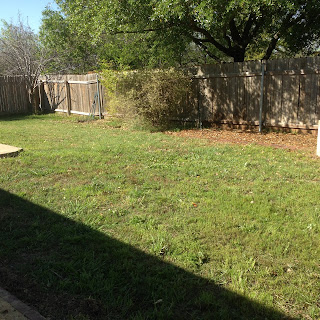
Strangely enough, this work - along with mowing and weed-whacking the rest of the yard - has me looking forward to improvements this year. Beyond the main garden (the one with the garlic and pepper plant) and the summer bean garden (just to the left of the bushes above) I am planning on a heavy planting of lavender, hopefully in preparation for bees.
Happy Spring!
First off, mulch. We need lots of it here as we have hot summers.


Hey - Look what survived! Pepper Plants:


Back part of the garden, now planted with Rye and Spring Wheat:


Strangely enough, this work - along with mowing and weed-whacking the rest of the yard - has me looking forward to improvements this year. Beyond the main garden (the one with the garlic and pepper plant) and the summer bean garden (just to the left of the bushes above) I am planning on a heavy planting of lavender, hopefully in preparation for bees.
Happy Spring!
Subscribe to:
Posts (Atom)