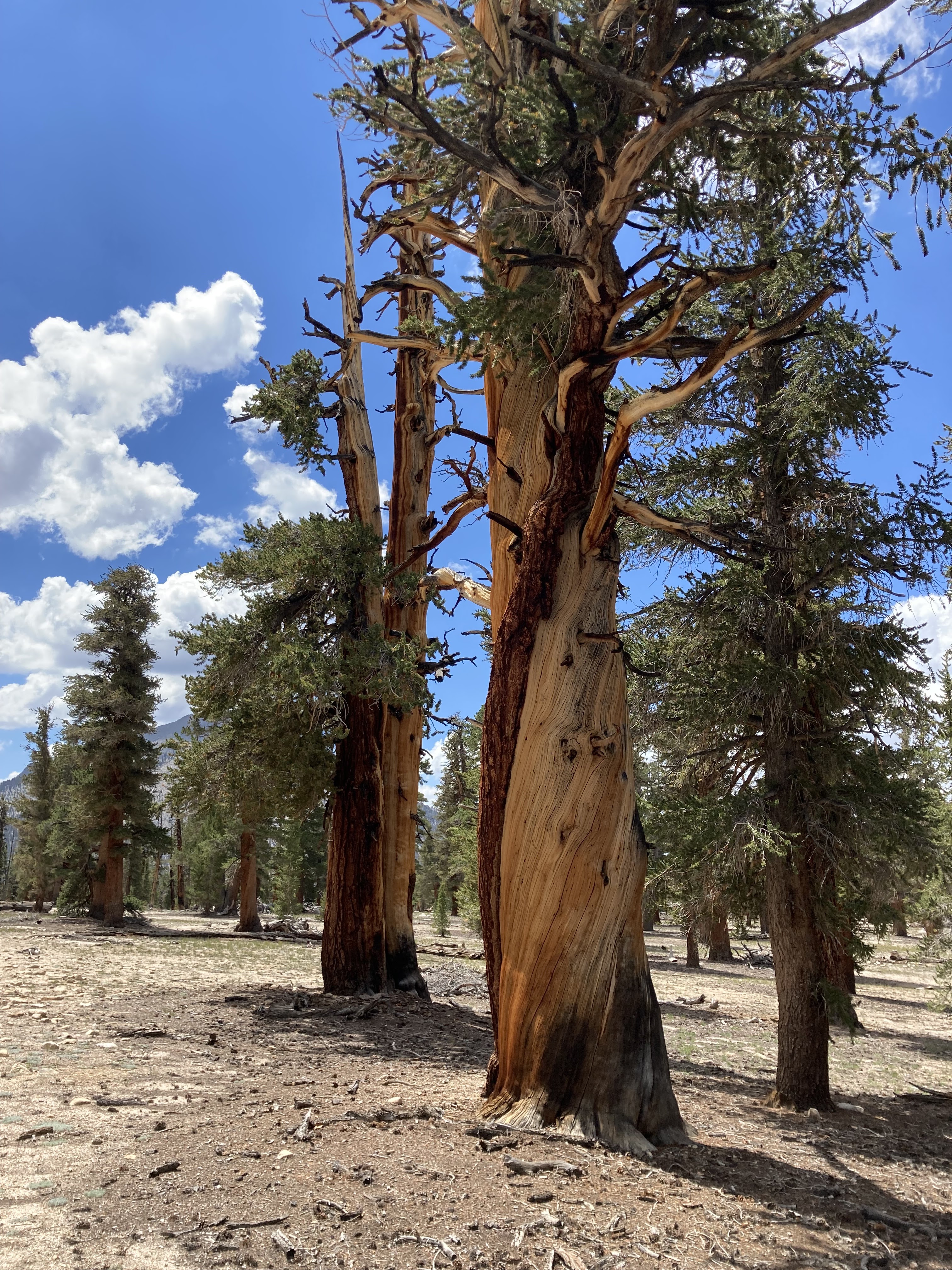
One of the most amazing of the trees we saw was almost as we ended the hike.

Closer up, it did look like a dead tree walking!
.JPG)
Closer up, it did look like a dead tree walking!
So likely this will be the last post on Whitney for awhile.
It is certainly not that I have exhausted my picture store - oh, there are still plenty of pictures! - as I have my immediate thoughts on it. It is almost a month in the rearview mirror now, and while the changes are there in me, life is clicking along at a pretty good pace. Smelling the roses is important, but smelling them only to the exclusion of other things does not move the needle in other areas.
With that said, here are the Mt. Whitney Rule of Five.
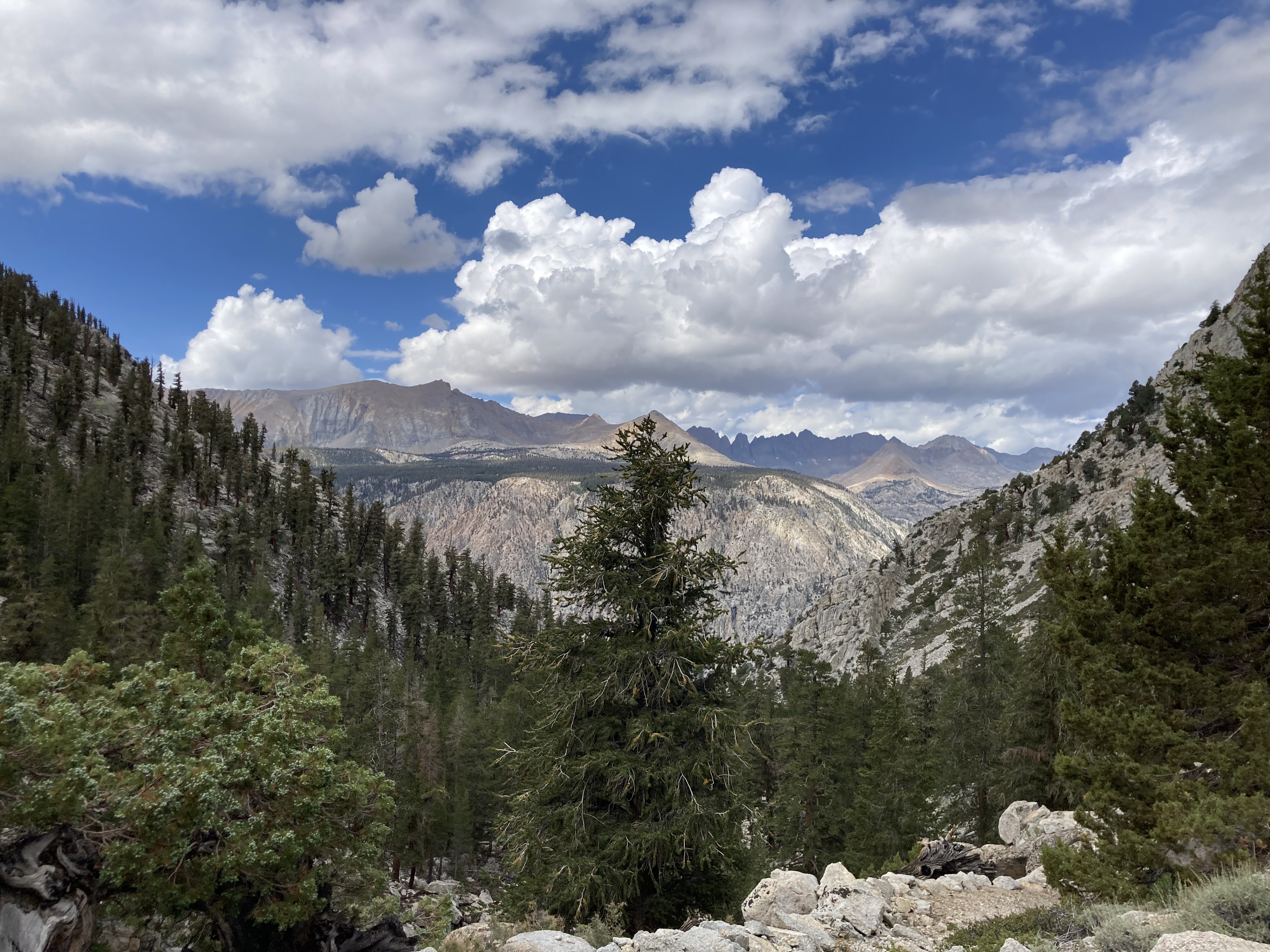
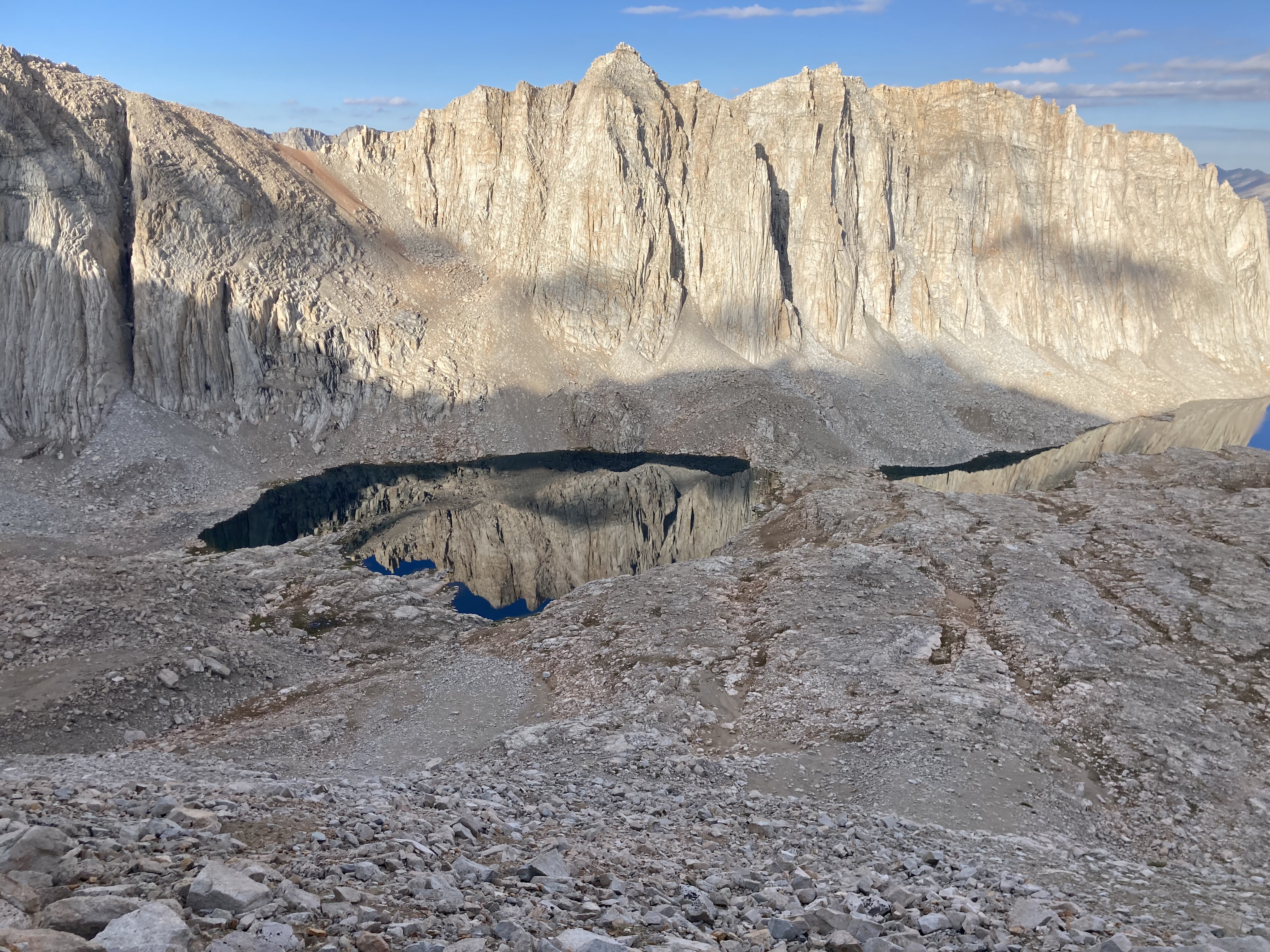

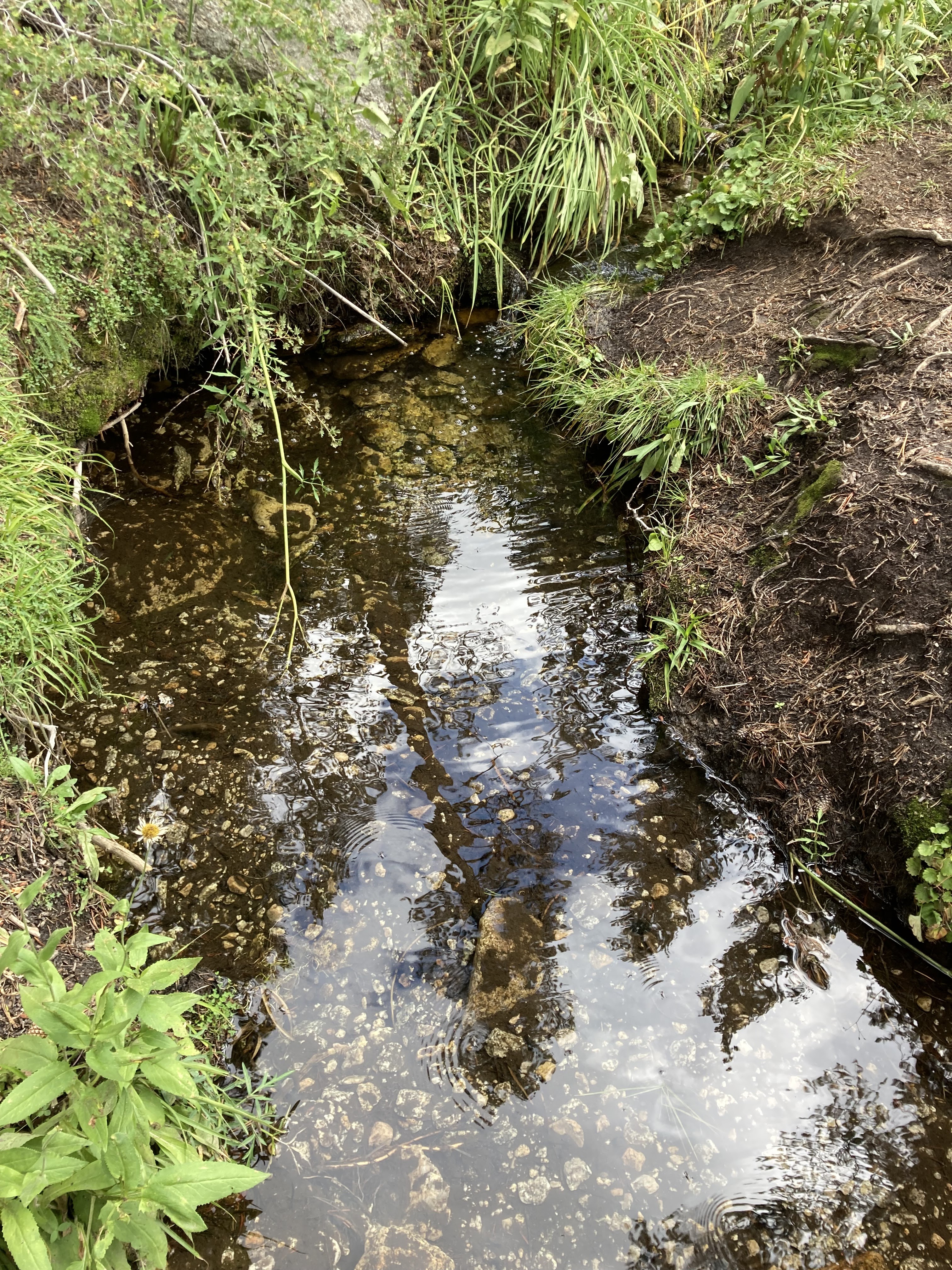

5) The world is big, we are small.
No mystery to most people that think or read those blogs to right, but the world is much bigger - and resilient - than we can possibly imagine. We get caught up in our small views of world, trapped in cities or urban areas, and come to believe that Nature "out there" is just like Nature "here". It is in kind, but not in grandeur or size or space. I hiked 83 miles in a wilderness and still likely saw a very small portion of it, a far smaller portion than I would likely see if I drove 83 miles between one city and another. Likely in that drive, I would become depressed by the similarity of all the urban centers I passed. In hiking, I was continually amazed by the variety and scope of the landscape.
(Fire update: Not as nearly good news today. The fire jumped the River and fire lines and started a second fire working its way up the canyon, about linear miles from my parents' house. The fire has actually gotten into some of the structures of the nearest town as well.)
This week I had need to talk to a lawyer - nothing alarming, just the fact that given all we have been through over the last two years, a will and certain directives (Power of Attorney, Do Not Resuscitate, etcetera) are in order . We had a pleasant initial conversation and later in the day I received the letter of engagement along with fees for service. There is a ranking of fees, based on whether one is an attorney, a law student, a paralegal, or a clerk (the caveat, of course, is that none of them "get" all that money; some always goes to firm). It a helpful tool in terms of speaking with them going forward; knowing the going rate, one can ask the question "Do I really need to talk to them?"
Time and value of course, time and value.

I have a value as defined by my current position, as I have for my previous positions. It is not just my salary (as our Personnel departments are always quick to tell us), but a combination of salary, benefits, and the other sorts of "extras" that may accrue. In my daily work life, I do not consider this as much as I should - often I am too eager to do something or get involved when the real question should be "Is this truly worth my time?" The value of my time gets lost in such a thing of course, because in point of fact I am employed by the company and so at some level, I need to do the work - there is no method for me to "make people use my time wisely" by charging them more. But neither is there value in doing the sorts of things that - literally - are not worth my time.
That said, how do I measure time and value in the real world?

On our hike, we consumed days covering up to 15 miles a day. The only value we realized is the value that we derived internally - and I suppose what is more ridiculous, we were paying for the experience so in that sense, we were not accruing financial value, we were expending it. Most of us were likely on PTO; were we not, not only would we be paying for the privilege, we would be losing money every day we were on the trail. Even our guides, bless them, likely made not a great deal of money - but if I asked them, they would tell me this is exactly what they wanted to do.
And yet, I suspect not one of us regrets going.
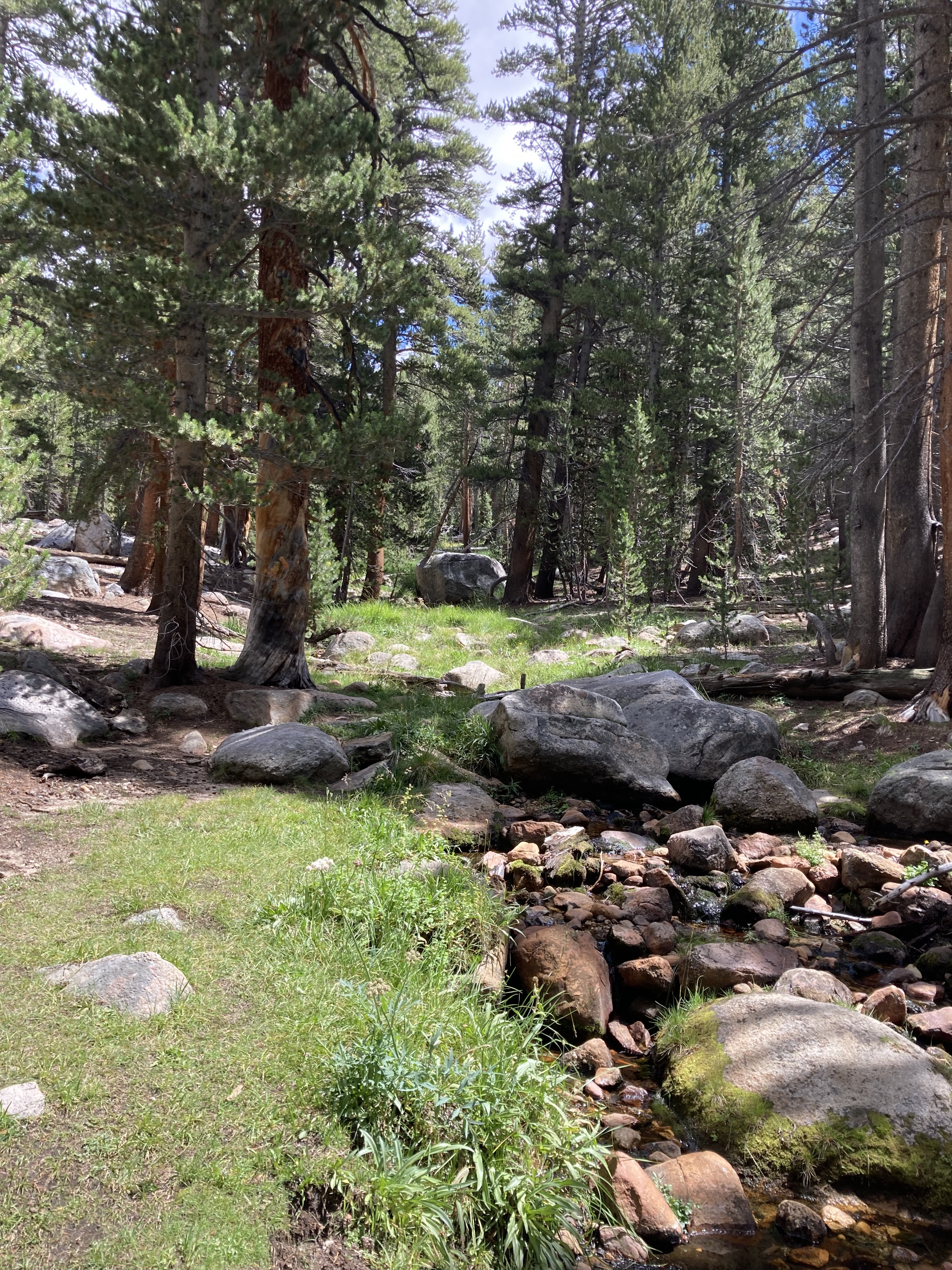
 I do not suppose there is a clear answer here, as everyone will ultimately have a different understanding of this issue - for some, time and value should always be monetary and directly linked, for others one weighs more heavily than the other, and for others, they can easily shift back and forth based on the circumstances. But what struck me as I looked at this list of costing was really the meaningful question to myself: Not "Am I spending my time wisely?", but rather "Am I valuing what I do based on the time I spend doing it?"
(Fire Update: The fire has continued its growth, but fortunately not significantly in the direction of The Ranch. The potential weather which was a possibility was south of the fire and thus, potential winds and lightning strikes which could have worsened things did not appear. Grateful for the prayers. I will say it is jarring to see the fire lines basically outlining the outskirts of the nearby town).
One of the things that we saw evidence of on our hike were previous forest fires.
Forest fires are a reality of lots of places, including Old Home (New Home has had its share as well, which was somewhat surprising to me when I moved here as it was not the sort of place I thought these things happened). We had seen evidence on our previous hikes and saw some driving in to the Mt. Whitney hike as well as some stands early in the hike on canyons to the west of us.
That I can see, this is only picture I took that perhaps shows fire damage:

I suppose it is understandable of course: The view of forests after burns are depressing at best. Sticks raised to the sky with branches stuck out like bare arms on the hillsides that are bare themselves. Blackened wood that is dead although it fakes the appearance of living.
And that is far away. They can be even more jarring up close.
Such fires are a tragedy, or so we consider them.
Part of the tragedy remains purely on us, of course. We stopped fires from occurring all together and so the more frequent fires that would clear out underbrush and smaller trees were allowed to grow, creating conditions for far more hot, intense fires. And we actively discouraged any sort of active thinning or logging which might have had some of the same impact (do not read into this that completely logging everything is a solution either; it is just as destructive).
Still, for all of that, the fires would have likely still occurred at some level. And that would also be a necessary thing for the renewal of the forest and the ecosystem.
The forest will recover - but its recovery will be measured in decades, not seasons (see the above paragraph for how we helped extend this period by poor choices). This is not a tragedy for the forest - it can wait 50 or 100 years to re-establish itself.
It is a tragedy for us, of course, because most of us will never live to see the forests regrown. In that sense, we have likely deprived ourselves and at least our children.
I may sound a bit aggravated about this - because I am aggravated. My father spent almost 10 years clearing brush and cleaning up The Ranch to prevent this sort of thing from happening there, and The Cowboy and The Young Cowboy have continued this work. You cannot completely eliminate forest fires, but things can be done to lessen their impact. For many years we did precisely nothing and even now, we are easing our way slowly back into active forest management. It takes time and effort and appreciation of the land, something too often missing in those that get their view of Nature from streaming media and carefully controlled and managed experiences.
At some point - hopefully September, but it truly may be October or November - I will be able to get back up to The Ranch and hopefully beyond. I know I am going to be saddened and shocked by what I will see - not just from the destruction, which I predict will be awful, but from the long term impact on the area. This was an area who depended to a great extent upon some level of logging and tourism due to outdoor recreation. Both of this will be almost completely gone.
Hopefully not gone in the long term sense of the forest, just gone in the sense of my own lifetime.
One wonders, if we would think in these terms, how much differently we would manage the forests.
A Final Note: It with sadness that I read Reverend Paul of Way Up North has decided to stop posting. He has been a long time friend of this blog and I will miss his posts (and his Iditarod updates every year!). If you have benefitted from his wisdom, you might drop by and let him know.
Originally I was going to call this post "Trees", but realized I have posted plenty of pictures of pine and oak and cedars that I knew. Not so much these.


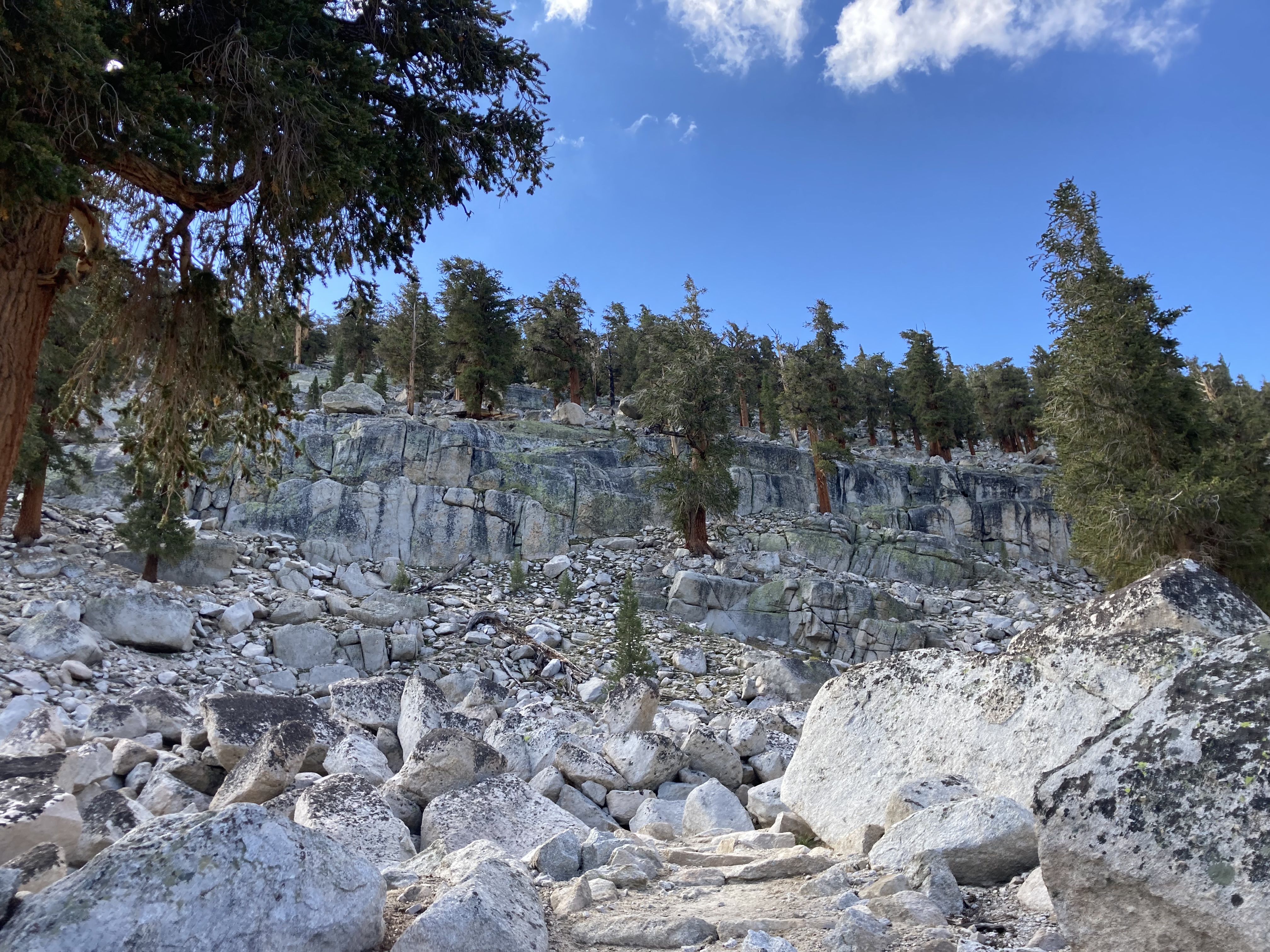




Four views from the top, actually:
The first is of the Kern River Valley. Of note to geography enthusiasts, this is where the water flows east on the Sierra Nevadas, not west;
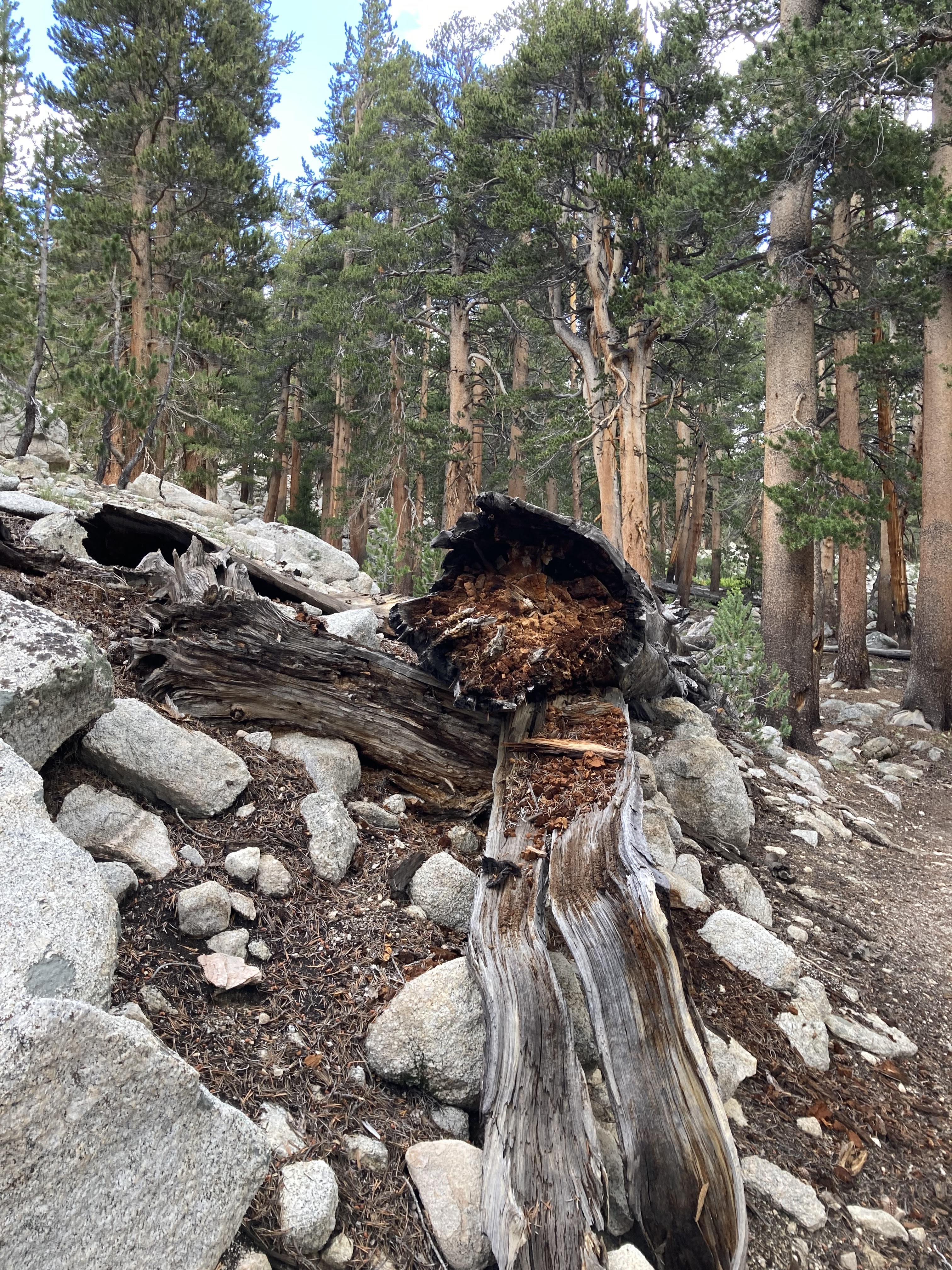
One of the things that confronts one when out in the wilderness is decay.




I moved in closer, and he still seemed uninterested in me:

This is less than 6 feet away. Apparently he was hoping I would be a potential food handout. When I was clear I was just there for the picture, he went on his way.


The hike after lunch saw us begin to stretch out over the trail. I suppose, in retrospect, this was not a big concern to our guides: the trail was clear, we had a known destination, and the big push would be the following day, when we scaled Mt. Whitney. We marched along in our clusters as we began to string ourselves out based on speed and drive.
And then, after lunch, it started to rain.


The silence of the High Sierras was deafening at the best of times. Absent were the sounds of insects and birds that fill the lower lands. Occasionally one would hear one, but it was a rather rare experience which frankly surprised me: after all, this is a place where people are very much absent by and large. Would wildlife not thrive?
Apparently not; I walked alone in the dripping rain and light wind with only the crunch of my shoes and my hiking poles to break the silence.

And then, for one brief instant, I was utterly lost to myself.

In that moment there was no separation between me and the world around me. I was not a person walking through the landscape, I was part of the landscape: the rocks beneath my feet running to the roots of the earth, the trees striving to reach the sky for light and the depths for water, the very air around me, dripping with water that meant life and renewal for all of this. For that moment there was simply no time, just the sense of one ageless moment.
And then, just like that, it was gone. I was again a hiker, moving through the wilderness to which I was a foreigner.

What was it? I suspect Christian mystics like St. John of the Cross and Teresa of Avila and Brother Lawrence of the Resurrection would say it was a moment of union with God. I am not so arrogant to presume such an event would ever happen to me (although perhaps it was). The easier term for me is actually from Buddhist thought: satori, or the moment of enlightenment. But perhaps if satori is actually realizing one's place in God's creation, that might very well work.
Not that I was enlightened at all, of course: One could almost feel the thought coming - and then it was gone. But, perhaps, that is enlightenment.


