Tuesday, October 22, 2024

2024 Turkey: Ephesus (I)

 "When Apollos was at Corinth, Paul through the upper country and came to Ephesus....And he entered the synagogue and for three months spoke boldly, pleading about the kingdom of God; but when some were stubborn and disbelieved, speaking evil of the Way before the congregation, he withdrew from them, taking the disciples with him, and argue daily in the hall of Tyrannus.  This continued for two years, so that all the residents of Asia heard the word of the Lord, both Jews and Greeks" - Acts of The Apostles, 19:1, 8-10

Map of Ephesus

The city of Ephesus has a long and famous history - although to many of its inhabitants, they would not have recognized the later city.

Records show that a city associated with this region - Apasa -existed during Mycenean Period (1500 - 1300 B.C.).  The Attic Greeks arrived circa 10th Century B.C. and founded a city - not here, but in nearby modern Selรงuk.  They prospered there, forming first the ancient association of the Ionian league, twelve cities of Anatolia that were Greek.   The location of the city along the river Cayster meant that it was a trading city - interestingly, it also meant the city relocated a fair amount.  Archaeologists have had some difficulty fixing the original city.


The city was most famous for the Temple of Artemis, at one time considered one of the Seven Wonders of the Ancient World.  The Greek goddess Artemis and the Anatolian goddess Cybele were conflated into one.  The site, as a religious center, dates back much farther than the use of it by the Greeks itself.


The city was razed by the Cimmerians (not those of the Conan variety around 650 B.C., but was rebuilt and became prosperous until conquered by king Croesus of the Kingdom of Lydia (who rebuilt the temple) in 547 B.C.  The kingdom of Lydia was in turn conquered by the Persian (Achaemenid) Empire and the city of Ephesus and all the cities of Ionia taken into a satrapy.

The main street in the town

The Ionian cities revolted in the Ionian revolt of 499 - 493 B.C.;  although they ultimately lost the peace they received was considered reasonable and profitable for both the Greeks and the Persians (although one of the results of the revolt was the beginning of the Greco-Persian Wars and the invasion of Greece.  Ephesus, 

The Temple of Artemis burned in 356 B.C. and was rebuilt into its third and final form and lasted for 600 years; this would have been the temple that the Apostles knew.


Ephesus and all of Anatolia fell to Alexander the Great, who liberated all the cities of Ionia.  After his death in 323 B.C. and the Wars of the Diadochi, Ephesus fell to the general Lysimachus.  

During the intervening years, the river Cayster had silted up and the harbor was lost, as well as an increase in disease due to the marshes that developed.  Lysimachus decreed a new city was to be built approximately1 mile away and a new harbor established.  When some of the inhabitants refused to relocate, he helpfully stopped up the sewers and forced everyone to move.  The city was renamed Arsinoe, after Lysimachus' wife.  After this death in 281 B.C., the name reverted to Ephesus

(The Bolouterion, or Council Chambers, of Ephesus.  The city council met here)


Ephesus passed from kingdom to kingdom:  First the Seleucid empire, then the kingdom of Pergamon, and then to Rome in 133 B.C.  They joined in the First Mithridatic revolt against Rome (88-84 B.C), partially fueled by rising taxes and the plundering of the city for artifacts to be sent abroad.  They lost, and were subject to taxes and indemnities that crippled the city for years.


In 27 B.C. Augustus named the city of Ephesus the capital of proconsular Asia.  It became the seat of the Governor of the province of Asia and a major center of commerce.  This is the city that the apostles of Christ would have known - and no wonder; it was considered second only to Rome.

Looking down the main street towards the harbor.


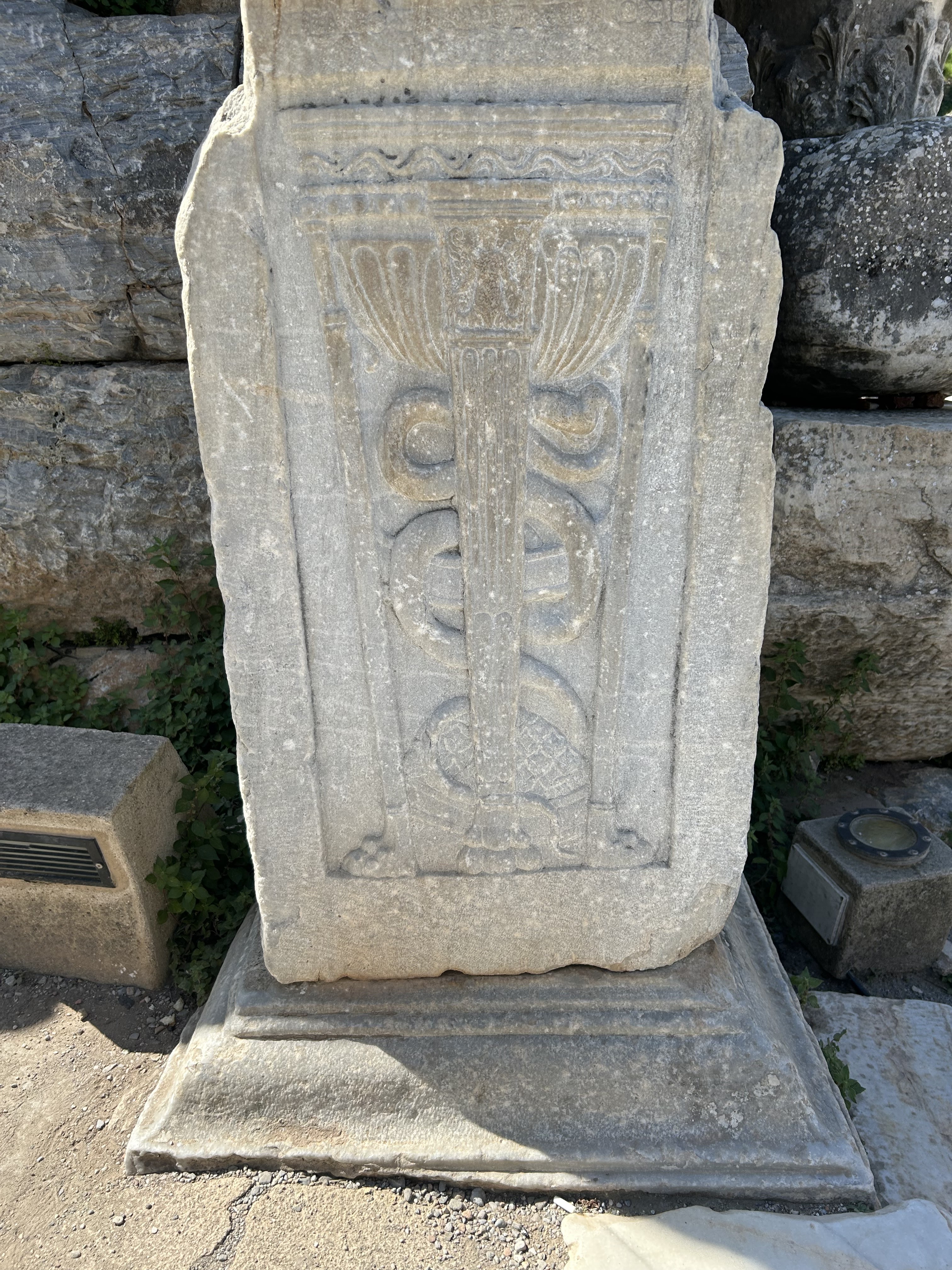
Symbols of Hermes:


The city was destroyed by the Goths in A.D. 263 but rebuilt by Constantine and remain a key city of the Empire into the A.D. 600s.  At that point two issues impacted the city. The first was a silting up of the harbor similar to what had happened to the first city; the harbor silted up and the coastline moved, thus destroying its value as a commercial port.  The second was another round of burning in A.D. 614-615 followed by a sacking by the advancing armies of Islam later that century.  By the time the Crusaders arrived in the late 11th Century A.D. it was little more than a village.


The city, once the location of a marvel of the ancient world and capital of the much of the modern area of Anatolia, was completely abandoned in the 15th Century A.D., remaining undiscovered until archeological efforts began in A.D. 1863.


Monday, October 21, 2024

Fire In The Sky

Apologies, friends.  In lieu of a post today, I offer you these pictures from my airplane flight to The Ranch this weekend.  


Saturday, October 19, 2024

Hammerfall 2.0: Bouncing The Rubble

(Editor's note:  My apologies; responses may be delayed as I am headed to The Ranch this weekend for my monthly visit.)

One of the last vestiges of the layoff that indirectly triggered this entire relocation to New Home 2.0 -  rather unoriginally known as "Hammerfall 2.0" (to differentiate it from my first layoff in 2009 "Hammerfall") is the fact that I have continued to stalk my former employer on line.

Originally this was done from somewhat from a sense of tracking my friends and former workers (most of whom had their own Hammerfall a month after we were gone), but also from a rather long standing habit I have of tracking my former employers to track the one of two seemingly inevitable outcomes:  buyout/merger or liquidation.  My record here stands almost unvanquished in this one realm:  few of the companies that I have left through layoffs or moving on make in on their own.  Most of that is simply due to the modern market of the biopharmaceutical industry:  If you cannot go big (and few companies can, anymore) you either need to have something someone else wants or prepare to fight a rearguard action against dwindling funds and likely dwindling interest.

This week, the law averages caught up with my former employer.

There was a hint of course, a big solid hint when at the annual meeting three weeks ago, they laid off 60% of their current employees (I keep a few shares from my one time "This is the thing that is going to propel me to retirement" options trove, mostly so I can vote in the annual meeting).  The simple math after the layoff indicated they had something like 12 employees remaining after that.  12 employees, in case you are wondering, is not enough to keep a biopharmaceutical company running, especially with clinical trials ongoing.

Last Friday, after hours, they lazily let an SEC filing slip into the InterWeb (doubly convenient as it was a banking holiday on Monday) that the Board of Directors, after a careful review of the situation, had decided to wind the company down - followed by the typical sorts of things one finds in these announcements:  continuing to seek opportunities to partner, have engaged a third party firm to assist this process, all but key management laid off, etc. etc.

The stock price acted pretty much like you would expect, plummeting an amazing 73.5% upon the news.

For once I can take a ball park guess at the amount of money that was wasted (there is no other word) during the life of this company.  My estimate:  Probably around $200-250 million, of which only approximately $9.5 million remained at the end of 30 June 2024.  And a then burn-rate of $8.1 million a quarter, which means they were pretty much down to pocket change and coupons:  even a fool like me can do the math.

Oh, the promise that was there. Oh, the great things that were going to be done. Oh, the enlightened corporate atmosphere we were to have.  All now reduced to a number of empty labs and manufacturing spaces filled with equipment, reagents, product, supplies - and no-one to utilize them.

The end is written:  investors, creditors, and companies looking for a bargain will swoop in and buy things for pennies on the dollar.  The documentation and quality systems will quietly pass into the server version of limbo, the product (if there is anything left) sold off or disposed of, the office furniture and lab fittings and manufacturing equipment (at one point we had over 200,000 square feet of office, lab, and manufacturing space) disbursed among new, eager companies ready to try their luck or old ones looking to start up pilot plants and labs.  The name - as they always do - will slowly fade into the background of people's resumes, becoming a wispy memory that is never mentioned again other than "Oh yes, at one time I lived in New Home and worked at Company X".

I have a few corporate sanctioned materials:  A rather nice shirt, a coffee mug (I always keep the coffee mugs), a yoga mat.  Likely I could write them off as a donation for more than my stock is worth now.

This is the way.  This has always been the way.

You may note I sound bitter. I am, probably a bit more than most of the companies I have been at.  The errors were too big and the spending too egregious for anyone but the willingly ignorant and deceived to miss the signs.  Like many startups, they forgot their first job was to make product and generate income, not to do everything under the sun.  And like many startups, they failed in a series of downward falls, the wreckage of human lives strewn across the proverbial landscape.

And now, the baleful eye of Sauron turns towards the initiator of Hammerfall 3.0.  There can only be, of course the Current Employer to rule them all.

Friday, October 18, 2024

On The End Of Autumn

 It appears that this weekend past was the last glorious weekend of Autumn in New Home 2.0.

According to the mighty weather predictors, it pretty much came at the stroke of midnight between Sunday night and Monday  morning, when the last truly good day  (for the next 10 anyway) disappears and the season of rain and clouds appears.  From every report of my coworkers, it will be like this through approximately March or April of next year.

That said, the weekend was a fine one, with temperatures in the mid 70's and not a hint of clouds in the sky.  I had a men's group activity Saturday morning replete with the sort of things men's gathering are made of after fasts:  smoked meat, carbs, and healthy sized desserts.  The rest of the day was spent in the minimal household chores I have (I do love that part of living in an apartment), reading, and taking a stroll across the tracks to treat myself with a latter and cupcake.  Sunday was church, then house cleaning, reading, and iaijutsu training.  All in all, just the sort of weekend that I enjoy:  perhaps one or two outings but the rest of the time with myself or Joy the Rabbit.

I was somewhat shocked to remember that this past week represents seven months of living in New Home 2.0.  It really does not seem like that much time at all, although if I think about it a great deal has happened in those seven months:  a funeral, a wedding, a move into an apartment (and then getting things into the apartment and unpacked), starting at a new dojo, I-Bun's passing, the passing of my father in law The Master Sergeant - along with continued sorting trips back to The Ranch and my new job.  I have not quite found my rhythm yet, but it seems to be coming along nicely.


For such a relatively engaged and busy time, it has had a certain peace to it.  And having the colors of Autumn for the viewing has been a welcome change.  They sit so well with the angle of the sun that I have come to associate with Autumn that it makes the coming transition bearable.  

The leaves bear me a reminder that nothing lasts forever - but in even in their passing, they can be glorious.

Thursday, October 17, 2024

The Collapse CLXV: Reports And Ruminations

 12 September 20XX

My Dear Luclius:

The last few days here have been spent busily continuing to prepare for Winter. Of especially interest is gathering up any and all pieces of wood I can get for the upcoming Winter: There will be two of us instead of one and while I can manage the cold, I have no idea what Pompeia Paulina’s limit may be. Other tasks – beyond the garden and prepping the greenhouse of course – are getting the pump shed in order and eyeing the progress of the Winter grains.

The Colonel and The Leftenant had the courtesy to stop by on their way out of town the day after our own meeting.. Their visit had been of mixed success – the farthest town away, Highwayville (so named by me because it sits at the junction of the main state highway and the road that runs through Birch) was more than interested in maintaining an alliance, yet they are the farthest away and likely the most exposed to any issues. The town closer in, Grant, has almost twice the population of Highwayville and six times the population of Birch. Apparently they have already taken the liberty of starting to push cars into place and make something of a wall around some part of the city. Their response, much like that of the rancher in our meeting, was a sort of guarded indifference: supportive, but not ready to commit to much aid.

On the whole, not surprising.

We pressed some supplies on the Colonel and the Leftenent as they had walked a great deal in the past few days on everyone’s behalf with little to show for it. They both tried to insist they had enough but we insisted more and finally they accepted. On his way out, the Colonel let both myself and Young Xerxes know we would be welcome in Kentucky City, should things come to that.

It was an exceedingly kind gesture.

Young Xerxes has said a few people have started moving to the surrounding places before the weather turns colder and unyielding. They carry what they can or find ways to transport it via wagon or cart or even horses. At least two of the neighbors on their street have said they are leaving; once they are gone they have offered up anything that is left behind as they do not expect to be back for a long time.

Could I go somewhere Lucilius? Yes, it sounds like we have a place to go now if we needed to. But would I? I find myself uncertain at best. Balancing the idea of life as a refugee and life as it is becomes difficult in my mind – realistically what could or would we transport the 9 miles to Kentucky City? Little enough at best, and I have no idea what we would find once we got there.

At best here we could simply make the place look like it was unremarkable and unoccupied. That can be done readily enough: The old winter window covers are still here from when these was a seasonal cabin. While the would make the interior very dark, they would also give every impression of something uninhabited (although likely the garden would give it away, if not the smoke from the chimney). Still, we are enough off the main road that it might not attract attention.

The other reason to stay, of course, is Stateira and Young Xerxes (or leave, I suppose, if they went). I have thought of having them come to stay here if things become too hard – the space is very small for four people (with a young married couple at that), but could be made to work. It has in the past.

On the whole, I suppose it remains a problem for the Spring – the Winter is coming soon enough here and while there is not a 100% chance of us being bothered by wandering bands, it is extremely low given the fact that we are so far off any main highway and that anyone foolish enough to make a long distance raid in the Winter here has fuel and food to burn.

But even as I write this, I am already thinking towards a Spring likely to have even less than we have now.

Your Obedient Servant, Seneca

Wednesday, October 16, 2024

2024 Turkey: KuลŸadasi

Warning:  Photo heavy post.  Mostly of sunsets.

KuลŸadasi (pronounced "coo-sha-da-see", the scwha "s' having a "sh" sound) means "Bird Island".  Humans have lived here for well over 3,000 years, most of that with some kind of port.  It was not nearly as important as the port of Ephesus (coming soon!), until Ephesus' port silted up.  The Romans knew it as Ephesus Neapolis (New Ephesus) and the Byzantines as Scala Nova  (New Port); the Turks names it after the shape of an island.

Our hotel - one of those sorts of things I could never actually afford except on a group tour - was built on the cliff right above the sea.  These pictures are over two days, but I can see where one could spend endless days here, watching the sun set.


The city of KuลŸadasi.  The island in the middle was an Ottoman fort.


The island you see to the left is the Isle of Samos - a Greek possession (and, interestingly enough, the one of the first examples of a thalassocracy [a maritime empire] under Polycrates the tyrant.  His ideas found full flower in the the naval empire of the Athenian Empire).


Below is one of my favorite pictures from Turkey:


Tuesday, October 15, 2024

2024 Turkey: Food And Driving To KuลŸadasi

 Part of being on a tour where you cover something like 1600 miles is that you spend a lot of time on the motorcoach.  It may seem like we "stop" a lot, but that is punctuated by periods (sometimes long) that are just driving with nothing more remarkable that looking at the landscape.

Our first stop after Pergamon was restaurant/road stop.

The bread in Turkey was inevitably delicious.


If I recall correctly, this was falafel:


Beer in a fancy mug:


More of that sweet, sweet grilled meat (and rice and more bread):


Another baklava?  Of course!


And coffee to go with it:


From lunch, we began to work our way back towards the coast.


Our destination for the evening:  KuลŸadasi