Tuesday, October 10, 2023

Greece 2023: Sailing To Corfu

We left the Meteora region and headed over what is known as the Greek Alps; apparently there is skiing here in the Winter.


Greece has skiing; who knew?


Descending to the coast, we reached the town of Igoumenitsa, a town located on the Ionian Sea.  Here, we would be taking a ferry to the island of Cofu ( Gr.  Kekyra, or Κέρκυρα).  Our ferry drove on, and we went upstairs.

The trip took about 1 hour.  It has been years since I took any sort of ride on the ocean of this nature.


A view of the Old Fortress. We will see more soon:


Looking back towards the Old Fortress:


From our hotel room overlooking Kalichiopoulos Lagoon.  This was likely the harbor of Corfu in ancient times.


Dinner was a buffet:


View from our hotel room at sunset:


Monday, October 09, 2023

Of Credit Fraud (An Update) And A New Roof

1)  A follow up to my post last week on credit card fraud:  turns out it was good news and alarming news.  The good news was that it was not fraud in that it was a charge for an annual renewal fee (VPN, as it ironically turns out) and was an expected charge (although apparently, forgotten by me).

The alarming part was that I had not updated my credit card with them, yet somehow they had the new number.

I went and did a screen of some other sites I use.  Nope, all of them had the old credit card that was canceled because of the original fraud.  Yet somehow, this company had the newly issued number that had been in existence for less than two weeks, if you count from the time it was issued and sent to me.

My gut tells me that somewhere in the terms of service there is a clause that somehow links the bank/credit account to that service.  But still find it disturbing that the number just somehow "magically appeared" when I had not notified them of any change at all.

Deep trust of technology deepened.

2)  Two weeks ago we experienced a severe hail storm in our area (naturally and once again, when I was away from New Home and at Old Home).  Severe does not cover it:  we had friends with broken windshields, broken home windows, and actual holes in their house.

And, of course, ruined roofs.

We did not have a contractor in mind (although they were literally making the rounds the day after) and finally just stumbled into one who seemed at least reputable on the InterWeb. They said we had damage - no surprise given the storm and even less of a surprise as the roof is at least 20 years old, and probably a bit older.  

I filed the claim; the adjustor came by on Saturday.

The adjustor was a super nice guy and let me know up front that apparently there was a declaration on our policy that they would only pay replacement costs based on the current value of the roof - that is to say, the roof had likely depreciated beyond anything that had value.  He would do what he could for us, but said that it was possible the insurance company would not pay at all.

The reimbursement offer came back that same day. I have no idea what roofs are going for now, but I am hopeful he estimated high to get us some kind of reimbursement:  we got 12% of what the roof estimate was.

This is not an ideal situation.

The next step is to contact the roofing company and see what an acceptable roof will actually cost.  Even at that, there will be some creative budgeting and belt tightening to manage it.

Two lessons:

1)  Check your homeowner's insurance policy for a declaration on your roof and current value payment.

2)  When you get your roof replaced, contact your home insurance company.  Apparently they will update the policy to remove the declaration.

Sunday, October 08, 2023

The Modernist


 Commentary:  Per the Open Doors organization, 360 millions Christians suffered persecution in 2023 to date, with 5,621 martyrs.  Likely you will not hear a whiff of this from a great many churches, let alone from the rest of the world.  Persecution was something that happened in the Days of Yore, not in today's modern world.

The fact that the modern world is not bothered does not surprise me.  The fact that the Church is not bothered bothers me greatly.

Saturday, October 07, 2023

On Credit Card Fraud

 About two weeks ago I was checking my bank balance when I noticed there was an Amazon charge on my account.

That surprised me a bit as I could not remember ordering anything from Amazon in quite some time.  I checked - no, I had not.  I then polled my family to see if somehow they had ordered something and my card had accidentally been on the order.  No, no-one had done so.

I checked the address of the charge (turns out you can do that).  It was at an Amazon locker at Seattle.  Seeing as I have not been to Seattle in something like 20 years, I contacted my bank and canceled my card.

The standard statement you get from the service representative (if you have not done this lately) is that the charge is rejected and the card is immediately shut down.  A new card will be shipped to you in 5 to 7 days in a plain white envelope. 

The surprising thing, as turns out, is how much I use my credit card.

I say "how much".  It is not as if I am out there buying out the world - but I do use it for things like fuel and groceries, mostly because I get the points help with my air travel.  It also means that incidental and larger purchases - say, a vet bill for Poppy The Brave and A the Cat - are a little more inconvenient to pay for.  

We do have cash at the house, but I usually do not carry more than a small amount for incidental purposes.  So add to that planning when I am doing things like purchasing groceries (fortunately we bought a fuel card so that is taken care of).

This past Wednesday my card came. I called it and activated it.  Yesterday evening, I received a text from the bank about another potentially fraudulent charge. I checked - yes, fraud confirmed.  Now I get to wait another 5 to 7 days for another plain white envelope to arrive.

The most frustrating part?  I had only used the card at three places.  On the bright side I suppose, I can narrow down where the fraud happened pretty clearly (and no, it was not at my mechanic's).  But once again, an inconvenience.

It does make me a lot more thoughtful about how I might use the card when I get it again - because previously I have had this card for 4 years without a single issue like this.  And likely should encourage me to use cash more as I am able.

(Friendly reminder:  check your accounts regularly, especially if you use a credit card).

Friday, October 06, 2023

On Writing and Return (The Second Entry)

There is a relationship between an author or authoress and their characters that goes deeper than non-writers might suppose.

Characters are, ultimately, a creation ex nihilo, a figment of thought given flesh and bones and motivations and emotions by words only.  To create a character is, in a very real way, to create an imaginary friend.

Some of the imaginary friends go nowhere, two dimensional cutouts or stock characters that disappear as quickly as they come as there is little to them.  Some others, though, take on a life of their own and become "real", as real as physical people.

Intuitively we know this happens.  We likely all have fictional characters that became real to us, perhaps real in ways those living were not.  When I was growing up, Edgar Rice Burrough's John Carter and Tars Tarkas and Dejah Thoris roamed my brain along with Robert E. Howard's Conan.  These were the ones that had series, but stand alone books - Andre Norton, H. Beam Piper - also created characters that had mental flesh and bones, were the sort of people one could imagine meeting.  And now later, the characters of Jerry Pournelle and Dostoevsky and Sir Walter Scott wander in and out of phase.

In many of the compilation books of Robert E. Howard's Conan the Barbarian edited by L. Sprague de Camp, a snippet was often included from one of Howard's letters in which he stated that he often felt less like he was writing fiction and more like he was simply conveying a history, a history that someone else was telling him.  It was not "his" story; it was someone else's story that he was relating.

It would also be ridiculous to assume that external events and time never have impact on writers and how they write.  Our experiences inform us as we go older and we simply have more depth and memories to write from; our view of events over time also change as we have the ability to see decisions play out in real time and judge them against their original declared intentions.  For the most part, the end and the beginning seldom match up.

When I started writing The Collapse 5 years ago (if one can believe it has been going that long),  it was originally just intended as a thought exercise on a certain set of circumstances:  an older single retired man who is approached for a simple request - consider re-entering the workforce - looks around, and realizes that the time is later than he thinks.  One thought exercise turned into another, and another, and before I knew it, I had a series going on.

But something else happened along the way as well:  the fictional character, Seneca, turned into more that just a collection of imagination and words. He became a person.

A fair question to ask, I suppose, is "Is he me?"  Maybe.  Parts of him are.  But as I have written of him over the years, parts of him have turned out to be completely his own.

It is exciting and dangerous when this happens, when "the character" becomes "the person".  On the bright side, writing can become easier as the character begins to relate things instead of the author telling the character.  I do not "generate content" in that sense of the word, I am truly just writing down what someone is relating to me.

The less good part, of course, is that the character is no longer a simple extension of the author.  The character can - and in my case has - flatly refused to be written into certain things or even tell me certain things about him (the impudence).  Having achieved some level of agency, the character elects in some cases to tell me what I am going write of him, not the other way around.

Originally I had no idea where this story was going to go - and to be fair, it is still a mystery.   In that sense even though it is in a future, it is being lived out in real time.   Sometimes I have a pretty good idea a week before the post what I will write of or sometimes even an idea for a series of weeks; other times Seneca simply refuses to go forward, points his finger imperiously at my keyboard, and says "Write this".

And thus, when I had one idea this entire week what I was going to write about but could not manage to start it for some reason, Seneca appeared on Wednesday night at 2230 and told me an entirely different story.

I will say this:  having at least four people running around in my head now - Seneca, Pompeia Paulina, Young Xerxes, Stateira - I never lack for a moment of conversation or thought.  In that sense, I am never "alone."

I do wonder what Lucilius will do with all of this when he finally gets the letters.

Thursday, October 05, 2023

The Collapse CXXI: Return (The Second Entry)

30 June 20XX+1 - Later

My Dear Lucilius:

It is seldom that I write twice in a day – especially at night, when I am now using hoarded power to see (which, to be fair, can be recharged – but there is the principle of the thing).

Simply put, I cannot sleep.

I tried to go back my notes and type them up more fully but found I could not even open the journal. Which is, objectively a ridiculous thing as it merely a book of my thoughts. Subjectively though, I cannot even bring myself to pick it up yet.

How, you might ask, could a simple book of pen and paper confound my very efforts to read it?

Because of what it represents.

Not at all what you are thinking, I imagine. Not what happened out there – although that itself is something that I am having enough trouble with. I tried to express my words to Pompeia Paulina but found myself almost in tears.

No, it is everything that it represents: a lost way of life.

Part of me, I suppose, had held out hope that what we have experienced for the last year or so was temporary thing. The bias of normalcy I suppose one might call it. I know, I know: you have often chided me for holding a mysterious contradictory combination of dire catastrophism and a seemingly endless hope that things would often right themselves. And strangely enough in my own personal life, they often did.

But my personal life is not the world.

We had often commented in our dinners – back when we still lived near enough to have them – that the modern world was bound by a million threads, carefully knit together into a whole. Remove one or two or even twenty and the overall fabric would look a little disheveled, but not come part. But at some point if one removes enough threads – or simply cuts them apart – the integrity of the fabric would begin to fail. Remove enough threads and it would simply fall apart.

I have come back understanding that too many threads have been pulled.

Perhaps we all go through this moment, Lucilius: the moment of realization that the thing is really true, that our parents really are gone or the marriage is over by divorce or death or the lifestyle enabled by the job we had is never coming back. It is at that moment that we can do one of two things: we can simply continue to look away, knowing that we are doing so intentionally, or face the fact that things simply are what they are and we need to operate on the situation as it has been revealed.

It need not be sad of course; epiphanies and reality checks are neither happy nor sad, they just are. Or as Master Oogway said in that martial arts classic Kung Fu Panda, “There is just news. There is no good or bad.”

Pompeia Paulina is reminding me that it is now much later than when I originally wrote and that it is high time that I come to bed.

It is almost High Summer, but I feel the chill of Winter in my bones already.

Your Obedient Servant, Seneca

Wednesday, October 04, 2023

Greece 2023: Monastery Of St. Stephen

The Monastery of St. Stephen originated in the 12th Century A.D.  It was eventually abandoned but after World War II a group of Orthodox nuns asked permission to restore and live in the monastery.

(A note:  The term "monastery" as applied to both male and female religious orders.  I am not sure if that is a failure of translation or just the way it is in Greek).


The sisters have a beautiful series of gardens within its walls.


Looking down towards Kalambaka and the plains of Thessaly:


The gardens really were enchanting:


Tuesday, October 03, 2023

Greece 2023: The Great Meteora

You may remember from the posting from the town of Kalambaka, we could see a monastery from our hotel:


Up a winding road, we arrived at it:


The region of Meteora, which had provided a refuge for ascetics and hermits, became a sort of gathering place for monks as the hills allowed them to seek solitude.  In the 14th Century the Great Meteora Monastery was founded.  At one time up to 24 monasteries existed in this area; only six remain currently.


Originally access to the monasteries was done via rope ladders or baskets with rope; fortunately for modern day visitors stairs have been built.


This is the sort of cave a monk might have dwelled in:


A note on the monastery, if you blow it up:


This is the back side of the main sanctuary.  Pictures are not allowed; I wish I could have taken one for you.  This was an Orthodox sanctuary in all of its 14th Century glory with six centuries of use.


Looking out over the Meteora:


These stairs have been here for hundreds of years, worn down by the feet of pilgrims and monks:


The next three pictures were a more recent addition to the monastery; it pictures Christ as the center of human thought and knowledge.  To His left and write are Greek writers, philosophers, and historians:


Looking down towards Kalambaka:


Monday, October 02, 2023

On Inflection Points Of Empire Downfalls

The indefatigable Old AF Sarge over at Chant du Depart posted an older piece of fiction yesterday (the man, by the way, can write. If you are not following him and the cast of misfits over there, you should be) about the battles of Lexington and Concord - as seen from the side of the British of that day.  In the middles of the story, one of the characters notes "It seemed to Tom that a war might be starting this very day. were these men insane?"

It was a thought provoking piece for a Sunday, which is come to be my deep breath day of the week wedged as it is between what has become effectively the end of the work week (Saturday) and the beginning of the next day.  It raised the salient thought:  How do you recognize the actual end of a civilization or a society?

These sorts of questions have always fascinated me, and of the many different types of history that I have devoured it is the end of empires that often garners the most attention.  Rome, Byzantium, The Ottoman Empire, The Austro-Hungarian Empire - I have read and re-read the fall of these empires until the progression of their unwinding becomes clear.

Why empires, or at least multinational states?  Because it is the fact that these are more often than not societies that have existed for hundreds of years and almost up to their end, they continue to show signs of life.  Even moribund, an empire can still continue to shamble forward based on the powers of a bureaucracy that defies inertia. 

And then, all of a sudden, there is the sudden end.  Curtain, finis

Were these inevitable collapses?  In hindsight of course, it is always difficult to say "no".  We know the history in a way that those living through it could not and we see all of the factors that contributed to the cracking, not just the ones that are easy to see.  But was there a moment just before the moment of inevitability, a moment where the course could have been corrected?  And if there is such a moment, could they have actually seen it for what it was?

Asked differently, can we think critically enough about pivotal points of history to consciously choose them?

I suspect the answer is no, as that would require more thought and consideration than most individuals are willing to put into any decision, let alone critical ones that impact them in ways that they cannot fully comprehend.  I do not think that this surprises me:  abstract decision making is very difficult for us when it directly impacts us, let alone when does not.  Add to that a hearty dose of kicking the can down the road, and the fact that a decision of this nature passes by in an instant is not surprising.

It does make me wonder though:  were the inhabitants of Rome or Byzantium or the Ottoman Empire or the Austro-Hungarian Empire of the previous 200 years to somehow magically move forward in time and see the outcome of their decisions, would they have changed them?  Or is the lure of the here and now, of themselves and their plans and desires, too much to overcome the survival of that which they might have held dear?

History suggests "no", but I am always willing to be pleasantly surprised.


Sunday, October 01, 2023

Church Size, Church Success

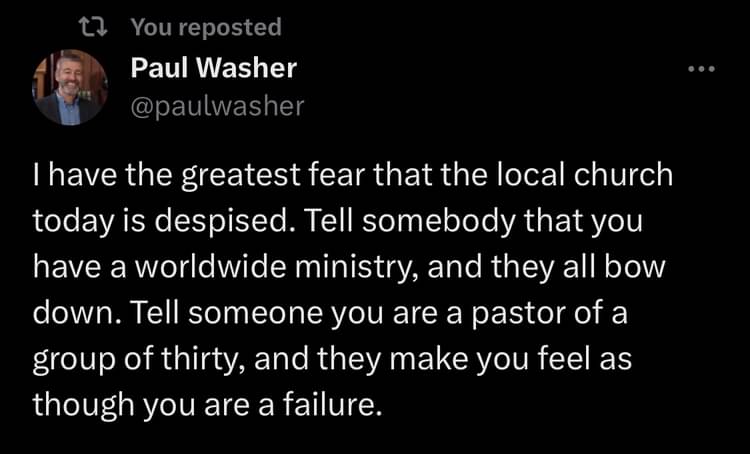
 A young man of my acquaintance (by "young", I mean probably 20 years younger than I am; by "acquaintance" I mean that I have known him 20 years or more) went to seminary and graduated with an MA in Theology.  He has ended up in the state of Washington, where he works at a local government agency and is pastor of a church.  This week he posted the following quote:

I can assure you from what my acquaintance posts he is passionate about his calling but also not in a position that it is his only means of supporting him and his family.  The church, from what I can gather, is a small one in what is likely a converted office or warehouse or even a home.  His theology is sound (knowing both him and where his degree is from).  And yet, he has confessed to more than once feeling discouraged in his calling, partially by his situation - or rather, about how his situation is perceived in the larger Christian world.

The quote and his situation does make me wonder how we assess and judge the "success" of a church.

We live in an age where mainline churches of my youth are fading fast and they seem to have no concern about it at all (although with their legacy expenses, they might want to think about it) and where large scale churches that either have huge facilities or congregations or have multiple sites are in vogue.

Where does the role of the small church come in?

For full disclosure, my formative years were spent in small churches, the Episcopalian (where my maternal grandparents and my parents had gone) and the American Lutheran Church (before it merged into the ELCA).  As an adult I have spent time in larger churches, from 500 to 2000.

Inherently I do not have a problem with either kind - frankly, different sizes of congregations work for different groups of people and the major concern at any time should be fidelity to Scripture, not necessarily the size of the congregation.

And yet I sympathize with my acquaintance.  In point of fact - to quote Friend Of This Blog (FOTB) Leigh from Five Acres and A Dream, we are too often consumed by the "bigger-bigger-more-more" syndrome - which at least in the US, also seems to extend to our places of worship.

Think about it:  we have an actual industry that is focused on church consulting and church growth.  Some of it is to combat what churches perceive to be a loss in membership, but some of it is also driven by churches wanting to expand and get bigger. And some of it, perhaps, is driving by a belief that the fastest way to success is using the world's tools.

I can come up with all sort of commentary from Scripture on the matter and how God views congregations - most Christians can.  But in point of fact the question - to the quote - goes deeper:  do we (as Christians, at least) celebrate and encourage small churches as much as we do big ones?  To the quote above, do we "despise" small churches?  Or have we - as in so much of what else we do - become just like the world in our desire to judge success only by the size of the endeavor and its perceived impact that we can outwardly see?

It does strike me as remarkably odd that, given the history of the church and its humble beginnings, it is even a matter we would have to consider at all.