We rise (mostly) with the lightening of the sky; there is little point in getting up before then as due to the changing season, the sunrise will not start until after 0600, there is no point in rising earlier, and inherent thoughtfulness for one’s neighbors prevent one from stirring for no reason.

The sunrise though, does not disappoint.

While we have the first cup of coffee (Via by Starbucks in the single serving; works remarkably well) we tear down our camp. It takes maybe ten minutes, but is quickly done – amazing how having little makes you quicker. After a round of breakfast sandwiches and topping off our water bottles, we continue down the Red Canyon.


We are in a wash now, which gently slopes downward, the steep inclines and narrow trails of the day before a recent memory. As we continue on, a sound begins to break out, followed by a sighting. The Hance Rapids of the Colorado River are before us.

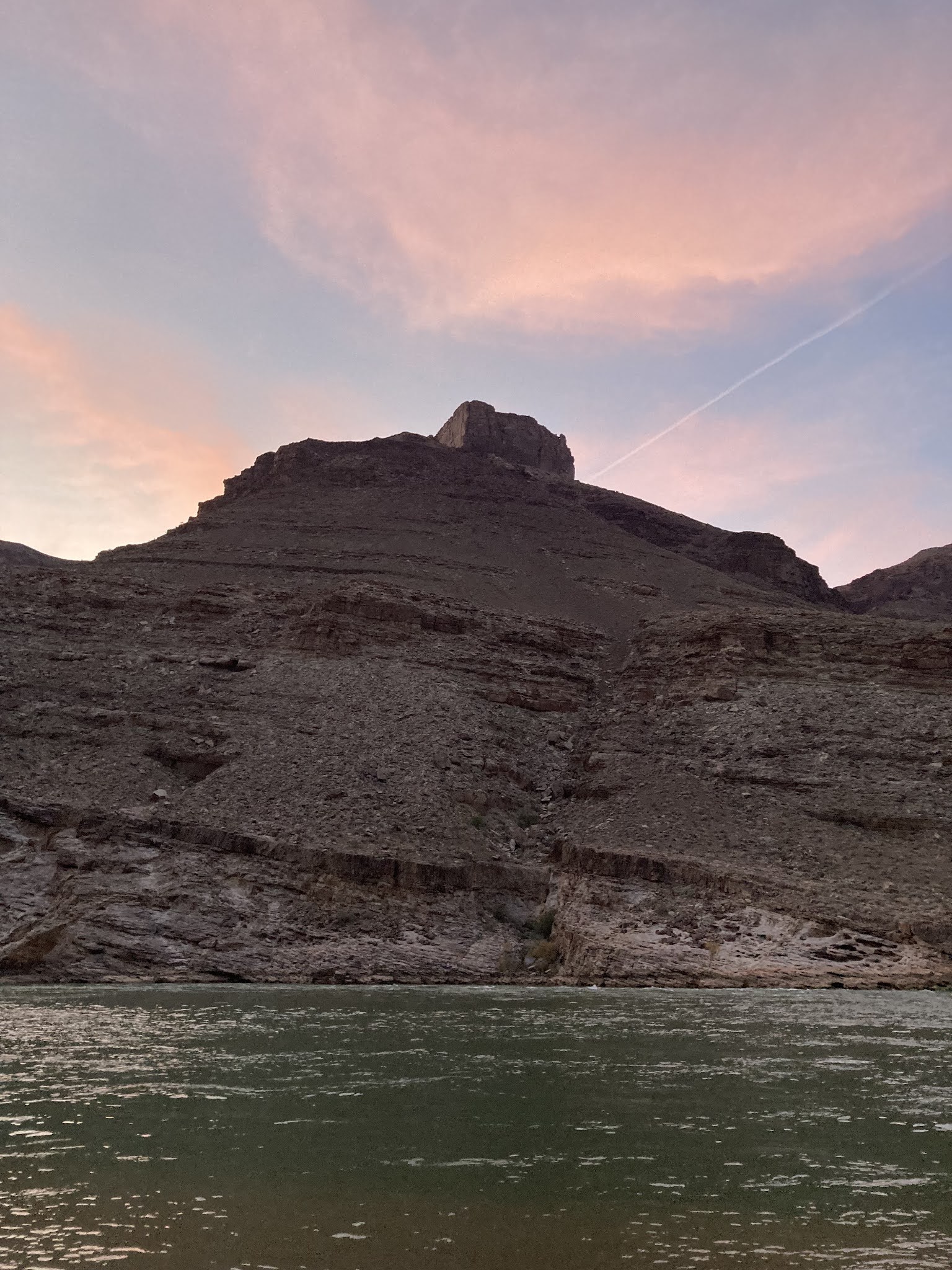
The River is wide and green colored, flowing swiftly but not so cold as the snow-fed rivers of my youth. It contrasts brilliantly against the backdrop of the Canyon walls.

We see some kayakers that pull up ahead of us and pull off, then troop down to look at the Rapids. We have a short conversation with them. They are kind and polite, asking how long we have been down and where we are going. This sort of conversation becomes the norm for the few people we see on the entire trip – two yesterday, the kayakers plus six more today and two tomorrow: there is a sort of shared communion among those in the Canyon that is different than that of the outer world.


After watching the kayakers take a crack at the Rapids – one succeeds, one fails and is overturned – we begin our hike up the River, weaving along its banks until we begin to pull away on what is now The Escalante Trail. The River will be the center of our universe for the next two days as we weave back and forth to its banks, the Escalante Trail our guide.

As we pull away, we continue to move inland until we reach the Papago Slide: a 200 foot or so rock slide from the Canyon wall, in which we come up halfway. We are to go up the Slide – a collection of rocks, scree, and dirt – and then cross over to the other side, where we will crawl down the Papago Wall.
We have to go in two groups; I stay behind with the second group as it is the slower group and I have decided to bring up the rear. We wait patiently for the first group to climb up; when we get the signal, it is our turn.
There are two theories in going up the Slide: go close together (to minimize the gathered speed of falling items) or to go far apart (to allow the dodging of falling items). We elect for the former and begin the climb.
Among my many fears, I have two: heights and unstable surfaces. The Papago Slide offers both in spades. Fortunately, I am spared the horror of constantly looking down: my face is directly looking at the slide before me and the feet and hands of the climber before me. I am forcing myself to lean forward into the slide, trying to counterweight the backpack which I imagine to be much heavier than I think, ever sensitive to the potential of the surface below me shifting. Slowly, we crawl from rock to rock and move up the Slide – until 100 yards later and perhaps 10 minutes (it certainly seemed longer) we emerge on the top and slowly make our way across the wall to the Papago Wall.

The Papago Wall, by contrast, holds little fear at this point: with the careful placement of hands and feet, it is relatively easy to conquer. A challenge which in my mind would have insurmountable before is a moderately tame inconvenience.

We continue on a bit in the hike until we reach 75 Mile Canyon, so named as it is at the 75th mile on the River.


The Canyon is a slot canyon, a narrow version of the water action that we see writ large before us overhead. In it, one can directly see the smaller application of the larger geologic forces around us.


We make our way back in it, slowly wending and winding our way up until we arrive at the end of the Canyon, where we have to go up and out. We work our way back along the top of the Canyon we just walked through – even with this, we are 30 or more feet above the floor.


After another gentle descent, we end at Escalante Beach.

Escalante Beach is not like other river beaches I can recall, small spits of rock or coarse sand: this is a white sandy beach with green water and waves rolling up to its shore, the equal of any good ocean beach I have seen. This will be our stop for the night.

After setting up their tents, some members of our party hop into the River for a swim or at least a rinse – although almost everyone immediately hops back out as well; the River is a bit cool. I have failed to bring shorts or a swim suit (but should do so next time); I content myself with dangling my feet in the River.

Dinner tonight is fajitas, which taste delicious – as does everything on this trip; hunger, as the Irish say, makes a fine sauce. We again go around in a circle to call out our wins and losses; almost everyone is excited that they conquered the Papago Slide. I am as well, although I start out by again mentioning the fact that I, once again, did not die.

Again tonight, we have a clear sky of bright stars, but it is combined with a river provides background noise not in the form of waves on the shore, as I am used to on the ocean, but rather a constant steady motion and roar in the background.
Rain, if you will, except on a grander scale.