Showing posts with label Costa Rica. Show all posts

Tuesday, December 28, 2021

Costa Rica: A Retrospective

 Thanks for taking the time to come along with us to Costa Rica.  I hope you enjoyed the trip.  We certainly did.

As it customary for my Iai training, it is expected at the end of every session that I provide an overview with what I learned during the experience.  This was a more difficult trip than most due to the fact for me at least, this seemed like  a much different "vacation" than what I have been used to.  None the less, an assignment is an assignment.  I was able to come up with three:

1)  There Are No Problems, Only Situations

(Monte Verde)

This was a saying that our guide gave as a typical "Costa Rican" attitude.  Problems, he said, are unsolvable and only allow people to sit around and complain.  Situations can be talked through until resolved.

I like this.  The amount of "problems" in my life are much less than the amount of "situations".

2)  There Is Great Joy In Simplicity

(Sugar Cane)

As I had mentioned, the national dish of Costa Rica is cansado, rice and beans which are served at every meal.  I had this several times for all different meals - and it was delicious.  There was a lot that was not present in Costa Rica - but a simple life, surrounded by such a beautiful landscape, is not a bad thing.

3)  The Small Town World Still Exists

(Mt. Arenal)

Once outside of San Jose, most of the towns were drove through were much smaller regional centers.  Driving through them, I was reminded of small towns I knew when I was growing up:  completely functional small towns with all the stores one would expect in a small town - not just one or two grocery stores and an mega-super store, but small shops with all kinds of goods.  For me, it was a nice step back time - small town America still exists in the world, just not really in America anymore.

Monday, December 27, 2021

Costa Rica: Drive, Capitol

 Some views from our hotel room in Monte Verde before leaving:


On the drive back, we stopped to see both the area the cloud forest is in as well as where the land was cleared away for cattle:


This is as close to the Pacific Ocean or a beach as we got:


In the afternoon after arrival, we took a walking tour of San Jose:


The National Theater of San Jose is a building that would fit into any European Capitol:


We also toured the National Museum, which included both clay artifacts as well as gold artifacts:


Squid thing that reminded me of Cthulu:


Our last dinner.  The soup was pumpkin and incredibly good:


Tiramisu!  It was delicious!


Video:  The clouds blowing in over the mountains at morning.


Sunday, December 26, 2021

Costa Rica: Coffee

 As one of our outings in Costa Rica, we went to the Cafe Monteverde, a sustainably grown and managed coffee company.  Founded in 1989 by a group of coffee growing families with several generations of growing experience, they now operate the plantation as a sustainability model as well a coffee growing operation.

But first, of course, we start with lunch!  All of the items below for lunch and the dessert (cooked pumpkin with caramelized sugar cane sap) was all produced on site.


Corona, the coffee farm dog.  Because all coffee farms need a dog.


Coffee, as you likely know, consists of two varieties:  Coffea Arabica and Coffea "Robusta".  Arabica is often considered to be the more desirable plant.


These are coffee seedlings from coffee beans. They will grow here for about a year.


After which, they are transplanted to the ground where they will grow for up to five years before being moved.


Once mature, they can live and produce from 15 to 30 years.


Part of the operation is working on sustainable methodologies for growing.  Here are ongoing practices of "fermenting" fertilizer, along with the ingredients and their open air composting (next two pictures).


The actual bean itself grows directly on the plant, starting green and ending red.  The season in Costa Rica runs from the End of November to April/May.


Green bean and fully ripe bean:


Coffee here is handpicked into baskets as it has been done for 100 years or more.  Pickers are paid by the basket (interesting fact:  Pickers are mostly from Nicaragua, as are a great many other agricultural operations.  Pickers here are paid $2.00 a basket; they would make $0.70 a basked in Nicaragua).


The Supervisor.  Because you always need a supervisor:


After picking, the outer layer of bean is dehusked.  Below is a small scale unit that is hand operated; the farm has a much larger industrial version down the mountain.


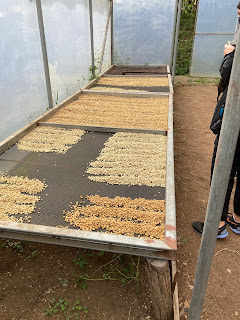
Here at Cafe Monteverde, coffee is then dried three ways:  the first is with two layers of husk/skin removed, the second with one layer removed, and third with the beans unhusked.


The final step is, of course, roasting.


Two small roasters are on site (again, there are larger units in another location).  Fun fact:  The difference between a light and dark roast are within the last five minutes of the roasting process.  When asked how a master roaster knows when a batch is ready, the answer was a combination of experience, smell, and just "knowing".  (Another fun fact:  Starbucks tastes burnt for a reason.  To cover up substandard or mixed lots of beans, they will just give the darkest roast possible, which equalizes out the flavor).


We tasted a total of five coffees: all three drying processes, and two other roasts.  Sadly (much like my wine abilities), I could not taste the difference.

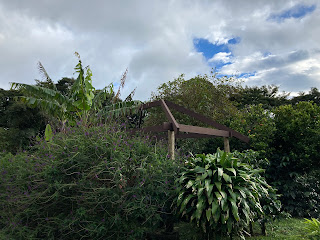
Some shots from around the farm:


This was a high point of our trip for me as I like coffee and I believe in the sort of sustainable agriculture being practiced here.  They ship world wide, so they are worth visiting on the InterWeb if you drink coffee:  Cafe Monteverde