Tuesday, July 23, 2024

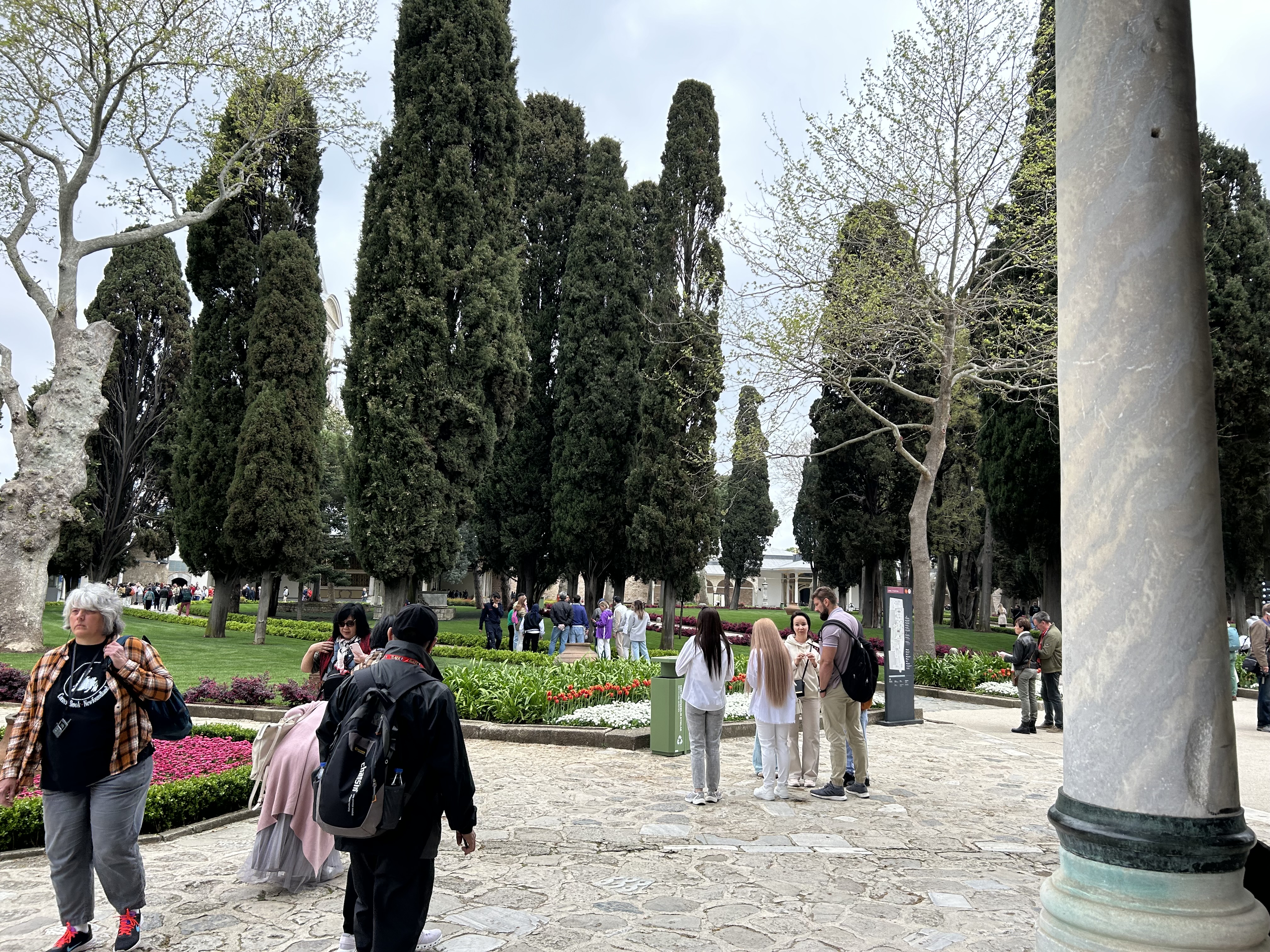
2024 Turkey: Topkapi Palace I

Topkapi Palace (Topkapi Serayi in Turkish) was the royal palace from 1460 to 1856, when it was replaced by the Dolmbache Palace across the Bosporus Straits.  Construction was begun in 1459, 6 years after the conquest of Constantinople by Mehmet The Conqueror.  Originally it was called the New Palace (Yeni Saray) to distinguish it from the first palace of the Ottomans in what was now Instanbul.  It was renamed to Topakapi Palace - "The Cannon Gate".   It occupies between 146 and 173 acres.

Topkapi Palace Schematic (Source)

The Topkapi Palace was a designed as a series of four courtyards, each courtyard entailing a hierarchy to enter it.   The original design was by Mehmet the Conqueror; part of its design was to seclude the Imperial family from the outside world.  To this end, a hierarchy was developed that regulated the ability to access the inner parts of the palace and the protocol to be followed.  One of the matters of protocol was the observance of silence in the inner courtyards.

The Bab-ı Hümayun, or Imperial Gate

The Imperial Gate opened up into the First Court, known as The Court of the Janissaries.  In this court was the Royal Mint, the former church of Hagia Irene (used as an armory by the military), as well as several other structures which are no longer present.  In this courtyard, visitors would pass through a line of Janissaries and court officials in their formal garb as the walked towards the inner courts.


Hagia Irene (now Aya Irene) in the background.

The Bosporus


Hagia Irene


Moving through the First Courtyard, visitors would come to the Second Gate, the Gate of Salutation (Orta Kapi). The current gate dates from at least A.D. 1542.  Visitors were tightly controlled, and any riders had to dismount as only the Sultan could ride through the gate.

The Gate of Salutation


The Gate of Salutation opens up into the Second Courtyard, or the Divan Square (Divan Medani).  In this courtyard were the entrances to the Harem (sadly, an additional cost on the tour), hospital, Janissary quarters, bakery, stables, and the Divan (the Imperial Council chambers of the Sultan's government).  In Ottoman times, the Sultan would have received his visitors here.  Peacocks and antelope would have wandered the grounds.


A view of the Divan

Looking towards the Bâbüssaâde, or Gate of Felicity - The entrance to the Third Court

The Divan.  To the left can be seen the entrance to the Imperial Harem.

The Gate of Felicity

On this spot was flown the Sancak-ı Şerif, or the Great Flag.  It is attributed to be the flag of Mohammad and is currently stored at the Topkapi Palace treasury

The kitchen complex was interesting.  Consisting of a total of 10 domed buildings, the kitchens fed the staff of the Topkapi Palace, the guards, as well as performing a charitable service of feeding the poor.  In the 16th Century A.D. up to 5,000 people worked at the Topkapi Palace; that number increased to 10,000 by the 17th Century A.D. To support this, a staff of 200 (in the 1460's) grew to almost 1300 by the 17th Century and continued at that level through the 18th Century.

Kitchens and Quarters


Interior of one of the kitchens

One of the dome roofs, which functioned as a chimney

Interestingly and per the law of Mehmet The Conqueror, the Sultan always ate alone.  He was served by the Chief Pantler, who was in turn served by men charged with the Sultan's bread, the Sultan's drinking water, the Sultan's dining tray and spoon washer, the Sultan's trays, the Sultan's pickles, the Sultan's sherbet, the Sultan's hand washing water, the Sultan's towel holder, the Sultan's coffee, and the Sultan's sherbet (if you were wondering, there are Turkish terms for each).

Monday, July 22, 2024

On Being Tired Of Things

 I typed out a super lovely essay on the fall of Republics.  I almost hit "Publish".  Almost.

But I did not. Even for my non-political stance here, it was a bridge too far.

Nothing, in my adult experience, separates people and sets them to fighting than politics now does (at least here in the U.S.).  Want to throw a hand grenade into any conversation?  Simply walk in wearing political gear from either Red or Blue party, make a supportive comment, and watch the sparks fly.

I know, I know.  Politics has always been a contentious business, and we have nothing on how the Greeks or Romans ran their elections.  I will admit that all of this has simply taken the wind of my sails.

Sadly, I am not a man made for this age.  I detest contention. I detest bad manners.  I detest every manner of embellishment, jargon, loud words, and images that has become the American Political System.  I come from a time - long distant now - that had arguments of reason and logic, not what we have today.

We have issues - significant issues - that need to be dealt with.  My belief that any of these will be dealt with has long since passed, because I have lived through the last 34 years of the political cycle.  It is somewhat hyperbole to say that "few things have gotten better, but many things have gotten worse", but that is my sense of the world today.  We are less resilient, less united, less capable, and less...free than we have ever been in my life (And not finger pointing.  Both sides restrict freedoms when it serves their interest).

If we have any kind of trust passed on to us by those that went before us, it is at least to pass down what we are given as good as we received it, if not better. I fear - no matter who wins - we will be unable to achieve even that.

I am tired - tired of the drama, tired of the hype, tired of the same group of people making the same promises that amount to nothing, tired of the inevitably bad outcomes that occur no matter what happens and the failure to make anything actually happen.  If there is a single thing I am grateful for, it is that my parents were spared all of this.  They would have understood it even less than I do.

The older I get, the more the world passes me by in these matters. And the less and less I have any hope of any improvement.

Saturday, July 20, 2024

Air Tides


Running tides of clouds
move with air beneath and lit 
by the sun above .

Friday, July 19, 2024

On News

My very first political memory was Gerald Ford entering the White House.

I have no idea now why that would have been the one, except perhaps a function of age:  in those days there was only a single television and limited channels in our house so the likelihood looking back is it is simply the time that my parents happened to be watching the news.  I do not even remember that I knew what I was watching (only that I was watching it); it was years later that I understood both what I had seen and the backstory that brought us to that point.

Trying to explain how news used to function to my own children is like spinning a tale that starts "Once Upon A Time": No InterWeb.  No 24 hour cycle.  Limited choices of news outlets:  NABCS and local affiliates, where the cycle was morning, noon, and evenings at 5:00 PM (interspersion for national news) and follow up at 6:00 PM with late news at 11 PM.  Radio serving as an actual conduit of news instead of just music and talk programs.  Written materials - newspapers, magazines - that were at least 24 hours behind the news cycle if not a week.

"How did you make do?"  I suppose would be the question.

It is a question I sometimes ask myself now, when we now life in the  24/7/365 (366 in Leap Year) News Cycle. Where things happen literally on a second by second basis.  Where we watch events happen in real time.

Where, in a real sense, life has almost become a movie which constantly playing in our heads and in our ears, should we let it.

I would be the first to admit it is addictive.  I can get dragged into that loop, constantly checking my less-than-smartphone to see if there is a breaking event (there almost never is).  It can consume hours, should I choose to let it do so.

I have wondered about this, as I wonder about all those that suffer from the same issue:  always wound up, always looking for that next immediate update.  I do not wonder that we have come to the point noted above that the world has simply become a show that we are addicted to, a sort of Truman Show where we are convinced that we should watch because somewhere deep down, we feel that somehow we have the ability to impact events thousands of miles away from us in some meaningful way when in fact we are no more than spectators - and spectators that waste far too much time on that which we cannot impact and ignore that which we can.

There is not a lot I can do about events out there, other than - at least for me - figure out whatever my ability to follow things is and then cut it by 60% just to be safe.  This is something I have actually done:  I make the rounds in the morning and once in the evening and call it complete.  Seldom do I find something that  I should have known that I could have changed out there.

It does make me wonder though:  Am I looking to the news cycle and events out there to avoid the real work I need to do internally and the good things I could do externally?

Thursday, July 18, 2024

The Collapse CLIV: Argument

 07 August 20XX +1

My Dear Lucilius:

Our Summer continues to grind on; it is one of the hottest ones that I can remember for some years. Watering has become of critical importance (and, of course, takes far more time due to the increased amount). It also pushes up the start of the day as well as the timing of the day; as I may have mentioned before (and is very clear now), work after 1300 in the sun is sheer folly (especially given the fact that at least for the current time, anything remotely looking like skin cancer is going to be incredibly hard to to treat if at all – I have left my container of liquid nitrogen along with the rest of civilization). There are always things to fill the time, of course – but there is plenty of time to talk as well.

This day, I had the privilege of virtually refereeing a fight between Young Xerxes and Stateira.

I have never much probed into their relationship: prior to meeting Stateira it was never really my business what that looked like and even now, having married into the family, it remains at best an involvement where one has to be invited, not puzzle one’s way in. Nothing worse than in-laws overhanging every exchange of a relationship.

That said, Young Xerxes came over this afternoon in a huff as I was sitting under the trees in back, calculating out dry wheat weight per person. He sat there, obviously upset about something, while I finished out my calculation. Pompeia Paulina mysteriously disappeared without a trace in the interval so that by the time I looked back up, it was only Young Xerxes and myself.

I raised my eyebrow at him, which serves as a universal sign for “Tell me your issues”. Rather vociferously, he let me know.

The specifics of the argument are both unmemorable and not surprising to either of us who has been in relationships in the past; a small argument that got blown up into a larger argument because of the responses to each other until the words said in the argument became the point of the argument, not the original item. You recall; we have had conversations about such things impacting both of us in the past.

“Unreasonable”. That was the word that kept coming up. She was being unreasonable in the argument and his reasoning remained sound and should be the one that was listened to, because it was the logical conclusion.

We sat there under the tree, he continuing to pour himself out until, like a ruptured dam that had run out of spilled water, the words trickled off and I just listening, beating out a steady time with my pen and notebook. Finally – almost 40 minutes later by my pocket watch – he was done. The wind kicked up a bit, rustled the grain beyond us, drying our skins out with the same sort of force as the argument had dried out his emotions.

Finally I said “Is it worth it?

He regarded me oddly.

“Is it worth it?” I asked again. “Is winning the argument worth the rupture in the relationship it will bring?”

“But I am right!” he protested.

I nodded. “Set that aside for a moment. What you described as being “right” about is a pretty small thing in the scope of what we are living out now – incredibly small, from my point of view. Look at the bigger picture: if winning this meant you ruined the relationship with Stateira, is it worth it? Is the cost of the relationship worth the price of victory?”

He sat there, thinking in the sun dappled shade as the wind blew. He sat there as Pompeia Paulina smoothly drifted over, deposited water glasses in our hands, and disappeared again without a sound.

“I suppose not” he finally said, taking a long drink from the glass.

“Your choice of course” I responded, looking carefully at the glass rather than him. “But given the state of the world now, the last thing in the world you probably want or can afford is fracturing the most basic relationships that you have. Trust me when I say that the argument itself will be forgotten before long, but if you do not go back today – now – and make it right, the feeling of that argument will last forever. And that is something, I can assure you, you can neither afford nor want to live with.”

He sat there for some moments more looking into the glass then looked up at me, nodded, and got up, heading back towards the gate and his house. I sat there, looking at anything but his back as he left. When a man is in the process of being humbled, there is no need to rub anything else in.

A few minutes later Pompeia Paulina came out and sat in the chair that Young Xerxes had vacated. “All well?” she asked.

I nodded. “I think so. Young people being young people, thinking that being right is always more important that the relationship.”

She laughed. “Is that why you never argue?”

I shook my head and smiled. “It is more just being painfully aware of how incredibly wrong I usually am.”

It is easy to be a good companion, Lucilius, if one knows one’s own limits and values the relationship above all else.

Your Obedient Servant, Seneca

Wednesday, July 17, 2024

Cabrillo Point

 Cabrillo Point National Monument is located (perhaps not surprisingly) at Cabrillo Point, the southernmost tip of Loma Point near San Diego. It commemorates the landing of Juan Rodriguez Cabrillo, the first European to set foot on the West Coast of North America (at least, as far as we know) in A.D. 1542.  The park includes a number of items including old coastal artillery installations, a national cemetery, a lighthouse (not open when we were there), a monument to Cabrillo - and, of course, the Pacific coastline, which is where we spent our time there.
The rock layers were amazing:


As was the power of the ocean:


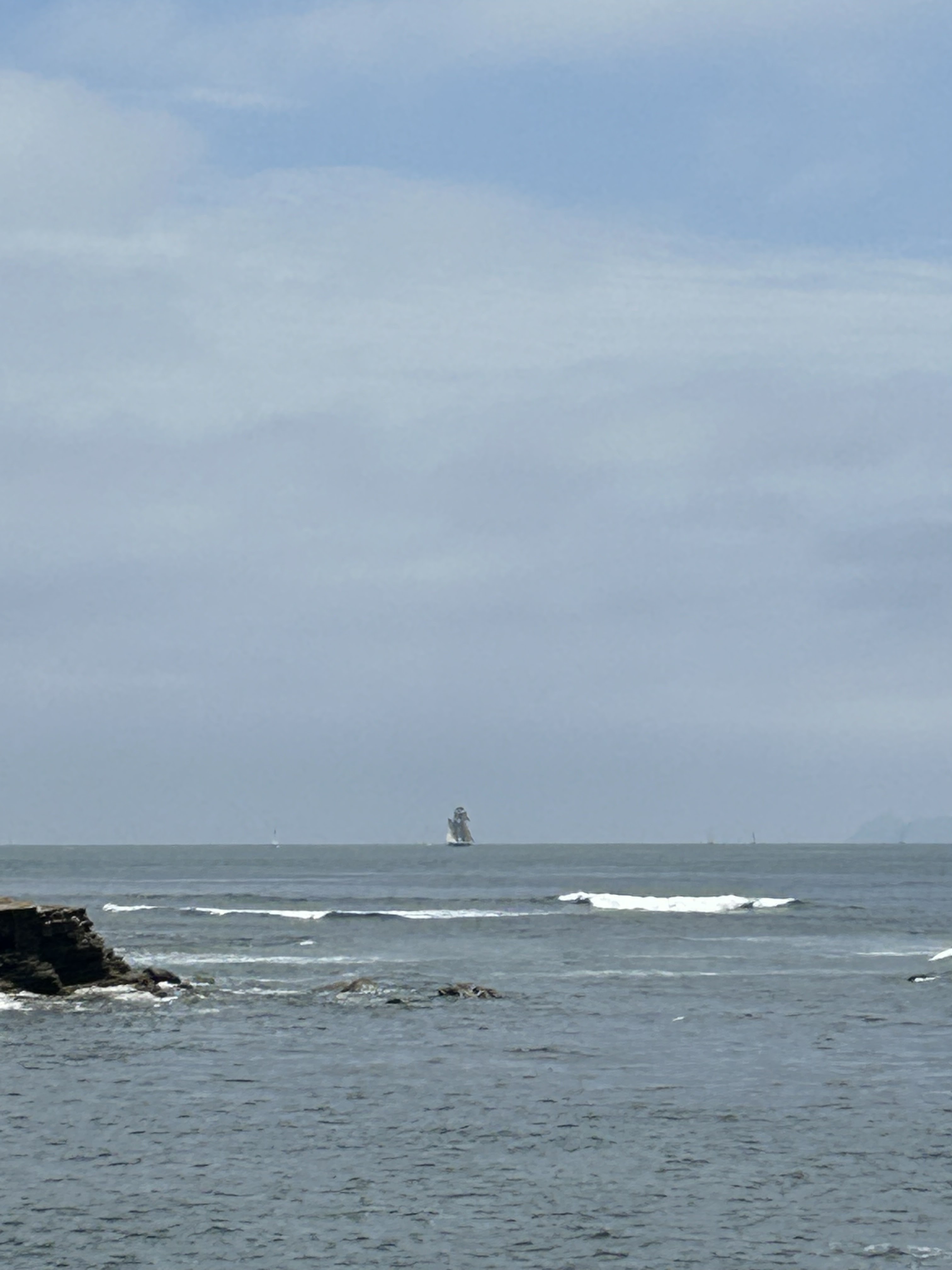
Off the point, someone was running a full rigged sailing vessel:


A natural mosaic rivaling anything the Greeks and Romans ever made:


Up the coast:


And over the coast:


The monument to Cabrillo:


Looking off the point.  You can see Tijuana in the distance:


Back towards San Diego and the Naval Air Station:


Tuesday, July 16, 2024

Japanese Peace Garden

As we arrived a day early for the ceremony, we took the opportunity to do a little sight seeing. Apparently one of my "things" is now going to Japanese gardens in the cities we visit.  This is from the Japanese Peace Garden in San Diego, CA.


S