Saturday, June 17, 2023

The Return Of The Prodigal Son: Conclusion

 "Be compassionate as your Father is compassionate."


As Henri Nouwen studied and reflected on Rembrandt's painting "The Return of the Prodigal Son", he progressed in his understanding as his reflected on how he was like the Younger Brother (The Prodigal) and the Elder Brother and came to understanding the compassion of the Father towards both of his sons.  As he continued down this path and with the reflections of others, he suddenly realized one final thing;  that he, and that all of us, are eventually called to be the father.

Children grow up, says Nouwen.  And while the Father went to both sons to bring them into his joy, he also went to them to be an example of how they should be, what they should grow into.  It happens to us in life of course: as adults, we have to embrace the responsibilities of adulthood, as parents we come to act not as children relying on the guidance of others but providing guidance to others.  

Becoming the father is difficult, suggests Nouwen:  

"Do I want to be like the father?  Do I want to be not just the one who is being forgiven, but also the one who forgives; not just the one who is being welcomed home, but also the one who welcomes home; not just the one who receive compassion but the one who offers it as well?

Isn't there a subtle pressure in both Church and society to remain a dependent child?  Hasn't the Church in the past stressed obedience in a fashion that made it hard to claim spiritual fatherhood, and hasn't our consumer society encouraged us to indulge in childish self-gratification?  Who has truly challenged us to liberate ourselves from immature dependencies and to accept the burden of responsible adults?  And aren't we ourselves constantly trying to evade the fearful task of fatherhood?"

Nouwen posits that one of Jesus' most radical statements is "Be compassionate as your Father is compassionate": "If the only meaning of the story was that people sin but God forgives, I could easily begin to think of my sins as a fine occasion for God to show me his forgiveness.  There would be no real challenge in such an interpretation.  I would resign myself to my weaknesses and keep hoping that God would close his eyes to him and let me come home, whatever I did.  Such sentimental romanticism is not the message of the Gospels."  

Instead, we are called to remember that as we are in the Father's house, we "make the Father's life my own and become transformed into his image.":  If God forgives sinners, we should do the same.  If God welcomes sinners home, we should do the same.  If God is compassionate, we should be the same.  And God himself in Christ is the model for this, we should be like Him.  Nouwen argues that in fact this becoming like God - not in power or essence or authority but in nature and love - is the point of what Christ taught. We need to love not based on comparison or competition - "God loves them more than me" but with the selfless, outgoing love that Rembrandt portrays in the painting and Jesus speaks of in his parable.  Christ, he says is the model of what we as children of God should be:  "He was the younger son without being rebellious.  He was the elder son without being resentful.  He hears everything the Father says and does everything the Father askes him to do, yet remains completely free.  He gives everything and receives everything."

Spiritual fatherhood, says Nouwen, has nothing to do with power or control.  It is about giving without wanting, loving without conditions of love.  But how does he propose we get there?

Grief - "Grief asks me to allow the sins of the world - my own included - to pierce my heart and make me shed tears, many tears, for them.  There is no compassion without many tears...grief is the discipline of the heart that sees the sin of the world, and knows itself to be the sorrowful price of freedom without which love cannot bloom. I am beginning to see much of praying as grieving...To become like the Father whose only authority is compassion, I have to shed countless tears and so prepare my hear to receive anyone, whatever their journey has been, and forgive them from that heart."

Forgiveness - "It is through constant forgiveness that we become like the Father.  Forgiveness from the heart is very difficult...But God's forgiveness is unconditional; it comes from a heart that does not demand anything for itself, a heart that is completely empty of self-seeking...It calls me to keep stepping over all my arguments that says forgiveness is unwise, unhealthy, and impractical.  It challenges me to step over all my needs for gratitude and compliments.  Finally, it demands of me that I step over that wounded part of my heart that feels hurt and wronged and that wants to stay in control a put a few conditions between me and the one whom I am asked to forgive."

Generosity - "(The father) does not simply offer more than can be reasonably expected from someone who has been offended; no, he completely gives himself away without reserve...In order to become like the Father, I must be generous as the Father is generous.  Just as the Father gives his very self to his children, so must I give my very self to my brothers and sisters. Jesus makes it very clear that it is precisely this giving of self that is the mark of the true disciple.  'No-one can have greater love than to lay down his life for his friend'....Every time I take a step in the direction of generosity, I am moving I know that I am moving from fear to love.

Finally, notes Nouwen, the Father is no longer called to come home as the sons were; instead he is called to be there when they return home:  

"It is very hard to just be home and wait.  It is a waiting in grief for those who have left and a waiting with hope to offer forgiveness and new life to those to return.  

As the Father, I have to believe that all the human heart desires can be found at home.  As the Father, I have to be free from the need to wander around curiously and catch up with what I might otherwise perceive as missed childhood opportunities.  As the Father, I have to know that, indeed, my youth is over and that playing youthful games is nothing but a ridiculous attempt to cover up the truth that I am old and close to death.  As the Father, I have to dare to carry the responsibility of a spiritually adult person and dare to trust that real joy and real fulfillment can only come from welcoming home those who have been hurt and wounded on their life's journey, and loving them with a love that neither asks for nor expects anything in return.  

There is a dreadful emptiness in this spiritual fatherhood.  No power, no success, no popularity, no easy satisfaction.  But that dreadful emptiness is also the place of true freedom.  It is the place where there is 'nothing left to lose', where love has no strings attached, and where real spiritual strength...Each time we touch the sacred emptiness of spiritual non-demanding love, heaven and earth tremble and there is great 'rejoicing among the angels of God.'  It is the joy of the returning sons and daughters.  It is the joy of spiritual fatherhood.

Living out this spiritual fatherhood requires the radical self discipline of being home.  As a self-rejecting person always in search of affirmation and affection, I find it impossible to love consistently without asking for something in return.  But the discipline is precisely to give wanting to accomplish this myself as a heroic feat."

It does not surprise him, concludes Nouwen, that few claim spiritual fatherhood for themselves. The pain is too apparently obvious, the joys too well hidden.  And yet this is what we are all called to. 

For if we will not do it, who will?

Friday, June 16, 2023

Snowrise


The morning sunlight 
radiantly lights the clouds
reflecting on snow.

Thursday, June 15, 2023

Wednesday, June 14, 2023

The Collapse CVI: Giving Advice

29 May 20XX +1

My Dear Lucilius:

Young Xerxes came by as he is prone to do on occasion. He had a question for me: What, he wondered, did I think if he asked Stateira to marry him?

Inside I chuckled a bit, my friend. When was the last time anyone asked us for dating advice, let alone for marital advice?

I caveated my answer by first explaining that on the whole, I did not give relational advice. My track record on the entire matter is pretty poor – including, as I recall, advice to you once upon a time (which, thankfully, you never held against me). That said of course, I asked him what would be considered the usual question: Why was he asking her? Where would they live? What did he have to offer her? Had they even talked about it?

I have always been rather unclear on where Young Xerxes lives: he has never really been willing to say and I, out of courtesy, have never really asked. He always appears clean and neat so it must be a real place, but where he has not mentioned. I have no idea of if he has a family or not or what he did before this current situation. He is certainly one of the busiest people here in town and seems to somehow know everyone and has the ability to find things that no-one else can seem to (you will, of course, remember the coffee).

As to asking her, he simply said that he – they – were in love. Yes, they had talked about marriage before and certainly more now, given the changes in the world. She had suggested that they could live with her mother Pompeia Paulina at least for the short term until things became clearer.

What did he have to offer? An honest heart, a pair of hard working hands, and love.

It is a hard thing to give any sort of meaningful advice in moments like these, not just because it is a highly personal and emotional ask, but often because the individual has already made up their mind. They are not really there to solicit opinions but to have their opinions validated. Add to that the fact that we live in an upside down world where the future remains highly fluid at best and downright unknown at worst, and any advice I would give is likely to be useless almost as soon as it would be given.

I have no reason not to advise young people to get married and especially these two young people whom I known for a period, so I gave the sorts of advice that all older people that have been married give to those that have not: it is not like you think it is, be faithful, talk often, celebrate life, always work to be in love. Certainly not the wisdom of the ages.

He seemed grateful – or relieved – at my response, thanking me profusely and promising he would return the favor. How one would return the favor of advice on a personal matter that is not novel, I have no idea, but the young like to believe they can do such things, and who am I to discourage them?

I would end the letter here, but a second thing happened later in the day – Pompeia Paulina and Stateira dropped by, bearing bread. It was “just a visit” as they said – but during the conversation, it somehow turned to the fact that Young Xerxes had asked Stateira for a formal dinner at their house. Would I being willing to host Pompeia Paulina for dinner at that same time?

Of all the things I thought might happen as an outcome of the world and its circumstances, being a bit player in a romance was not one of them.

Your Obedient Servant, Seneca

Tuesday, June 13, 2023

Old English, A Historical Background: The What-Ifs

I suspect among the fantasy lives of historians, one of the deeper darker secrets is the engaging in the examinations of the What-Ifs, those forks in history where something went one way when there were two (or more) options to take.  We practice this in our own lives, of course;  what if I did not go to this school or move here, which means I did not meet this person and then we did not become friends/get married/become enemies for life.  

It is perhaps a trifle harder on the historical scale, as the variables are far greater as almost no historical event exists in isolation from all other historical events.  But even with that, there remain significant inflection points where an outcome which was different, regardless of the surrounding events, would likely have made a significant impact on following events.

And so, in an almost paroxysm of "fun" (or as much fun as historians can have), we will spend a few minutes on the What-Ifs of Anglo-Saxon Britain:

1)  Britain does not fall:  I list this as a potential item, but it is (among all of them) the least unrealistic.  Even if the legions had not departed in the early 5th Century, the Western Roman Empire was still in collapse.  Legions in Britain may have held off the onslaught for a bit longer, but ultimately someone would have arrived - even if the legions remained, there would have been no reinforcements.

2) The Anglo, Saxons, and Jutes were not initially defeated:  One theory is that the Romano-British were the victim of their own initial successes: had they not defeated and held the Angles, Saxons, and Jutes to a smaller, self contained area, the cultural cohesion would not have developed and the area become thoroughly "germanized".  Had the initial invasions pushed through as they did in virtually all of the remaining Western Empire, likely a Germanic elite would have ruled over a Celtic-Romano population much as they ruled over a Gaulish, Italian, or Celtiberian populations - and have been subsumed by it in due time.  An Ambrosius Aurelianus may have indeed arisen at a later time - to conquer the invaders, not just stop them.

3)  Wessex is not the ultimate reigning kingdom: This one is harder to assess.  Certainly during the period of the Heptarchy, Wessex was not the leading contender for power.  It was their neighbor Mercia.  There were differences in dialect between Mercian and West Saxon Anglo-Saxon and undoubtedly small cultural differences as well.  Would a united Anglo-Saxon kingdom under Mercia or Northumbria have looked different, and if so, how?

4)  The Viking invasions are successful:  At multiple times in its history Anglo-Saxon England was threatened with conquest by Danes or Norwegians - literally up almost to the end of its existence.  What would this have looked like?  We have a bit of a vision in the North Sea Empire under Canute the Great, but in that case England was only a part of a larger empire.  What would a single Danish or Norwegian kingdom looked like, especially if (earlier in history) the Anglo-Saxons had much less of a unified culture?

5)  Alfred the Great fails:  Later Anglo-Saxon England owes its continued existence to Alfred the Great; had he not pushed back the Vikings at Ashdown or succeeded but been killed, it is likely to say Anglo-Saxon England would look very different and we would not have near the history or records that we do from the simple fact that a unified Anglo-Saxon Chronicle would likely not have been started or exist.

6) Canute the Great does not die early:  As we have discussed before, the North Sea Empire did not significantly outlast Canute the Great.  Had he lived another 10 or 15 years, how much stronger would the North Sea Empire have been?  Could it have weathered a transition of power more successfully and remained whole instead of falling into its constituent parts?

7)  There is a direct heir to the House of Wessex upon the death of Edward the Confessor:  As you may recall, part of the issue with the succession after Edward the Confessor was that there was no direct heir of age.  If Edward had a son or if Edmund Ironside's son Edward had survived instead of dying, there would have been far less uncertainty and concern about the succession.  Yes, William the Conqueror may have still tried to invade as he had a small claim on his mother's side, but his reasoning would have been much less persuasive and his cause much more mercenary.

8)  William the Conqueror is not successful at invading Britain: This could have taken a number of forms.  The weather could have prevented his crossing the English Channel (it was already late in the year, as you recall).  William loses the Battle of Hastings instead of winning it.  In either case, the Anglo-Saxon power structure would have remained firmly in place.

9)  King Harold does not die at the Battle of Hastings:  One of the reasons that resistance fell apart after the defeat at the Battle of Hastings was that there was no unifying figure for the Anglo-Saxons:  the sons of Harold were untested and young and Edgar Edmund Ironsides' son was the same.  Had Harold survived the battle, even in defeat, it is possible he could have rallied resistance in a way no one else could have.

It is amusing, in my off moments, to wonder what a Anglo-Saxon England which was not Normanized might have looked like in Medieval Europe.  Would Anglo-Saxon England have invaded Ireland as Norman England did?  What would the border wars between Scots and Welsh have looked like.  Would England have involved themselves in Continental wars?  And culturally, the 12th and 13th Century have little Middle English literature due to the Conquest - what works would we have that were never written?

And perhaps most importantly (for our discussion), without the Norman influence, what would the English language even look like?

I have to admit - and in doing so, admit I am odd - that I find such potential scenarios engaging.  A world where we had so much more Anglo-Saxon literature would be a great world indeed.

Monday, June 12, 2023

Gone Hiking 2023 Hetchy Hetch: Water

 As I mentioned, there was a lot of water on our hike, plentiful to the point it had likely not been so in years.  Some of the water I have not already shown:


Sunday, June 11, 2023

Gone Hiking 2023 Hetch Hetchy Day 3: Lake Vernon To O'Shaughnessy Dam

Mileage:  10.86 miles/17.48 km

Elevation Gain:  1,015 ft/309 m

I was surprised to find that through the night, I slept warmly enough and that there was no intrusion of water into my tent.  That is what actual equipment - hiking tent, inflatable materials, and sleeping bag rated down to 15 F will do for you.  


Also, when you go to bed at 1900, you wake up early.  We were packed up and on the trail by 0630.


Re-crossing the bridge over the Lake Vernon outlet, we started our ascent.  We had no idea how long the snow would go, only that at some point it would end.  My feet were immediately cold and wet, but otherwise I was fine.


Hiking through snow for Day 2 was largely the same as Day 1:  Slow, exhausting.  Following all trails, we veered back and forth across streams - no "through the water" crossings, but I made one or two branches/rocks in streams ventures.


Once or twice I post holed up to my thigh.  It was a briefly terrifying experience - I can understand where the danger might come in.  It also meant the snow was getting less deep. Additionally once or twice we crossed snow bridges across streams.  They were easily 4 feet thick, but a failure there could have made for a very bad day.


And then, we started to hit sections of actual earth without snow.


A short time later, the snow simply disappeared. I do not think I have seen a better example of a snow line.  My estimate is that we spent at least 9 miles/14.9 km on snow, or almost a third of the trip.


The descent down - thankfully all down at this point - was pleasant.  The day heated up again and my feet finally began to dry out.


Within an hour or so, the reservoir came back into view.


As we descended, we ran into two or three groups of hikers going up.  They were fairly impressed that we had completed the entire loop.


The last two miles or so rejoined the main trail we had left on two days ago.  We passed day hikers on their way to the falls.  


It was hard for me to believe that, five hours previous, I had been standing on six feet of snow.

Saturday, June 10, 2023

The Return Of The Prodigal Son: The Father Calls For A Celebration

"The father said to his servants, 'Quick!  bring out the best robe and put it on him; put a ring on his finger and sandals on his feet.  Bring the calf we have been fattening, and kill it; we will celebrate by having a feast, because this son of mine was dead and has come back to life; he was lost and is found.'  And they began to celebrate."


It is clear from the setting, says Nouwen, that the family of the parable is not poor:  they have a farm, they have servants, they can afford to raise a calf specifically for a feast, they are richly attired.  The first thing the father calls for is that the Younger Brother be restored on the outside:  he is re-dressed in the finest robe, given a ring.  The father dresses his son not as a servant, but as a free man - no less, says Nouwen, than what God does for us when we return to him:  He dresses us in spotless robes and calls us before heaven as His children.

Then, the father calls for a celebration.

Nouwen points out that celebrations are part and parcel of God's kingdom.  Jesus often used parables revolving around feasts.  The Book of Revelation describes a splendid wedding feast at the arrival of the New Heaven and New Earth.  God rejoices at the conversion of a single sinner.  God is joyful, God rejoices.

And God does not wait until everything is complete.  God rejoices as each sinner comes home, as each piece of God's kingdom manifests itself.  Do we, asks Nouwen?  Even in the midst of all the things that are not right in the world, can we celebrate the small victories, the small comings home, the signs that God is active and alive in the world?

It is discipline, says Nouwen, the discipline of choosing joy over despair - not once, but daily, realizing that even in the smallest of actions there is reason for rejoicing:  "From God's perspective, one hidden act of repentance, one little gesture of selfless love, one moment of true forgiveness is all that is needed to bring God from his throne to run to his returning son and to fill the heavens with sounds of divine joy."

If this, suggests Nouwen, is God's way, then the challenge to us is to "let go of all the voices of doom and damnation that drag me into depression and allow the 'small' joys to reveal the truth about the world I live in."  This joy, "...the joy of belonging to the household of God whose love is stronger that death and who empowers us to be in the world already belonging to the kingdom of joy.  This is the secret of the joy of the saints."

There is a difference, he notes, between cynicism and joy:

"Cynics seek darkness wherever they go.  They point always to approaching dangers, impure motives, and hidden schemes.  They call trust naive, care romantic, and forgiveness sentimental.  They sneer at enthusiasm, ridicule spiritual fervor, and despise charismatic behavior.  They consider themselves realists who see reality for what it truly is and who are not deceived by 'escapist emotions'.  But in belittling God's joy, their darkness only calls forth more darkness.

People who have come to know the joy of God do not deny the darkness, but they choose not to live in it.  They claim that the light that shines in the darkness can be trusted more than the darkness itself and that a little bit of light can dispel a lot of darkness.  They point each other to flashes of light here and there, and remind each other that they reveal the hidden but real presence of God.  They discover that there are people who heal each other's wounds, forgive each other's offenses, share their possessions, foster the spirit of community, celebrate the gifts they have received, and life in constant anticipation of the full manifestation of God's glory."

We have a choice, says Nouwen,  we can choose - every moment - between cynicism and joy.  Some might argue that the sorrow of the world casts out the joy, but Jesus himself was both a Man of Sorrows and a Man of Joy.  Even in his greatest sufferings, God is never broken - even when He felt abandoned by God at the Cross.

"The joy of God belongs to his sonship, and this joy of Jesus and his Father is offered to me.  Jesus wants me to have the same joy he enjoys:  'I have loved you, just as my Father has loved me.  Remain in my love.  If you keep my commandments you will remain in my love just as I have kept my Father's commandments and remain in his love.  I have told you this, so that my own joy may be in you and your joy may be complete.'"

As children of God, we already live in His.  Do we hear the celebration that is occurring all around us, or do we only choose to compare ourselves to others and see the darkness through the windows looking out?


Friday, June 09, 2023

Gone Hiking 2023 Hetch Hetchy Day 2b: Snow To Lake Vernon

 Mileage:  11.83 miles/19 km

Elevation Gain:  3,412 ft/1040 m

The second half of day was completely and totally hiking in snow.


On the bright side, the snowpack was still relatively thick - I would estimate 4' to 6'/1.2 to 1.8 m and so post holing (dropping through the crust to your thigh or waist) was a non issue. One did get down to one's ankles every time though, and the wet shoes from water crossings never really dried.  My feet were cold, but never as cold as they were last year when our shoes froze overnight.


From the boles of trees, one could get a sense of how much snow there was.  I have not hiked on this much snow...ever.  The last time I saw this much was likely 45 years ago.


The Outdoorsman is a far quicker hiker than I am and I was soon left behind, following a trail of footprints.  Fortunately no-one had been this way, so the trail was quite easy to follow.


Hiking in snow, for those that have done it, is exhausting.  It was not physically difficult, the lifting of the feet and placing them, but the amount of energy required to do it was rather surprising to me (not to my readers that live in snow country, I suspect).


Finally, at the crest of the hill, we saw Lake Vernon.  

We also, on our way down, saw another hiker.  This was incredibly encouraging as he was heading the other way - so we knew the trail out was passable.


The descent to the bottom of the hill took two forms.  One was glissading, a fancy French word for sliding down the hill on your butt.   The Outdoorsman did this several times.  I, being the far more fearful, slowly worked my way down sidestepping.  

Until I fell on my butt and I, too discovered glissading.


(Actual post-glissading photo)

We continued down, until we reached the outlet for Lake Vernon.  Oddly enough at the bridge over the outlet (thankfully there was a bridge - one more significant water crossing would have killed me), we had cellphone service. The Outdoorsman was talking with my sister - apparently the subject of conversation was whether or not he had lost me when I (thankfully) came around the corner).


The area that the campground was on was (of course) covered with snow.  After looking on AllTrails, the app that we use for hiking and finding nothing that hinted at an actual campsite, I finally confessed that I was just about spent.  We found an area which had trees that had exposed rock and earth around them.  I started to set up my tent but discovered that melted earth means inhabitants - ants, in this case, who were more than happy to have visitors.


The Outdoorsman had already set his tent up on the snow.  I joined him.


As the ants were quick to visit anyone or anything not on the snow, we jury rigged a methodology to sit, cook and eat on the snow.  The evening was pleasant - helped, of course, by tonight's choice of alcohol, whiskey.  For the first time forever, on the rocks without any ice cubes.


As soon as the sun sank behind the hills, the temperature began to drop rapidly.  By 1900 we were in our tents getting ready for bed.


Thursday, June 08, 2023

Gone Hiking 2023 Hetch Hetchy Day 2a: Rancheria Falls to Snow

Mileage:  11.83 miles/19 km

Elevation Gain:  3,412 ft/1040 m

The rising this morning was set with a bit of discussion. 

When we had come into the park, we had asked about making the Lake Vernon Loop. The recommendation from Ranger was neither Yay nor Nay.  Instead he told us a story about two groups the previous week, one group fairly inexperienced and an experienced hiker with snowshoes.  Both groups made it out at the same time, but the first group got to pay $4,000-8,000 for an aerial rescue when they got stuck in the snow.  The Outdoorsman and I talked, and our agreement was that we would hike until we no longer felt safe.  We were up and out by 0730.

This ascent rose much more quickly than yesterday's - it felt like we were hiking much more than doing a day walk with 25 lbs of gear on our back.  We quickly traversed the first ridge and then began to make our way over.


As the other hikes, the early morning start means that we were well ahead of any other hikers and thus we were surrounded by silence, sun, and birdsong.

As we started to cross the ridgeline and come down, we met a creek making its way down with us.


We also saw a newt, going about his business:


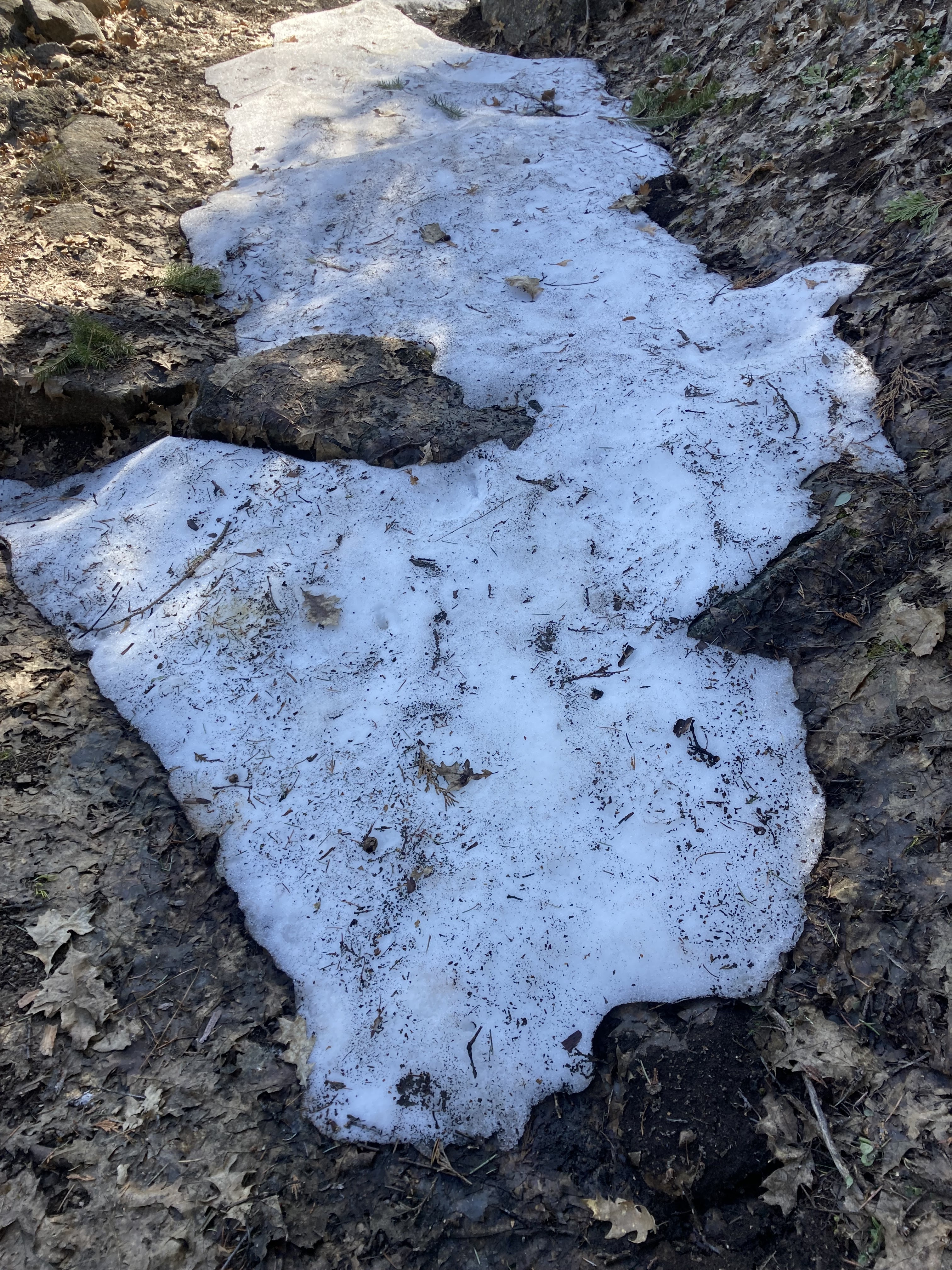
A patch of snow.  This is not foreshadowing at all...


The trail dropped us down into the Tiltill Valley, one of the most scenic and gorgeous places I have seen to date on my hikes:


The one thing above that video alludes to is that, like many High Sierra valleys in Spring, it is covered in water.  Not just a bit either, up to calf deep.  For about a quarter mile.  I am not a fan of water crossings anyway, but it was still early in the day and we would have plenty of time to dry.


As we climbed out of the Tiltill Valley, we met not one but two mountain stream flowing with decent force.  Water crossings were made (note previous comment above about not being my favorite), both times at about knee level.


It was as we went up this second ridge that we hit the snow:


It started as small drifts but rapidly increased into nothing but snow.  Judging from the thaw points, it was easily one to two feet deep here.  How deep would it get?


About the time we broke for lunch, we were well into nothing but snow as far as the eye could see. I was feeling a bit of altitude sickness (and so was not very hungry but forced something down). My feet were quite cold and wet, but the temperature remained a solid mid-70's so everything else was quite hot.  "How was I feeling?"  asked the Outdoorsman?


Thinking back over the ascents, the two streams (which would undoubtedly be more full now as the melt increased), and the Tiltill Valley marsh and looking ahead, I thought long and and hard.


"I feel fine"  I responded.  "We press on".